If your PA needs tighter crossover control, cleaner sub integration, and more predictable system tuning, the right processor can make a big difference.
This roundup of the best digital crossover for PA system options in 2026 focuses on flexibility, ease of setup, and real-world performance for DJs, bands, venues, and mobile rigs.
Best 10 Digital Crossover for PA System Picks for 2026
Flagship DSP Manager

- Improved Auto EQ for faster, accurate room EQ
- Enhanced AFS for more precise feedback control
- Android and iOS remote control support
Best For: Users who want a full PA management system with guided setup
Budget 4-Way Crossover

- Mono 4-way design for stage signal routing
- Easy operation with no professional skills required
- ABS housing is described as durable
Best For: Stage users who want a simple, easy crossover
Calibrated Bundle Pick

- Includes PA2, RTA-M mic, and multiple XLR cables
- Designed for system calibration and hookup
- Good turnkey option for PA setup
Best For: Buyers who want the processor and calibration accessories together
Precision Stereo Crossover

- Stereo 2-way or mono 3-way crossover support
- Independent subwoofer frequency control
- Mute switches help with band adjustment
Best For: Users who want a straightforward crossover with subwoofer control
Rack-Ready DSP Power
Crown XLS1002 Class D Amp with PureBand Crossover

- Built-in PureBand crossover system
- Peakx Limiters for speaker protection
- Lightweight Class D rack amp
Best For: DJs and mobile PA setups needing amp plus crossover in one unit
Dual-Crossover Control
Mr. Dj DXO200+ PRO Stereo Crossover with Subwoofer

- 2-way stereo crossover with sub section
- Balanced XLR outputs for wired setups
- Rack-mount format with switchable voltage
Best For: Club and PA systems that need simple stereo plus sub crossover control
Multi-Way Signal Control
MUSYSIC MU-CO4W 2/3/4-Way Audio Crossover
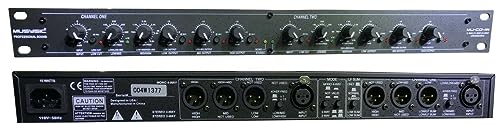
- Switchable 2-way, 3-way, and 4-way modes
- Subwoofer crossover from 50-250Hz
- Rack-mount unit with XLR and 1/4" I/O
Best For: Complex PA, DJ, and live sound systems needing multi-way crossover control
Stage-Ready 234XL
Professional Stereo 2/3 Way Mono 4 Way Crossover

- Stereo 2/3-way and mono 4-way modes
- Easy to use for stage and PA routing
- ABS build for everyday durability
Best For: Outdoor stage performance and simple multi-mode PA setups
Rack-Mount Control
Professional 2/3 Way Stereo/4 Way Mono Crossover

- 2-way stereo, 3-way stereo, and 4-way mono modes
- Per-band gain, phase, and 40 Hz low-cut controls
- Balanced XLR I/O with rugged rack-mount build
Best For: PA builders and DJs needing detailed frequency control
Clean Signal Mixer
Professional 2/3-Way Stereo & 4-Way Mono Audio Crossover
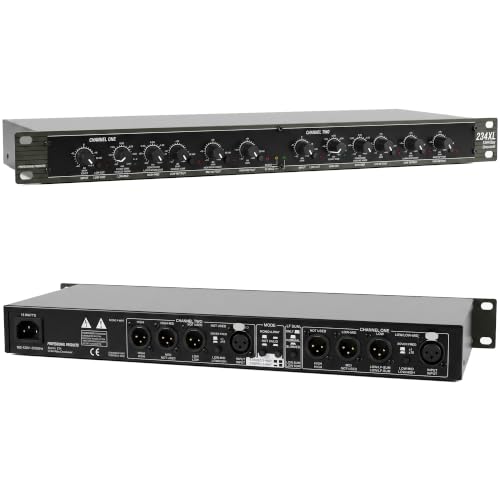
- 2/3-way stereo and 4-way mono operation
- Independent gain, phase, and low-cut controls
- Balanced XLR I/O with clear LED status
Best For: Live sound, studio monitors, and installed PA systems
Flagship DSP Manager – dbx DriveRack PA2
If you want a digital crossover for PA system use that does more than basic band-splitting, the dbx DriveRack PA2 is built around loudspeaker management. Its updated Auto EQ aims for a fast, accurate, and less intrusive calibration process, while the enhanced AFS feedback suppression is designed to work more precisely without hurting your system’s tone.
Best For: Players and engineers who want a full-featured PA management unit with guided setup and remote control.
Pros:
- Improved Auto EQ is designed for faster, more accurate room correction.
- Enhanced AFS algorithm targets feedback elimination with less impact on tone.
- Wizard functions provide step-by-step setup guidance.
- Android and iOS control adds convenient remote operation.
Cons:
- More system-focused than a simple crossover.
- Best value is for users who will use the full feature set.
The PA2 is the most complete option here if your goal is a smarter PA management workflow rather than just basic crossover duties. It suits users who want calibration, protection, and control in one rack unit.
Budget 4-Way Crossover – 234XL Mono 4 Way
For shoppers looking for a straightforward digital crossover for PA system routing, the 234XL mono 4 way crossover focuses on simple operation and stage use. The supplied notes emphasize premium sound crossover, stereo effect, and stable performance, making it a practical choice when you want easy signal distribution without a complex control package.
Best For: Users who need an easy-to-operate mono 4-way crossover for stage performance and general sound distribution.
Pros:
- Supports premium sound crossover and stereo effect.
- Mono 4-way design fits multi-band stage routing needs.
- Easy to operate, with no professional skills required.
- Premium ABS construction is described as durable and long-lasting.
Cons:
- Feature set is presented in broad terms rather than deep technical detail.
- Not positioned as a full loudspeaker management system.
This model is the simplest pick in the group if you mainly need functional crossover routing for live sound. It leans toward ease of use and basic reliability rather than advanced processing tools.
Calibrated Bundle Pick – dbx DriveRack PA2 Kit
dbx DriveRack PA2 PA Management System w/ RTA-M Measurement Microphone, Cables Bundle
Check Price On AmazonIf you want a digital crossover for PA system setup with calibration gear included, this DriveRack PA2 bundle is the most turnkey option here. It pairs the PA2 with an RTA-M measurement microphone, a long XLR lead, and additional XLR cables, so you have the basics needed to connect the unit and calibrate the system right out of the box.
Best For: Buyers who want the PA2 plus a measurement microphone and cable bundle for faster setup.
Pros:
- Includes the dbx DriveRack PA2 plus an RTA-M measurement microphone.
- Bundle adds a 50 ft. XLR cable and eight 20 ft. XLR cables.
- Supports connection to mixer, microphone, audio player, instrument, and power amplifier devices.
- Package is geared toward full system calibration and hookup.
Cons:
- Bulkier bundle than buying the processor alone.
- Most useful for users who will take advantage of the included calibration gear.
This is the best convenience-focused pick if you want to assemble a working PA management setup with fewer missing pieces. It is especially appealing when calibration and wiring are part of the purchase decision.
Precision Stereo Crossover – Behringer CX2310
The Behringer SUPER-X PRO CX2310 is a practical digital crossover for PA system applications when you want clear stereo or mono routing with easy band adjustment. Its subwoofer output with independent frequency control and individual output mute switches make it useful for tuning live sound setups without unnecessary complexity.
Best For: Users who need a straightforward stereo 2-way or mono 3-way crossover with sub control.
Pros:
- Supports stereo 2-way and mono 3-way crossover configurations.
- Subwoofer output includes independent frequency control.
- Individual output mute switches help with quick band adjustment.
- XLR, TRS, and RCA input/output options add flexibility.
Cons:
- Specifications are more utility-focused than feature-rich.
- Not aimed at the advanced calibration features of a full DSP manager.
This is a solid choice for users who prioritize classic crossover functions and easy adjustment over smart room tools. It fits well in setups that need dependable routing and subwoofer control.
Rack-Ready DSP Power – Crown XLS1002 Class D Amp with PureBand Crossover
If you want a digital crossover for PA system duties built into a power amp, the Crown XLS1002 is a practical all-in-one option. Its integrated PureBand Crossover System, band pass filters, and Peakx Limiters make it useful for small-to-mid PA rigs where clean routing and speaker protection matter.
Best For: DJs, bands, and mobile PA users who want a lightweight rack amp with built-in crossover and limiter control.
Pros:
- Integrated PureBand Crossover System for easier PA speaker routing
- Peakx Limiters help protect speakers while keeping output controlled
- Flexible inputs: XLR, 1/4″ TRS, and RCA
- Lightweight Class D design at under 11 lb.
Cons:
- Only 2 channels, so it is not a full multi-way processor
- Best suited to amplification duties rather than advanced system tuning
Overall, the XLS1002 is a strong choice if you want efficient amplification with crossover features already on board. It keeps the setup compact while still offering the control needed for straightforward PA system use.
Dual-Crossover Control – Mr. Dj DXO200+ PRO Stereo Crossover with Subwoofer
The Mr. Dj DXO200+ PRO is a dedicated digital crossover for PA system and DJ use when you need simple stereo splitting with subwoofer control. It offers a 2-way stereo crossover plus subwoofer section, with rack-mount convenience and balanced XLR outputs for wired pro-audio setups.
Best For: DJs, club rigs, and fixed-install PA systems that need straightforward stereo crossover and subwoofer management.
Pros:
- 2-way stereo crossover plus dedicated subwoofer section
- Balanced XLR outputs for pro audio connections
- Switchable 110V-220V power support
- Rack-mount design for installed or portable systems
Cons:
- Less flexible than multi-way processors like 3-way or 4-way units
- Inputs are unbalanced XLR/1/4″ jacks, so it may not suit every wiring plan
This is a practical crossover if your setup is centered on stereo mains and a sub. It keeps the signal path simple while giving you enough control to separate bass from the rest of the mix.
Multi-Way Signal Control – MUSYSIC MU-CO4W 2/3/4-Way Audio Crossover
The MUSYSIC MU-CO4W is a flexible digital crossover for PA system builds that need more than basic left-right splitting. With switchable 2-way, 3-way, and 4-way operation, plus dedicated crossover ranges for sub, low, mid, and high bands, it is aimed at users who want tighter speaker management and cleaner system balance.
Best For: PA builders, DJs, and live sound users who need a versatile multi-way crossover for complex speaker setups.
Pros:
- Selectable 2-way, 3-way, and 4-way stereo operation
- Subwoofer crossover range from 50-250Hz
- Low-cut filter at 30Hz to reduce rumble
- Rack-mount design with XLR and 1/4″ connectivity
Cons:
- More setup complexity than a basic 2-way crossover
- Best value only if your system actually needs multi-way routing
For larger PA or live sound systems, the MU-CO4W offers the kind of routing flexibility that can make system tuning easier. It is a good match when you need control over several speaker bands instead of a single crossover point.
Stage-Ready 234XL – Professional Stereo 2/3 Way Mono 4 Way Crossover
If you need a digital crossover for PA system setups that can handle multiple routing options, this 234XL-style unit is built for flexible stage use. It offers stereo 2/3-way and mono 4-way operation, plus a simple front-panel layout that keeps setup straightforward for live sound and other performance environments.
Best For: Outdoor stage performances and users who want a simple, multi-mode crossover for general PA routing.
Pros:
- Supports stereo 2-way, stereo 3-way, and mono 4-way crossover modes.
- Designed for stage performance and other sound distribution tasks.
- Easy to operate, even without professional skills.
- ABS construction is made for durable, long-term use.
Cons:
- Listing does not mention XLR connections or detailed control features.
- Less feature-specific than more advanced rack units.
Overall, this is a practical choice if you want a straightforward crossover for stage audio rather than a heavily specialized processor. Its main appeal is versatility and ease of use in a compact, performance-focused package.
Rack-Mount Control – Professional 2/3 Way Stereo/4 Way Mono Crossover
This digital crossover for PA system use is aimed at users who want more control over how frequencies are split and sent to their speakers. With selectable stereo and mono operating modes, balanced XLR I/O, and band-specific controls, it’s a solid fit for cleaner live sound and more organized system tuning.
Best For: PA builders, DJs, and venue setups that need flexible routing and detailed crossover control.
Pros:
- Three operation modes: 2-way stereo, 3-way stereo, and 4-way mono.
- Separate output gain, phase reverse, and 40 Hz low-cut controls per band.
- Balanced XLR inputs and outputs help support clean signal transfer.
- Rugged metal construction and rack-mount format suit pro installs.
Cons:
- Operates on 110V only, which may limit use in some setups.
- More control means a slightly more involved setup than basic crossovers.
For users who want better routing control and more precise sound shaping, this model stands out as the most feature-rich option in the group. It’s especially appealing if you’re building a PA system where balanced connections and individual band control matter.
Clean Signal Mixer – Professional 2/3-Way Stereo & 4-Way Mono Audio Crossover
For buyers comparing a digital crossover for PA system applications, this 234XL-style active crossover focuses on practical signal management and clean routing. It supports selectable stereo and mono modes, balanced XLR connections, and front-panel indicators that make it easier to monitor during live use or installation.
Best For: Live sound, studio monitoring, and installed PA systems that need clear mode switching and balanced connectivity.
Pros:
- Selectable 2/3-way stereo and 4-way mono crossover modes.
- Independent gain, phase invert, and 40 Hz low-cut filters per band.
- Balanced XLR input/output design supports clean signal transfer.
- LED matrix provides quick visual status of crossover mode and signal.
Cons:
- Product details do not list rack size or mounting specifics.
- More advanced than a basic crossover, so setup may take some attention.
This model is a strong all-around option if you want control without unnecessary complexity. Its mix of mode flexibility, band-level adjustment, and easy front-panel monitoring makes it well suited to professional PA workflows.
How We Picked the Best Digital Crossover for PA System
We looked for crossover units and PA management solutions that offer practical channel configurations, usable XLR connectivity, and features that help users dial in speakers without unnecessary complexity. Priority went to models with strong control over multi-way systems, subwoofer management, and dependable live-sound operation.
Quick Comparison
Some options here are full loudspeaker management systems with DSP and remote control, while others are straightforward analog-style crossovers built for simple stereo 2-way or mono 3-way setups. That matters: a Digital Crossover for PA System use is best when you need system-wide tuning, but a basic crossover may be enough if you only need to split highs, mids, and subs.
Key Buying Factors for Digital Crossover for PA System
Channel Layout and System Type
Match the crossover to your speaker layout first. Stereo 2-way systems are common for compact rigs, while 3-way and 4-way mono setups fit larger systems with dedicated lows, mids, and highs. Buying more flexibility than you need can add cost and setup time.
DSP, Filters, and Protection
For more advanced setups, look for DSP tools such as limiter control, band-pass filtering, delay, and EQ. These features help protect speakers and improve clarity, especially when the system is run hard or in different rooms.
Inputs, Outputs, and Connectivity
XLR input/output is the safest bet for pro audio reliability. If you use modern control apps or external measurement tools, check compatibility early so the crossover fits your workflow instead of forcing extra adapters or workarounds.
Ease of Setup
Some buyers want set-and-forget simplicity; others need deep tuning control. If you are managing multiple events or changing venues often, a more configurable Digital Crossover for PA System use can save time and reduce guesswork.
Who Should Buy Which Digital Crossover for PA System?
DJs and mobile entertainers usually benefit from flexible 2-way plus sub solutions. Bands and small venues may prefer a straightforward unit that is easy to install and quick to tune. Installers and advanced users should lean toward DSP-based management systems when they need presets, protection, and more detailed system control. If your priority is clean, efficient system division rather than full speaker management, a simpler crossover may be the smarter value.