Studio monitors with ribbon tweeters are popular for one reason: they can reveal detail in the highs without sounding harsh. That makes them a strong fit for mixing, editing, and critical desktop listening.
In this roundup, we focus on the models that offer the best balance of clarity, bass extension, connectivity, and value so you can choose the right pair for your space and workflow.
Best 10 Studio Monitors with Ribbon Tweeters Picks for 2026
Editor’s Pick
ADAM T8V 8.5" Bundle with Isolation Pads

- ART ribbon tweeter with HPS waveguide
- 35Hz–22kHz response and 118dB SPL
- Includes isolation pads and XLR cables
Best For: Bass-focused producers and larger mix rooms
Best for Home Audio
200W Ribbon Tweeter Bookshelf Pair
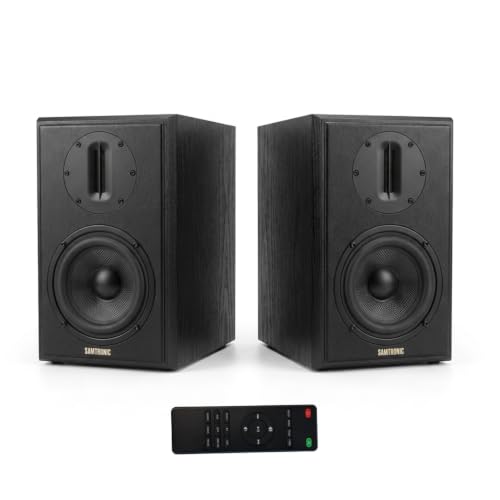
- 4-inch planar ribbon tweeter
- 200W Class D power with DSP crossover
- HDMI ARC, optical, USB, RCA, and Bluetooth
Best For: Home listening and flexible desktop setups
Compact Pick

- Compact 3.5-inch powered monitor pair
- Room control and high trim adjustments
- XLR/TRS, RCA, and stereo mini inputs
Best For: Small studios and desktop setups
Classic Choice

- Ribbon tweeter for detailed highs
- 8-inch nearfield monitor format
- High- and low-shelf tuning filters
Best For: Users building a larger nearfield setup
Compact Desktop Starter
PreSonus Eris 3.5 Powered Studio Monitors

- 50W powered stereo pair
- Silk-dome tweeters, not ribbon
- EQ controls for room tuning
Best For: Small desks and everyday near-field listening
High-End Nearfield Reference
ADAM Audio A7V 7-inch Powered Studio Monitor

- X-ART ribbon tweeter for detailed highs
- DSP tuning and rotatable waveguide
- 7-inch nearfield monitor, sold individually
Best For: Producers seeking ribbon-tweeter accuracy and room tuning
Best Value Bundle
Adam Audio T7V 7" Studio Monitor Pair Bundle

- ART ribbon tweeter with HPS waveguide
- 70W bi-amp pair, 39Hz–22kHz
- Includes stands, pads, and XLR cables
Best For: Home studios wanting a complete ribbon-tweeter setup
Hybrid Home Theater Pick
5.25'' 200W Active Bookshelf Speakers

- 4-inch super ribbon tweeter
- 200W active Class D power
- HDMI ARC, optical, RCA, USB, Bluetooth 5.3
Best For: Home audio buyers who want ribbon tweeter clarity
Deep Bass Studio Choice

- U-ART ribbon tweeter design
- 8-inch woofer with 33Hz extension
- XLR and RCA studio connections
Best For: Mixing and production with strong bass extension
Compact Desktop Pick
ADAM Audio D3V Active Desktop Monitor

- D-ART desktop ribbon tweeter
- USB-C plus balanced TRS input
- Compact pair with angled stands
Best For: Small desks and close-up listening
Editor’s Pick – ADAM T8V 8.5" Bundle with Isolation Pads
If you want studio monitors with ribbon tweeters that can handle serious low end, the ADAM Audio T8V bundle is built for it. The 8.5-inch powered monitors use ADAM’s ART ribbon-derived tweeter with HPS waveguide for detailed highs and controlled stereo dispersion, while the large cabinets reach down to 35Hz for bass-heavy tracking and mixing.
Best For: Producers who need full-range nearfield monitoring for hip-hop, trap, electronic music, and larger mix rooms.
Pros:
- ART ribbon tweeter with HPS waveguide for accurate high-frequency detail and imaging
- 35Hz–22kHz response with up to 118dB SPL for deeper bass and higher headroom
- XLR, TRS, and RCA input compatibility for flexible studio setups
- Includes Gator isolation pads and multiple XLR cable lengths
Cons:
- 8.5-inch monitors are larger than typical desktop nearfields
- Deep bass extension may need room EQ in untreated spaces
- Bundle extras help, but the monitors themselves still suit bigger setups best
The T8V is a strong choice when you want ribbon-style top-end detail without giving up sub-bass reach. If your work depends on hearing the bottom end clearly, this bundle adds both the monitors and the accessories to get them set up properly.
Best for Home Audio – 200W Ribbon Tweeter Bookshelf Pair
These 200W active bookshelf speakers bring ribbon tweeters into a home-audio setup that still works well as a near field studio monitor speaker. With 5.25-inch carbon fiber woofers, a 4-inch planar ribbon tweeter, and DSP-based active crossover, they’re aimed at clean playback across music, TV, gaming, and desktop use.
Best For: Listeners who want versatile powered speakers with ribbon tweeters, multiple inputs, and Bluetooth convenience.
Pros:
- 4-inch planar ribbon tweeter for extended high-frequency detail above 20kHz
- 200W active Class D amplification with DSP and active crossover
- Multiple inputs including HDMI ARC, optical, coaxial, USB, RCA, and Bluetooth 5.3
- 15mm MDF cabinet construction to help reduce unwanted resonance
Cons:
- More of a home audio/bookshelf hybrid than a traditional pro studio monitor
- Only one pair is included, so there’s no extra accessory bundle
- Large ribbon tweeter size may not suit every desktop or compact desk layout
If you want one speaker pair that can cover casual listening and desktop monitoring, this model offers a lot of connectivity and a ribbon tweeter design. It’s especially practical when you need HDMI ARC or Bluetooth in the same setup.
Compact Pick – Yamaha HS3 Black Pair
The Yamaha HS3 is a compact option for users who want studio monitors without ribbon tweeters, but still need a practical nearfield reference. This pair uses a 3.5-inch woofer and 0.75-inch dome tweeter, with room control and high trim adjustments to help match the monitors to a desk or small studio.
Best For: Small workspaces and creators who prioritize compact size, simple connectivity, and included setup accessories.
Pros:
- Very compact tabletop design for tight desks and small rooms
- Room control and high trim controls for basic tuning
- XLR/TRS combo, RCA, and stereo mini inputs for flexible connections
- Includes anti-slip pad, speaker cable, and stereo mini-to-RCA cable
Cons:
- Uses a dome tweeter, not a ribbon tweeter
- 3.5-inch woofer and 70Hz–22kHz response limit low-end reach
- Lower output power makes it less suited to larger rooms
HS3 makes sense if space is the priority and you want a straightforward monitor pair with useful controls. It won’t deliver the airy top end of ribbon tweeter models, but it is easy to place and easy to hook up.
Classic Choice – ADAM T8V Nearfield Monitor
The ADAM Audio T8V is a straightforward studio monitor with ribbon tweeter performance for people who want a single-speaker listing to anchor a larger setup. It pairs an 8-inch nearfield design with ADAM’s ribbon tweeter architecture, plus crossover and shelf controls for dialing in the speaker to your room.
Best For: Producers who want an 8-inch nearfield monitor with ribbon tweeter detail and simple tuning controls.
Pros:
- Ribbon tweeter design for detailed high-frequency reproduction
- 8-inch nearfield format for fuller low-end monitoring
- Adjustable high-shelf and low-shelf filters for room matching
- Input sensitivity options for +4 dBu and -10 dBV setups
Cons:
- Listed with limited specification details compared with the bundled T8V pair
- Sold as a single monitor listing, not a pair bundle
- Best suited to users who already know they want a larger monitor footprint
This T8V listing keeps the core ADAM formula intact: ribbon tweeter clarity, substantial woofer size, and basic controls for adapting the sound. It’s a solid fit if you’re building a monitor setup one piece at a time.
Compact Desktop Starter – PreSonus Eris 3.5 Powered Studio Monitors
If you want studio monitors with ribbon tweeters look elsewhere, but the PreSonus Eris 3.5 is still a practical compact choice for desktop listening, gaming, and basic music production. Its 3.5-inch woofer and silk-dome tweeter are tuned for clear, balanced playback in tight spaces, and the built-in EQ controls help you tailor the sound to your room.
Best For: Small desks, budget-conscious buyers, and everyday near-field listening where simple setup matters more than ribbon-tweeter detail.
Pros:
- 50W built-in amplification for a clean, distortion-free stereo pair
- Woven-composite woofers and silk-dome tweeters for balanced highs and tighter bass
- High- and low-frequency tuning controls help adapt the sound to your room
- Flexible inputs: balanced TRS, RCA, front aux, and front headphone jack
Cons:
- Not a ribbon-tweeter model
- 3.5-inch woofer limits bass output compared with larger monitors
- Best suited to desktop and near-field use rather than bigger rooms
The Eris 3.5 is a straightforward all-in-one monitor pair that prioritizes convenience and value over advanced tweeter technology. For buyers comparing studio monitors with ribbon tweeters, it is more of an entry-level desktop alternative than a mixing-focused upgrade.
High-End Nearfield Reference – ADAM Audio A7V 7-inch Powered Studio Monitor
The ADAM Audio A7V is a strong pick if you are specifically shopping for studio monitors with ribbon tweeters, since it uses ADAM’s X-ART HF driver for highly detailed, low-distortion highs. Its 7-inch woofer, DSP-based tuning, and rotatable waveguide make it a serious nearfield monitor for users who need accurate translation in a treated or adaptable space.
Best For: Engineers and producers who want a single high-end nearfield monitor with ribbon-style tweeter detail and DSP room tuning.
Pros:
- X-ART ribbon tweeter delivers ultra-accurate highs with no distortion at high SPLs
- DSP-based tuning helps adapt the monitor to different rooms
- 7-inch woofer gives substantial nearfield bass extension
- Rotatable HPS waveguide adds placement and imaging flexibility
Cons:
- Sold as a single monitor, so you need to buy a pair separately
- Higher-end choice may be more than casual listeners need
- Focused on nearfield monitoring rather than portable or desktop convenience
The A7V stands out for buyers who want a monitor built around ADAM’s ribbon-tweeter approach and precise tuning tools. It is the most serious reference option in this roundup, especially when accurate high-frequency detail is the priority.
Best Value Bundle – Adam Audio T7V 7" Studio Monitor Pair Bundle
The Adam Audio T7V bundle is the most complete option here for shoppers who want studio monitors with ribbon tweeters in a ready-to-use package. Each monitor uses an ART ribbon tweeter with an HPS waveguide, and the bundle adds stands, isolation pads, and XLR cables so you can set up a serious nearfield listening station right away.
Best For: Home and project studios that want ribbon-tweeter detail plus a full accessory package in one purchase.
Pros:
- ART ribbon tweeter with HPS waveguide for accurate imaging and controlled dispersion
- 70W bi-amp design with 39Hz–22kHz response and up to 114dB SPL
- Includes desktop stands, isolation pads, and multiple XLR cable lengths
- Rear HF and LF shelving EQ helps with room correction
Cons:
- Bulky 7-inch monitors take more desk space than compact speakers
- Best results depend on proper placement and room setup
- Bundle extras add value, but also make the kit less minimal
For most buyers focused on ribbon-tweeter studio monitors, this bundle offers the best balance of sound, size, and setup convenience. The included accessories make it especially appealing if you are building a studio from scratch and want to avoid piecing everything together separately.
Hybrid Home Theater Pick – 5.25'' 200W Active Bookshelf Speakers
If you want studio monitors with ribbon tweeters that can also pull double duty for TV, gaming, and casual listening, this SAMTRONIC pair is built for that flexible role. The 5.25-inch woofer and 4-inch super ribbon tweeter are aimed at delivering clear highs, solid bass, and an easy setup with multiple wired and wireless inputs.
Best For: Buyers who want a powered bookshelf speaker with ribbon tweeter detail for home audio, TV, and computer use.
Pros:
- 200W active Class D amplification for plenty of output
- 4-inch super ribbon tweeter for crisp high-frequency detail
- Supports Bluetooth 5.3, HDMI ARC, optical, RCA, and USB playback
- Includes remote control for easier volume and input changes
Cons:
- Not a traditional nearfield studio monitor design
- Heavier cabinet may be less convenient for small desks
- Uses a bookshelf format rather than a compact desktop footprint
As a practical all-in-one option, this model makes the most sense if you want ribbon-tweeter clarity without giving up home entertainment connectivity. It is less specialized for pure mixing work, but it offers a broad feature set for mixed-use listening.
Deep Bass Studio Choice – ADAM Audio T8V Studio Monitor
For studio monitors with ribbon tweeters, the ADAM Audio T8V stands out as a larger 2-way monitor built for low-end reach and detailed top-end reproduction. Its U-ART tweeter is designed to reduce ear fatigue, while the 8-inch woofer and extended bass response make it suitable for bass-heavy production and long mixing sessions.
Best For: Producers and mixers who want a larger studio monitor with ribbon-style tweeter detail and strong bass extension.
Pros:
- U-ART accelerated ribbon tweeter for detailed high frequencies
- 8-inch woofer and 33Hz low-end extension for bass-heavy work
- HPS waveguide helps create a wider, more controlled sweet spot
- XLR and RCA inputs support common studio setups
Cons:
- Larger cabinet may be too big for tight desk spaces
- Designed as a wired studio monitor, not a casual wireless speaker
- Best results depend on proper placement in the room
The T8V is a strong fit if you need serious low-end performance along with the clarity ADAM Audio is known for. Its size and tuning make it better for production-focused users than for small desktop listening areas.
Compact Desktop Pick – ADAM Audio D3V Active Desktop Monitor
If your search for studio monitors with ribbon tweeters is really about getting accurate sound on a desk, the ADAM Audio D3V is the most compact option here. It pairs a 3.5-inch woofer system with a D-ART desktop accelerated ribbon tweeter, plus USB-C connectivity and built-in DSP controls for desktop-friendly monitoring.
Best For: Songwriters, producers, and music listeners who need a small desktop monitor with ribbon tweeter detail.
Pros:
- D-ART ribbon tweeter for precise, unfatiguing highs
- USB-C direct connection for computers and mobile devices
- Balanced TRS input plus DSP switches for placement issues
- Includes angled stands and microphone stand mounting support
Cons:
- 3.5-inch woofer is limited compared with larger monitors
- Designed for desktop use rather than filling a large room
- Front headphone jack and controls are convenient, but it remains a compact system
The D3V is the most desk-focused choice in this roundup, making it ideal when space is limited but you still want ribbon tweeter performance. It is best viewed as a compact monitoring solution rather than a full-size studio workhorse.
How We Picked the Best Studio Monitors with Ribbon Tweeters
We focused on Studio Monitors with Ribbon Tweeters that offer a practical mix of accuracy, power, and usability. Priority went to models with strong frequency response, useful input options, solid SPL for nearfield listening, and features that suit real-world setups like small studios, home offices, and content creation desks.
We also considered whether the monitor is best for mixing, casual listening, or hybrid use. Some options lean toward reference accuracy, while others are better for everyday desktop audio with a bit more convenience.
Quick Comparison
In general, smaller 3.5-inch and 5.25-inch models are the easiest fit for compact desks and close listening, but they won’t deliver the same low-end weight as 7-inch or 8-inch designs. Larger monitors usually provide more headroom and fuller bass, making them better for production work in more open rooms.
Bluetooth, USB-C, and RCA inputs are useful for flexible listening, but balanced XLR or TRS connections are still the better choice for serious monitoring. If you want the most accurate stereo image and crisp top end, the ribbon-tweeter designs in this roundup are a strong starting point.
Key Buying Factors for Studio Monitors with Ribbon Tweeters
Driver Size and Room Size
Match the woofer size to your space. Smaller rooms and close-up desks usually benefit from compact monitors, while larger rooms can take advantage of 7-inch and 8-inch models with more bass extension and output.
Tweeter Behavior and Listening Fatigue
Ribbon tweeters are valued for smooth, detailed highs. If you do long sessions, look for a model that keeps treble clarity without exaggerating sibilance or brightness.
Inputs and Connectivity
Choose the connections your setup actually uses. Balanced inputs are ideal for interfaces and production gear, while Bluetooth and desktop-friendly inputs can be helpful for mixed-use systems.
EQ and Placement Controls
Room correction tools such as high- and low-shelf EQ can help tame boundary reflections or bright rooms. Isolation pads and stands can also improve clarity by reducing desk resonance.
Who Should Buy Which Studio Monitors with Ribbon Tweeters?
If you want the most capable option for mixing and fuller-range monitoring, go for a larger 7-inch or 8-inch model. If you need monitors for a small desk, editing station, or casual production setup, a compact pair will be easier to place and less overwhelming in tight spaces.
For hybrid users, choose the model that balances sound quality with convenience features like Bluetooth, USB-C, or compact cabinet sizing. The best choice depends less on brand alone and more on how much space you have, how loud you listen, and whether accuracy or convenience matters most.