PROZOR 192KHz Digital to Analog Audio Converter review buyers usually search for when they need a straightforward optical or coaxial-to-analog fix.
It is a focused solution for PCM or LPCM digital audio setups, not a universal decoder.
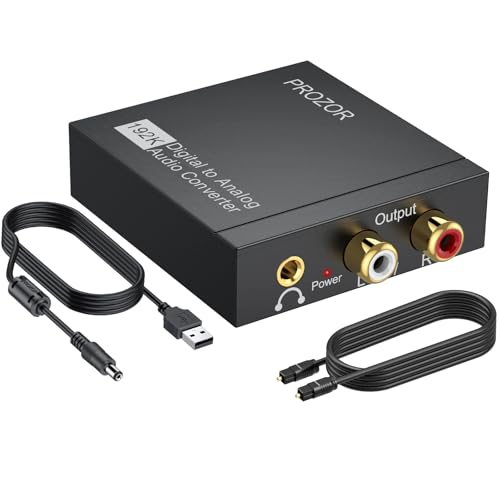
PROZOR 192KHz DAC Review Summary
The case for the PROZOR 192KHz Digital to Analog Audio Converter is simple: if your source outputs PCM or LPCM over optical or coaxial and you need analog RCA or 3.5mm output, this is built to bridge that gap cleanly.
It suits buyers connecting a TV, set-top box, DVD/Blu-ray player, or game console to an older amp, powered speakers, or headphones, especially when the priority is getting sound working without a complicated setup.
What makes it appealing is not novelty but specificity.
The listing positions it as a compact DAC with multiple input and output options, a built-in amplifier chip, and support for up to 192kHz sampling.
That combination is useful for a buyer who already knows the signal path they need and wants a simple converter rather than a more ambitious all-in-one audio processor.
Review Scorecard
| Category | Score | Rationale |
|---|---|---|
| Setup simplicity | 9/10 | Multiple inputs and outputs make it easy to place in a basic TV-to-amp chain. |
| Source compatibility | 8/10 | Works with optical or coaxial digital input, but the listing stresses PCM/LPCM only. |
| Output flexibility | 8/10 | Provides both RCA and 3.5mm analog outputs simultaneously. |
| Audio utility | 7/10 | The built-in amplifier chip is meant to help with low output volume. |
| System fit | 8/10 | Suits home audio, AV amps, headphones, and common media devices. |
| Clarity of limitations | 9/10 | The listing is explicit about PCM output and power requirements. |
Bottom line: this is a sensible buy for simple digital-to-analog conversion, provided your source format matches what it expects.
Key Features and Specifications of PROZOR 192KHz DAC
The product is a digital-to-analog audio converter with optical Toslink/SPDIF and coaxial digital inputs.
On the output side, it offers analog L/R RCA and a 3.5mm jack at the same time, which is practical if you want to feed more than one kind of analog audio gear.
The listing says it supports 32, 44.1, 48, 96, and 192kHz sample rates and a 24-bit SPDIF incoming bit stream.
It also says the device is intended for uncompressed 2-channel LPCM or PCM output, and it warns that optical output is not supported in the sense of passing through a digital optical signal.
The power arrangement matters.
The converter is powered by USB using a 5.5mm USB power cable, and the listing specifically recommends a certified 5V 1A wall adapter.
That is a small detail, but it is one of the most important ones because unstable power can turn a basic audio adapter into a troubleshooting project.
Another practical point is the note about TV audio settings.
The listing says users may need to set the source device to PCM or LPCM and adjust TV audio output settings rather than expecting the remote volume buttons to directly control optical output.
That tells you this is meant for users who are comfortable checking output format settings on their TV or player.
Useful listed details:
- Inputs: 1 x Toslink/optical/SPDIF, 1 x coaxial
- Outputs: 2 x RCA (L/R), 1 x 3.5mm jack
- Supported formats: PCM / LPCM, with a stated 2-channel limitation
- Supported sample rates: 32, 44.1, 48, 96, 192kHz
- Power: USB, with a recommended 5V 1A adapter
- Claimed hardware: built-in audio amplifier chip
- Use cases: HD TVs, TV boxes, DVD/Blu-ray players, PS3/PS4/PS5, AV amps, headphones
For search relevance, the searchable identity is straightforward: PROZOR 192KHz DAC.
That is the version most buyers will remember, and it captures the key use case without the listing clutter.
Pros and Cons of PROZOR 192KHz DAC
Pros
- Clear purpose: it is designed for one common job, converting digital optical or coaxial audio to analog output.
- Flexible outputs: RCA and 3.5mm output together make it useful across different speaker and amplifier setups.
- Broad household device fit: the listing explicitly references TVs, consoles, DVD/Blu-ray players, and TV boxes.
- Power guidance is explicit: the recommendation for a 5V 1A adapter reduces guesswork.
- Built-in amplifier chip: useful if a simple converter needs a bit more output confidence.
Cons
- PCM/LPCM only: if your source is outputting something else, this is not the right converter.
- Not a surround-sound solution: the listing is clear about 2-channel audio, so it is not the answer for 5.1 decoding.
- Requires correct TV settings: some buyers will need to change audio output settings before it works properly.
- Depends on proper power: using the wrong adapter could create noise or instability.
Who Should Buy PROZOR 192KHz DAC?
Buy this if you have a TV, player, or console that can output PCM or LPCM over optical or coaxial and you need to turn that into analog audio for an older amplifier, powered speakers, or headphones.
It is also a good fit if you want one compact converter that can feed both RCA and a 3.5mm device without extra adapters.
It is a better match for practical home audio repairs than for audiophile experimentation.
The listing reads like a utility tool: simple signal conversion, minimal fuss, and enough compatibility to solve common living-room or desktop audio problems.
Skip it if your setup depends on multichannel surround decoding, if your source cannot be set to PCM/LPCM, or if you want a pass-through device that preserves digital optical output.
The product’s own notes make those limits plain.
How the PROZOR 192KHz DAC Fits a TV Audio Setup
Optical to Analog Conversion
The core job here is turning a TV or source device’s digital optical or coaxial audio into analog sound that an older amp or speaker system can use.
That makes it most valuable in mixed-vintage systems where the display is newer than the audio gear.
PCM Settings Matter
The strongest clue in the listing is the repeated warning about PCM or LPCM.
That is not a minor setup note; it is the compatibility gate.
If the source is not set correctly, the converter will not be doing its best work, and the user may wrongly blame the hardware.
RCA and 3.5mm Output Usefulness
The ability to output to both RCA and a 3.5mm jack is more than a convenience feature.
It means the converter can fit a wider range of receiver inputs, speakers, headphone amps, and temporary test setups without additional splitters.
Power and Noise Awareness
The supplied guidance about using a certified 5V 1A adapter and a ferrite-core power cable signals that the product is intended to be installed thoughtfully.
For a budget converter, that kind of attention to interference and clean power is a real part of the buying decision.
Alternatives to PROZOR 192KHz DAC
If you want a comparable optical-to-analog converter, the most obvious alternatives are other well-known DAC product lines on Amazon such as FiiO DAC, Techole optical to RCA converter, and Tendak DAC.
Those are reasonable comparison points if you want to compare compact converters with similar home audio jobs.
If your goal is broader audio system integration rather than a basic converter, you may also want to look at Schiit DAC options or Audioengine DAC products.
Those searches are more relevant if you are shopping beyond a simple TV audio adapter and want a more established desktop or hi-fi ecosystem.
The key difference to keep in mind is that the PROZOR model is a function-first adapter.
Many alternatives will be either more specialized, more expensive, or aimed at a different tier of audio use, so the right comparison is usually about format support and connection type rather than brand prestige.
Is PROZOR 192KHz DAC Worth It?
Yes, if your setup matches its assumptions.
The PROZOR 192KHz Digital to Analog Audio Converter is worth considering when you need a basic, well-defined bridge from optical or coaxial PCM audio to analog RCA or 3.5mm output.
It is not a universal fix, and it is not trying to be one.
The strengths are its straightforward feature set, explicit compatibility guidance, and practical output options.
The main drawback is also its main limitation: it is only a good choice when your source can provide the right digital format.
For buyers who want a no-drama adapter for a compatible TV or media setup, this looks like a sensible, purpose-built purchase.
If you need surround decoding or broader format support, keep shopping.