The right stage monitor helps every performer hear pitch, timing, vocals, and cues without competing with the front-of-house mix. For bands, that usually means choosing between traditional floor wedges and wireless in-ear monitoring.
This roundup compares 10 practical options across powered and passive designs, monitor sizes, price points, and channel configurations. Use the guide below to match your stage setup, performance style, and monitoring needs.
Best 10 Stage Monitors for Bands Picks for 2026
Practical Powered Pick

- 250-watt powered 12-inch monitor
- Adjustable feedback filter and limiter
- XLR, 1/4-inch, RCA, and Speakon connections
Best For: Bands wanting a straightforward powered stage monitor
Pair Value Choice
Seismic Audio SA-12M.3 Monitors
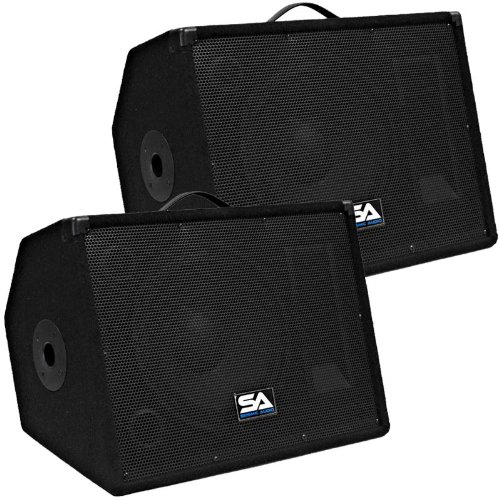
- Includes two passive 12-inch monitors
- 150 watts RMS and 300 watts peak each
- Plywood panels with steel grilles and handles
Best For: Bands needing a matched pair of passive floor monitors
High-Power Powered Pick

- 300-watt powered 2-way monitor
- 12-inch woofer with 1-inch compression driver
- Feedback filter, limiter, processor, and 3-band EQ
Best For: Live performers wanting a higher-output powered monitor
Reliable Passive Classic

- 300-watt program and 600-watt peak handling
- 12-inch woofer with 1-inch compression driver
- Built-in pole socket and protective cabinet features
Best For: Bands using a separate amplifier and traditional wired PA gear
Compact Powered Choice

- 10-inch woofer with 1-inch titanium compression driver
- Integrated 300W amplifier and three-band EQ
- XLR, 1/4-inch, and 1/8-inch inputs
Best For: Small venues, rehearsals, and church performances
Wireless Multi-Performer System

- Four-channel UHF mono in-ear monitoring
- Supports four standalone mixes with no stated delay
- Includes four receivers, earphones, and rackmount kit
Best For: Four-member bands and worship teams
High-Output Floor Monitor
Rockville RSM15A 15-inch Powered Monitor

- 15-inch woofer with 350W RMS powered output
- Combo XLR/1/4-inch TRS input and 3-band EQ
- Adjustable 300Hz–5kHz feedback filter
Best For: Bands, DJs, and larger live-stage monitoring
Wireless Freedom
Two-Channel In-Ear Monitoring System

- Two channels with five bodypack receivers
- 80 preset UHF frequencies and 300+ foot range
- Dual antennas with battery and RF indicators
Best For: Bands needing multiple wireless mono in-ear monitor feeds
Big Stage Coverage
Rockville RSM15P 15-Inch Monitor

- 15-inch woofer with 1.75-inch titanium driver
- 1,400-watt peak output specification
- 70° x 50° coverage with Speakon and 1/4-inch connections
Best For: High-output passive monitoring on larger stages
Matched Pair Value
Rockville RSM12P 12-Inch Monitors

- Two passive 12-inch wedge monitors
- 1,000-watt peak rating per cabinet
- Speakon and 1/4-inch input/thru connections
Best For: Bands needing two versatile wedges for small and mid-size setups
Practical Powered Pick – Behringer EUROLIVE F1220D
The Behringer EUROLIVE F1220D is a practical powered option for bands that want stage monitors for bands without adding a separate power amplifier. Its 12-inch woofer, 250-watt output, adjustable feedback filter, and integrated limiter suit live performance and music playback.
Best For: Bands needing a compact, powered 12-inch monitor with built-in feedback control.
Pros:
- Built-in 250-watt Class-D amplification keeps the setup straightforward.
- Adjustable feedback filter and integrated limiter help with system control and protection.
- Offers XLR, 1/4-inch, RCA, and Speakon connectivity.
Cons:
- It is corded and requires access to power on stage.
- The enclosure is not waterproof or water resistant.
- It is a single monitor rather than a paired set.
Choose the F1220D when convenient powered operation and flexible wired connections matter more than getting two monitors in one package.
Pair Value Choice – Seismic Audio SA-12M.3 Monitors
The Seismic Audio SA-12M.3 delivers two passive 12-inch floor monitors in one package, making it a useful starting point for bands outfitting multiple performers. Each speaker is rated at 150 watts RMS and 300 watts peak, with 8-ohm wiring and dual 1/4-inch inputs.
Best For: Bands that need a matched pair of passive monitors for stage, studio, church, karaoke, or DJ use.
Pros:
- Includes two monitors for broader stage coverage.
- 12-inch woofer, 40-ounce magnet, and 2-inch voice coil support the pro-audio design.
- Plywood front panels, steel grilles, metal corners, and pocket handles support practical handling.
Cons:
- Passive speakers require a compatible amplifier.
- The pair weighs 62 pounds according to the supplied specifications.
- Connectivity is limited to wired 1/4-inch inputs.
This set makes the most sense when you already have amplification and want two durable-looking floor monitors rather than a single powered cabinet.
High-Power Powered Pick – Behringer EUROLIVE F1320D
The Behringer EUROLIVE F1320D is designed for bands seeking stage monitors for bands with more powered headroom than a smaller 250-watt model. It combines 300-watt Class-D amplification, a 12-inch woofer, a 1-inch compression driver, feedback filtering, and an integrated sound processor.
Best For: Live performers who want a powered 2-way monitor with built-in control and protection features.
Pros:
- 300-watt output supports live and playback applications.
- Adjustable feedback filter and integrated limiter help manage stage-monitor operation.
- Built-in sound processor and 3-band EQ provide additional system control.
- Class-D amplification keeps the powered design relatively lightweight for its output.
Cons:
- It is a single monitor, so a stereo or multi-position setup requires additional units.
- The speaker is corded and needs a nearby power source.
- It is not waterproof or water resistant.
The F1320D is a strong fit when you want a powered 12-inch monitor with more output and onboard processing, especially for live setups that benefit from feedback management.
Reliable Passive Classic – Yamaha BR12M Floor Monitor
The Yamaha BR12M is a passive 12-inch floor monitor built for live performance, public address, sound reinforcement, and stage monitoring. Its 300-watt program and 600-watt peak handling, 97 dB sensitivity, and 1-inch compression driver make it a practical choice for bands with an existing amplifier and mixer setup.
Best For: Bands wanting a traditional passive monitor with high power handling and stand-mount flexibility.
Pros:
- Handles 300 watts program and 600 watts peak power.
- Uses a 12-inch woofer and 1-inch compression driver with a 90-by-40-degree horn.
- Built-in pole socket allows stand mounting when needed.
- Features large steel handles, corner protectors, and integral protection circuitry.
Cons:
- It requires a separate amplifier and speaker cables.
- It is a single passive monitor rather than a pair.
- There is no wireless communication technology.
The BR12M is a sensible choice for bands building around conventional wired PA equipment and wanting a rugged, flexible monitor that can also be pole mounted.
Compact Powered Choice – Sound Town METIS-10MPW
For bands seeking stage monitors for bands that are easy to set up and transport, the Sound Town METIS-10MPW combines a 10-inch woofer, 1-inch titanium compression driver, and integrated 300W amplification in a low-profile wedge cabinet. Its onboard EQ and multiple inputs make it practical for rehearsals, small venues, churches, and live performances.
Best For: Small-venue bands, rehearsals, churches, and performers who need a compact powered wedge monitor.
Pros:
- Integrated 300W amplifier simplifies a stage-monitor setup.
- Three-band EQ allows quick bass, mid, and treble adjustments.
- XLR input and output support flexible connections and daisy chaining.
- Recessed handle, metal grille, and reinforced corners support transport.
Cons:
- Its 10-inch woofer is less substantial than the larger 15-inch option in this roundup.
- It is not water resistant.
The METIS-10MPW is a sensible choice when portability, built-in amplification, and straightforward controls matter more than maximum low-end output.
Wireless Multi-Performer System – Phenyx Pro PTM-33-4B
The Phenyx Pro PTM-33-4B takes a different approach to stage monitors for bands by providing wireless mono in-ear monitoring for up to four performers. Its integrated monitor station supports four standalone mixes, while UHF transmission, IR syncing, and included bodypacks help reduce stage clutter and simplify monitoring for touring or worship teams.
Best For: Four-member bands, worship teams, stage productions, and performers who prefer wireless in-ear monitoring.
Pros:
- Four channels can provide separate mixes for multiple performers.
- Includes four UHF bodypack receivers and four in-ear earphones.
- Up to 140–164 feet of interference-free line-of-sight range is specified.
- Rackmount kit and loop outputs support organized touring setups.
Cons:
- Monitoring is mono rather than stereo.
- Wireless range can be affected by thick walls, glass, and metal.
- It requires compatible mixer outputs and battery-powered bodypacks.
Choose the PTM-33-4B when each band member needs personal wireless monitoring and lower stage volume. It is more involved than a powered wedge, but better suited to coordinated multi-performer mixes.
High-Output Floor Monitor – Rockville RSM15A 15-inch Powered Monitor
For bands that need substantial output from stage monitors for bands, the Rockville RSM15A pairs a 15-inch woofer with a 1.75-inch titanium diaphragm driver and a 350W RMS powered design. Its tilt-back wedge cabinet, three-band EQ, and adjustable feedback filter make it suited to live stages, DJs, and larger monitoring demands.
Best For: Bands, DJs, and live events that need a larger powered floor monitor with strong output and feedback controls.
Pros:
- 15-inch woofer and 350W RMS output provide substantial stage volume.
- Combo XLR/1/4-inch TRS input supports mixers, microphones, and instruments.
- Three-band EQ and adjustable 300Hz–5kHz feedback filter aid sound shaping.
- Tilt-back design and ergonomic handles support floor monitoring and portability.
Cons:
- At 61.2 pounds, it is considerably heavier than a compact monitor.
- The cabinet is larger and less convenient for smaller stages.
- It is not water resistant.
The RSM15A is the strongest fit here for performers prioritizing fuller output and a large monitoring footprint. Its weight makes it better for stationary or vehicle-based setups than frequent lightweight transport.
Wireless Freedom – Two-Channel In-Ear Monitoring System
For bands that need flexible stage monitors for bands, this two-channel UHF in-ear system provides five bodypack receivers, preset frequencies, and a stated range of over 300 feet. Its dual-antenna design and LCD battery indicators make it practical for performers who need to move freely while monitoring in mono.
Best For: Bands, churches, schools, studio sessions, and live performances that need multiple wireless in-ear monitor feeds.
Pros:
- Includes two channels and five bodypack receivers for shared monitoring setups.
- Offers 80 preset frequencies and 572–603.5 MHz UHF coverage.
- Dual antennas, RF indicators, and low-battery alerts support easier operation.
- Uses two AA batteries per receiver and lists over 300 feet of reception range.
Cons:
- Provides mono monitoring rather than stereo.
- Requires performers to use in-ear headphones and manage bodypack batteries.
- The system is designed for 6.35 mm audio input compatibility.
This is a strong option when a band wants several performers connected to a single wireless monitoring setup. It is more focused on mobility and multi-user convenience than on advanced personal mixing features.
Big Stage Coverage – Rockville RSM15P 15-Inch Monitor
The Rockville RSM15P is a large passive wedge for bands that want high-output stage monitors for bands in live music, DJ, or PA setups. Its 15-inch woofer, titanium compression driver, and angled enclosure are intended to deliver strong, broadly dispersed monitoring from the floor.
Best For: Larger stages, DJs, live bands, and PA systems with an external amplifier or powered mixer.
Pros:
- 15-inch woofer and 1.75-inch titanium compression driver support powerful full-range output.
- Listed peak power handling reaches 1,400 watts.
- 70° x 50° horn coverage helps distribute sound across the stage.
- Dual 1/4-inch and Speakon input/output connectors allow flexible system integration.
Cons:
- Passive design requires a compatible external amplifier or powered mixer.
- At 54.9 pounds, it is relatively heavy to transport.
- The supplied details state that it has no warranty.
Choose this model when output and low-frequency authority matter more than compact size. Its rugged wedge cabinet and handles suit event use, but the weight and passive configuration should be considered before building a portable rig.
Matched Pair Value – Rockville RSM12P 12-Inch Monitors
This matched pair gives bands two compact passive wedges for practical stage monitors for bands setups. Each RSM12P combines a 12-inch woofer, titanium compression horn, 8-ohm impedance, and daisy-chain-friendly connectors, making the pair useful for vocals, keys, guitars, or cue mixes.
Best For: Small venues, rehearsals, houses of worship, DJs, and bands that need two consistent floor wedges.
Pros:
- Includes two monitors with 12-inch low-frequency drivers and 1-inch titanium horns.
- Each cabinet is rated for 1,000 watts peak and 250 watts RMS in the supplied notes.
- Speakon and 1/4-inch input/thru connections support flexible cabling and daisy-chaining.
- Angled wedge cabinets include recessed handles, rubber feet, and protective grilles.
Cons:
- Passive speakers require suitable amplification.
- The cabinets are not waterproof.
- At 36.8 pounds each, they are manageable but not especially lightweight.
The two-pack is a sensible choice for bands outfitting multiple performers at once. It balances coverage, portability, and connection flexibility better than a single large monitor, provided your amplifier can support the 8-ohm cabinets.
How We Picked the Best Stage Monitors for Bands
We focused on the features that matter during rehearsals, performances, and venue setup: speaker format, power requirements, driver size, feedback control, portability, connectivity, and likely use case. The selection includes powered wedges for simpler setups, passive monitors for systems that already have amplifiers, and wireless in-ear monitor kits for bands that want a cleaner stage.
Because no single monitor suits every group, we considered different band sizes, venues, budgets, and sound preferences rather than ranking products by wattage alone.
Quick Comparison
| Monitor type | Best for | Main advantage | Watch for |
|---|---|---|---|
| Powered floor wedge | Small and midsize live setups | Built-in amplification | Requires AC power at the monitor position |
| Passive floor wedge | Existing PA systems | Flexible system integration | Needs a compatible amplifier |
| Wireless in-ear system | Mobile or clutter-free stages | Consistent personal monitoring | Requires frequency planning and fit checks |
Key Buying Factors for Stage Monitors for Bands
Powered or Passive Design
Powered monitors are the easiest choice when you need a straightforward setup: connect the mixer output, supply power, and position the wedge. Passive models can be a better fit when your band already owns an amplifier, speaker processor, or complete PA rack. Confirm impedance, power handling, and connector compatibility before pairing components.
Monitor Size and Output
A 10-inch monitor is often compact and easier to transport, while 12-inch models offer a useful balance of vocal clarity and low-frequency response. A 15-inch wedge can move more air, but it is larger and may provide more low end than performers actually need on a crowded stage. Choose based on the room, instrument mix, and required volume—not just the biggest specification.
Feedback Control and Placement
Feedback resistance depends on the speaker, microphone, equalization, volume, and placement together. Look for built-in feedback filters or processing when available, then place the wedge in the microphone’s rejection zone and keep unnecessary low frequencies out of the monitor mix.
Wedges Versus In-Ear Monitoring
Floor wedges offer a familiar, shared listening experience and are simple for occasional gigs. In-ear systems reduce stage volume and can provide each performer with a more controlled mix, but they require transmitters, bodypacks, suitable earphones, and time to establish comfortable levels.
Who Should Buy Which Stage Monitors for Bands?
- Small bands and bar gigs: Choose a powered 10-inch or 12-inch wedge for fast setup and reliable vocal monitoring.
- Bands with an existing PA rack: Consider passive 12-inch or 15-inch monitors that match your amplifier’s output and impedance.
- Louder rock or full-band stages: A higher-output powered wedge or larger passive monitor may provide more headroom, but manage bass carefully.
- Churches, studios, and fixed installations: Prioritize consistent coverage, simple operation, and feedback control over maximum output.
- Bands seeking a quieter stage: A multi-channel wireless in-ear system can improve separation and reduce wedge spill when the band is prepared to manage wireless frequencies and personal monitoring levels.
Before buying, count the monitor mixes you need, check available outputs on your mixer, measure transport space, and confirm whether AC power or an external amplifier is available at each position. Those details usually narrow the best choice faster than headline wattage.