Choosing among button accordions means balancing layout, reed response, bass capacity, weight, and the musical traditions you want to play. The right instrument should feel comfortable in your hands while offering room to develop.
This roundup compares 10 options ranging from children’s starter instruments and compact beginner models to full-size diatonic and digital accordions for more experienced performers.
Best 10 Button Accordions Picks for 2026
Classic GCF Value

- 31-button G/C/F diatonic layout
- Includes straps and method book
- Matte-black basswood body
Best For: Beginners seeking a traditional G/C/F button accordion
Beginner Carry Kit

- 22 keys and 8 bass buttons
- Backpack and accessories included
- One-year warranty
Best For: Adult beginners wanting a ready-to-carry package
Digital Feature Pick

- 62 buttons with Standard and Free Bass modes
- Built-in stereo speakers
- USB and multiple sound sets
Best For: Players wanting electronic versatility and onboard amplification
Rugged GCF Starter

- 31 treble and 12 bass buttons
- Two treble-reed sets
- Padded suitcase included
Best For: G/C/F players wanting traditional features and protected transport
Versatile Performance
Hohner ACES II 34-Button Accordion

- 34 treble and 12 bass buttons
- Three registers for tonal changes
- Includes a case and 1/4-inch jack
Best For: Players wanting a versatile F/B♭/E button accordion
Folk-Ready Value
31-Key Diatonic Accordion Carry Kit

- F/B/E diatonic tuning
- Airtight bellows and hand-tuned reeds
- Includes case, straps, gloves, and wipes
Best For: Folk learners and portable practice or performance
First Musical Steps
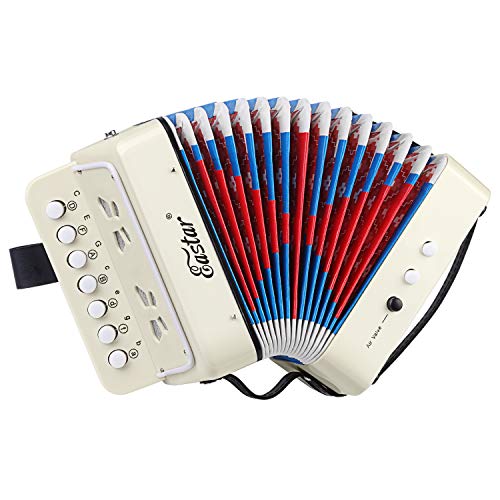
- Compact and lightweight at 1.9 pounds
- 10-key layout for young beginners
- Includes a learning guide
Best For: Children over three starting accordion exploration
Best Beginner Pick
22-Key 8-Bass Red Button Accordion

- Ergonomic buttons designed for lower hand fatigue
- Airtight windbox for stable tone
- Includes straps, accessories, and backpack
Best For: Beginners, hobbyists, and casual performers
Best Traditional-Style Option
34-Key 12-Bass White Accordion

- Expanded 34-key, 12-bass layout
- Handcrafted wood body with Italian-style details
- Includes adjustable straps and hard case
Best For: Players wanting a larger, presentation-focused accordion
Best Professional-Size Choice
41-Key 120-Bass White Accordion

- Full-size 41-key, 120-bass configuration
- 21 sound combinations for multiple genres
- German reeds and reinforced touring-ready construction
Best For: Advanced players, performers, and serious adult learners
Classic GCF Value – Hohner Panther 3-Row
The Hohner Panther is a practical choice for players seeking traditional button accordions in a G/C/F setup. Its 31 treble buttons and 12 bass buttons provide a familiar three-row layout, while the included straps and method book make it ready for practice.
Best For: Beginners and players wanting a value-focused G/C/F diatonic accordion.
Pros:
- 31 buttons and 12 bass buttons in a 3-row G/C/F configuration
- Includes straps, cleaning cloth, and Hohner Diatonic Method Book
- Matte-black basswood construction with 1/4-inch jack and XLR connectors
- Compact package focused on essential playing features
Cons:
- Available only in G/C/F and matte black
- No gig bag is included
- Limited 90-day warranty
This is an appealing entry point for traditional button-accordion learners who want a recognized brand and useful starter accessories. The lack of a gig bag and short warranty are worth considering for frequent transport or long-term peace of mind.
Beginner Carry Kit – 22-Key 8-Bass Accordion
This 22-key, 8-bass model is designed as an accessible option among button accordions, with responsive round buttons, adjustable voice changers, and a portable backpack. Its included accessories make it convenient for beginners who want a complete setup.
Best For: Adult beginners who prioritize included carrying and practice accessories.
Pros:
- 22 keys and 8 bass buttons with touch-responsive controls
- ABS, wood, and metal construction with a hand-polished finish
- Includes backpack, two straps, gloves, and cleaning cloth
- One-year warranty is included
Cons:
- Smaller 22-key, 8-bass layout offers less range than larger models
- Listed weight is 4.63 kg, which may feel substantial for some beginners
The bundled backpack and accessories give this accordion strong practical appeal for new players. Consider its more compact button-and-bass layout if you expect to progress toward a larger traditional instrument.
Digital Feature Pick – Roland FR-1XB V-Accordion
The Roland FR-1XB brings electronic versatility to the button accordion category with 62 buttons, built-in speakers, multiple accordion sets, orchestral sounds, and USB functionality. It is suited to players who want varied sounds and onboard features rather than a purely acoustic instrument.
Best For: Performers and electronic-minded players who want built-in amplification and sound variety.
Pros:
- 62-button layout with Standard and Free Bass modes
- Built-in 7 W x 2 speakers in a bass-reflex box
- Includes 16 accordion sets, orchestral sounds, and virtual tone-wheel presets
- USB port supports Wave/MP3 playback and data loading or saving
Cons:
- At 21 pounds, it is heavier than the smaller acoustic option in this roundup
- Plastic ABS body may not suit players seeking a traditional wood construction
- Its electronic feature set may be more than a traditionalist needs
The FR-1XB is the clear technology-focused choice, offering substantial tonal flexibility and onboard sound. Choose it when USB functions, speakers, and programmable sounds matter more than acoustic simplicity.
Rugged GCF Starter – Horse 31-Key G/C/F Accordion
The Horse 31-key accordion offers a traditional G/C/F, 3-row button layout with 12 bass buttons and two sets of treble reeds. Its padded suitcase and adjustable bass strap make it a practical choice for beginners through professionals who need straightforward transport protection.
Best For: Players seeking a traditional G/C/F diatonic accordion with a protective case.
Pros:
- 31 treble buttons and 12 bass/chord buttons in G/C/F
- Two treble-reed sets provide a rich, robust tone
- Noise-damping technology is designed to reduce unwanted sounds
- Includes padded suitcase box and adjustable bass strap
Cons:
- Heavier 4,500-gram build may be less convenient for extended carrying
- Only the G/C/F tuning is specified
This model combines a familiar traditional layout with useful transport protection, making it especially practical for lessons, rehearsals, and travel. Its 1-year warranty also provides more coverage than the shorter warranty on the Hohner option.
Versatile Performance – Hohner ACES II 34-Button Accordion
The Hohner ACES II is a practical choice for players who want button accordions with room for melodic variety and tonal adjustment. Its 34 treble buttons, 12 bass buttons, three registers, and two-voice MM tuning support both traditional and modern playing.
Best For: Intermediate players and performers seeking a versatile F/B♭/E accordion with register control.
Pros:
- 34 treble buttons support complex melodic playing.
- Three registers provide changes in tonality and sound texture.
- Includes a case and a 1/4-inch jack.
- Two-voice MM tuning offers balanced, harmonious sound.
Cons:
- Its 12-pound weight may be less convenient for extended carrying.
- The 90-day warranty is relatively short.
Choose this model if flexible controls and a full-size button layout matter more than minimizing weight. The black lacquered finish also gives it a traditional, performance-ready appearance.
Folk-Ready Value – 31-Key Diatonic Accordion Carry Kit
This F/B/E diatonic model is one of the more complete button accordions for folk practice and portable performance. It combines 31 responsive treble keys, 12 bass buttons, airtight bellows, hand-tuned reeds, and a useful accessory kit.
Best For: Beginners, adult folk musicians, and players of Irish, polka, bluegrass, or country music.
Pros:
- F/B/E tuning delivers a folk-oriented sound profile.
- Airtight bellows are designed to support stable airflow and pitch.
- Responsive buttons require minimal pressing force.
- Includes a case, backpack, straps, gloves, and polishing wipes.
Cons:
- At about 7.99 kg, it is relatively heavy for frequent transport.
- The diatonic layout is specialized for its F/B/E tuning.
Its combination of hand-tuned reeds and included maintenance accessories makes it especially practical for learners and gigging folk players. Consider it when a ready-to-carry kit is more important than a lightweight body.
First Musical Steps – Eastar 10-Key Kids Accordion
The Eastar kids accordion offers a compact introduction to button accordions for young beginners. Its 10-key design, lightweight construction, learning guide, and child-oriented materials make it easier to handle during early music exploration.
Best For: Children over age three who are beginning to explore accordion playing and musical coordination.
Pros:
- Compact 7.5-by-7.2-by-4-inch size is easy to carry.
- At 1.9 pounds, it is manageable for children.
- Food-grade ABS resin and durable bellows support child-friendly use.
- Includes a learning guide and belt buckles for easier holding.
Cons:
- Its 10-key layout is intended for beginners rather than advanced playing.
- The small design offers fewer playing options than full-size button accordions.
This is a sensible starter instrument for supervised lessons, classroom activities, or home exploration. Its portability and simple layout help children focus on coordination and developing interest in music.
Best Beginner Pick – 22-Key 8-Bass Red Button Accordion
If you are comparing button accordions for lessons, home practice, or casual performances, this 22-key, 8-bass model offers a beginner-friendly starting point. Its ergonomic buttons, lightweight design, included straps, and storage backpack make it practical for regular use and transport.
Best For: Beginners, teenagers, hobbyists, and adult learners seeking a compact accordion for practice, school events, family gatherings, and simple performances.
Pros:
- Sensitive, smooth buttons and an ergonomic design help reduce hand fatigue.
- Airtight windbox supports a consistent, full tone.
- Includes adjustable straps, cleaning cloth, gloves, and a protective backpack.
- Durable basswood construction and a two-year manufacturer warranty support long-term use.
Cons:
- The 22-key, 8-bass layout is more limited than larger professional models.
- At 8 pounds, it may still feel substantial for younger players.
This is a sensible choice among button accordions for learners who want useful accessories and a comfortable, portable setup without moving immediately to a full-size instrument.
Best Traditional-Style Option – 34-Key 12-Bass White Accordion
For shoppers comparing button accordions with a more substantial layout, this 34-key, 12-bass model provides additional range over compact beginner instruments. Its Italian-style decorations, adjustable straps, and premium hard case make it suited to musicians who value presentation and protected storage.
Best For: Music lovers and players who want a handcrafted wood accordion with a 34-key, 12-bass configuration for learning, practice, or personal performance.
Pros:
- Offers 34 keys and 12 bass buttons for a broader playing layout than smaller models.
- Handcrafted construction and Italian-style decorations add a distinctive appearance.
- Adjustable hand and shoulder straps support carrying and playing comfort.
- Includes a premium hard case for storage and transport.
Cons:
- Its 9.87 kg weight makes it less convenient to carry than smaller beginner accordions.
- The listed manufacturer warranty is only 30 days.
This white accordion is a reasonable middle-ground option for players who want more keys and bass buttons than an entry-level model, while still receiving a hard case and adjustable straps.
Best Professional-Size Choice – 41-Key 120-Bass White Accordion
Among button accordions and full-size accordion options, this 41-key, 120-bass instrument is aimed at players who need extensive tonal and bass control. Its weighted keyboard, German reeds, 21 sound combinations, reinforced corners, and transport backpack support serious practice, recording, touring, and stage work.
Best For: Advanced players, adult learners, performers, educators, collectors, and musicians seeking a full-size instrument for varied genres and demanding use.
Pros:
- Provides 41 weighted keys and 120 bass buttons for a comprehensive playing range.
- Offers 21 sound combinations across folk, jazz, classical, world, and pop styles.
- German reeds, an airtight windchest, lambskin bellows, and reinforced steel corners are suited to regular performance use.
- Includes a padded backpack and adjustable straps, plus a two-year manufacturer warranty.
Cons:
- At 24.2 pounds, it is considerably heavier than compact beginner instruments.
- Its full-size professional configuration may be more instrument than a casual player needs.
This is the strongest fit for serious musicians who want broad register options and a robust, full-size design, but its weight and advanced specification should be considered before buying.
How We Picked the Best Button Accordions
We evaluated these Button Accordions by looking at their button count, bass configuration, diatonic tuning, construction, portability, controls, and intended player level. We also considered practical details such as included straps or cases, speaker availability, register controls, and whether the instrument is better suited to home practice, traditional folk styles, lessons, or stage use.
Because accordion layouts vary, a higher button count does not automatically mean a better choice. Compatibility with your teacher, repertoire, and preferred tuning system matters just as much as size or price.
Quick Comparison
| Best For | What to Look For |
|---|---|
| Young children | Compact size, light weight, simple controls, and durable construction |
| Beginners | Accessible button layout, manageable bellows, straps, and reliable pitch |
| Folk players | Diatonic tuning, suitable key system, responsive buttons, and adequate bass buttons |
| Advanced performers | More registers, broader range, stronger projection, and refined action |
| Digital practice or stage use | Multiple sounds, speakers, volume control, and flexible configuration |
Key Buying Factors for Button Accordions
Button Layout and Tuning
Confirm whether the instrument is diatonic, chromatic, or digital, and check its key arrangement before buying. G/C/F, F/Bb/Eb, and other systems serve different repertoires. A familiar layout will make lessons and practice considerably easier.
Button and Bass Count
More melody buttons can provide additional range, while more bass buttons expand accompaniment options. However, larger instruments are usually heavier and may require more practice to control comfortably.
Bellows, Action, and Comfort
Look for smooth bellows movement, buttons that respond consistently, and straps that keep the instrument secure. Weight is especially important for children, beginners, and players who expect to practice for long sessions.
Sound and Controls
Acoustic models produce their character through reeds and registers. Digital models add volume control, multiple voices, and headphone-friendly practice features. Decide whether traditional tone or versatility is your priority.
Included Accessories
A case, shoulder straps, and protective padding can add meaningful value. Check the listing carefully, since accessories and warranty coverage may differ between otherwise similar instruments.
Who Should Buy Which Button Accordions?
Children and very young beginners should start with a small, lightweight model that is easy to hold. Adult beginners generally benefit from a 22-key or similarly manageable instrument with straps and a straightforward layout. Players focused on traditional folk music should choose a diatonic model in the key system used by their teacher or ensemble.
More experienced musicians may prefer a 31- or 34-key accordion for greater range and register options, while advanced performers seeking a fuller accompaniment setup should consider a larger bass configuration. Choose a digital V-Accordion when silent practice, sound variety, and stage flexibility matter more than a purely acoustic response.