The right desktop speaker stand can improve listening position, reduce unwanted vibration, and free up valuable workspace. Whether you use compact bookshelf speakers, studio monitors, or a small pair of computer speakers, the best choice depends on fit, height, tilt, and load capacity.
We’ve selected 10 speaker isolation stands for desktop setups across several designs, from foam wedges and angled risers to adjustable isolation platforms and clamp-mounted stands.
Best 10 Speaker Isolation Stands for Desktop Picks for 2026
Best Angled Isolation Stands
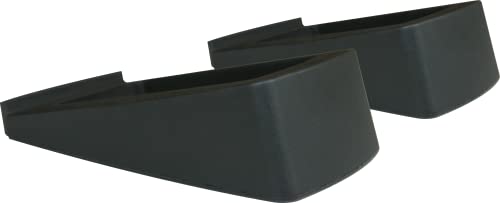
- 15° angled silicone risers
- Designed for small speakers
- 8-pound maximum load
Best For: Compact desktop speaker setups
Best Heavy-Duty Desktop Riser
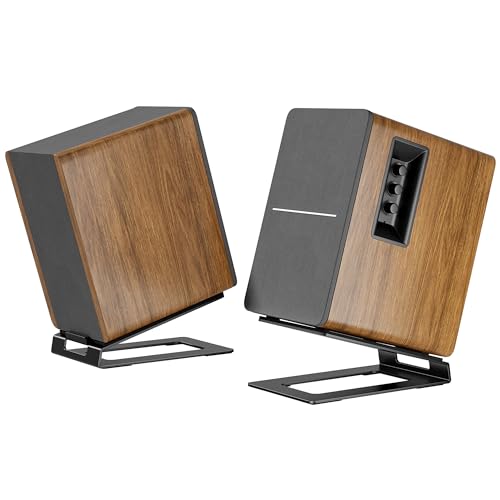
- 22-pound load capacity
- 16° listening-angle tilt
- Freestanding or screw-mounted
Best For: Heavier bookshelf speakers and gaming desks
Best Clamp-Mount Stands

- Adjusts from 9 to 14 inches
- Clamps to desks up to 2.6 inches
- Supports up to 50 pounds
Best For: Elevated studio monitors on crowded desks
Best Space-Saving Cantilever Stands

- C-shaped design frees desk space
- Adjustable 5.5–7.5-inch depth
- 12-pound capacity per stand
Best For: Organized desks with small or medium speakers
Best Budget Pick
JiffyPoint Metal Desktop Speaker Stands

- 30-pound load capacity
- Rubber anti-vibration pads
- Space-saving C-shaped design
Best For: Sturdy desktop speaker support on a budget
Best Adjustable Isolation
IsoAcoustics Iso-130 Speaker Stands
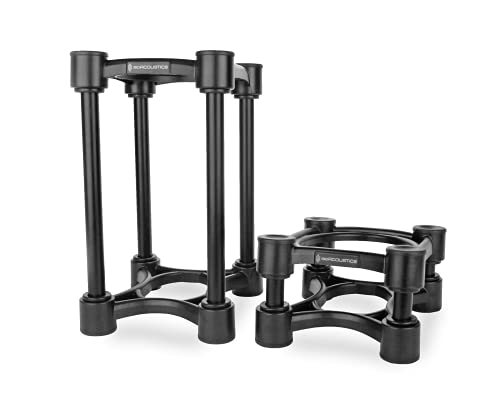
- 14 height and tilt variations
- 2.8- to 8.25-inch adjustment range
- Designed to reduce resonance and reflections
Best For: Precisely positioning desktop studio monitors
Best for Small Speakers
Kanto SE2 Elevated Desktop Stands

- Compact 3.8-inch elevation
- Metal construction
- Two-year manufacturer warranty
Best For: Small speakers in space-conscious desktop setups
Adjustable Foam Angle

- Five adjustable listening angles
- Dense, non-slip polyurethane foam
- Compact support for 3-4.5-inch monitors
Best For: Small desktop studio monitors needing flexible positioning
Compact Tilted Pair
Monoprice Small Speaker Stands

- Pair of desktop wedge stands
- Fixed 15-degree listening angle
- Anti-vibration TPR rubber construction
Best For: Small speakers in space-limited desktop setups
Medium Monitor Riser
Monoprice Medium Desktop Stands

- Pair for medium desktop speakers
- 15-degree fixed tilt
- Rubber anti-vibration wedge design
Best For: Most 5-inch and larger bookshelf speakers or monitors
Best Angled Isolation Stands – Audioengine DS1
The Audioengine DS1 is a compact option for anyone seeking speaker isolation stands for desktop use. Its 15-degree angle aims small bookshelf, computer, and gaming speakers toward the listener while silicone construction helps reduce vibration.
Best For: Desktop users who want a compact, angled riser for small speakers.
Pros:
- 15-degree tilt helps direct sound toward the listener.
- Silicone construction helps dampen vibration.
- Fits small bookshelf, computer, and gaming speakers.
- Includes a pair and supports up to 8 pounds.
Cons:
- 8-pound load limit may not suit heavier speakers.
- The compact base may be too small for larger cabinets.
Choose the DS1 when a simple, low-profile angled stand is more important than height adjustment or heavy-duty capacity. Its included three-year warranty adds useful support for a long-term desktop setup.
Best Heavy-Duty Desktop Riser – PEGZONE 22-Lb Stands
These PEGZONE speaker isolation stands for desktop setups combine a metal base, 16-degree tilt, and anti-vibration pads. They are designed for most bookshelf speakers and provide substantially more stated load capacity than compact silicone risers.
Best For: Gamers, creators, and listeners needing sturdy stands for heavier bookshelf speakers.
Pros:
- Supports up to 22 pounds.
- 16-degree tilt positions speakers toward the listener.
- Can be used freestanding or secured with screws.
- Protective and anti-vibration pads help protect the desk and reduce resonance.
Cons:
- The metal base occupies more space than a compact silicone stand.
- Only a one-year warranty is specified.
This pair is a practical choice when speaker weight and stability are priorities. The two installation methods also let you start with a simple setup and add fastening if you want a more secure installation.
Best Clamp-Mount Stands – Vondynote Adjustable Pair
For a desktop with limited surface area, the Vondynote pair offers clamp-mounted speaker isolation stands for desktop use. The stands adjust from 9 to 14 inches, attach to desks up to 2.6 inches thick, and support studio monitors up to 50 pounds.
Best For: Studio monitor users who need height adjustment and want to preserve desk space.
Pros:
- Height adjusts from 9 to 14 inches.
- Desk clamps use minimal surface area.
- Supports speakers up to 50 pounds.
- EVA pads help protect the desk and reduce speaker vibration.
Cons:
- Clamp installation requires more setup than freestanding risers.
- Compatibility depends on desk thickness and available clamp space.
- The 9-by-9-inch top plate may not suit every speaker cabinet.
The Vondynote stands make the most sense for elevated studio monitors and crowded workstations. Their strong capacity and adjustable height are useful, but buyers should verify both desk thickness and speaker footprint before ordering.
Best Space-Saving Cantilever Stands – PUTORSEN 6° Pair
The PUTORSEN pair uses a C-shaped cantilever design to create usable space beneath the speakers. These speaker isolation stands for desktop use also offer 6-degree tilt, adjustable depth, and anti-vibration padding for small and medium bookshelf speakers, computer speakers, and studio monitors.
Best For: Desks where under-speaker storage and adjustable speaker support are useful.
Pros:
- Cantilever design leaves about 5.9 inches of space below each speaker.
- Depth adjusts from approximately 5.5 to 7.5 inches.
- 6-degree tilt helps align speakers toward the listener.
- EVA and vibration-absorption pads improve stability and help reduce resonance.
Cons:
- Each stand supports up to 12 pounds.
- The 6-degree angle is less pronounced than some angled alternatives.
- Designed for small and medium speakers rather than very large cabinets.
Consider the PUTORSEN stands when desk organization matters as much as speaker positioning. Their adjustable ledge and open space underneath offer flexibility, while the moderate weight limit keeps them best suited to smaller desktop audio gear.
Best Budget Pick – JiffyPoint Metal Desktop Speaker Stands
If you want speaker isolation stands for desktop use without taking up much room, this JiffyPoint pair offers a practical metal platform for computer speakers and studio monitors. Its 5-degree upward angle aims sound toward your ears, while rubber pads help limit movement, scratches, and vibration transfer.
Best For: Desktop listeners who want sturdy, space-saving stands with a 30-pound capacity.
Pros:
- Steel construction supports up to 30 pounds.
- Rubber feet and top pads help reduce slipping and vibration.
- C-shaped design adds 4.12 inches of height and leaves storage space underneath.
- 6-inch top plate suits computer speakers and studio monitors.
Cons:
- The fixed-height design offers less positioning flexibility than adjustable stands.
- The listed dimensions may be larger than necessary for very compact speakers.
This is a sensible choice for a tidy desktop setup where stability, basic vibration control, and extra clearance matter more than advanced adjustment options.
Best Adjustable Isolation – IsoAcoustics Iso-130 Speaker Stands
For shoppers prioritizing precise placement, the IsoAcoustics Iso-130 is one of the more flexible speaker isolation stands for desktop setups. Its height and tilt adjustment system provides 14 positioning variations, while the patented isolators are designed to manage speaker energy and reduce unwanted surface resonance.
Best For: Studio monitor users who need adjustable height, tilt, and focused tweeter placement.
Pros:
- Offers 14 height and tilt combinations.
- Adjusts from 2.8 to 8.25 inches in height.
- Isolation design helps reduce vibrations and internal reflections.
- Supports up to 20 pounds per pair of stands as specified.
Cons:
- Its 20-pound capacity may not suit heavier monitors.
- The more specialized design may be unnecessary for basic computer speakers.
The Iso-130 is the strongest fit when monitor alignment and isolation performance are central to your setup, especially if your listening position changes or your desk requires careful angle control.
Best for Small Speakers – Kanto SE2 Elevated Desktop Stands
The Kanto SE2 is a compact option for shoppers looking for speaker isolation stands for desktop use with small speakers. These metal stands raise speakers by 3.8 inches and have a compact footprint, making them easy to fit into workstations where desk space is limited.
Best For: Small desktop speakers and compact workstations needing a simple elevated platform.
Pros:
- Compact 3.8-inch height works well for smaller speakers.
- Metal construction provides a sturdy platform.
- Listed load capacity is up to 66 pounds.
- Includes two stands and a two-year manufacturer warranty.
Cons:
- The supplied information does not specify dedicated vibration-absorbing pads.
- Fixed height provides less placement flexibility than adjustable models.
Choose the SE2 when you mainly need a compact lift for small speakers and prefer a straightforward pair of metal stands over a more adjustable isolation system.
Adjustable Foam Angle – Liquid Stands Isolation Pads
For shoppers comparing speaker isolation stands for desktop setups, these Liquid Stands foam pads combine monitor elevation, vibration reduction, and adjustable positioning in a compact wedge design. The dense polyurethane foam supports compatible small studio monitors while helping optimize listening height.
Best For: Desktop users with 3- to 4.5-inch studio monitors who want adjustable angles and a space-saving foam riser.
Pros:
- Five adjustable angles help position monitors toward the listening area.
- 50 kg/m³ foam construction provides a stable support surface.
- Non-slip surface helps keep speakers securely in place.
- Compact 12 x 8-inch footprint suits limited desk space.
Cons:
- Designed for smaller monitors rather than larger bookshelf speakers.
- Sold as one item, so confirm the quantity needed for a stereo setup.
Choose these pads when flexible tilt adjustment and a compact desktop footprint matter most. Their stated compatibility and 5-inch maximum height make them a practical fit for smaller studio-monitor arrangements.
Compact Tilted Pair – Monoprice Small Speaker Stands
These Monoprice wedge stands are a straightforward option for shoppers seeking speaker isolation stands for desktop use. Sold as a pair, they use anti-vibration thermoplastic rubber and a fixed 15-degree tilt to raise and angle small speakers without taking up much desk space.
Best For: Small bookshelf speakers or studio monitors in compact desktop setups.
Pros:
- Pair includes two stands for a stereo speaker setup.
- 15-degree tilt helps angle speakers toward the listener.
- Thermoplastic rubber construction is designed for anti-vibration support.
- Quick installation works well in limited desktop space.
Cons:
- Fixed 15-degree angle offers less adjustment than multi-angle pads.
- Intended for small-sized speakers.
These stands keep the feature set simple: a clean wedge shape, a fixed listening angle, and rubber support in a pair. They are a sensible choice when easy placement matters more than height or angle customization.
Medium Monitor Riser – Monoprice Medium Desktop Stands
For larger desktop speakers, these Monoprice stands provide a pair of rubber wedge risers with a 15-degree tilt. They are listed for most standard 5-inch and larger bookshelf speakers and studio monitors, making them a practical alternative to smaller speaker isolation stands for desktop setups.
Best For: Standard 5-inch and larger bookshelf speakers or studio monitors that need a tilted desktop platform.
Pros:
- Pair format supports a stereo speaker arrangement.
- 15-degree tilt is intended to improve speaker positioning toward the listener.
- Rubber construction provides anti-vibration support.
- 7.75 x 4.75-inch dimensions offer a compact desktop footprint.
Cons:
- Fixed tilt does not provide multiple angle options.
- Despite the medium size, users should verify speaker dimensions before buying.
This model is the stronger fit of the two Monoprice wedges when your speakers are around 5 inches or larger. Its pair packaging, compact footprint, and fixed 15-degree angle keep desktop installation simple.
How We Picked the Best Speaker Isolation Stands for Desktop Use
We focused on stands and risers designed for desks rather than full-size floor stands. Our selection considers speaker compatibility, supported weight, platform dimensions, vibration control, listening-angle adjustment, build materials, and how much desk space each design uses. We also included varied formats so shoppers can compare simple wedges with more substantial metal or adjustable stands.
Quick Comparison
Angled wedge stands are usually the simplest and most affordable option for small speakers. Foam isolation pads can provide broad vibration control and flexible placement, while metal stands generally offer greater rigidity and weight capacity. Clamp-on models are useful when desk space is limited, and adjustable isolation stands are the most versatile choice for fine-tuning height and tilt.
Key Buying Factors for Speaker Isolation Stands for Desktop
Speaker Size and Weight
Check the stand’s platform dimensions and maximum load before buying. The speaker should sit securely with its center of gravity over the platform, without excessive overhang. Allow extra capacity if your speakers are heavy or may be upgraded later.
Isolation and Stability
Isolation materials help reduce energy transferred from the speaker cabinet into the desk, which can limit rattling and coloration. Foam is lightweight and effective for many compact setups, while rubber-padded metal stands can provide a firmer, more stable base. A heavier stand is not automatically better if it overwhelms a lightweight desk.
Height and Listening Angle
For nearfield listening, aim to position the tweeters close to ear level when seated. Angled stands can direct sound toward your ears without raising the speaker excessively. Adjustable models are useful if you frequently change seating position or speaker orientation.
Desk Space and Placement
Measure the available depth and width, including space for cables and rear-facing ports. Clamp stands can preserve surface area, but they require a compatible desk edge and enough clearance underneath. Also check whether the stands leave room for a monitor, keyboard, or other equipment.
Who Should Buy Which Speaker Isolation Stands for Desktop?
Choose compact angled or wedge stands if you want an affordable way to aim small desktop speakers upward. Foam isolation pads suit users who need flexible positioning or broad contact with the desk. Metal padded stands are a better fit for heavier bookshelf speakers or anyone who prioritizes a rigid platform.
Clamp-mounted stands are best for crowded desks where preserving workspace matters most. If you want precise control over height and tilt, adjustable isolation stands offer the most room for fine-tuning. Before ordering, compare the listed platform size, weight limit, stand height, and speaker dimensions rather than relying only on the product’s general size description.