The right speaker stand can do more than raise your tweeters to ear level. It can reduce unwanted vibration, improve stereo positioning, and help bookshelf speakers perform more consistently on desks, shelves, or floors.
We compare 10 speaker isolation stands for bookshelf speakers, from compact acoustic foam pads to height-adjustable floor stands, so you can match support, fit, and placement to your listening setup.
Best 10 Speaker Isolation Stands for Bookshelf Speakers Picks for 2026
Best Adjustable Isolation
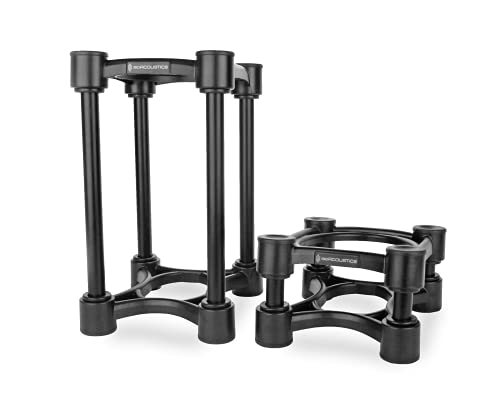
- 14 height and tilt variations
- 20-pound load capacity
- Low and tall height settings
Best For: Flexible monitor and bookshelf speaker placement
Best Foam Value

- 50 kg/m³ acoustic foam
- Fits 3- to 4.5-inch speakers
- Supports up to 16 pounds
Best For: Compact desktop speakers and monitors
Best Tilted Desktop Stand
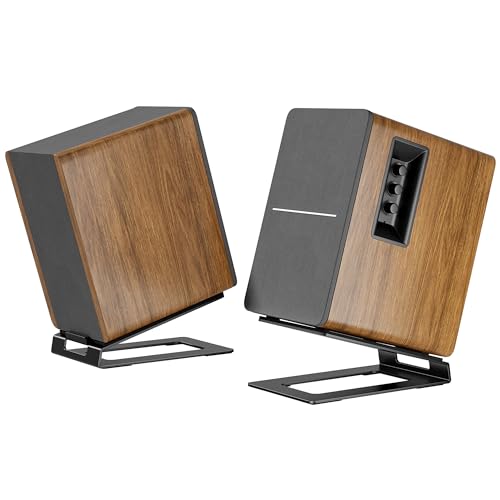
- 22-pound load capacity
- Fixed 16-degree upward tilt
- Freestanding or screw-mounted
Best For: Gaming and office desktop setups
Best Angled Foam Pad

- Five selectable angle settings
- 50 kg/m³ high-density foam
- Non-slip surface
Best For: Small monitors needing flexible desktop angles
Desktop Isolation Pick
Adjustable Monitor Isolation Pads

- Five angle settings for speaker aiming
- Fits many 6.5- to 8-inch monitors
- Supports up to 44 pounds per pair
Best For: Desktop setups using medium-sized studio monitors
Floor Isolation Pick

- Spikes, rubber feet, and top pads aid isolation
- Internal channels conceal speaker cables
- Supports bookshelf speakers up to 25 pounds
Best For: Stable, tidy surround-sound floor setups
Best Height-Adjustable Stands
PERLESMITH PSSS2 Speaker Stands

- Height adjusts from 33.3 to 45 inches
- Supports speakers up to 11 pounds
- Includes cable management options
Best For: Small bookshelf or satellite speakers needing floor placement
Best Angled Monitor Pads

- Five adjustable listening angles
- 50 kg/m³ dense foam construction
- Compact 14-by-11-inch footprint
Best For: Compact desktop studio monitors needing angled support
Best Adjustable Isolation – Iso-130 Speaker Stands
For listeners who want precise placement from speaker isolation stands for bookshelf speakers, the IsoAcoustics Iso-130 offers adjustable height and tilt in a compact pair. Its 14 positioning variations can help align tweeters with ear level while managing speaker energy transferred to the supporting surface.
Best For: Bookshelf or monitor setups that need flexible height and angle adjustment.
Pros:
- Offers 14 height and tilt variations.
- Supports speakers weighing up to 20 pounds.
- Available in low and tall height settings.
- Designed to reduce surface vibration and internal reflections.
Cons:
- Its 5.1-by-6-inch platform may not suit larger bookshelf speakers.
- More specialized and potentially less compact than foam pads.
The Iso-130 is a strong choice when speaker positioning is as important as isolation. Its adjustable design gives it an advantage for desktop or studio users fine-tuning stereo imaging and listening height.
Best Foam Value – SMPad 4 Isolation Pads
The SMPad 4 is a simple, space-efficient option among speaker isolation stands for bookshelf speakers. Its high-density acoustic foam is sized for many compact speakers and can be repositioned into multiple angle configurations.
Best For: Small bookshelf speakers, studio monitors, and desktop audio systems.
Pros:
- Made from 50 kg/m³ high-density acoustic foam.
- Fits many 3- to 4.5-inch speakers.
- Supports up to 16 pounds without changing shape.
- Allows multiple angle configurations.
Cons:
- Not intended for larger or heavier speakers beyond its rated capacity.
- Provides foam-pad elevation rather than adjustable stand height.
For compact desktop systems, the SMPad 4 delivers a straightforward way to decouple speakers and adjust their angle without adding bulky hardware. Its broad compatibility makes it particularly practical for smaller powered speakers.
Best Tilted Desktop Stand – PEGZONE Speaker Risers
These PEGZONE stands are practical speaker isolation stands for bookshelf speakers when you want a stable desktop riser with a fixed listening angle. The 16-degree tilt directs sound upward, while anti-vibration pads help separate the speakers from the desk.
Best For: Gaming desks, workstations, and desktop bookshelf speaker setups.
Pros:
- Supports up to 22 pounds.
- Uses a 16-degree upward tilt.
- Can be used freestanding or secured with screws.
- Includes protective and anti-vibration pads.
Cons:
- Offers a fixed tilt rather than adjustable positioning.
- Raises speakers only 3.1 inches.
The PEGZONE pair suits users who want a sturdy, low-profile desktop solution with more support than foam alone. Its installation options are useful if you sometimes need portability and sometimes prefer a more secure mount.
Best Angled Foam Pad – Liquid Stands Isolation Pads
Liquid Stands isolation pads offer a flexible foam-based approach to speaker isolation stands for bookshelf speakers and compact studio monitors. The pads provide five angle settings, a non-slip surface, and a curved design intended to improve listening height and reduce vibration.
Best For: Small studio monitors and desktop setups needing several angle choices.
Pros:
- Provides five angle settings from -10 to 10 degrees.
- Uses 50 kg/m³ high-density foam.
- Includes a non-slip surface.
- Compatible with many 3- to 4.5-inch monitors.
Cons:
- Designed for smaller monitors rather than large bookshelf speakers.
- Foam construction may offer less rigid support than metal stands.
These pads are a good fit when angle flexibility and compactness matter more than stand height. They can help refine speaker orientation while keeping a low-profile footprint on a desk or existing stand.
Adjustable Heavy-Duty Pick – Height-Adjustable Wood Speaker Stands
These height-adjustable speaker isolation stands for bookshelf speakers are a practical choice when you want flexible placement and a clean home-theater or studio setup. Their 18- to 28-inch range helps position compatible speakers closer to ear level, while the broad bases and cable clips support a tidy, stable installation.
Best For: Large bookshelf, satellite, or studio-monitor speakers in living rooms, bedrooms, and music rooms.
Pros:
- Adjustable from 18 to 28 inches for flexible listening height.
- Supports up to 50 pounds and fits a wide range of bookshelf and monitor speakers.
- Large 12.2-by-9.1-inch top plates and adjustable rubber feet improve stability on uneven floors.
- Included cable clips help reduce wire clutter and tripping hazards.
Cons:
- The wooden construction and 12.2-inch-square footprint may not suit every decor or compact room.
- Assembly is required.
Choose these stands if height flexibility and high load capacity matter more than a minimalist footprint. They are especially useful for larger bookshelf speakers that need a stable, elevated platform.
Desktop Isolation Pick – Adjustable Monitor Isolation Pads
These speaker isolation stands for bookshelf speakers use compact acoustic foam pads rather than floor-standing columns. The two-component design offers five angle settings, helping desktop and bookshelf setups aim compatible monitors more precisely while reducing unwanted vibration transfer.
Best For: Desktop users and studio-monitor owners with 6.5- to 8-inch speakers.
Pros:
- Five angle settings support more precise speaker positioning.
- 13-by-10.65-inch pads accommodate many 6.5- to 8-inch monitors.
- Each pair supports up to 44 pounds and uses Vibredux HD foam for isolation.
- Works well with desktop speaker stands and bookshelf speaker setups.
Cons:
- These are desktop pads, not elevated floor stands.
- Compatibility is aimed primarily at 6.5- to 8-inch monitor speakers.
These pads make the most sense when your speakers already sit on a desk or shelf and you want isolation plus aiming flexibility without adding full-size stands. Check your speaker dimensions and total weight before ordering.
Floor Isolation Pick – Fluance SS05S Speaker Stands
The Fluance SS05S is one of the more complete speaker isolation stands for bookshelf speakers, combining a listening-height design with adjustable floor spikes, rubber isolation feet, and rubber pads on the top plate. Internal cable routing also keeps wires concealed for a cleaner surround-sound setup.
Best For: Bookshelf and surround speakers weighing up to 25 pounds in a stable floor-standing arrangement.
Pros:
- Adjustable spikes and rubber feet improve stability and help isolate vibrations.
- Rubber top-plate pads provide additional speaker-to-stand decoupling.
- Internal cable management hides wires through the pole and base.
- Wide 10.43-inch base and optional wall-anchor hole support a secure installation.
Cons:
- Maximum load is 25 pounds, so it is less suitable for heavy bookshelf speakers.
- Wall-anchor hardware is not included.
- The fixed design reaches up to 31.1 inches, offering less height flexibility than adjustable models.
This pair is a strong fit when vibration control, concealed wiring, and floor stability are priorities. It is particularly appealing for surround-sound systems, provided each speaker stays within the 25-pound capacity.
Best Foam Isolation Pads – SMPad 5 Monitor Isolation Pads
If you need speaker isolation stands for bookshelf speakers or compact studio monitors, the Sound Addicted SMPad 5 offers a simple desktop or stand-mounted way to reduce unwanted vibration. Its dense acoustic foam supports monitors up to 24 pounds and can be angled for more flexible positioning.
Best For: Owners of 5-inch studio monitors who want lightweight, adjustable foam isolation without adding a full floor stand.
Pros:
- High-density 50 kg/m³ acoustic foam
- Supports up to 24 pounds without changing shape
- Multiple angle configurations for positioning flexibility
- Includes two pads for a left and right speaker
Cons:
- Designed primarily for 5-inch monitors
- Provides pads rather than height-adjustable floor stands
The SMPad 5 is a practical choice when vibration control and angle adjustment matter more than raising speakers to floor-standing listening height. Check your monitor dimensions and weight before buying.
Best Height-Adjustable Stands – PERLESMITH PSSS2 Speaker Stands
For shoppers seeking speaker isolation stands for bookshelf speakers with adjustable listening height, the PERLESMITH PSSS2 provides a pair of steel floor stands. The columns extend from 33.3 to 45 inches and accommodate compatible bookshelf or satellite speakers weighing up to 11 pounds.
Best For: Small, rectangular bookshelf, satellite, and studio speakers that need elevated floor placement for music or surround sound.
Pros:
- Adjustable height from 33.3 to 45 inches
- Fits speakers 4.5 to 9 inches wide and up to 11 pounds
- Steel construction with wide bases and non-slip foot pads
- Offers internal cable routing plus exterior hook-and-loop straps
Cons:
- Not suitable for round or irregularly shaped speakers
- Small cable openings may not fit every connector
- Limited to speakers weighing 11 pounds or less
These stands are more suitable than foam risers when you need floor-level height adjustment and cable management. Confirm speaker dimensions, shape, weight, and cable size before ordering.
Best Angled Monitor Pads – Liquid Stands Isolation Pads
The Liquid Stands isolation pads are a space-saving alternative to traditional speaker isolation stands for bookshelf speakers and studio monitors. Their dense foam wedge uses a non-slip surface and five angle settings to help position compatible speakers while limiting unwanted movement.
Best For: Desktop or stand-mounted studio monitor setups using compact speakers that benefit from angled positioning and vibration control.
Pros:
- 50 kg/m³ high-density foam construction
- Five adjustable angles, including 0°, 5°, 10°, -5°, and -10°
- Non-slip surface helps keep monitors in place
- Compact 14-by-11-by-2-inch design saves space
Cons:
- Compatibility notes focus on 3- to 4.5-inch monitors
- Does not provide a tall, floor-standing listening position
This model makes sense for compact monitors where angle control and a low-profile footprint are priorities. Measure your speakers and available surface area to ensure a suitable fit.
How We Picked the Best Speaker Isolation Stands for Bookshelf Speakers
We focused on the factors that most affect real-world performance: compatibility with common bookshelf and studio-monitor sizes, vibration control, stability, height adjustment, weight capacity, footprint, and installation requirements. The selection includes foam isolation pads, angled risers, desktop stands, and full-height floor stands to cover different rooms and budgets.
We also considered whether each design helps position speakers correctly. Isolation material can reduce energy transferred into a desk or shelf, while elevated or adjustable stands can improve tweeter alignment and stereo imaging. Because speaker dimensions vary widely, always compare the listed platform size and weight rating with your speakers before buying.
Quick Comparison
| Stand type | Best for | Main advantage | Watch for |
|---|---|---|---|
| Foam isolation pads | Desks and studio monitors | Affordable vibration control | Limited height and load support |
| Desktop speaker stands | Bookshelf speakers on workstations | Raises speakers and saves desk space | Platform dimensions and stability |
| Adjustable desktop stands | Flexible listening positions | Height and tilt control | Higher cost or more setup |
| Floor stands | Living rooms and surround systems | Better ear-level placement | Requires more floor space |
Key Buying Factors for Speaker Isolation Stands for Bookshelf Speakers
Speaker Fit and Weight Capacity
The platform should fully support the speaker base without obstructing ports or controls. Check both the stand’s dimensions and its maximum load, leaving a safety margin rather than choosing a model that is only just strong enough.
Isolation and Construction
High-density foam is convenient for desks and monitors, while rigid metal or wood stands usually provide stronger structural support. Look for non-slip surfaces, rubber feet, spikes, or other contact points that limit movement and prevent the stand from sliding.
Height, Tilt, and Placement
For seated listening, aim the tweeters toward ear level when possible. Tilt-adjustable designs help compensate for low desks, short platforms, or speakers placed above the listener. Floor stands are useful when furniture placement makes desktop positioning impractical.
Stability and Cable Management
A wide base, solid construction, and secure speaker contact matter more than a tall maximum height. If cables are visible or vulnerable to being pulled, consider stands with cable-routing features or enough clearance to keep wiring tidy.
Who Should Buy Which Speaker Isolation Stands for Bookshelf Speakers?
Choose foam isolation pads if you use compact monitors on a desk and mainly want to reduce resonance without adding much height. Angled pads are particularly useful when the speakers sit below ear level.
Choose desktop stands if you need to raise bookshelf speakers, create space beneath them, or improve stereo positioning in a workstation setup. Adjustable models are the best fit when your seating position or speaker placement changes frequently.
Choose floor stands for living rooms, surround systems, or larger bookshelf speakers that need independent support away from furniture. Prioritize a stable base, appropriate height, and secure speaker placement over decorative styling.