Hardwood floors can amplify low-frequency energy and transmit unwanted vibration through speaker cabinets, stands, and furniture. The right isolation setup helps protect the floor while improving stability and reducing resonance.
These 10 picks cover adjustable monitor stands, acoustic foam platforms, subwoofer isolators, spikes, and protective pads for different room layouts and speaker sizes.
Best 10 Speaker Isolation Stands for Hardwood Floors Picks for 2026
Best Adjustable Stand

- 14 height and tilt variations
- 40-pound capacity; pair included
- Helps reduce surface vibration and reflections
Best For: Adjustable studio monitor placement
Best Subwoofer Platform
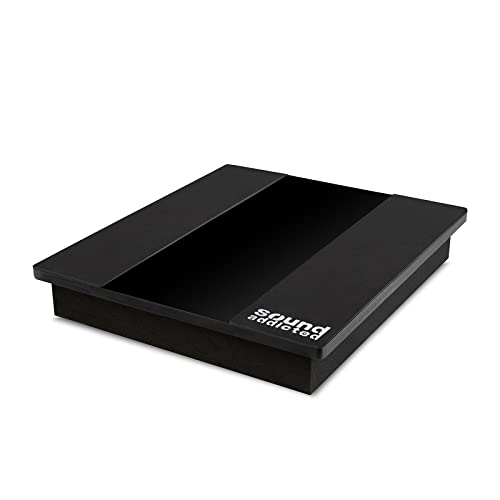
- Fits 8- to 10-inch subwoofers
- Supports up to 165 pounds
- Layered foam, EVA, and MDF construction
Best For: Heavy subwoofer isolation
Best Dedicated Subwoofer Stand
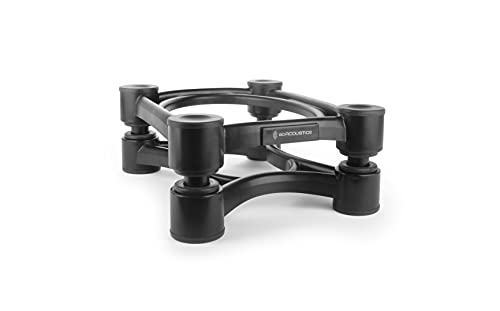
- 75-pound capacity and 3.5-inch height
- Designed for most subwoofers
- Additional units can support larger cabinets
Best For: Compact subwoofer vibration control
Best Angled Foam Pad
Liquid Stands Monitor Isolation Pads

- Five selectable speaker angles
- Compact 14-by-11-by-2-inch profile
- High-density foam with non-slip surface
Best For: Small monitors needing low-profile angling
Floor-Safe Spike Isolation

- Includes protective non-slip mats
- Supports about 100 lb per set
- Raises components for added airflow
Best For: Bookshelf speakers and audio components on hardwood floors
Studio Monitor Cushioning

- High-density acoustic foam construction
- Pair sized for five-inch monitors
- Supports up to 24 pounds
Best For: Compatible five-inch studio monitors
Heavy-Duty Aluminum Isolation

- Solid CNC-machined aluminum construction
- Removable non-slip rubber rings
- Listed capacity up to 880 pounds
Best For: Heavy speakers, subwoofers, and hi-fi components
Large Monitor Pad Riser
8–10-Inch Studio Isolation Platform

- Broad 15.5-by-13-inch platform
- Three-layer vibration-dampening design
- Two-pack with non-slip base
Best For: Large studio monitors and subwoofers
Universal Spike Protection
Nickel-Plated Speaker Spike Pads
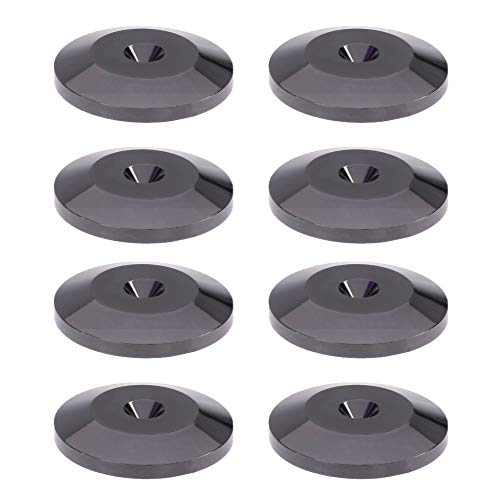
- Fits pointed speaker foot nails
- Eight pads included
- Compact 5-by-25mm design
Best For: Protecting hardwood beneath spike feet
Adjustable Spring Feet
Aluminum Speaker Isolation Pads
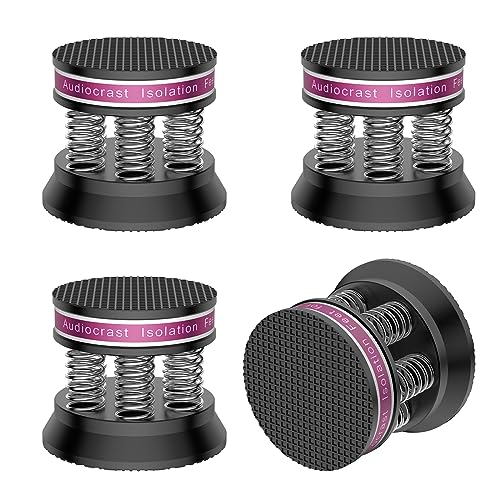
- Spring-based adjustable isolation
- No drilling or adhesive needed
- 50 kg stated load capacity
Best For: Adjustable isolation for speakers and audio equipment
Best Adjustable Stand – IsoAcoustics Iso-155
The IsoAcoustics Iso-155 is a strong choice when shopping for speaker isolation stands for hardwood floors and need precise monitor positioning. Its adjustable height and tilt help place tweeters at ear level while its isolation design manages speaker energy that could resonate through the supporting surface.
Best For: Studio monitors and desktop setups needing adjustable height, tilt, and isolation.
Pros:
- Offers 14 height and tilt variations, from 3 to 8.25 inches.
- Supports up to 40 pounds and includes a pair of stands.
- Designed to reduce supporting-surface vibrations and internal reflections.
Cons:
- The 6.1-by-7.5-inch platform may not fit larger speakers.
- Its specialized design may cost more than basic foam pads.
Choose the Iso-155 if speaker alignment is as important as vibration control. The pair format and broad adjustment range make it particularly practical for stereo monitor placement on desks or other hard surfaces.
Best Subwoofer Platform – Sound Addicted VibeBoss P10
The Sound Addicted VibeBoss P10 is a broad isolation platform for shoppers seeking speaker isolation stands for hardwood floors, especially under a subwoofer. Its foam, EVA, and MDF construction combines damping with a non-slip base to help reduce vibration transfer in studios, apartments, and home listening rooms.
Best For: 8- to 10-inch subwoofers that need a stable, low-profile isolation platform.
Pros:
- Fits 8-, 9-, and 10-inch subwoofers across brands and models.
- Supports up to 165 pounds.
- Non-slip base and layered construction help with stabilization and damping.
Cons:
- At 2.5 inches high, it offers little elevation.
- Its large footprint may use substantial desk or floor space.
The VibeBoss P10 makes sense when the priority is supporting a heavier subwoofer rather than raising a monitor to ear level. Its generous load rating and wide platform provide a practical buffer between the subwoofer and a hardwood floor.
Best Dedicated Subwoofer Stand – IsoAcoustics Iso-200Sub
The IsoAcoustics Iso-200Sub is a dedicated subwoofer stand for setups where speaker isolation stands for hardwood floors need to manage low-frequency vibration. Its 75-pound capacity and compact 7.8-by-10-inch footprint are suited to many subwoofers, while additional units can be combined for larger cabinets.
Best For: Most subwoofers requiring a compact, purpose-built isolation stand.
Pros:
- Supports up to 75 pounds at a 3.5-inch height.
- Designed to reduce vibration through the supporting surface and adjoining rooms.
- Can be used singly or combined with additional units for larger subwoofers.
Cons:
- Only one stand is included.
- Its dimensions may not fully support unusually large subwoofer cabinets without additional units.
The Iso-200Sub is a focused option for buyers who want a dedicated isolation solution rather than a general-purpose pad. Verify your subwoofer’s footprint and weight, and plan on extra units if the cabinet extends beyond the stand’s support area.
Best Angled Foam Pad – Liquid Stands Monitor Isolation Pads
Liquid Stands isolation pads offer a low-profile alternative for shoppers comparing speaker isolation stands for hardwood floors, desks, or existing stands. The high-density foam wedges use a non-slip surface and five angle settings to help position compatible studio monitors while reducing unwanted movement and vibration.
Best For: Compact studio monitors and setups needing angled, space-saving foam isolation.
Pros:
- Provides five angle options, including 0, -5, 10, -10, and 5 degrees.
- Compact 14-by-11-by-2-inch design saves space.
- High-density 50 kg/m³ foam and a non-slip surface support stable placement.
Cons:
- Designed for smaller studio monitors rather than large speakers.
- Foam pads provide less elevation than adjustable metal stands.
This pad is a practical fit when you need basic isolation and aiming without adding a tall stand. Check your monitor dimensions carefully, since the supplied compatibility information is aimed at compact studio monitors.
Floor-Safe Spike Isolation – Adjustable Aluminum Feet
If you need speaker isolation stands for hardwood floors, these adjustable aluminum spikes pair with included protective mats to help reduce vibration while keeping the cone tips secured. They also lift components just over an inch, creating additional airflow underneath.
Best For: Bookshelf speakers, amplifiers, and other audio components that need elevated, floor-conscious isolation.
Pros:
- Includes four deep, wide-crater mats designed to protect flooring and hold spike tips in place.
- Supports about 100 pounds per four-spike set.
- Precision-machined aluminum alloy with a durable gold finish.
- Works with speakers, amplifiers, turntables, CD/DVD players, and other equipment.
Cons:
- Dimensions should be checked carefully before installation.
- Spike-style feet may require more precise placement than broad isolation pads.
This is a practical choice when you want the focused contact of isolation spikes without placing bare metal directly on a hardwood floor. The included mats add a useful layer of stability and surface protection.
Studio Monitor Cushioning – SMPad 5 Isolation Pads
For speaker isolation stands for hardwood floors, the SMPad 5 offers a softer alternative to metal spikes. These high-density foam pads are designed for pairs of five-inch studio monitors and can be arranged at multiple angles.
Best For: Home studios using compatible five-inch monitors on stands, desks, or other hard surfaces.
Pros:
- High-density acoustic foam is rated at 50 kg/m³.
- Pair includes one pad for each speaker.
- Multiple configurations allow angled monitor placement.
- Designed to hold up to 24 pounds without changing shape.
Cons:
- Designed specifically for five-inch studio monitors rather than larger speakers.
- Maximum supported weight is 24 pounds.
- Foam pads do not provide the rigid, adjustable contact of spike feet.
Choose these pads when compatibility and cushioning matter more than a rigid metal interface. Confirm your monitors’ dimensions and weight before using them, especially with floor stands.
Heavy-Duty Aluminum Isolation – Audiocrast HiFi Feet
These Audiocrast feet are a strong option for speaker isolation stands for hardwood floors when you want aluminum isolators with removable rubber rings. The rings help prevent slipping and protect surfaces, while the feet are suitable for speakers, subwoofers, amplifiers, and turntables.
Best For: Heavier hi-fi equipment and listeners seeking stable, non-slip isolation feet with a compact footprint.
Pros:
- Solid, CNC-machined aluminum with an anodized and sandblasted finish.
- Removable rubber rings help reduce slipping and surface scratches.
- Universal design works with multiple types of audio equipment.
- Listed load capacity is up to 880 pounds.
Cons:
- Installation uses 4M screws, so equipment compatibility should be verified.
- At 0.79 inches high, these provide less lift than taller stand solutions.
- The compact metal-foot design may need careful positioning on hardwood.
With its high stated load capacity and rubber-ring interface, this set is geared toward substantial equipment rather than lightweight desktop monitors. Check the mounting arrangement and place the feet evenly for stable support.
Large Monitor Pad Riser – 8–10-Inch Studio Isolation Platform
For anyone comparing speaker isolation stands for hardwood floors, this two-pack provides a broad, padded platform for larger studio monitors and subwoofers. Its three-layer construction is designed to reduce vibration while the non-slip base helps keep equipment stable on a desk, shelf, or floor surface.
Best For: 8–10-inch studio monitors, loudspeakers, and subwoofers in home, apartment, desktop, or studio setups.
Pros:
- Large 15.5-by-13-inch platforms fit many 8–10-inch speakers.
- Three-layer rubber-sponge and fibreboard construction helps damp vibration.
- Non-slip base helps keep speakers in place.
- Includes two isolation pads for a stereo pair.
Cons:
- Designed for larger speakers, so it may be oversized for compact monitors.
- At 1.8 inches high, it adds noticeable height to the speaker setup.
This is the most substantial option in the group, offering a ready-to-use platform rather than individual feet. Choose it when broad support and straightforward vibration damping matter more than adjustability.
Universal Spike Protection – Nickel-Plated Speaker Spike Pads
8 Pack of Black 24K Nickel Plated Speaker Spikes Pads Mats 5x25mm Isolation Stand Foot Cone Base
Check Price On AmazonThese compact spike pads are a simple choice for speaker isolation stands for hardwood floors when your stands or speakers use pointed feet. Positioned between the foot nail and the ground, they help protect the surface without requiring a full platform.
Best For: Speaker stands or equipment with pointed spike feet that need a universal protective interface.
Pros:
- Works with any pointed foot nail according to the supplied details.
- Compact 5-by-25mm pad format suits spike-foot applications.
- Eight-piece pack supports multiple feet or spare replacements.
- Black finish with nickel-plated construction.
Cons:
- These are small spike pads, not freestanding speaker stands or broad isolation platforms.
- The supplied details do not specify a load capacity or acoustic damping rating.
Pick these when floor protection is the primary goal and your existing equipment already has spike feet. Their minimal design preserves the existing stand setup while adding a dedicated pad between the spikes and the floor.
Adjustable Spring Feet – Aluminum Speaker Isolation Pads
For a more adjustable approach to speaker isolation stands for hardwood floors, these four aluminum spring feet combine non-slip rubber with spring-based isolation. They install without drilling or double-sided tape and can be adjusted by moving or adding springs to suit the load.
Best For: Speakers, subwoofers, amplifiers, turntables, DACs, and other equipment requiring compact, adjustable isolation feet.
Pros:
- Spring design is intended to absorb vibration and reduce acoustic feedback.
- Aluminum-alloy construction is CNC machined and finished in brushed black.
- No holes or double-sided tape are required for installation.
- Supplied load capacity is up to 50 kg.
Cons:
- These are individual feet, so compatible equipment must provide a suitable mounting surface.
- Adjusting the spring configuration may require experimentation.
- The four-piece set may be less convenient than a single ready-made platform.
This set is the flexible choice for listeners who want to tune the isolation rather than simply place equipment on foam. Its universal-fit design and 50 kg stated capacity also make it useful across several types of audio hardware.
How We Picked the Best Speaker Isolation Stands for Hardwood Floors
We focused on products that address the two main problems in a hardwood-floor listening setup: unwanted vibration and secure placement. The selection includes full isolation platforms, angled monitor pads, adjustable feet, spikes, and spike-receiving floor protectors. We also considered stated weight and size compatibility, construction materials, installation requirements, and whether each product is intended for monitors, bookshelf speakers, or subwoofers.
Because room acoustics and speaker cabinets vary, no single design works for every system. Foam platforms are usually the simplest option, while adjustable feet and spikes can provide more precise leveling. Subwoofer platforms need a larger, stronger contact area than compact monitor accessories.
Quick Comparison
- Best for adjustable monitor placement: IsoAcoustics Iso-Stand Series.
- Best for larger subwoofers: Sound Addicted VibeBoss P10 or IsoAcoustics Iso-200Sub.
- Best budget foam option: Liquid Stands or Sound Addicted monitor pads.
- Best for compact floor protection: speaker spike pads and mats.
- Best for fine leveling: adjustable isolation spikes.
Key Buying Factors for Speaker Isolation Stands for Hardwood Floors
Speaker or Subwoofer Size
Measure the cabinet footprint before buying. A platform should support the speaker’s full base without unstable overhang. Check both the listed dimensions and the recommended speaker size, especially for 8- to 10-inch monitors and subwoofers.
Isolation Design
Dense acoustic foam is convenient and works well for many desktop or studio-monitor setups. Mechanical isolators, rubber interfaces, and suspension-style designs may be preferable when a subwoofer transfers substantial energy. Spikes can improve contact control, but they should generally be paired with protective cups or mats on hardwood.
Height and Angle
Choose adjustable or angled supports when tweeter alignment matters. Raising a monitor so the tweeter aims toward ear level can improve imaging, while a fixed foam pad may be better when you want a low-profile setup.
Floor Protection and Stability
Hardwood is vulnerable to scratches, dents, and finish damage from narrow metal points. Use spike bases or floor-protection discs under pointed feet, and confirm that the complete assembly cannot slide or rock. Adhesive or rubber contact surfaces can help, but inspect them periodically for trapped grit or residue.
Who Should Buy Which Speaker Isolation Stands for Hardwood Floors?
Home studio owners should prioritize compact monitor isolation pads or adjustable stands that improve tweeter alignment. Subwoofer users need a platform rated for the cabinet’s dimensions and weight, with enough surface area to distribute vibration. Hi-fi listeners using floorstanding speakers may prefer spikes for leveling and coupling, but hardwood protection pads are essential. Renters and anyone concerned about finish damage should choose broad, non-marking isolation platforms or rubber-backed protectors rather than bare spikes.
Before ordering, verify the product’s dimensions, load capacity, contact materials, and whether it is sold as a pair, single unit, or multi-pack. Correct sizing and secure placement matter as much as the isolation material itself.