Speaker selector switches make it easier to share one stereo amplifier or receiver with speakers in multiple rooms. The right model lets you activate zones independently while helping match your system’s power and impedance requirements.
We compared 10 options ranging from compact two-way switchers to high-capacity eight-zone distribution boxes, including models with volume controls and impedance protection.
Best 10 Speaker Selector Switches Picks for 2026
Flexible Four-Zone Control

- Controls up to four speaker pairs
- Handles 100W per channel at 8 ohms minimum
- 14-gauge wire support and push buttons
Best For: Simple four-zone home stereo setups
Two-Way A/B Switching
SOLUPEAK P2 Amp/Speaker Switch
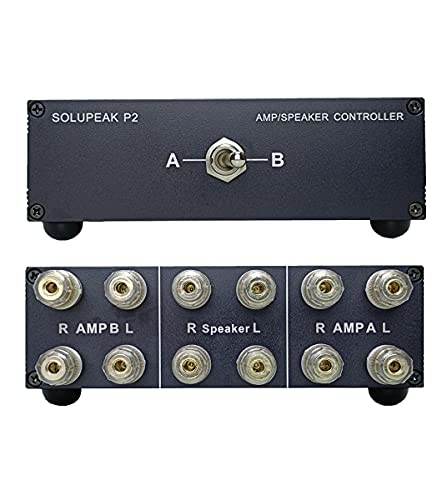
- Routes two amps to one pair or one amp to two pairs
- Passive, one-press A/B operation
- 12-gauge-compatible gold-plated banana jacks
Best For: Amplifier and speaker comparison systems
Six-Pair Distribution
Pyle PSS6 Home Speaker Selector

- Connects up to six speaker pairs
- Push-button zone operation
- Plug-and-play high-power distribution design
Best For: Larger home stereo systems with multiple speaker pairs
Multi-Room Zone Control
PROZOR AS005 4-Zone Speaker Switch

- Independent A/B/C/D zone buttons
- Supports 4–16-ohm speakers at 150W RMS per channel
- Passive design with master AMP switch
Best For: Multi-room passive speaker distribution
Four-Zone Distribution
Monoprice 4-Channel Speaker Selector

- Distributes audio to up to four zones
- Impedance protection circuit is optional
- Supports 70W per channel with protection or 140W without
Best For: Multi-room home audio distribution
Flexible Two-Zone Control
PROZOR Passive Speaker Switch Box

- Independent controls select Zone A, B, or both
- Supports one amp/two pairs or two amps/one pair
- Handles 150W RMS per channel and 4–16Ω speakers
Best For: Two-zone systems and controlled amplifier switching
Best High-Capacity Pick
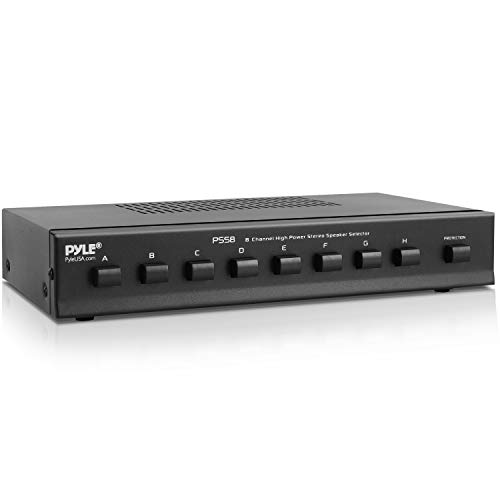
- Controls up to eight speaker pairs
- Independent zone selection buttons
- Protection for connected equipment
Best For: Large multi-room stereo systems
Best With Volume Control
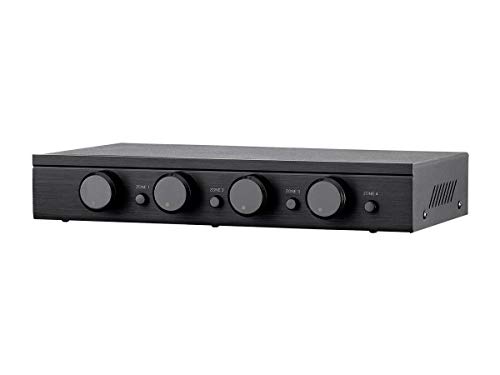
- Individual zone volume controls
- Automatic impedance protection
- 100 watts per channel continuous handling
Best For: Four-zone systems needing room-by-room volume
Best Mid-Size Value

- Supports six speaker pairs
- Independent volume controls
- Overload protection circuitry
Best For: Six-zone home theater and stereo systems
Flexible Four-Zone Control – Pyle PSS4 4-Channel Selector
The Pyle PSS4 is a straightforward choice among speaker selector switches when you need to connect up to four separate speaker pairs to one stereo system. Its push-button design and plug-and-play setup keep zone selection simple.
Best For: Home audio systems needing A/B/C/D speaker-pair control from a single stereo setup.
Pros:
- Supports up to four separate speaker pairs.
- Handles up to 100 watts per channel with speaker systems rated at a minimum of 8 ohms.
- Accepts speaker wire up to 14-gauge.
- Push-button operation and plug-and-play setup.
Cons:
- Its 8-ohm minimum limits compatibility with lower-impedance speaker systems.
- Offers four channels rather than the six-channel capacity of some larger selectors.
Choose the PSS4 if you want uncomplicated four-zone switching and your speakers meet its impedance and power requirements. Its compact black enclosure is suited to a basic, organized stereo installation.
Two-Way A/B Switching – SOLUPEAK P2 Amp/Speaker Switch
The SOLUPEAK P2 stands out among speaker selector switches for comparison setups. It can route two amplifiers to one speaker pair or one amplifier to two speaker pairs, with one-press passive A/B switching.
Best For: Audiophiles comparing amplifiers or switching one amplifier between two speaker pairs.
Pros:
- Supports reversible 2-in/1-out or 1-in/2-out configurations.
- Passive operation requires no external power.
- Gold-plated banana jacks accept speaker wires up to 12-gauge.
- Rated for 100W RMS and 200W peak per channel.
Cons:
- In 1-in/2-out mode, only speaker pair A or B operates at a time.
- Requires banana plugs rather than RCA cables.
- Tube amplifiers need to be in standby or turned off before switching.
The P2 is a focused switcher rather than a multi-zone distribution box. Its flexible signal direction and passive design make it practical for quick A/B testing, provided connections and tube-amp precautions are followed.
Six-Pair Distribution – Pyle PSS6 Home Speaker Selector
The Pyle PSS6 is a high-capacity option among speaker selector switches, connecting up to six separate speaker pairs to a stereo system. Its push-button operation and plug-and-play setup are suited to larger home audio installations.
Best For: Home stereo systems that need distribution to as many as six speaker pairs.
Pros:
- Supports up to six separate speaker pairs.
- Designed as a premium distribution system with high power handling.
- Provides simple push-button operation.
- Offers plug-and-play setup.
Cons:
- The supplied notes do not specify an impedance range or per-channel power limit.
- Its larger capacity may be unnecessary for smaller two- or four-pair systems.
If your installation requires more zones than a typical four-channel selector, the PSS6 provides the extra capacity without adding complicated controls. Confirm your amplifier and speaker requirements before connecting multiple pairs.
Multi-Room Zone Control – PROZOR AS005 4-Zone Speaker Switch
The PROZOR AS005 is a practical choice among speaker selector switches for one-amplifier, multi-room audio. Independent A/B/C/D buttons, a master AMP switch, passive operation, and support for 4–16-ohm speakers make daily zone control straightforward.
Best For: Home, patio, shop, or studio systems sharing one amplifier across up to four passive speaker pairs.
Pros:
- Controls up to four speaker pairs with independent zone buttons.
- Supports 4–16-ohm passive speakers and up to 150W RMS per channel.
- Passive design requires no external power adapter.
- Master AMP switch and spring-clip terminals simplify operation and setup.
Cons:
- It does not provide independent volume control; volume remains controlled by the amplifier.
- Designed for passive speakers, not active speaker systems.
- Safe setup requires powering off the amplifier before wiring.
The AS005 is a strong fit when you want clearly separated zones and broad speaker-impedance compatibility. Its metal housing, anti-slip feet, and stated support for speaker runs up to 164 feet add useful flexibility for larger installations.
Compact Stereo Switching – Kurrent Electric A/B Speaker Selector
This compact option among speaker selector switches lets you route one stereo receiver output to speaker set A, set B, or both at once. Its metal construction and included adhesive rubber feet suit straightforward tabletop or shelf installations, while the 200-watt-per-channel continuous music-power limit should be matched to your system.
Best For: Stereo systems needing simple A/B or A+B speaker selection.
Pros:
- Select speaker set A, B, or A+B.
- Sturdy metal construction.
- Adhesive rubber feet are included.
Cons:
- Limited to 200 watts per channel of continuous music power.
- Provides two speaker outputs rather than four zones.
This is a focused, no-frills selector for two speaker sets. Confirm your amplifier’s output fits the stated power limit before choosing it.
Four-Zone Distribution – Monoprice 4-Channel Speaker Selector
For systems that need broader coverage, this four-channel model is one of the more versatile speaker selector switches for distributing audio to up to four speaker zones. It supports up to 70 watts per channel with its impedance-protection circuit enabled, or up to 140 watts without that circuit.
Best For: Home audio setups distributing one source across up to four speaker zones.
Pros:
- Supports up to four separate speaker zones.
- Optional impedance protection helps keep the amplifier load constant.
- Offers up to 70W per channel with protection or 140W without it.
- Rugged black design from Monoprice.
Cons:
- Maximum supported power depends on whether protection is enabled.
- The supplied notes do not specify independent source selection for each zone.
The main appeal is flexible multi-room distribution at a stated power range. Pay close attention to the protection setting when matching it with your amplifier.
Flexible Two-Zone Control – PROZOR Passive Speaker Switch Box
This PROZOR unit combines two-zone speaker switching with amplifier-input selection, making it a flexible choice among speaker selector switches. Its independent A/B controls can run either zone individually or both together, while the passive design requires no external power. When using two amplifiers, only one amplifier should be switched on as the input source at a time.
Best For: Users switching between two speaker zones or between two amplifier inputs.
Pros:
- Independent A/B controls select Zone A, Zone B, or both.
- Can connect one amplifier to two speaker pairs or two amplifiers to one pair.
- Supports up to 150W RMS per channel and 4–16Ω passive speakers.
- Passive operation requires no external power.
Cons:
- With two amplifiers connected, only one input amplifier should be on at a time.
- It is designed for passive speakers and does not include an external power supply.
With its metal housing, anti-slip feet, spring-clip terminals, and stated 164-foot cable-run support, this is a practical choice for distributed audio. Its amplifier-switching capability requires careful operation.
Best High-Capacity Pick – 8-Channel Speaker Selector
The Pyle PSS8 is a practical choice when comparing speaker selector switches for multi-room audio. It lets you connect and control up to eight speaker pairs from one source amplifier, with clearly labeled controls and protection buttons for straightforward operation.
Best For: Homes or stereo systems needing independent on/off control for up to eight speaker zones.
Pros:
- Supports up to eight pairs of Hi-Fi speakers.
- Independent controls make zone selection simple.
- Built-in protection helps guard the amplifier and speakers against overload.
- Designed for stereo receivers or amplifiers up to 100 watts per channel.
Cons:
- It does not provide independent volume control for each zone.
- Its eight-zone capacity may be more than needed for smaller setups.
The PSS8 stands out for maximizing the number of speaker zones in a single selector. Choose it when zone capacity and simple switching matter more than per-zone volume adjustment.
Best With Volume Control – 4-Channel Speaker Selector
The Monoprice SSVC-4.1 is one of the more versatile speaker selector switches for a four-zone setup. It combines individual zone on/off buttons with volume controls, automatic impedance protection, and screw-type connectors for 12–18 AWG speaker wire.
Best For: Users who want four-zone speaker switching plus independent volume adjustment from one amplifier.
Pros:
- Provides individual on/off buttons and volume controls for each zone.
- Automatic impedance protection helps support safe multi-speaker operation.
- Handles 100 watts per channel continuously and 200 watts per channel peak.
- Isolated left/right circuit grounds support floating-ground or bridged amplifiers.
Cons:
- Supports four speaker zones rather than the larger capacities of some selectors.
- Its 6.9-pound construction may be less convenient for portable installations.
For a moderate-size installation, the SSVC-4.1 offers a strong balance of control and protection. Its individual volume knobs make it especially useful when different rooms need different listening levels.
Best Mid-Size Value – 6-Channel Speaker Selector
The Pyle PSLSW6 is a useful middle-ground option among speaker selector switches. It supports up to six speaker pairs, adds independent source-channel volume controls, and uses screw terminals that accept speaker wire up to 14 AWG.
Best For: Home theater and stereo systems needing six selectable speaker pairs with front-panel volume adjustment.
Pros:
- Controls up to six speaker pairs individually or in combination.
- Independent volume controls allow customized levels for each pair.
- Compact tabletop design suits home theater setups.
- Includes overload protection circuitry and supports up to 100 watts per channel.
Cons:
- It is specified for 8-ohm speakers.
- Its 100-watt-per-channel maximum may not fit higher-powered systems.
- It has fewer zones than an eight-channel selector.
The PSLSW6 is a sensible choice for buyers who need more than four zones but still want per-zone volume control. Verify speaker impedance and amplifier power before connecting a full six-pair system.
How We Picked the Best Speaker Selector Switches
We focused on practical features that affect everyday multi-room audio use: the number of selectable zones, supported speaker pairs, switching flexibility, power handling, impedance protection, controls, and overall installation convenience. The lineup includes passive selector boxes for simple A/B switching as well as multi-zone controllers designed for several rooms.
Because published power ratings and impedance specifications can vary by manufacturer, treat them as compatibility guidelines rather than guarantees. Always compare a selector’s limits with your amplifier, receiver, and speakers before connecting the system.
Quick Comparison
| Best For | Look For |
|---|---|
| One extra speaker pair | Two-way A/B or A+B switching |
| Several rooms | Four-, six-, or eight-zone controls |
| Independent room adjustment | Individual volume controls |
| Safer multi-speaker operation | Impedance protection or matching |
| High-powered systems | A suitable per-channel RMS rating |
Key Buying Factors for Speaker Selector Switches
Zone Count and Switching Modes
Choose the number of speaker pairs you expect to use, with some room for expansion. A/B selectors suit basic front-and-back speaker setups, while four-, six-, and eight-zone models are better for whole-home audio. If you want multiple zones playing simultaneously, verify that the switch supports A+B or independent zone operation.
Power and Impedance Compatibility
Check the selector’s stated wattage against your amplifier’s output and the speakers’ demands. When several pairs are connected, the amplifier may see a lower combined impedance. Impedance protection can reduce risk, but it does not replace checking whether the entire system is electrically compatible.
Volume Controls and Usability
Built-in zone volume controls are useful when rooms have different sizes, speaker sensitivities, or listening preferences. For simple systems, front-panel buttons may be all you need. Look for clearly labeled controls and independent on/off switches so unused zones can be disabled easily.
Construction and Installation
Consider the unit’s footprint, terminal style, cable access, and placement. Passive boxes typically need no power and are easy to add to an existing receiver, but they cannot provide advanced source selection, wireless control, or app-based automation.
Who Should Buy Which Speaker Selector Switches?
Choose a compact two-way model if you only need to switch between two speaker pairs or receivers. Four-zone selectors are a practical middle ground for apartments, living rooms, patios, and small multi-room systems. Six- and eight-zone units make more sense for larger homes or installations with several dedicated listening areas.
If separate loudness control matters, prioritize a selector with individual volume knobs. If you regularly run multiple speaker pairs at once, prioritize impedance protection and confirm the amplifier can handle the resulting load. For occasional switching and straightforward wiring, a passive selector with clearly labeled A/B controls is usually the simplest, most affordable choice.