The best screw guitar capos make key changes quick while applying controlled pressure across the strings. Unlike basic spring clamps, adjustable designs let you fine-tune tension to reduce buzzing, tuning drift, and unnecessary strain on the neck.
We compared 10 options for acoustic and electric players, focusing on adjustment control, compatibility, build quality, ease of use, and value. Whether you need a compact capo for live performance or a dependable model for practice and recording, this roundup can help narrow the field.
Best 10 Screw Guitar Capos Picks for 2026
Precision Pick

- Micrometer tension adjustment
- Lightweight aluminum construction
- One-handed operation with pick holder
Best For: Players seeking precise tension control on acoustic or electric guitars
Traditional Screw Choice

- Thumb-screw tension adjustment
- Swivel tension bar
- Cushioned felt and plastic contact points
Best For: Players wanting a traditional capo for acoustic, classical, or electric guitar
Set-and-Forget Favorite

- Set-and-forget pressure setting
- Simple lever locking
- Fingertip-like rubber grip
Best For: Acoustic players who want consistent pressure and quick operation
Electric Guitar Specialist
- Made for radiused electric fretboards
- Micro-dial tension control
- Clamps at any exposed fret
Best For: Six-string electric guitarists needing a specialized capo
Adjustable Tone Control

- Adjustable tension knob for pressure control
- Curved clamp with protective silicone pads
- Lightweight zinc-alloy body with 2-year warranty
Best For: Six-string acoustic and electric guitarists who prioritize fine tension adjustment
Premium Screw Performance

- FlexFit Technology adapts to fretboard radius
- One-handed tension adjustment and repositioning
- Suitable for six- and 12-string guitars
Best For: Players who need versatile, buzz-free capo control across multiple guitar types
USA-Made Precision Fit
- Direct center tension saddle and radiused bar
- Felt-lined contact points protect guitar finishes
- Replaceable tubing and behind-the-nut storage
Best For: Six-string acoustic players seeking precise, finish-conscious construction
Lightweight Precision Pick

- Micrometer screw for precise tension
- Lightweight durable ABS construction
- Fits 6- and 12-string radiused fretboards
Best For: Players seeking easy one-handed adjustment and low weight
Versatile Quick-Change Value

- Quick clip-on key changes
- Lightweight aluminum-alloy body
- Works with guitar, bass, ukulele, banjo, and more
Best For: Multi-instrument players wanting a fast clamp capo
Tour-Ready Tension Control

- Micrometer adjustment for buzz-free performance
- Durable aircraft-grade aluminum
- Fits 6- and 12-string acoustic or electric guitars
Best For: Players needing durable precision for regular playing or touring
Precision Pick – D'Addario NS Tri-Action
The D’Addario NS Tri-Action is a strong option if you want a screw guitar capo with precise, micrometer-style tension control. Its lightweight aluminum construction and one-handed operation suit both acoustic and electric guitar players.
Best For: Players who want adjustable tension, low neck weight, and quick capo changes on six-string guitars.
Pros:
- Micrometer adjustment helps provide buzz-free, in-tune performance.
- Tri-Action geometry reduces operating force and applies even tension.
- Aircraft-grade aluminum is lightweight and durable.
- Includes a headstock clamp and integrated pick holder.
Cons:
- The design is specified for six-string acoustic and electric guitars.
- Its precision features may be more than casual players need.
Choose this capo if controlled pressure and lightweight construction are priorities. It offers the most feature-rich approach in this group while retaining straightforward, single-hand handling.
Traditional Screw Choice – Hamilton KB19 StagePro
The Hamilton KB19 StagePro is a traditional screw guitar capo with a thumb-screw adjustment for controlling mounting tension. Its swivel tension bar and cushioned contact points make it a practical choice for players who prefer a classic metal capo design.
Best For: Acoustic, classical, and electric guitarists who want simple screw adjustment and a traditional capo format.
Pros:
- Thumb-screw adjustment lets you control mounting tension.
- Swivel tension bar helps with attachment and removal.
- Felt and soft plastic cushions provide cushioned contact points.
- Works with acoustic, classical, and electric guitars.
Cons:
- At 3.2 ounces, it is heavier than the lightweight aluminum options listed here.
- The traditional design may take more handling than a quick-lever capo.
The KB19 is a sensible pick when adjustable screw tension matters more than minimum weight. Its broad instrument compatibility also makes it a versatile accessory for players using multiple guitar types.
Set-and-Forget Favorite – Shubb C1 Standard
The Shubb C1 Standard offers an adjustable screw guitar capo design that can be set once and reused without resetting pressure each time. Its lever operation and fingertip-like rubber grip are designed to support secure, in-tune capoing on acoustic guitar.
Best For: Acoustic players who want consistent pressure and fast locking without repeated tension adjustments.
Pros:
- Set-and-forget adjustment avoids resetting pressure for each use.
- Locking and removal require a simple lever flip.
- Custom rubber grip is designed to work like a fingertip.
- Nickel-plated brass body provides a distinctive, established design.
Cons:
- The C1 Standard is specified for acoustic guitar.
- It does not emphasize one-handed headstock storage or an integrated pick holder.
This is a strong choice for acoustic guitarists who value repeatable setup over frequent manual adjustment. The combination of lever handling and set-and-forget pressure makes it especially convenient for regular use.
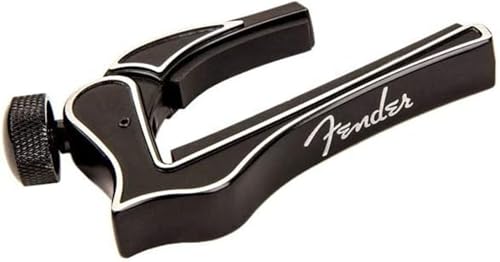
Electric Guitar Specialist – Fender Dragon Capo
The Fender Dragon Capo is designed specifically for six-string electric guitars with radiused fretboards. Its cast aluminum body and micro-dial tension control provide an adjustable screw guitar capo format that clamps at any fret without requiring separate adjustments.
Best For: Electric guitarists using six-string instruments with radiused fretboards who want compact, adjustable tension control.
Pros:
- Designed for six-string electric guitars with radiused fretboards.
- Micro-dial tension control supports adjustable pressure.
- Can clamp at any fret on the exposed fretboard.
- Requires no adjustments during placement and is designed not to interfere with playing.
Cons:
- Its stated instrument compatibility is limited to six-string electric guitars.
- It may be less suitable for acoustic or classical guitar users.
For electric guitar players, the Dragon Capo focuses on fit and unobtrusive placement rather than broad instrument compatibility. Its radiused-fretboard design and micro-dial control make it the specialized choice in this roundup.
Adjustable Tone Control – Aroma AC-11 Guitar Capo
Aroma Guitar Capo Adjustable Tension Performance Capo for 6 Strings Acoustic Electric Guitars
Check Price On AmazonFor players comparing screw guitar capos, the Aroma AC-11 offers adjustable tension for six-string acoustic and electric guitars. Its tension knob, curved clamp, and protective silicone pads are designed to provide a stable, buzz-free fit without marking the instrument.
Best For: Guitarists who want fine tension adjustment and a lightweight capo for acoustic or electric six-string guitars.
Pros:
- Adjustable tension knob helps fine-tune neck pressure.
- Curved clamp is designed for a secure, stable fit.
- Silicone pads help protect against scratches and pressure marks.
- Zinc-alloy body is lightweight and has a rust-resistant finish.
Cons:
- Designed for six-string guitars rather than instruments with other string configurations.
- Its many finish and tension features may be more than casual players need.
The AC-11 is a practical choice when precise pressure control matters. It combines a compact zinc-alloy build with guitar-friendly padding and a two-year warranty.
Premium Screw Performance – D'Addario Pro Plus Capo
The D’Addario Pro Plus is a premium screw-style option for players seeking consistent pressure across the fretboard. Its FlexFit Technology adapts to different fretboard radii, while one-handed operation makes it easy to reposition during practice or performance.
Best For: Players using six- or 12-string guitars who want adjustable tension, easy movement, and buzz-free performance.
Pros:
- FlexFit Technology automatically adjusts to fretboard radius.
- Designed to provide optimal pressure on each string.
- Supports six- and 12-string guitars or instruments with octave pairs.
- Single-hand operation simplifies tension adjustment and repositioning.
Cons:
- Its premium screw design may be unnecessary for players wanting the simplest possible capo.
- The supplied details identify it primarily as a black premium model, limiting finish choice.
With radius adaptation and convenient one-handed control, the Pro Plus is well suited to players who move a capo frequently or use more than one guitar configuration.
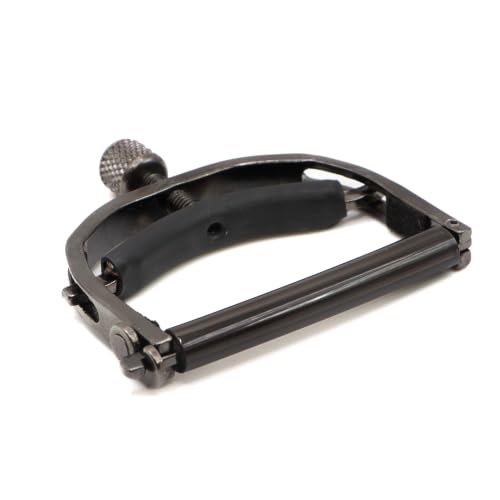
USA-Made Precision Fit – Paige 6-String Acoustic Capo
The Paige P6E is a USA-made screw guitar capo built for standard six-string acoustic guitar necks. Its direct center tension saddle, radiused bar, and felt-lined contact points focus on even pressure, reliable placement, and finish protection.
Best For: Acoustic guitarists who value precise fit, protected finishes, and a capo that can be stored behind the nut between uses.
Pros:
- Manufactured in the USA with precision measurements.
- Direct center tension saddle helps distribute pressure evenly.
- Felt-lined contact points help protect the guitar finish.
- Replaceable tinted tubing and a smooth-action clip support long-term use.
Cons:
- Designed specifically for six-string acoustic guitars.
- Its standard-neck fit may not suit unusually shaped or wider neck profiles.
- The supplied warranty is 30 days.
The P6E stands out for its traditional, carefully fitted construction and repairable components. It is a strong match for acoustic players who prefer controlled tension and discreet storage behind the nut.
Lightweight Precision Pick – D'Addario NS Lite Capo
If you want screw guitar capos with quick, precise tension control, the D’Addario NS Lite uses a micrometer adjustment mechanism to help deliver buzz-free, in-tune performance. Its lightweight ABS construction is designed for acoustic and electric guitars with radiused fretboards.
Best For: Players who want a lightweight capo with one-handed adjustment for 6- or 12-string acoustic and electric guitars.
Pros:
- Micrometer tension adjustment helps minimize buzzing and excessive pressure.
- Fast micrometer screw supports one-handed use and easy repositioning.
- Lightweight, durable molded ABS thermoplastic construction.
- Works with 6- and 12-string acoustic or electric guitars.
Cons:
- Designed for radiused fretboards, so it may not suit every guitar neck profile.
- ABS construction may appeal less to players seeking an all-metal capo.
The NS Lite is a practical choice when portability and fine tension adjustment matter more than a heavier premium-metal build.
Versatile Quick-Change Value – Htaxepu Aluminum Guitar Capo
For shoppers comparing screw guitar capos with faster clamp-style operation, this Htaxepu model is built for quick key changes during a song. Its lightweight aluminum-alloy body and silicone grip are compatible with a broad range of instruments.
Best For: Musicians who need one capo for acoustic and electric guitar, bass, mandolin, ukulele, or banjo.
Pros:
- Quick clip-on design makes changing keys convenient.
- Aluminum-alloy body is lightweight and finished to resist oxidation and fading.
- Silicone grip material helps protect the instrument’s neck and fretboard.
- Compatible with several stringed instruments beyond guitar.
Cons:
- Its clamp design does not offer the micrometer-style tension adjustment of the D’Addario screw models.
- The notes do not specify compatibility with radiused or flat fretboards.
This is a flexible, easy-to-use option for players who prioritize speed and multi-instrument compatibility over finely dialed screw tension.
Tour-Ready Tension Control – D'Addario Pro Capo
The D’Addario Pro Capo is a strong choice among screw guitar capos when dependable construction and exact tension control are priorities. Its micrometer adjustment is designed to provide clear, buzz-free notes on 6- or 12-string acoustic and electric guitars with radiused fretboards.
Best For: Gigging, touring, and home players who want an adjustable aluminum capo for acoustic or electric guitar.
Pros:
- Micrometer adjustment helps dial in the tension needed at each fret.
- Aircraft-grade aluminum construction is durable while adding little weight.
- Designed for both 6- and 12-string acoustic and electric guitars.
- Available in multiple color options, including black, silver, metallic grey, and metallic bronze.
Cons:
- Designed for radiused fretboards rather than explicitly for classical guitar.
- The screw-adjustment design may be slower to reposition than a simple clip capo.
With its durable aluminum body and precise adjustment, the Pro Capo suits players who want a reliable, long-term capo for regular playing or demanding schedules.
How We Picked the Best Screw Guitar Capos
We evaluated these Screw Guitar Capos using the features that matter most in everyday playing: tension adjustment, string coverage, neck compatibility, construction, portability, and likely tuning stability. Models were selected across several styles, including thumb-screw, adjustable-tension, lightweight, and traditional clamp designs.
We also considered whether each capo is suited to acoustic guitars, electric guitars, 6-string instruments, or broader use. A good capo should hold every string cleanly without requiring excessive force, and it should be easy to reposition between songs or practice exercises.
Quick Comparison
| Best For | Look For |
|---|---|
| Live performance | Fast adjustment, secure grip, and compact handling |
| Recording | Precise tension control and minimal tuning movement |
| Acoustic guitar | Enough clearance for the neck profile and full string coverage |
| Electric guitar | Lower-profile construction and gentle, controlled pressure |
| Budget backup | Simple operation, reliable clamping, and replaceable padding |
Key Buying Factors for Screw Guitar Capos
Tension Adjustment
The main advantage of a screw capo is control. Choose a model that can apply enough pressure to eliminate buzzing but not so much that it pulls notes sharp. Fine adjustment is especially useful with low action, lighter strings, and recording setups.
Neck and String Compatibility
Confirm that the capo is designed for your instrument and fretboard width. Most options here target standard 6-string guitars, while some may also accommodate 12-string instruments. Check the product specifications if you use a wide, radiused, or unusually thick neck.
Padding and Construction
Soft, well-fitted padding helps protect the finish and distribute pressure across the strings. Metal construction generally offers durability, while lighter materials can be easier to carry. Inspect the adjustment mechanism for smooth movement and a secure hold.
Speed and Portability
Screw mechanisms offer precision, but they can be slower than spring clamps. For frequent key changes on stage, prioritize a design that adjusts quickly with one hand or can remain attached to the headstock when not in use.
Who Should Buy Which Screw Guitar Capos?
Choose a precision adjustable model if you record often, use delicate tuning setups, or want maximum control over string pressure. A thumb-screw design is a practical choice for players who prefer straightforward adjustment and a secure fit. Lightweight models suit commuters, students, and anyone who keeps a capo in a gig bag at all times.
Acoustic players should prioritize full fretboard coverage and padding that follows the neck radius. Electric guitarists may prefer a lower-profile option that does not interfere with bends or access to higher frets. If you play both instruments, select a versatile 6-string model with a broad adjustment range. For occasional use, a simple affordable capo can be enough; frequent performers should spend more on smooth adjustment and durable materials.