Partial guitar capos make it easier to explore alternate tunings, drone-string arrangements, and new chord shapes without fully clamping every string. The right model can also simplify transitions during practice or performance.
We compared 10 popular options, including three-string designs, drop-D capos, and versatile full-neck models, focusing on tuning compatibility, note clarity, adjustability, and everyday usability.
Best 10 Partial Guitar Capos Picks for 2026
Best DADGAD-Style Pick

- Simulates a DADGAD-like sound profile
- Lightweight aircraft-grade aluminum
- Quick-change design with headstock storage
Best For: Acoustic players seeking fast DADGAD-style effects
Best Adjustable Brass Option

- Covers two different three-string groupings
- Set-and-forget pressure design
- Brass body with custom rubber grip
Best For: Players exploring adjustable Drop-D-style effects
Best One-Handed Design

- Fast one-handed clamping and release
- Even pressure supports clear tone
- Fits most neck profiles
Best For: Players prioritizing quick changes over partial coverage
Best Simple Three-String Capo

- Dedicated three-string coverage
- Works on two specified string groupings
- Brass body with rubber grip
Best For: Electric players seeking focused partial-capo effects
Precision Pick

- Micrometer tension adjustment
- Lightweight aircraft-grade aluminum
- One-handed use with pick holder
Best For: Players seeking adjustable, buzz-free capo performance
Partial-Capo Specialist

- Covers three inside strings
- Brass body with polished finish
- Rubber grip material
Best For: Players wanting a dedicated three-string partial capo
Quick-Change Favorite

- One-handed quick-change operation
- Lightweight aluminum with steel spring
- Parks on the headstock
Best For: 6-string acoustic players wanting simple, fast capo changes
Best Open-Tuning Specialist
G7th Newport 3-String Partial Capo
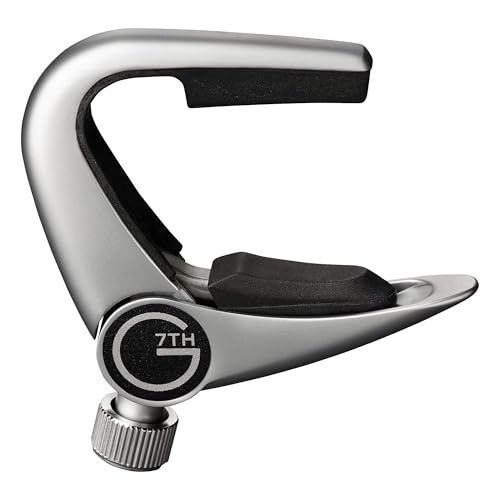
- Creates DADGAD and open-G-style effects
- Fine-tune pressure control for tuning stability
- Quick release with protective silicone pads
Best For: Players focused on open-style tunings and partial capo techniques
Best Set-and-Forget Classic
Shubb C1 Standard Acoustic Capo

- Adjustable design needs no repeated pressure reset
- Simple lever locking and removal
- Rubber grip designed to support tuning stability
Best For: Acoustic players wanting a dependable standard capo
Best Budget Multi-Instrument Pick
WINGO Rosewood-Color Guitar Capo
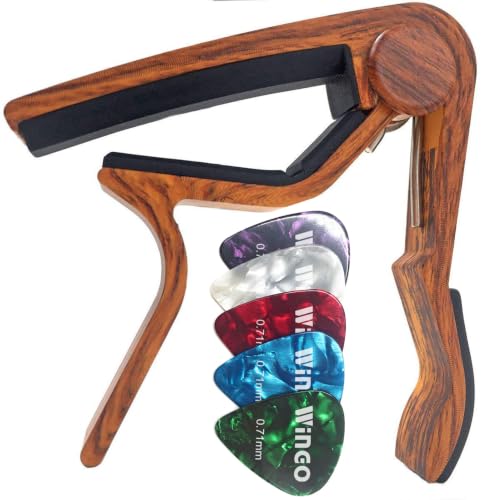
- Quick-release, single-handed operation
- Works with several listed string instruments
- Includes five medium celluloid picks
Best For: Players wanting an affordable everyday capo with broad compatibility
Best DADGAD-Style Pick – Kyser Short-Cut Partial Capo
The Kyser Short-Cut is one of the more specialized partial guitar capos in this roundup. Designed to simulate DADGAD tuning on an acoustic guitar, it offers quick changes, lightweight aluminum construction, and convenient headstock storage when not in use.
Best For: Acoustic guitarists who want DADGAD-like sounds and fast, simple key changes.
Pros:
- Designed specifically for a DADGAD tuning simulation.
- Aircraft-grade aluminum keeps the capo lightweight.
- Quick-change design can park on the headstock when unused.
- Made in the USA and guaranteed for life.
Cons:
- Its specialized three-string design is less versatile than a full-guitar capo.
- The supplied information focuses on acoustic guitar use.
Choose this Kyser when your priority is a focused DADGAD-style effect rather than broad partial-capo adjustability. Its lightweight, quick-change format is particularly practical for players who switch sounds during practice or performance.
Best Adjustable Brass Option – Shubb C8B Drop-D Partial Capo
The Shubb C8B Drop-D is an adjustable partial capo for acoustic guitarists exploring alternate voicings and effects. Its design can cover the 2-3-4 or 3-4-5 strings, while the custom rubber pad applies pressure like a fingertip to help maintain tuning.
Best For: Players who want an adjustable brass partial capo for Drop-D-style experiments and alternate effects.
Pros:
- Can cover either the 2-3-4 or 3-4-5 strings.
- Set-and-forget design does not require pressure resetting each use.
- Custom rubber helps keep the guitar in tune.
- Durable brass body with a polished finish.
Cons:
- At 22.68 grams, it is heavier than the Kyser option in this roundup.
- Its adjustable design may take more setup than a fixed three-string capo.
The C8B stands out when adjustability matters. It is a practical choice for guitarists who want to explore more than one string grouping without buying separate fixed partial capos.
Best One-Handed Design – Martin One-Handed Guitar Capo
The Martin one-handed capo is a straightforward option for guitarists who value speed and consistent pressure. Although it is not identified in the notes as a partial model, its compact silicone construction and adaptable fit make it worth considering alongside partial guitar capos when quick changes and clean fretting are priorities.
Best For: Players who want one-handed operation, consistent fretting, and compatibility with varied neck profiles.
Pros:
- Clamps and releases with one hand.
- Applies even pressure for clear tone and accurate fretting.
- Fits a variety of guitar neck shapes and thicknesses.
- Lightweight silicone construction weighs 5.67 grams.
Cons:
- It is a full capo rather than a clearly specified partial capo.
- The supplied details do not identify a specialized alternate-tuning function.
This Martin is best viewed as a convenient general-purpose alternative, not a dedicated partial-capo tool. Choose it if fast, one-handed changes and broad neck compatibility matter more than selective string coverage.
Best Simple Three-String Capo – Shubb C7B Partial Capo
The Shubb C7B is a focused three-string partial capo for electric guitar. Its brass-and-rubber construction is designed to cover either the 2-3-4 or 3-4-5 strings, giving players a simple way to create alternate effects while using a set-and-forget pressure adjustment.
Best For: Electric guitarists who want a dedicated, adjustable three-string partial capo.
Pros:
- Designed specifically for three-string partial coverage.
- Supports either the 2-3-4 or 3-4-5 string groupings.
- Custom rubber grip is designed to help keep the guitar in tune.
- Polished brass body offers a durable, substantial build.
Cons:
- Its 22.68-gram weight is relatively substantial for a capo.
- Limited to the specified string groupings rather than full-string coverage.
The C7B is a strong fit for players who specifically want three-string coverage without a complicated feature set. Its adjustable layout provides more flexibility than a fixed partial capo while remaining focused on electric-guitar effects.
Precision Pick – D'Addario NS Tri-Action Capo
For guitarists comparing partial guitar capos and standard capo options, the D’Addario NS Tri-Action emphasizes precise tension control and easy one-handed use. Its micrometer adjustment is designed to help deliver buzz-free, in-tune performance on 6-string acoustic and electric guitars.
Best For: Players who want adjustable tension, lightweight construction, and a capo that can be stored on the headstock.
Pros:
- Micrometer tension adjustment helps control pressure at any fret.
- Tri-Action geometry reduces operating force and applies even tension.
- Aircraft-grade aluminum is lightweight and durable.
- Includes an integrated pick holder and one-handed operation.
Cons:
- Designed for 6-string guitars rather than other instrument types.
- Its adjustable mechanism may be more than players need from a basic capo.
The NS Tri-Action is a strong all-purpose choice when reliable clamping and fine adjustment matter more than a minimalist design.
Partial-Capo Specialist – Shubb C7B Brass Partial Capo
The Shubb C7B is a purpose-built option for guitarists exploring partial guitar capos. This limited-edition brass capo covers the three inside strings, letting you alter part of the instrument’s voicing while leaving the outer strings uncovered.
Best For: Guitarists specifically seeking a three-inside-string partial capo with a polished brass body.
Pros:
- Covers three inside strings for partial-capo arrangements.
- Brass body provides a solid, distinctive construction.
- Rubber grip material helps interface with the instrument.
- Polished brass finish gives it a traditional appearance.
Cons:
- Its partial coverage is specialized and not a substitute for a full capo.
- The brass construction may appeal less to players prioritizing the lightest possible option.
Choose the C7B when the three-string configuration matches your playing style; its specialized coverage is the main reason to buy it.
Quick-Change Favorite – Kyser KG6B Quick-Change Capo
The Kyser KG6B is a straightforward choice for players comparing partial guitar capos with conventional full-neck designs. Made for 6-string acoustic guitars, it uses a one-handed quick-change design and can park on the guitar’s headstock when not in use.
Best For: Acoustic guitarists who value fast, simple capo changes and a lightweight aluminum build.
Pros:
- Original one-handed Quick-Change design.
- Strong, lightweight aluminum body with a steel spring.
- Stores on the guitar’s headstock when not in use.
- Made in the USA and backed by a stated lifetime guarantee.
Cons:
- Designed for 6-string acoustic guitars, not partial-string coverage.
- Its spring design offers less user-adjustable tension than a micrometer-style capo.
The KG6B is a practical everyday capo for acoustic players who want quick operation and convenient storage rather than partial-string functionality.
Best Open-Tuning Specialist – G7th Newport 3-String Partial Capo
For players specifically shopping for partial guitar capos, the G7th Newport is built to create open-style effects without retuning. Its three-string design, fine-tune pressure control, and low-profile lever make it a focused option for creative acoustic arrangements and live transitions.
Best For: Guitarists exploring DADGAD-style effects, open G-style sounds, and quick changes between standard and altered tunings.
Pros:
- Clamps selected strings to create open-style tuning effects without retuning.
- Fine-tune knob helps control string pressure and tuning stability.
- Silicone pads help protect the guitar and reduce unwanted damping.
- Quick-release mechanism and flip lever support fast changes.
Cons:
- Its three-string partial design is specialized rather than a general full-neck capo.
- Listed for a 7.25-inch to flat fingerboard radius, so fit should be checked for other guitars.
The Newport stands out when partial capo technique is central to your playing. It offers more tuning and tone control than a basic clamp, though its specialized format is best suited to players who intend to use open-style voicings.
Best Set-and-Forget Classic – Shubb C1 Standard Acoustic Capo
The Shubb C1 is a trusted standard capo for acoustic guitar, but it is not a partial capo. If your search for partial guitar capos also includes dependable conventional options, its adjustable design and fingertip-like rubber grip make it a straightforward choice for full-neck capoing.
Best For: Acoustic players who want a familiar, adjustable capo that can be set once and reused without resetting pressure each time.
Pros:
- Distinctive design trusted by musicians for over 35 years.
- Set-and-forget operation avoids resetting pressure with each use.
- Lever makes locking and removal simple.
- Custom-made rubber is designed to grip like a fingertip and help keep the guitar in tune.
Cons:
- It is a standard acoustic guitar capo, not a three-string partial capo.
- Its listed instrument application is acoustic guitar rather than a broad multi-instrument range.
The C1 is a sensible conventional-capо alternative when ease of use matters more than partial-tuning experimentation. Choose it for reliable full-neck capoing, not for selectively clamping individual strings.
Best Budget Multi-Instrument Pick – WINGO Rosewood-Color Guitar Capo
The WINGO is a conventional spring-style capo rather than a partial capo, but it can suit shoppers comparing affordable options for several stringed instruments. Its quick-release design, aluminum body, silicone pad, and included picks make it a practical everyday accessory.
Best For: Players who need a quick-clipping capo for acoustic or electric guitar, banjo, mandolin, or ukulele and appreciate included picks.
Pros:
- Quick-release clip makes key changes during a song convenient.
- Listed as suitable for steel-string acoustic and electric guitar, banjo, mandolin, and ukulele.
- Spring pressure is designed to provide clear tone without buzzing.
- Includes five 0.71 mm medium celluloid picks.
Cons:
- It is a standard single-handed capo, not a selective three-string partial capo.
- The notes do not specify a fine-tune pressure adjustment.
- Fit and pressure may vary across its wide range of listed instruments.
The WINGO offers broad instrument compatibility and useful extras at a practical level. It is a better match for quick conventional capo changes than for players specifically seeking partial guitar capo voicings.
How We Picked the Best Partial Guitar Capos
We focused on the features that matter most when a capo covers only selected strings: accurate fretting, even pressure, compact construction, and reliable placement. The lineup includes purpose-built Partial Guitar Capos from Kyser, Shubb, and G7th, along with adjustable or full-neck alternatives from Martin and D’Addario that may suit players who want more flexibility.
We also considered the intended use of each design. A capo made for DADGAD or drop-D applications has a different purpose from a three-string capo for open-style voicings. Models with one-handed operation or quick adjustment can be especially useful for live playing, while simple spring or screw mechanisms may appeal to players who prioritize straightforward value.
Quick Comparison
- Three-string partial capos: Best for targeted alternate voicings, drone strings, and open-style tunings.
- Drop-D partial capos: Designed to preserve or create drop-D-style arrangements while leaving selected strings unaffected.
- Adjustable or full-neck capos: Better for players who switch between standard and alternate tunings frequently.
- Traditional full guitar capos: Useful if you want one accessory for ordinary transposition as well as experimentation.
Key Buying Factors for Partial Guitar Capos
String Coverage
Check exactly which strings the capo presses before buying. Three-string models may cover the inner strings or another specified group, so the design must match your intended tuning and chord shapes. A capo that does not cover the correct strings will not produce the expected voicing.
Neck and Fret Compatibility
Measure or inspect your guitar’s neck profile if possible. Capos need enough range to fit the neck without excessive force. Acoustic, electric, classical, and wide-neck guitars can require different shapes or adjustment ranges.
Pressure and Note Clarity
Too little pressure can cause buzzing, while too much may pull notes sharp or make fretting uncomfortable. Adjustable screw mechanisms offer more control; spring-loaded designs are faster but provide less fine-tuning.
Speed and Portability
For stage use, look for quick one-handed operation and a low-profile design. For home practice, a more deliberate adjustable capo may be worthwhile if it delivers precise tension and stable placement.
Materials and Finish
Metal construction can provide durability, while padded contact surfaces help protect the fretboard and strings. Finish is mostly a preference, but smooth edges and secure padding are practical advantages.
Who Should Buy Which Partial Guitar Capos?
Choose a dedicated three-string model if you regularly play open tunings, partial-capo arrangements, or songs built around ringing strings. Choose a drop-D model if your main goal is fast access to drop-D-style chord shapes. Choose an adjustable design if you use several guitars or need precise control over pressure. Choose a full-neck capo if standard transposition is more important than specialized partial voicings.
Before ordering, confirm the product’s string coverage, your guitar’s neck width, and the tuning or chord system you plan to use. Those three checks matter more than appearance and will help ensure the capo performs as expected.