The right crossover keeps low and high frequencies directed to the drivers designed to reproduce them. That can improve clarity, reduce unwanted strain, and help a two-way speaker system perform more consistently.
Our roundup covers passive options for car audio, bookshelf speakers, home projects, and higher-power installations. Use the buying guide below to match power handling, impedance, crossover control, and system type to your setup.
Best 10 Audio Crossovers for Two Way Speakers Picks for 2026
Adjustable Divider
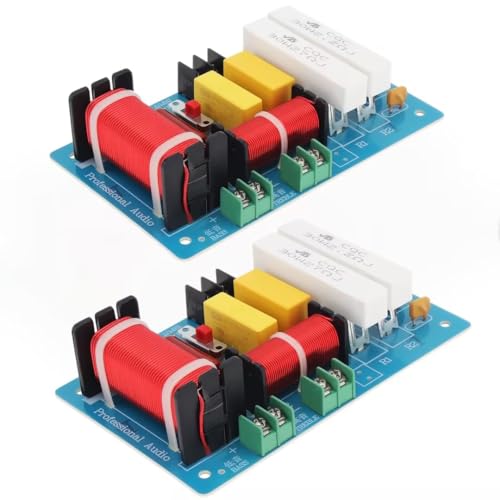
- 450-watt rating
- 2,850/2,900 Hz switchable point
- Screw-terminal installation
Best For: DIY car or home speaker builds
Compact Car-Audio Option
Audiopipe CRX-203 2-Way Crossover

- 150-watt RMS rating
- Gold-plated screw terminals
- Compact ABS enclosure
Best For: Moderate-power car-audio systems
Bookshelf Speaker Pick

- 130-watt maximum power
- 3,500 Hz division point
- Compact labeled terminals
Best For: Bookshelf and small speaker projects
Compact Car Audio Upgrade

- 300-watt two-way design
- Bass inductor and magnet
- Solderless plug-in connection
Best For: Simple car-audio speaker upgrades
Professional Speaker Power Pick
Dpofirs 800W Passive Crossover
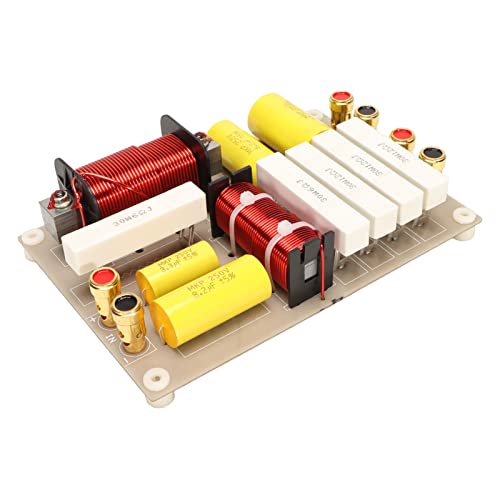
- 800-watt two-way design
- Fits 10- to 18-inch speakers
- Heat-dissipating high-power components
Best For: Conference and stage speaker systems
Adjustable DIY Pair
GODIYMODULES Adjustable 2-Way Crossover

- Two crossover units included
- Four-speed high/low adjustment
- For home or car audio
Best For: DIY audio projects needing adjustable frequency control
Adjustable Power Pick
400W 2-Way Adjustable Crossover

- 400W stated output in a two-piece set
- Adjustable treble and bass tuning
- Pure copper wire and copper-wound inductance
Best For: DIY builders who want adjustable tonal control
HiFi Upgrade Choice
250W Switchable 2-Way Crossover

- 2750/2800 Hz switchable division
- Supports 4–12 ohm speakers
- Solderless terminals ease installation
Best For: Speaker upgrades needing selectable frequency points
Bass-Focused Option

- Second-order low-pass bass filter
- 200W rating for compatible systems
- Supports 4–8 ohm applications
Best For: Subwoofer and bass-focused DIY audio projects
High-Power Pick – DS18 PRO-CFX 2-Way Passive Crossover
The DS18 PRO-CFX is a practical choice when comparing audio crossovers for two way speakers in a car system. Its 300-watt RMS capability, two-way filtering, and compact metal-and-plastic housing are suited to setups using a tweeter and mid-range speaker.
Best For: High-power car audio systems needing a compact passive crossover pair.
Pros:
- Handles up to 300 watts RMS.
- Uses one amplifier channel for two speakers.
- Compact 6.3 x 3.5 x 1.5-inch design.
- Includes two crossovers with a one-year limited warranty.
Cons:
- Designed for wired car audio rather than wireless systems.
- The listed 3.5 kHz frequency response may not suit every speaker pairing.
Choose this model when power handling and straightforward installation matter most. Confirm the crossover point and speaker ratings before connecting it to your system.
Adjustable Divider – 450W 2-Way Speaker Crossover
This two-piece unit is worth considering for audio crossovers for two way speakers when adjustable division is useful. It offers selectable 2,850 or 2,900 Hz crossover points, screw terminals, and separate low- and high-frequency slopes for car or home audio use.
Best For: DIY car or home speaker builds needing adjustable crossover points and simple screw-terminal wiring.
Pros:
- Rated for up to 450 watts and 4–8 ohms.
- Switchable 2,850/2,900 Hz division point.
- Uses 12 dB low-pass and 18 dB high-pass slopes.
- Includes capacitor and self-recovery fuse protection.
Cons:
- Only the package dimensions and weight are supplied, so mounting space should be checked.
- Its adjustable range is limited to the two listed frequency settings.
The screw terminals make installation accessible, while the protection features add practical reassurance for higher-power operation. Verify impedance and speaker compatibility before choosing the setting.
Compact Car-Audio Option – Audiopipe CRX-203 2-Way Crossover
300 Watts 2 Way Crossover - (2 Pack) Passive Car Audio Speaker Tweeter Mids and Highs CRX-203
Check Price On AmazonThe Audiopipe CRX-203 is a compact option for audio crossovers for two way speakers in a car stereo. It supports 150 watts RMS and 300 watts peak, with gold-plated screw terminals and enclosed ABS cabinets for a tidy installation.
Best For: Car-audio tweeter and midrange setups requiring a small enclosed crossover.
Pros:
- Rated at 150 watts RMS and 300 watts peak.
- Gold-plated screw terminals support wired installation.
- Enclosed ABS cabinet offers a compact 2.56 x 4.13 x 1.38-inch format.
- Sold as a two-way crossover pair.
Cons:
- Its power rating is lower than some 300-watt RMS alternatives.
- Frequency ranges are fixed rather than user-adjustable.
This model makes sense for moderate-power car systems where enclosure size and simple connections are priorities. Match its RMS rating to the amplifier and connected speakers.
Bookshelf Speaker Pick – 130W 2-Way Crossover Pair
For bookshelf systems, this pair provides a straightforward approach to audio crossovers for two way speakers. It separates the incoming signal into treble and bass paths at approximately 3,500 Hz, with labeled terminals for the amplifier, tweeter, and woofer.
Best For: Bookshelf, karaoke, or small car speaker projects rated for 4–8 ohms.
Pros:
- Supports up to 130 watts with 4–8-ohm speakers.
- Provides 12 dB/octave filtering for both treble and bass.
- Clearly labeled IN, T, and W connection points.
- Compact 3.3 x 2.4 x 1-inch dimensions.
Cons:
- Lower power handling than the other listed options.
- Frequency division is fixed at approximately 3,500 Hz.
- Connections require welding or direct wiring rather than screw terminals.
This is a sensible fit for smaller speaker builds and bookshelf applications, especially when a compact board and balanced 12 dB/octave filtering are preferred. Confirm the speaker impedance and power rating first.
Compact Car Audio Upgrade – 300W 2-Way Crossover
300 Watts 2 Way Crossover, Car Audio Crossover Universal Heat Dissipation Speaker Frequency Divider
Check Price On AmazonFor shoppers comparing audio crossovers for two way speakers, this Fydun model focuses on straightforward car-audio installation, sound separation, and heat management. Its 300-watt rating, bass inductor, solderless plug-in socket, and ABS housing make it a practical option for compatible vehicle speaker systems.
Best For: Car-audio users who want a simple, compact passive crossover with bass-focused features.
Pros:
- Designed to improve sound quality and frequency accuracy.
- Bass inductor and magnet target bass sag.
- Solderless plug-in socket supports easier connections.
- Double-layer ABS housing is designed for heat dissipation and durability.
Cons:
- The supplied information does not specify crossover frequencies or impedance.
- Its 300-watt rating may be less suitable than higher-power options for large professional systems.
This is a sensible choice when installation simplicity and a durable enclosure matter more than detailed adjustment options. Confirm your speaker specifications and wiring requirements before buying.
Professional Speaker Power Pick – Dpofirs 800W Passive Crossover
For audio crossovers for two way speakers in conference or stage setups, the Dpofirs passive crossover emphasizes high power handling and broad speaker compatibility. Large capacitors, high-power inductors, aluminum-film resistors, and heat-dissipation features support demanding installations.
Best For: Professional conference and stage speakers measuring 10 to 18 inches.
Pros:
- 800-watt two-way design for higher-power applications.
- Compatible with 10- to 18-inch professional speakers.
- High-power inductors and large capacitors support frequency separation.
- Premium PCBA material and heat-dissipation construction are intended for durability.
Cons:
- The product is relatively heavy at 1.74 pounds.
- The supplied details do not list specific crossover points or impedance values.
With its stated power capacity and professional-speaker compatibility, this model is better suited to larger audio systems than casual home setups. Match its specifications to your drivers and amplifier before installation.
Adjustable DIY Pair – GODIYMODULES Adjustable 2-Way Crossover
This two-piece GODIYMODULES set stands out among audio crossovers for two way speakers because it offers four-speed adjustment for high and low frequencies. It is intended for both home and car audio projects, with stereo output and relay-based construction for DIY experimentation.
Best For: DIY users who want adjustable high- and low-frequency control for home or car audio.
Pros:
- Includes two crossover units.
- Four-speed adjustable high- and low-frequency settings.
- Suitable for home audio and car audio applications.
- Designed to provide more precise high/low frequency distribution.
Cons:
- It is not waterproof.
- The supplied details do not state a power rating or crossover-frequency range.
- The plastic enclosure may be less rugged than a metal housing.
This pair is appealing when adjustability and DIY flexibility are priorities. Because key electrical specifications are not provided in the supplied information, verify compatibility carefully with your speakers and amplifier.
Adjustable Power Pick – 400W 2-Way Adjustable Crossover
For shoppers comparing audio crossovers for two way speakers, this two-piece adjustable model offers a flexible way to tune treble and bass. Its design is also listed for 2.1 satellite setups and automotive loudspeakers.
Best For: DIY speaker builders who want adjustable treble and bass control across compatible setups.
Pros:
- 400W stated maximum output and a two-piece package.
- Adjustable treble/bass division for hands-on sound tuning.
- Pure copper wire and anaerobic copper-wound inductance.
- Suitable for two-way, 2.1 satellite, and automotive speaker applications.
Cons:
- The supplied specifications list 16-ohm impedance, so compatibility should be checked before installation.
- It is not waterproof.
- Adjustment-oriented design may require user tuning to achieve the preferred sound.
This is the most flexible option of the three for listeners who want to experiment with tonal balance. Confirm the speaker impedance and wiring requirements before buying.
HiFi Upgrade Choice – 250W Switchable 2-Way Crossover
This two-piece crossover is a practical option for audio crossovers for two way speakers when you want switchable frequency division and clearly separated high and low frequencies. It supports a 4–12 ohm speaker range and uses solderless terminals for easier installation.
Best For: Speaker upgrades and assemblies that need selectable 2750/2800 Hz division with straightforward wiring.
Pros:
- 250W rating for speaker upgrade and assembly projects.
- Switchable 2750/2800 Hz frequency division points.
- 12dB low-pass and 18dB high-pass slopes with phase compensation.
- Solderless terminal block simplifies installation.
Cons:
- Its frequency options are limited to the listed 2750/2800 Hz settings.
- The supplied notes do not specify dimensions or a detailed mounting method.
- Compatibility still depends on matching the speaker system to the 4–12 ohm range.
Choose this model when installation convenience and selectable crossover points matter more than broad adjustment. Its listed electrical range makes it a versatile candidate, but system matching remains essential.
Bass-Focused Option – 200W Subwoofer Crossover
Among audio crossovers for two way speakers, this two-piece model is specifically aimed at bass and subwoofer duties. It provides a second-order low-pass filter for 4–8 ohm applications and is rated for 200W.
Best For: Home audio, 5.1 bass, and car-audio DIY projects using compatible 4- to 8-inch subwoofers.
Pros:
- Designed as a low-pass subwoofer crossover for bass applications.
- 200W stated maximum power.
- Supports 4–8 ohm speaker impedance.
- Supplied as a two-piece set for compatible DIY builds.
Cons:
- It is bass-focused rather than a full-range adjustable two-way treble/bass divider.
- Specified for 4- to 8-inch subwoofers, which limits application size.
- The supplied notes do not provide a crossover frequency.
This is the most targeted choice for adding or filtering bass in a compatible system. Select it when your project needs a subwoofer low-pass function, not broad high-frequency control.
How We Picked the Best Audio Crossovers for Two Way Speakers
We focused on passive two-way crossover networks that divide an audio signal between a woofer or midrange driver and a tweeter. The selected models represent common use cases, including car audio, bookshelf speakers, DIY builds, subwoofer integration, and professional or conference systems.
Our comparison emphasizes stated power handling, supported impedance, pair quantity, frequency-control features, construction, and installation practicality. Because manufacturer ratings can use different testing methods, treat wattage as a compatibility reference rather than a guarantee of real-world output.
Quick Comparison
| Best For | What to Prioritize | Models to Consider |
|---|---|---|
| Car audio | Compact size, heat management, suitable impedance | DS18 PRO-CFX, CRX-203, 300-watt universal models |
| Bookshelf or home speakers | Moderate power, clean terminals, appropriate crossover range | 130-watt bookshelf model, 250-watt and 450-watt options |
| DIY tuning | Adjustable frequency or level controls | Adjustable 2-way and 400-watt adjustable models |
| High-output systems | Conservative power matching and robust construction | 800-watt professional-style model |
Key Buying Factors for Audio Crossovers for Two-Way Speakers
Power Handling
Choose a crossover rated for at least the continuous power your drivers will receive, preferably with headroom. Do not match only the amplifier’s maximum or peak rating. Excessive power, clipped signals, and low-frequency energy sent to a tweeter can still cause damage even when the crossover has a high advertised wattage.
Impedance Compatibility
Check whether the network is designed for 4-, 6-, or 8-ohm drivers. A crossover’s frequency behavior depends on the connected driver impedance, so using the wrong rating can shift the crossover point and change the tonal balance. Confirm the woofer and tweeter ratings separately before wiring.
Crossover Frequency and Slope
The crossover frequency determines where the woofer hands off to the tweeter. Select a point within the safe operating range of both drivers and consider the network’s slope, such as first- or second-order filtering. A steeper slope generally offers more protection but may affect phase alignment and response.
Adjustability and Installation
Adjustable models can help compensate for driver sensitivity or room and vehicle acoustics, but they add complexity. For a straightforward replacement or matched component set, a fixed network is often easier to install. Verify terminal polarity, enclosure space, wire gauge, and whether protective covers or mounting hardware are included.
Who Should Buy Which Audio Crossovers for Two Way Speakers?
Choose a compact car-audio crossover if you are upgrading tweeters and midrange drivers in a vehicle and need a simple passive solution. Choose a bookshelf-focused model for modest-power home speakers, especially when the driver impedance and intended crossover range are clearly specified.
Choose an adjustable crossover if you are building a DIY system and expect to tune tweeter level or frequency response. Choose a higher-rated professional-style unit only when your drivers, amplifier, enclosure, and wiring can genuinely support the claimed power. For most installations, correct impedance and crossover design matter more than the largest wattage printed on the case.