Finding the right metronome can make steady practice easier, especially when you are still developing timing, coordination, and confidence. The best beginner models offer clear beats, simple controls, and enough flexibility for piano, guitar, drums, strings, and other instruments.
We selected 10 metronomes for beginners across digital, rechargeable, mechanical, tuner-equipped, and vocal-counting designs. Use the guide below to narrow the options by sound, portability, power, features, and playing style.
Best 10 Metronomes for Beginners Picks for 2026
Best Rechargeable Option
Sondery ProBeat Digital Metronome
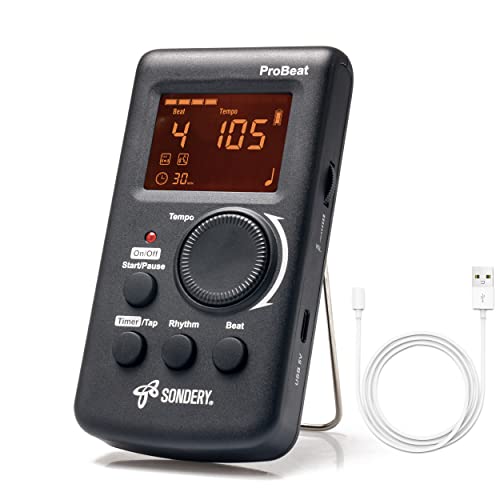
- Rechargeable battery with USB charging
- Vocal counting and visual LED tempo cue
- Tap tempo, timer, and 10 beat patterns
Best For: Beginners wanting flexible practice cues and portable charging
Best Rugged Pick

- Portable and rugged construction
- Visual practice assistance
- Odd-time support and headphone jack
Best For: Beginners who value durability and rhythmic variety
Best Tuner Combo
Donner DMT-01 Metronome and Tuner

- Metronome, tuner, and tone generator in one
- 30–260 bpm range with eight rhythms
- Large angled LCD and jog-dial controls
Best For: Multi-instrument beginners needing an all-in-one practice tool
Best Sound Variety

- Eight selectable metronome sounds
- 19 beat patterns including triplets and claves
- Memory backup and sound-out tuning mode
Best For: Beginners wanting varied sounds and advanced rhythm options
Best Mechanical Pick

- Battery-free wind-up operation
- 40–208 BPM tempo range
- Click and bell for clear rhythm cues
Best For: Beginners learning steady timing on multiple instruments
Best Digital Value

- Larger display with beat visuals
- Tap tempo and eight rhythm types
- Up to 400 hours on alkaline batteries
Best For: Flexible digital practice for orchestral instruments
Best for Vocal Counting
SDREAM Rechargeable Digital Metronome

- English voice counting option
- USB-C rechargeable design
- Headphone output for private practice
Best For: Beginners who want spoken beat cues during practice
Best All-in-One Pick
Aroma 3-in-1 Digital Metronome Tuner

- Metronome, tuner, and tone generator in one compact unit
- 30–260 BPM with 10 beat patterns and 8 rhythm styles
- Backlit display, LED cues, volume control, and headphone jack
Best For: Beginners wanting rhythm practice plus tuning and ear-training tools
Best for Silent Practice
Ueteto Rechargeable Digital Metronome
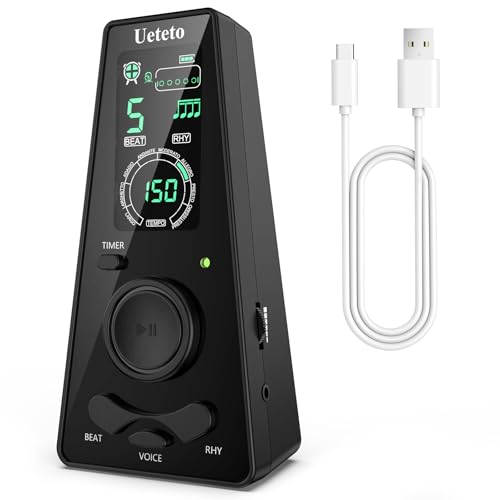
- Headphone jack for private practice and monitoring
- Up to 16 hours of use with a rechargeable battery
- LCD, flashing LED, 9 rhythms, 10 beats, and practice timers
Best For: Beginners who want flexible, rechargeable, and headphone-ready practice
Best Simple Pick
Rechargeable Digital Metronome with Voice Counting

- Human voice counting plus three selectable digital tones
- Smooth 30–250 BPM adjustment with a scroll wheel
- USB-C charging, large display, stand, and headphone jack
Best For: Beginners learning timing through spoken and visual beat cues
Best Rechargeable Option – Sondery ProBeat Digital Metronome
For beginners comparing metronomes for beginners, the Sondery ProBeat offers straightforward button-and-dial controls, a readable color screen, and several ways to follow the beat. Its rechargeable battery and compact design also make it convenient for regular practice.
Best For: Beginners who want vocal counting, visual tempo cues, and rechargeable portability.
Pros:
- Vocal counting, three digital sounds, and a top LED provide multiple practice cues.
- Rotary tempo control covers 40–208 bpm, with tap tempo and 10 beat patterns.
- Rechargeable lithium-polymer battery, headphone jack, timer settings, and pocket-sized design.
Cons:
- Its tempo range starts at 40 bpm, rather than covering slower settings.
- Plastic construction may feel less substantial than a larger traditional-style unit.
The ProBeat is a flexible starter metronome for learners who benefit from both sound and visual feedback. Vocal counting and timed practice are especially useful when building steady routines.
Best Rugged Pick – BOSS Dr. Beat DB-30 Metronome
The BOSS Dr. Beat DB-30 is a practical choice for beginners who want a portable metronome with visual practice assistance and support for odd time signatures. Its rugged build and headphone jack suit lessons, home practice, and travel.
Best For: Beginners seeking a durable, compact metronome with visual guidance and headphone practice.
Pros:
- Portable, rugged construction for regular practice and transport.
- Visual practice assistance helps reinforce the beat without relying only on sound.
- Supports odd time signatures and includes a headphone jack and auto power-off.
Cons:
- The supplied notes do not specify its tempo range or number of patterns.
- It uses a lithium-metal battery rather than a rechargeable battery.
The DB-30 focuses on dependable practice essentials rather than extra instrument functions. Its odd-time support makes it a useful step-up option for learners exploring rhythms beyond basic meters.
Best Tuner Combo – Donner DMT-01 Metronome and Tuner
The Donner DMT-01 combines a metronome, chromatic tuner, and tone generator in one beginner-friendly unit. For players who want to tune and practice rhythm without carrying separate devices, its jog dial and large angled display keep controls accessible.
Best For: Beginners who play multiple instruments and want tuning, tone generation, and metronome functions together.
Pros:
- Three functions cover metronome practice, instrument tuning, and reference tones.
- Tempo range of 30–260 bpm, 0–9 beats per measure, and eight rhythms offer broad practice coverage.
- Large LCD, 45-degree viewing angle, and jog dial support easy operation.
Cons:
- It requires a AAA battery and is not described as rechargeable.
- The added tuner functions may be unnecessary if you only need a metronome.
The DMT-01 is a strong space-saving choice for beginner instrumentalists, especially those switching between instruments. Its wide tempo range and tone generator also support more than basic beat keeping.
Best Sound Variety – Korg KDM-3 Digital Metronome
The Korg KDM-3 gives beginners a familiar mechanical-metronome style with modern digital flexibility. Its powerful speaker, varied sounds, memory backup, and broad beat-pattern selection make it a practical option for learners developing timing across different musical styles.
Best For: Beginners who want clear speaker output, varied click sounds, and extensive beat-pattern options.
Pros:
- Eight sounds include mechanical metronome, cowbell, rimshot, and voice options.
- Offers 19 beat patterns, including triplets and claves, across 0–9 beats per measure.
- Memory backup preserves settings, while auto power-off helps conserve battery.
Cons:
- It uses a CR2 battery rather than a rechargeable power system.
- Its 6.4-ounce body is heavier than some compact digital alternatives.
The KDM-3 is well suited to beginners who may outgrow a basic click quickly. Its sound choices and rhythm patterns provide useful variety, while the sound-out mode adds a reference option for tuning by ear.
Best Mechanical Pick – Ueteto Mechanical Metronome
For beginners comparing metronomes for beginners, the Ueteto offers a straightforward, battery-free way to build steady timing. Its audible click, bell, adjustable tempo, and traditional pendulum make it practical for several instruments.
Best For: Beginners who want a simple mechanical metronome for piano, violin, guitar, bass, or drums.
Pros:
- Wind-up operation requires no batteries.
- Tempo range of 40–208 BPM supports gradual practice.
- Offers beat selections of 0, 2, 3, 4, and 6.
- Audible click and bell help mark the rhythm.
Cons:
- A full wind lasts at least 18 minutes, depending on tempo.
- Mechanical operation requires winding before use.
The Ueteto is a good fit if you prefer a traditional visual and audible tempo guide. Its uncomplicated controls should be approachable for children and beginners, though digital users may prefer tap tempo or extra practice modes.
Best Digital Value – Korg MA-2 Digital Metronome
The Korg MA-2 is a compact digital choice for beginners who want clear timing feedback and flexible settings. Its larger display, louder buzzer, tap tempo, and long alkaline-battery life make it convenient for regular practice.
Best For: Beginners practicing orchestral instruments who want multiple tempo controls and visible beat information.
Pros:
- 30% larger display includes beat visuals.
- Supports pendulum, full-step, and tap-tempo settings.
- Offers time signatures from 0–9 beats and eight rhythm types.
- Alkaline batteries provide approximately 400 hours of continuous operation.
Cons:
- Requires AAA batteries for operation.
- Its extra modes may be more than beginners need for basic timing practice.
With a clear sound, visual beat display, timer mode, and sound-out mode, the MA-2 gives beginners room to expand their practice routine. It is especially useful when you want digital flexibility without a large device.
Best for Vocal Counting – SDREAM Rechargeable Digital Metronome
Among metronomes for beginners, the SDREAM stands out for its spoken English beat counting. It combines independent tempo, beat, and rhythm controls with USB-C charging, an LCD display, and headphone output for focused practice.
Best For: Beginners who benefit from hearing beats counted aloud during piano, guitar, or violin practice.
Pros:
- Switches between English voice counting and electronic beats.
- Provides 40–208 BPM tempo adjustment, 10 rhythm patterns, and beat settings from 0–9.
- USB-C rechargeable with more than eight hours of tested use per charge.
- 3.5mm headphone output supports private listening.
Cons:
- Battery runtime varies with settings.
- Its plastic body may feel less traditional than a mechanical metronome.
- The supplied notes list a 9V battery requirement alongside USB-C charging.
The SDREAM is a practical option when spoken counting makes the pulse easier to follow. Its headphones and compact pyramid design also suit home practice, though users should plan to recharge it between longer sessions.
Best All-in-One Pick – Aroma 3-in-1 Digital Metronome Tuner
For beginners comparing metronomes for beginners, the Aroma AMT-560 stands out by combining tempo practice, chromatic tuning, and reference tones in one compact unit. Its adjustable settings and clear visual and audio feedback make it practical for lessons, daily practice, and travel.
Best For: Beginners who want one portable device for rhythm practice, instrument tuning, and ear training.
Pros:
- Combines a metronome, chromatic tuner, and tone generator.
- Offers 30–260 BPM, 10 beat patterns, and 8 rhythm styles.
- Large angled backlit display, LED feedback, adjustable volume, and headphone output.
- Compact 3.94 x 2.56 x 0.67-inch design with included AAA batteries.
Cons:
- The included tuner is not suitable for piano tuning.
- Its plastic body may be less rugged than heavier practice equipment.
The AMT-560 is a flexible choice when a beginner needs more than a basic click track. Choose it especially if tuning and tone generation are useful additions to your practice routine.
Best for Silent Practice – Ueteto Rechargeable Digital Metronome
The Ueteto is a practical option for beginners seeking metronomes for beginners with straightforward controls, visual tempo guidance, and private listening. Its center wheel, timer settings, and rechargeable battery support regular practice across piano, guitar, drums, and other instruments.
Best For: Beginners who need headphone practice, timers, and a rechargeable metronome for multiple instruments.
Pros:
- Includes a clear LCD, flashing LED, 9 rhythms, and 10 beat settings.
- 3.5mm headphone jack supports silent practice and monitoring.
- Rechargeable battery provides up to 16 hours of continuous use.
- Offers 15-, 30-, 45-, and 60-minute timer options.
Cons:
- Its tempo range is 40–208 BPM, narrower than some alternatives.
- Requires about 2 hours to fully charge.
With vocal counting, electronic beats, adjustable volume, and a center control wheel, the Ueteto is easy to adapt to different practice environments. It is particularly useful when loud playing or drumming makes headphone output important.
Best Simple Pick – Rechargeable Digital Metronome with Voice Counting
For beginners evaluating metronomes for beginners, this rechargeable digital model emphasizes easy tempo changes and clear beat awareness. Vocal counting, three selectable tones, a scroll wheel, and standard time-signature options help make timing easier to follow while learning.
Best For: Beginners who benefit from spoken beat counting, quick tempo adjustments, and a visible or audible practice cue.
Pros:
- Counts beats with a human voice and offers woodblock, electronic, and percussion tones.
- Scroll wheel adjusts tempo smoothly from 30–250 BPM.
- Supports common signatures including 1/4, 2/4, 3/4, 4/4, 3/8, and 6/8.
- USB-C rechargeable battery lasts up to 8 hours and charges in about 1.5 hours.
Cons:
- Battery life is shorter than the Ueteto’s stated 16 hours.
- It is a pure metronome rather than a metronome-tuner combination.
The large display, saved settings, stand, headphone jack, and stepless volume control give this model a beginner-friendly setup. It is a strong fit when hearing the beat spoken aloud is more helpful than relying on clicks alone.
How We Picked These Metronomes for Beginners
We focused on features that matter during everyday practice rather than advanced studio functions. The selection includes compact digital models, traditional mechanical designs, rechargeable units, and metronome-tuner combinations. We also considered instrument compatibility, beat visibility, sound projection, control simplicity, and useful rhythm features such as subdivisions, accents, memory settings, and vocal counting.
Because beginners have different needs, the list includes both straightforward options and more versatile models. A piano student may prioritize a loud, easy-to-follow beat, while a guitarist may prefer a tuner combination that reduces the number of accessories needed.
Quick Comparison
| Type | Best For | Main Advantage | Potential Trade-Off |
|---|---|---|---|
| Basic digital | Simple practice | Easy controls and compact size | May have fewer advanced rhythm tools |
| Rechargeable digital | Frequent practice and portability | No regular battery replacements | Needs charging |
| Metronome tuner | String and wind players | Combines timing and tuning | More controls can increase complexity |
| Vocal-counting model | Players learning subdivisions | Spoken counts can clarify the pulse | Voice features may not suit every session |
| Mechanical | Traditional visual and audible feedback | No electronic battery or charging system | Less portable and less flexible |
Key Buying Factors for Metronomes for Beginners
Sound and Visibility
Choose a beat that is easy to hear over your instrument. Loudness control, accent settings, and a clear display are especially helpful for piano, drums, ensemble practice, and noisy rooms. A visible pendulum or flashing indicator can provide useful backup when the sound is difficult to hear.
Controls and Tempo Range
Look for simple tempo adjustment and a readable screen. Tap-tempo input, subdivision settings, and stored presets are helpful as your practice becomes more structured, but they are not essential if you mainly need a reliable steady pulse.
Power and Portability
Rechargeable models are convenient for regular travel and practice, while battery-powered units may be easier to keep ready for occasional use. Mechanical metronomes avoid batteries altogether but are typically larger and more delicate.
Tuning and Instrument Support
If you play guitar, bass, violin, ukulele, or another instrument that needs frequent tuning, a combination metronome tuner can be a practical choice. Confirm that the tuning modes and input or microphone sensitivity suit your instrument.
Who Should Buy Which Metronomes for Beginners?
Choose a basic digital model if you want the simplest, most affordable way to practice with a steady beat. Choose a rechargeable model if you practice often or carry your metronome between lessons, rehearsals, and home sessions.
Choose a metronome tuner if you play a string or wind instrument and want two everyday tools in one device. Choose vocal counting if spoken subdivisions help you understand rhythm more clearly. Choose a mechanical model if you prefer a classic visual pendulum, a familiar physical control, and battery-free operation.
For most new players, the best choice is the model with controls you will use consistently. A clear beat, dependable power, and easy tempo changes matter more than a long feature list.