The best guitar tuners make accurate tuning quick, whether you are preparing for a performance, practicing at home, or checking an instrument between songs. This roundup compares clip-on, pedal, rechargeable, and metronome-style options for guitarists with different needs.
We evaluated these guitar tuners by considering tuning accuracy, display visibility, instrument compatibility, power options, portability, and ease of use. Use the guide below to narrow the list to the tuner that best fits your setup and playing routine.
Best 10 Guitar Tuners Picks for 2026
Best Everyday Clip-On

- Full-color display
- Guitar and bass-focused frequency range
- Front- or back-of-headstock use
Best For: Routine guitar and bass tuning
Best Stage Pedal

- 21-segment high-visibility LED meter
- Accurate to plus or minus one cent
- Automatic signal muting
Best For: Live guitar and bass performance
Best Multi-Instrument Clip-On

- Five dedicated tuning modes
- Color LCD needle display
- Dual-hinge headstock clip
Best For: Players using guitar, bass, ukulele, or violin
Best Adjustable-Calibration Clip-On
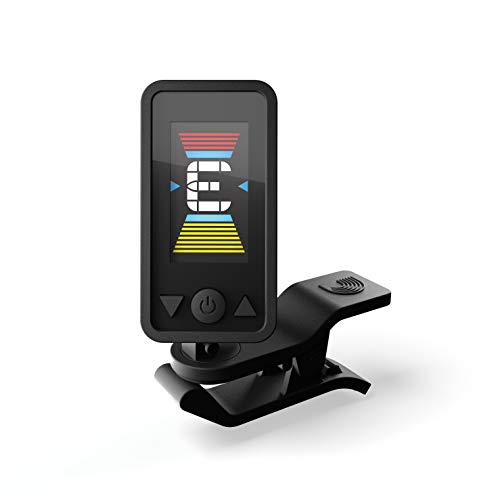
- 435–450 Hz calibration range
- Full-color vertical display
- Strong dual-swivel clamp
Best For: Flexible tuning for guitar, bass, and ukulele
Best All-in-One Practice Tool
Aroma 3-in-1 Digital Metronome Tuner

- Combines tuner, metronome, and tone generator
- 30–260 BPM with multiple rhythm settings
- Supports several instruments with ±0.5-cent accuracy
Best For: Multi-purpose practice and ear training
Best Rechargeable Clip-On
D'Addario Nexxus 360 Guitar Tuner

- Up to 24 hours of tuning per charge
- 360-degree rotating head and bright display
- Strong clamp with 415–465Hz calibration
Best For: Battery-free guitar and bass tuning
Best Straightforward Fender Option
Fender FT-1 Professional Clip-On Tuner

- Works with electric, acoustic, and bass guitars
- Dual hinges and backlit LCD improve positioning and visibility
- Includes CR2032 battery and limited warranty
Best For: Simple, readable everyday guitar tuning
Best Compact Color-Screen Pick
Rechargeable New bee Guitar Tuner
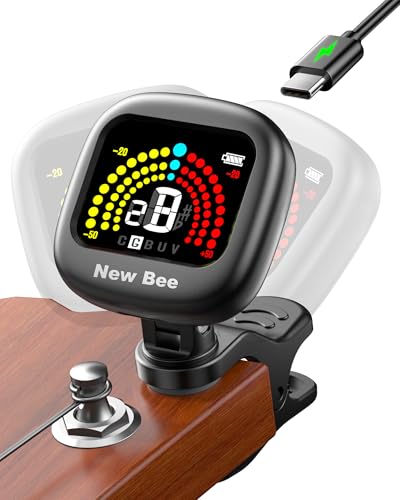
- Bright color display for varied lighting
- 360-degree screen and padded clamp
- Up to 6 hours per charge
Best For: Portable practice, stage, and travel tuning
Best Long-Lasting Rechargeable Pick

- Up to 24 hours per charge
- 435–450Hz adjustable calibration range
- Strong clamp with dual-swivel display
Best For: Guitar and bass players needing extended runtime
Best Multi-Instrument Pick

- Supports five instruments and chromatic tuning
- Includes guitar open-tuning detection
- USB-C charging with up to 10 hours
Best For: Musicians who tune multiple instruments
Best Everyday Clip-On – Snark SN5X
The Snark SN5X is a straightforward choice for guitar tuners when you want a compact clip-on design and an easy-to-see color display. Its frequency range is tailored to guitar and bass, and it can attach to either the front or back of the headstock.
Best For: Guitarists and bass players who want a simple, lightweight tuner for practice and everyday setup.
Pros:
- Full-color display is easy to view while tuning.
- Frequency range is tailored to guitar and bass.
- Can be used on the front or back of the headstock.
- Lightweight 1.58-ounce design.
Cons:
- Its listed tuning focus is narrower than multi-instrument models.
- Plastic construction may feel less rugged than a stage-style pedal tuner.
The SN5X keeps the essential features uncomplicated, making it a practical option for routine guitar or bass tuning without adding unnecessary controls.
Best Stage Pedal – BOSS TU-3
The BOSS TU-3 is built for players who need dependable guitar tuners onstage. Its tank-tough stompbox housing, high-visibility 21-segment LED meter, precise tuning, and automatic signal muting make it suited to live performance.
Best For: Performing guitarists and bassists who want a durable pedal tuner with silent tuning and strong display visibility.
Pros:
- Accurate to plus or minus one cent.
- High-brightness LED meter with adjustable brightness.
- Supports chromatic, guitar/bass, and drop tuning modes.
- Automatically mutes the signal while tuning.
Cons:
- Its stompbox format is less compact than a clip-on tuner.
- Requires a 9-volt power source.
- More features than needed for basic home tuning.
With support for extended-range instruments, drop tunings, and pedal power daisy-chaining, the TU-3 is a strong fit for a performance-oriented pedalboard.
Best Multi-Instrument Clip-On – Fender FCT-2
Fender FCT-2 Professional Multi-Instrument Clip-On Tuner for Guitar, Bass, Ukulele, and Violin
Check Price On AmazonThe Fender FCT-2 is a versatile option among guitar tuners, using instrument vibration sensing to maintain tuning feedback in loud or quiet settings. Dedicated modes cover guitar, bass, ukulele, violin, and chromatic tuning.
Best For: Players who switch between guitar and other stringed instruments and want one clip-on tuner for several setups.
Pros:
- Dedicated modes for guitar, bass, ukulele, violin, and chromatic tuning.
- Color LCD needle display provides quick visual feedback.
- Dual-hinge clip adjusts for viewing on either side of the headstock.
- Includes a CR2032 battery and supports a B0 to B7 tuning range.
Cons:
- Molded plastic construction may not suit users seeking a metal-bodied tuner.
- Its broader instrument support may be unnecessary for guitar-only players.
The FCT-2 stands out for flexibility: its multiple modes, vibration-based sensing, and adjustable clip make it useful for musicians with varied instruments.
Best Adjustable-Calibration Clip-On – D'Addario Eclipse
The D’Addario Eclipse is a flexible choice among guitar tuners, combining a large full-color vertical display with a strong clamp and dual swivels. Its adjustable 435–450 Hz calibration range supports more precise setup across different instruments and playing situations.
Best For: Guitar, bass, and ukulele players who value flexible screen positioning and adjustable calibration.
Pros:
- Wide 435–450 Hz calibration range.
- Full-color vertical display is designed for clear viewing.
- Dual swivels accommodate left- or right-handed mounting.
- Strong clamp can be positioned around the headstock.
Cons:
- Adjustable calibration may be more control than casual players need.
- Its larger listed dimensions may be less discreet than a very compact clip-on.
The Eclipse is a practical pick when viewing angle and calibration flexibility matter, especially for players using several headstock positions or multiple stringed instruments.
Best All-in-One Practice Tool – Aroma 3-in-1 Digital Metronome Tuner
If you want more than basic pitch checking, this compact unit combines a chromatic tuner, digital metronome, and tone generator. It is a versatile choice for guitarists who want one portable practice tool for timing, tuning, and ear training.
Best For: Guitarists and multi-instrumentalists who want metronome and reference-tone functions alongside tuning.
Pros:
- Combines a tuner, metronome, and tone generator in a pocket-sized design.
- Offers a 30–260 BPM tempo range with 10 beat patterns and 8 rhythm styles.
- Supports multiple instruments and provides ±0.5-cent tuning accuracy.
- Backlit display, LED feedback, adjustable volume, and a headphone jack support flexible practice.
Cons:
- Not suitable for piano tuning, despite supporting a broad A0–C8 range.
- Requires two AAA batteries.
This Aroma tuner is especially appealing for practice sessions where timing and intonation matter as much as basic guitar tuning. Its extra functions add value, though players seeking only a simple clip-on tuner may prefer a smaller dedicated model.
Best Rechargeable Clip-On – D'Addario Nexxus 360 Guitar Tuner
The D’Addario Nexxus 360 is a convenient clip-on option for guitar and bass players who want quick tuning without regularly replacing batteries. Its rotating display and strong clamp make it easy to position on different headstocks.
Best For: Guitarists and bassists who prefer rechargeable power, flexible screen positioning, and a secure clip.
Pros:
- Provides up to 24 hours of tuning per charge.
- 360-degree rotating head and display accommodate different viewing angles.
- Wide 415–465Hz calibration range supports precise tuning adjustments.
- Strong clamp is designed to stay mounted on the headstock.
Cons:
- Requires access to USB power for recharging.
- Designed for guitar and bass rather than a broad range of instruments.
With its rechargeable design and adjustable viewing position, the Nexxus 360 is a practical everyday tuner for players who dislike disposable batteries. It is a focused choice rather than a multi-function practice device.
Best Straightforward Fender Option – Fender FT-1 Professional Clip-On Tuner
The Fender FT-1 is a compact chromatic clip-on tuner for electric, acoustic, and bass guitars. Its dual-rotating hinges, backlit LCD, and color-changing tuning display make it a straightforward choice for players who want clear visual feedback.
Best For: Guitarists seeking an easy-to-read clip-on tuner with flexible positioning and included battery.
Pros:
- Works with electric, acoustic, and bass guitars.
- Dual-rotating hinges allow flexible placement and viewing.
- LCD backlight and green in-tune indication improve readability.
- Includes a CR2032 battery and a limited warranty.
Cons:
- Uses a replaceable CR2032 battery rather than rechargeable power.
- Offers fewer extra functions than a metronome-and-tuner combination unit.
The FT-1 focuses on the essentials: convenient clip-on placement, readable pitch guidance, and broad guitar compatibility. It is a sensible pick for beginners and experienced players who want a simple tuner from a familiar instrument brand.
Best Compact Color-Screen Pick – Rechargeable New bee Guitar Tuner
If you want guitar tuners that are quick to read and easy to carry, this rechargeable New bee model combines a bright color display with a compact clip-on design. Its piezo sensor is built for fast, accurate tuning across several instruments, while the swiveling screen helps you find a comfortable viewing angle.
Best For: Players who want a small, rechargeable tuner for practice, performances, or travel.
Pros:
- High-resolution color screen remains visible in dark or bright conditions.
- 360-degree rotating screen and padded adjustable clamp suit different headstocks and viewing positions.
- Rechargeable battery provides up to 6 hours of tuning per charge.
- Supports guitar, bass, violin, ukulele, and other instruments.
Cons:
- Six hours of use per charge is shorter than some rechargeable alternatives.
- Plastic construction may be less substantial than metal-bodied options.
This is a practical choice when portability and display visibility matter most. The one-hand clip and compact size make it especially convenient to keep in a gig bag or instrument case.
Best Long-Lasting Rechargeable Pick – D'Addario Eclipse Tuner
Among guitar tuners, the D’Addario Eclipse stands out for its long battery life and adjustable full-color display. It offers quick tuning for guitar and bass, a strong clamp, and calibration adjustment for players who need a precise, flexible headstock tuner.
Best For: Guitarists and bassists who prioritize extended battery life and adjustable tuning calibration.
Pros:
- Provides up to 24 hours of tuning per charge.
- Wide 435–450Hz calibration range supports precise adjustment.
- Full-color vertical screen and dual swivels offer flexible viewing angles.
- Strong adjustable clamp is designed to stay secure on the headstock.
Cons:
- It is listed as compatible with guitar, so it is less versatile on paper than multi-instrument models.
- The listed dimensions are larger than the most compact tuners in this roundup.
Choose the Eclipse when recharging less often is a priority. Its 24-hour runtime, calibration range, and secure clamp make it a capable option for frequent rehearsals, gigs, and regular practice.
Best Multi-Instrument Pick – New Bee GT30 Clip-On Tuner
For shoppers comparing guitar tuners with broader instrument support, the New Bee GT30 offers guitar, bass, ukulele, violin, cello, chromatic, and open-tuning modes. Its vivid color screen, 360-degree adjustment, and USB-C charging keep the design flexible for practice, studio use, or performance.
Best For: Multi-instrument musicians who want open tuning support in a compact rechargeable tuner.
Pros:
- Supports five named instruments plus chromatic and guitar open-tuning modes.
- High-resolution color display makes notes easy to see in different lighting.
- Silicone-padded clamp grips the instrument without damaging it.
- USB-C charging and up to 10 hours of use support portable operation.
Cons:
- Its 10-hour battery life is shorter than the D’Addario Eclipse’s listed runtime.
- Plastic construction may not feel as substantial as a metal-bodied tuner.
The GT30 is the most versatile choice of the three for musicians switching between instruments. Open-tuning detection and broad instrument coverage add useful flexibility without sacrificing a pocket-friendly design.
How We Picked the Best Guitar Tuners
We selected models that cover the main tuner formats musicians use today: compact clip-on tuners, pedal tuners for live rigs, rechargeable headstock models, and combination tuner-metronomes. The lineup also includes options for guitar, bass, ukulele, violin, and other instruments.
Our comparison focuses on practical performance rather than specifications alone. A useful tuner should detect notes quickly, show whether the pitch is sharp or flat clearly, remain easy to read from a playing position, and provide dependable power for its intended use.
Quick Comparison
| Tuner type | Best suited to | Main advantage |
|---|---|---|
| Clip-on chromatic | Home practice and rehearsals | Portable, simple, and often affordable |
| Rechargeable clip-on | Frequent players | Less battery waste and convenient charging |
| Pedal tuner | Performers and pedalboard users | Hands-free operation and stage visibility |
| Tuner with metronome | Students and practice-focused players | Combines tuning and rhythm practice |
Key Buying Factors for Guitar Tuners
Accuracy and Response
Chromatic tuning is the most versatile choice because it can detect every note rather than relying only on preset strings. Look for a responsive display that settles quickly and makes small pitch adjustments easy to see.
Display and Viewing Angle
A bright color screen can be helpful on dim stages, while a clear, high-contrast display may be all you need at home. Rotating hinges and 360-degree screens make it easier to position a clip-on tuner around different headstocks.
Power and Battery Life
Replaceable batteries are convenient when you need a quick swap, while rechargeable models reduce ongoing battery purchases. Check charging time, battery expectations, and whether the tuner can be used while charging if that matters to your setup.
Instrument Compatibility
Most clip-on models work well with acoustic and electric guitars, but multi-instrument players should confirm support for bass, ukulele, violin, or other instruments. A pedal tuner is generally the better fit for an electric guitar connected to a pedalboard.
Who Should Buy Which Guitar Tuners?
Choose the Snark, Fender FT-1, D’Addario Eclipse, or New Bee clip-on models if you want an inexpensive, compact tuner for everyday practice. Their headstock-mounted design is convenient for lessons, rehearsals, and quick tuning checks.
Choose a rechargeable model such as the D’Addario Nexxus 360, D’Addario Eclipse Rechargeable, or New Bee Rechargeable if you tune frequently and prefer not to keep spare coin batteries available. These are especially practical for regular players who value flexible screen positioning.
Choose the BOSS TU-3 if you perform with an electric guitar and want a durable pedalboard tuner with hands-free operation. Its format is less portable than a clip-on, but it integrates naturally into a live rig.
Choose the Aroma 3-in-1 if structured practice is a priority. A combined tuner and metronome can save space and help players work on both accurate pitch and consistent timing.