Looking for an arranger keyboard for songwriting that helps you capture ideas fast? The best options balance playable keys, useful sounds, and simple workflow so you can turn sketches into complete songs.
Below, we focus on portable, buyer-friendly picks that work well for writing, practicing, and building arrangements without slowing you down.
Best 10 Arranger Keyboard for Songwriting Picks for 2026
Performance Songwriting Workhorse
Casio CT-X3000 61-Key Arranger

- 800 editable tones and 235 rhythms
- 17-track recorder with phrase pads
- USB-MIDI and expression pedal input
Best For: writers and performers who want a portable arranger with deep creative control
Beginner Starter Bundle
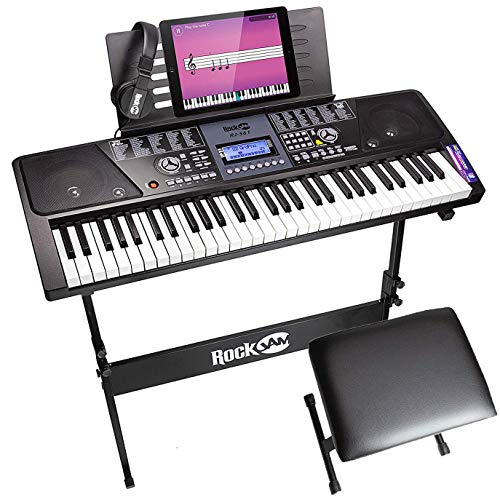
- Includes stand, stool, headphones, and stickers
- 100 rhythms and 50 tones for practice
- Teaching functions and recording support
Best For: beginners who want an all-in-one keyboard package for practice and simple songwriting
Compact MIDI Sketchpad
25-Key USB MIDI Arranger Controller

- Ultra-compact USB MIDI design
- Octave, modulation, and pitch controls
- Good for DAWs, travel, and rehearsals
Best For: mobile producers and writers who want a tiny USB controller for fast MIDI songwriting
Lesson-Friendly Arranger
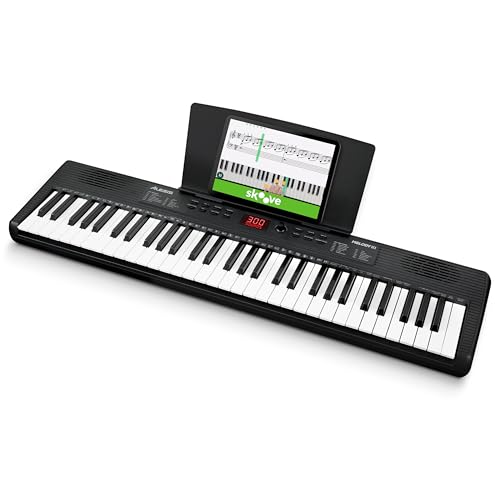
- 300 sounds and 300 accompaniment rhythms
- Auto-chord and record mode for sketching songs
- USB-MIDI plus lesson access included
Best For: beginners who want a lightweight keyboard with lessons and simple songwriting tools
Portable Beat-Making Starter
Donner STARRYKEY-37 PLAY MIDI Keyboard Controller
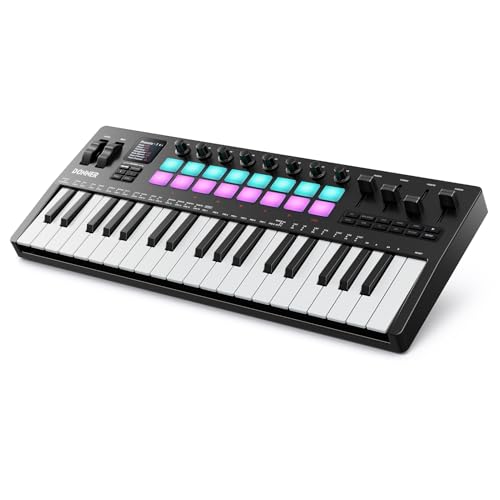
- 128 built-in voices for immediate songwriting
- 16 pads plus faders, encoders, and sequencer
- USB, MIDI, and wireless connectivity
Best For: portable DAW-based songwriting and beat sketching
Beginner Home Keyboard
RockJam RJ654 54 Key Keyboard Piano

- 54 full-size keys in a compact frame
- Built-in sounds, rhythms, and demo songs
- Includes note stickers and lesson access
Best For: new players writing simple songs at home
DAW-Ready Songwriting Controller
Novation Launchkey Mini 37 MK4

- 37 mini keys with Scale and Chord modes
- 16 RGB pads and 8 rotary encoders
- Deep integration with major DAWs
Best For: software-first songwriting and beat creation
Beginner Songwriting Starter
Yamaha 61-Key Portable Keyboard with Smart Chord

- 61 full-sized keys for standard playing technique
- Smart Chord simplifies quick chord ideas
- Built-in songs and Quiz Mode support practice
Best For: New songwriters who want an easy portable keyboard for chords and practice
Controller-Centered Writing Rig
Arturia KeyLab MK3 49 White Bundle for DAW Control

- 49-note semi-weighted keyboard with aftertouch
- Pads, faders, encoders, and transport controls
- Includes Ableton Live Lite, stand, and microphone
Best For: Songwriters building arrangements in software who want tactile DAW control
Portable Practice Pick
RockJam RJ490 49-Key Mini Keyboard with Rhythms

- Compact 49-key keyboard for easy portability
- Built-in sounds, rhythms, and recording
- Headphone jack supports quiet practice
Best For: Beginners and casual writers who want a small keyboard for quick song ideas
Performance Songwriting Workhorse – Casio CT-X3000 61-Key Arranger
If you want an arranger keyboard for songwriting that feels equally at home in sketchpad sessions and live jams, the Casio CT-X3000 gives you a deep sound set and plenty of creative control. Its AiX sound engine, 235 rhythms, phrase pads, and 17-track recorder make it easy to build ideas into full arrangements without jumping straight to a computer.
Best For: Writers and performers who want a portable arranger with strong sounds, built-in recording, and enough rhythm options to develop full songs.
Pros:
- AiX sound source delivers expressive tones with realistic detail.
- 800 editable tones, 235 rhythms, and 100 editable DSP effects expand songwriting options.
- 17-track recorder plus phrase pads help capture and layer ideas quickly.
- USB-MIDI, audio input, and pedal support make it easy to integrate with a studio setup.
Cons:
- 61 keys may feel limiting for players who want a larger keyboard.
- Best suited to users who will take advantage of its deeper feature set.
The CT-X3000 stands out if your priority is moving from melody ideas to arranged demos with minimal friction. It offers a strong balance of portability, sounds, and songwriting tools for players who want more than a basic practice keyboard.
Beginner Starter Bundle – RockJam RJ561 Keyboard Kit
For anyone looking for an arranger keyboard for songwriting on a budget, the RockJam RJ561 is a simple entry point that includes the basics in one box. With 100 rhythms, 50 tones, teaching functions, and recording support, it gives new players a straightforward way to test song ideas while learning the instrument.
Best For: Beginners who want an all-in-one keyboard package for practice, learning, and very simple songwriting.
Pros:
- Complete kit includes stand, stool, headphones, and stickers.
- 100 rhythms and 50 tones provide a useful starting palette.
- Teaching functions and demo songs support guided practice.
- Headphones enable quiet sessions in shared spaces.
Cons:
- Sound and feature set are more basic than dedicated arranger workstations.
- Not ideal if you want deep production or advanced editing tools.
This bundle is strongest as a first keyboard rather than a long-term writing hub. Still, the included accessories and practice features make it a practical low-stress choice for early songwriting and learning.
Compact MIDI Sketchpad – 25-Key USB MIDI Arranger Controller
If your workflow centers on DAWs and virtual instruments, this compact arranger keyboard for songwriting is built more like a mobile idea-capture tool than a full standalone keyboard. It connects over USB for quick laptop or tablet use, and its octave shift, modulation, and pitch controls make it easy to sketch melodies, chords, and beat ideas wherever you work.
Best For: Mobile producers, students, and writers who want a tiny USB controller for fast MIDI-based songwriting.
Pros:
- Compact and lightweight design is easy to carry anywhere.
- USB connection works with laptops and tablets for fast setup.
- Octave, modulation, and pitch controls support songwriting and beat-making.
- Suitable for home studios, rehearsals, classrooms, and travel.
Cons:
- As a controller, it depends on external software or instruments.
- Small key count limits traditional two-handed playing.
This is a smart pick if you mainly write into software and want a no-fuss controller for capturing ideas quickly. It is less of an all-in-one arranger and more of a streamlined MIDI companion for modern songwriting workflows.
Lesson-Friendly Arranger – Alesis Melody 61 MK4
The Alesis Melody 61 MK4 is a beginner-friendly arranger keyboard for songwriting if you want built-in accompaniment features and easy computer connectivity. Its 300 sounds, 300 accompaniment rhythms with auto-chord functions, and record mode make it useful for practicing ideas, while the USB-MIDI connection helps when you’re ready to move into software.
Best For: Beginners who want a lightweight keyboard with lesson access and simple built-in songwriting tools.
Pros:
- 300 sounds and 300 accompaniment rhythms offer plenty of variety.
- Auto-chord functions and record mode help with quick song sketches.
- USB-MIDI supports recording and educational software on Mac or PC.
- Lightweight design and battery power option improve portability.
Cons:
- 61 keys may not be enough for players wanting a larger range.
- Focused more on entry-level use than advanced arranger performance.
For new writers, this model makes it easy to experiment with accompaniment and capture ideas without a complicated setup. It is especially appealing if lessons and portability matter as much as songwriting features.
Portable Beat-Making Starter – Donner STARRYKEY-37 PLAY MIDI Keyboard Controller
If you want an arranger keyboard for songwriting that leans toward modern production, the Donner STARRYKEY-37 PLAY gives you a compact way to sketch ideas fast. Its 37 spring-loaded keys, built-in voices, pads, faders, arpeggiator, sequencer, and chord functions make it useful for writing melodies, building rhythms, and testing arrangements without a lot of setup.
Best For: Songwriters who want a portable MIDI controller with built-in sounds and hands-on controls for sketching ideas in a DAW.
Pros:
- 128 built-in voices let you start composing without extra VST sounds.
- 16 RGB pads, 8 rotary encoders, and 4 faders add plenty of control for songwriting and production.
- 7-mode arpeggiator, note repeat, 64-step sequencer, and chord functions support fast idea building.
- USB, MIDI, and wireless connectivity works with Windows, macOS, iOS, iPadOS, and Android.
Cons:
- 37 mini keys may feel small if you prefer a larger keyboard feel.
- It is a controller, so DAW-based songwriting will matter more than standalone piano-style play.
- The included lessons are helpful, but they are aimed at beginners through arrangement basics rather than advanced orchestration.
This is a strong fit if your focus is writing and arranging on the go, especially when you want built-in sounds and performance controls in a very compact footprint.
Beginner Home Keyboard – RockJam RJ654 54 Key Keyboard Piano
The RockJam RJ654 is a simple option if you want an arranger keyboard for songwriting practice at home. It has 54 full-size keys in a compact body, built-in sounds and rhythms, and recording features, making it easier to work through melodies, chord ideas, and basic song structures while you learn.
Best For: Beginners, teens, and adults who want an affordable practice keyboard with lessons and basic songwriting tools.
Pros:
- 54 full-size keys offer a more traditional playing feel than mini-key models.
- Built-in tones, beats, and demo songs keep practice and songwriting sessions engaging.
- Note stickers and lesson access help speed up the first weeks of learning.
- Battery or mains power makes it easy to practice in different spaces.
Cons:
- It is aimed at beginners, so it is less suited to advanced arranging workflows.
- Connectivity is limited compared with MIDI controller-style keyboards.
- At 8.3 pounds, it is portable enough for moving around, but not ultra-light.
This is a practical pick if you want a straightforward keyboard for learning and writing simple songs, especially when you value full-size keys and guided lessons.
DAW-Ready Songwriting Controller – Novation Launchkey Mini 37 MK4
If your arranger keyboard for songwriting needs are centered on software, the Novation Launchkey Mini 37 MK4 is built for that workflow. It combines 37 synth-style mini keys, 16 RGB velocity-sensitive pads, 8 rotary encoders, Scale Mode, Chord Mode, and an arpeggiator to help you build parts quickly inside a DAW.
Best For: Songwriters who want tight DAW integration, chord tools, and a compact controller for idea generation.
Pros:
- Seamless integration with major DAWs like Ableton Live, Logic, Cubase, Reaper, FL Studio, and more.
- Scale Mode and Chord Mode help you avoid wrong notes and trigger chords from one key or pad.
- 16 FSR pads can handle drumming, clip launching, chord triggering, and step sequencing.
- Includes software and lessons, plus Native Instruments NKS-ready support.
Cons:
- 37 mini keys are compact, so pianistic two-handed writing will feel limited.
- USB-only connectivity keeps it dependent on a computer or compatible setup.
- It is focused on control and workflow rather than built-in standalone sounds.
This model stands out for fast software-based songwriting, especially if you want a small controller that makes chords, scales, and beat creation easier inside your DAW.
Beginner Songwriting Starter – Yamaha 61-Key Portable Keyboard with Smart Chord
If you want an arranger keyboard for songwriting that helps you sketch ideas quickly, the Yamaha YPT280 is a practical beginner-friendly option. Its 61 full-sized keys, Smart Chord feature, and built-in songs make it easy to experiment with harmony, play along, and build basic progressions without a steep learning curve.
Best For: New songwriters who want an easy, portable keyboard for chord practice, ear training, and simple sketching.
Pros:
- 61 full-sized keys give beginners a standard layout for developing technique.
- Smart Chord lets you play a range of chords with one finger, which is helpful for quick songwriting.
- Built-in songs provide material to play along with and learn from.
- Quiz Mode adds ear-training games to support musical development.
Cons:
- Designed for beginners, so it is not a deep arranger workstation.
- No advanced controller or MIDI features are listed in the supplied notes.
- Best suited to simple writing and practice rather than full production workflows.
This is a good fit if you mainly need a lightweight keyboard that keeps songwriting approachable. The Smart Chord and built-in songs help you move fast, while the portable design makes it easy to use at home or take elsewhere.
Controller-Centered Writing Rig – Arturia KeyLab MK3 49 White Bundle for DAW Control
For an arranger keyboard for songwriting setup that leans into software control, this Arturia KeyLab MK3 49 White bundle is built for hands-on composition. The semi-weighted keys, aftertouch, pads, faders, encoders, and Ableton Live Lite support make it a strong choice if you want to trigger parts, shape sounds, and manage a DAW from one surface.
Best For: Songwriters who want a MIDI controller bundle for software-based arranging and performance control.
Pros:
- 49-note semi-weighted keybed with channel aftertouch and release-velocity response.
- Deep control layout includes pads, faders, encoders, and transport controls.
- USB-C bus power and 5-pin DIN MIDI I/O add flexible connection options.
- Bundle includes Ableton Live Lite plus a stand and microphone.
Cons:
- As a MIDI controller, it does not include built-in sounds in the supplied notes.
- Best suited to users who already plan to work with software or external gear.
- The bundle may be more than needed if you only want a simple standalone keyboard.
This bundle makes more sense for writers who want to build songs inside a DAW and control multiple parts from one keyboard. It is less of a traditional arranger and more of a flexible composition hub for software-driven workflows.
Portable Practice Pick – RockJam RJ490 49-Key Mini Keyboard with Rhythms
If you are shopping for an arranger keyboard for songwriting on a budget, the RockJam RJ490 keeps things simple and portable. It offers 49 responsive keys, built-in sounds and rhythms, recording, and a headphone jack, so you can test ideas, practice quietly, and keep early song sketches moving.
Best For: Beginners and casual writers who want a compact, travel-friendly keyboard for basic songwriting ideas.
Pros:
- Compact 49-key design is easy to move between home, school, and trips.
- Built-in sounds and rhythms add variety during early songwriting sessions.
- Recording support helps capture quick ideas.
- Headphone jack allows quiet practice.
Cons:
- Mini keyboard layout is less substantial than a full-sized keybed.
- USB-C cable is not included for plugged-in use.
- Limited feature set compared with more advanced songwriting keyboards.
This is a straightforward pick for sketching melodies and experimenting with rhythm without a big footprint. It is best viewed as a portable practice keyboard that can support early songwriting rather than a full arranger workstation.
How We Picked the Best Arranger Keyboard for Songwriting
To choose these 10 options, we looked for instruments and controllers that support fast songwriting, easy portability, and a practical feature set for home studios, practice rooms, and mobile setups. That means useful onboard sounds or DAW control, responsive keybeds, and features that make capturing ideas easier.
For an Arranger Keyboard for Songwriting, the most important thing is workflow: can you sketch chords, melodies, and rhythm quickly without fighting the instrument?
Quick Comparison
Traditional portable keyboards are best if you want built-in sounds, rhythms, and speakers for immediate writing. MIDI controllers are better if you work mainly in a DAW and want tighter control over virtual instruments, chord tools, and production software.
If you want to write away from your computer, prioritize onboard speakers, battery power, and built-in accompaniment. If you mostly produce in software, look for transport controls, pads, scale/chord modes, and solid DAW integration.
Key Buying Factors for Arranger Keyboard for Songwriting
Keys and Playability
Choose a key count that matches your space and writing style. 25- to 37-key units are highly portable and great for sketching ideas, while 49- and 61-key models feel more complete for two-handed parts, chord voicings, and arrangement work.
Sound Library and Songwriting Tools
Built-in sounds, rhythm patterns, arpeggiators, chord modes, and recording features can speed up the writing process. A strong Arranger Keyboard for Songwriting should help you move from idea to demo with minimal setup.
Connectivity
USB MIDI, standard MIDI support, sustain pedal input, and audio output matter if you plan to connect to a computer, interface, or external speakers. Consider whether you need direct DAW integration or standalone operation.
Portability and Power
Weight, size, and power options matter if you write in different rooms or on the go. Battery operation and built-in speakers are useful for spontaneous sessions, while bundles with stands and headphones can simplify a home setup.
Who Should Buy Which Arranger Keyboard for Songwriting?
If you want the most self-contained songwriting experience, choose a full-size portable keyboard with built-in sounds and speakers. If you produce in a laptop-based studio, a MIDI controller with pads and DAW features will usually be the better fit. Beginners may prefer bundled keyboards with accessories and lessons, while experienced writers often benefit from more expressive controllers and stronger software integration.
In short, the best pick depends on whether you value standalone arranging, compact portability, or hands-on DAW control. Match the keyboard to your workflow, and you’ll write faster with less friction.