Compact speaker selector switches make it easier to route one amplifier to multiple speaker pairs or manage separate listening zones. The right model can simplify a home audio setup while preserving straightforward, passive control.
This roundup compares 10 options across two-channel, multi-channel, zone-based, and in-wall designs, with attention to power handling, controls, wiring, and installation needs.
Best 10 Compact Speaker Selector Switches Picks for 2026
Flexible Four-Zone Control
Pyle 4-Channel Speaker Selector

- Connects up to four speaker pairs
- Accepts wire up to 14-gauge
- 100W per channel for 8-ohm systems
Best For: Multi-room stereo setups needing four speaker outputs
Simple A/B Comparison
P2 Passive Amp/Speaker Switcher
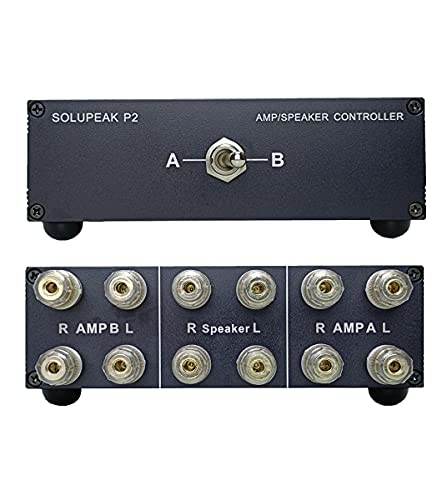
- Reversible 2-in-1-out or 1-in-2-out use
- Passive design needs no external power
- Accepts banana connections up to 12-gauge
Best For: Comparing amplifiers or alternating speaker pairs
Six-Pair Expansion

- Supports up to six speaker pairs
- Push-button plug-and-play operation
- Works with several listed amplifier brands
Best For: Larger stereo systems with multiple speaker zones
Versatile Two-Way Routing

- Routes two amps to one pair or one amp to two pairs
- No external power required
- Accepts banana connections up to 12-gauge
Best For: Alternating amplifiers or passive speaker pairs
Best Value Multi-Zone Pick
Monoprice 4-Channel Speaker Selector

- Controls up to four speaker zones
- Optional impedance protection
- Up to 140W per channel without protection
Best For: Budget-friendly four-zone home audio
Best Two-Zone Flexibility
PROZOR 2-Zone Speaker Switch Box

- Independent A/B zone controls
- Supports up to 150W RMS per channel
- Passive, no external power needed
Best For: Two-zone systems and amplifier switching
Best for Large Speaker Distribution
Pyle 8-Channel Speaker Selector
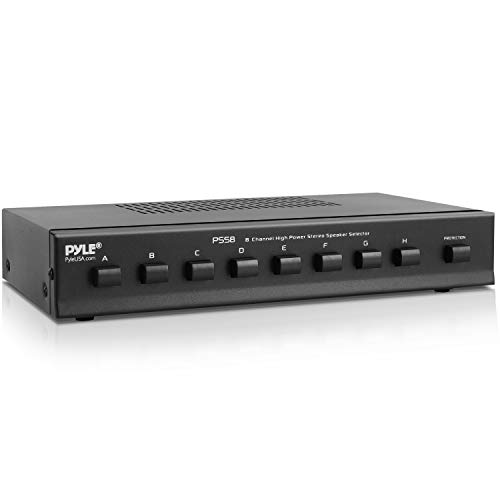
- Controls up to eight speaker pairs
- Independent speaker-set operation
- Protection buttons for overload safety
Best For: Large multi-room audio installations
Compact Two-Zone Pick

- Controls two speaker pairs from one stereo amplifier
- Passive operation with no extra power supply
- Compact metal tabletop design
Best For: Small two-zone home audio systems
Whole-Home Control Choice

- Connects one amplifier to four speaker pairs
- Independent A/B/C/D zone buttons
- 150W RMS per channel with passive operation
Best For: Multi-room passive speaker systems
Clean Installation Option

- Fits standard electrical junction or gang boxes
- Selects A, B, or both speaker pairs
- Push-button control with up to 120W load handling
Best For: Discreet in-wall two-pair speaker setups
Flexible Four-Zone Control – Pyle 4-Channel Speaker Selector
If you need compact speaker selector switches for several listening areas, the Pyle PSS4 provides four selectable speaker outputs in a straightforward desktop-style box. Its push-button operation and plug-and-play setup make it practical for managing separate speaker pairs from one stereo system.
Best For: Homes or small audio setups connecting up to four separate speaker pairs.
Pros:
- Supports up to four separate speaker pairs.
- Accepts speaker wire up to 14-gauge.
- Handles 100 watts per channel with speaker systems rated at a minimum 8 ohms.
- Uses simple push-button operation and requires no complicated setup.
Cons:
- It is intended for 8-ohm speaker systems or higher.
- Its four-zone capacity may be more than needed for a basic two-speaker setup.
Choose the PSS4 when four speaker-pair connections matter more than minimizing the enclosure size. Verify your speakers meet the stated impedance requirement before connecting them.
Simple A/B Comparison – P2 Passive Amp/Speaker Switcher
For compact speaker selector switches focused on A/B testing, the P2 offers a reversible 2-in-1-out or 1-in-2-out layout. Its passive design, gold-plated banana jacks, and one-press switching let you compare amplifiers or speaker pairs without repeatedly changing cables.
Best For: Audiophiles comparing two amplifiers or switching one amplifier between two speaker pairs.
Pros:
- Supports two amplifiers to one speaker pair or one amplifier to two speaker pairs.
- Passive, non-powered operation avoids an external power supply.
- Gold-plated banana jacks accept speaker wire up to 12-gauge.
- Rated for 100W RMS and 200W peak per channel.
Cons:
- In one-amplifier-to-two-speaker mode, only speaker pair A or B operates at a time.
- Banana plugs are required; it is not designed for RCA speaker connections.
- Tube amplifiers require standby or power-off precautions before switching.
The P2 is a focused choice for quick, controlled comparisons rather than simultaneous multi-room playback. Its reversible configuration adds flexibility, but careful switching is especially important with tube amplifiers.
Six-Pair Expansion – Pyle PSS6 Speaker Selector
The Pyle PSS6 is among the more capacity-focused compact speaker selector switches, offering control for up to six separate speaker pairs. Its push-button, plug-and-play design suits systems where one stereo source needs to distribute audio across multiple connected speaker zones.
Best For: Larger home stereo installations requiring up to six speaker-pair connections.
Pros:
- Connects up to six separate speaker pairs.
- Uses push-button operation for straightforward selection.
- Designed as a plug-and-play speaker distribution system.
- Compatible with a range of amplifiers, including Pyle, Crown, Denon, Sony, Panasonic, and Yamaha models.
Cons:
- Six-channel capacity can be unnecessary for smaller systems.
- The supplied notes do not specify a speaker-wire gauge limit.
- It is a larger enclosure than a basic two-way switcher.
Consider the PSS6 when connection count is the priority. It provides substantially more output capacity than two- or four-pair selectors while retaining uncomplicated push-button control.
Versatile Two-Way Routing – PROZOR Amp/Speaker Switcher
The PROZOR switcher is a practical option among compact speaker selector switches when you need either two amplifiers feeding one speaker pair or one amplifier feeding two pairs. Its no-power design and A/B control simplify switching, while gold-plated banana ports support installations using heavier speaker wire.
Best For: Users who need flexible amplifier or speaker selection without simultaneous output.
Pros:
- Supports two amplifiers to one speaker pair or one amplifier to two speaker pairs.
- Gold-plated banana ports accommodate wire up to 12-gauge.
- Requires no external power and uses plug-and-play A/B switching.
- Rated for 100W RMS and 200W peak per channel.
Cons:
- Only one selected input or output position can operate at a time.
- It does not support simultaneous playback through both speaker sets.
- Connections use banana plugs rather than general-purpose RCA cables.
The PROZOR is best viewed as a flexible selector for alternating equipment or speaker pairs, not as a multi-zone distribution hub. Confirm that your setup uses compatible passive speakers and banana-plug connections.
Best Value Multi-Zone Pick – Monoprice 4-Channel Speaker Selector
The Monoprice 4-Channel Speaker Selector is a practical choice when compact speaker selector switches need to distribute one audio source across multiple rooms. It supports up to four speaker zones and includes optional impedance protection to help keep the amplifier load consistent.
Best For: Home theater and distributed audio setups needing four independently selectable speaker zones.
Pros:
- Distributes audio to up to four different zones.
- Supports up to 70 watts per channel with protection enabled, or 140 watts without it.
- Optional impedance protection helps maintain a consistent load for the amplifier.
- Rugged design at a budget-conscious price.
Cons:
- The higher 140-watt rating requires the protection circuit to be disabled.
- It is designed for four zones, so larger installations need another solution.
Choose this model if four-zone coverage and flexible power handling matter more than advanced switching features. Its impedance protection makes it especially useful for straightforward multi-room systems.
Best Two-Zone Flexibility – PROZOR 2-Zone Speaker Switch Box
The PROZOR 2-Zone Speaker Switch Box is a compact speaker selector switch for systems that need simple A/B control. Its independent buttons can operate two speaker zones from one amplifier, or switch between two amplifiers and one speaker pair.
Best For: Home or office setups requiring two-zone selection or amplifier-to-speaker switching.
Pros:
- Independent A and B controls allow Zone A, Zone B, or both.
- Supports up to 150W RMS per channel and 4–16Ω passive speakers.
- Passive design requires no external power supply.
- Metal housing and anti-slip feet support stable placement.
Cons:
- When using two amplifiers, only one amplifier input should be switched on at a time.
- It handles two zones rather than larger multi-room installations.
The PROZOR is a good fit when straightforward controls and high stated power handling are the priorities. Its passive operation keeps installation simple, while the amplifier-switching option adds flexibility for smaller systems.
Best for Large Speaker Distribution – Pyle 8-Channel Speaker Selector
The Pyle PSS8 is built for installations that need more outputs than typical compact speaker selector switches. It can manage up to eight pairs of speakers from one source amplifier, with individual controls and protection buttons for each set.
Best For: Multi-room audio systems requiring control of up to eight separate speaker pairs.
Pros:
- Controls up to eight speaker pairs from one distribution hub.
- Each speaker set can be operated independently.
- Built-in protection buttons help safeguard the amplifier and speakers from overload.
- Compatible with stereo receivers and amplifiers up to 100 watts per channel.
Cons:
- Its eight-zone capacity may be excessive for small setups.
- The supplied notes specify compatibility up to 100 watts per channel.
If your priority is maximum zone capacity, the PSS8 is the most capable option in this group. It offers centralized control for eight speaker pairs without manually changing connections between rooms.
Compact Two-Zone Pick – P21 A/B Speaker Selector
For shoppers comparing compact speaker selector switches, the TENEALAY P21 is a straightforward tabletop option for controlling two pairs of speakers from one stereo amplifier. Its passive design requires no extra power supply and supports 8–16-ohm speakers with up to 80 watts per channel.
Best For: Small home theater or stereo setups that need simple A/B or combined control for two speaker pairs.
Pros:
- Controls up to two pairs of speakers in separate or combined use.
- Compact, slim metal housing suits tabletop installations.
- Accepts speaker wire up to 14 AWG and needs no external power.
Cons:
- Limited to two speaker pairs.
- Rated for speakers from 8–16 ohms and up to 80 watts per channel.
The P21 focuses on uncomplicated two-zone switching in a small enclosure. It is a practical fit when you do not need four-zone distribution or advanced controls.
Whole-Home Control Choice – PROZOR 4-Zone Selector
The PROZOR AS005 is one of the more capable compact speaker selector switches for multi-room audio, connecting one amplifier to as many as four pairs of passive speakers. Independent A/B/C/D buttons, a master AMP switch, and passive operation keep daily zone management simple.
Best For: Whole-home, patio, shop, or studio systems that need independent control of up to four passive speaker zones.
Pros:
- Supports four independently selectable speaker zones.
- Handles up to 150W RMS per channel and 4–16-ohm passive speakers.
- Includes a master AMP switch and requires no external power.
- Metal housing with anti-slip feet supports stable placement.
Cons:
- Designed for passive speakers; volume remains controlled by the amplifier.
- Spring-clip terminals may be less convenient for users who prefer other connection styles.
With four zones and a master switch, the PROZOR offers considerably more distribution flexibility than a two-pair selector. Its 164-foot maximum stated wiring distance also suits larger installations, provided the speaker and amplifier requirements are met.
Clean Installation Option – Pyle PVCS2 In-Wall Switch
The Pyle PVCS2 takes a different approach to compact speaker selector switches by mounting in a standard electrical junction or gang box. Its push-button controls select A speakers, B speakers, or both, making it suitable for a tidy indoor or outdoor speaker installation.
Best For: Wall-mounted home audio systems where a discreet two-pair selector is preferred over a tabletop box.
Pros:
- In-wall design fits standard electrical boxes and includes a Decora-style wall plate.
- Offers three configurations: A, B, or A+B.
- Push-button operation is simple for everyday speaker selection.
- Handles up to a 120-watt power load.
Cons:
- Controls only two speaker pairs.
- Requires in-wall installation rather than simple tabletop placement.
The PVCS2 is best when appearance and permanent installation matter. It provides basic two-channel selection without adding a visible box to an audio rack, though installation is less flexible than with a standalone switcher.
How We Picked These Compact Speaker Selector Switches
We selected models that address common home audio routing needs, from simple A/B switching to four-, six-, and eight-channel distribution. We considered channel count, stated power capacity, control layout, passive operation, compatibility with typical stereo amplifiers, and whether each switch is better suited to desktop, cabinet, wall-mounted, or multi-zone use.
Because specifications and system requirements vary, treat advertised wattage as a compatibility reference rather than a guarantee of performance. Your amplifier’s impedance limits, speaker wiring, and intended volume level matter just as much.
Quick Comparison
| Setup need | Best switch style | What to prioritize |
|---|---|---|
| Two speaker pairs | Two-way A/B selector | Simple controls and impedance compatibility |
| Several listening areas | Multi-channel selector | Independent buttons and clear labeling |
| One amplifier, multiple zones | Zone-based switcher | Power handling and simultaneous-use support |
| Clean built-in installation | In-wall selector | Box depth, wiring access, and finish |
Key Buying Factors for Compact Speaker Selector Switches
Channel and Zone Count
Choose based on the number of speaker pairs you need to control, not just the number you may add later. A two-way model is usually easiest for one room or two pairs, while four- to eight-channel units make more sense for distributed audio.
Power and Impedance
Check the selector’s stated wattage against your amplifier’s output and your speakers’ requirements. Also confirm whether the switch includes impedance protection or assumes that only one pair will play at a time. Running multiple pairs simultaneously can change the load seen by the amplifier.
Independent Switching
Individual A/B/C/D buttons are useful when different rooms need separate control. If you only alternate between two speaker pairs, a simpler selector may reduce cost, wiring, and clutter.
Installation and Connections
Passive switch boxes generally need no power, but they still require accessible speaker and amplifier wiring. Look for clearly labeled terminals, suitable connector spacing, and a form factor that fits your equipment shelf. In-wall models require more planning and may need an appropriately sized electrical box.
Simultaneous Playback
Do not assume every selector can safely drive every connected pair at once. Review the product’s operating instructions and your amplifier’s minimum impedance before using multiple outputs together.
Who Should Buy Which Compact Speaker Selector Switches?
Choose a two-way selector if you want quick A/B switching between two speaker pairs. A four-channel model is a practical middle ground for a living room, office, patio, or small distributed-audio system. Six- and eight-channel options suit larger homes or installations where several speaker pairs need dedicated front-panel controls.
Zone-oriented PROZOR-style designs are a better fit when one amplifier must feed distinct areas with independent selection. An in-wall controller is preferable when visible equipment should be minimized, provided you are comfortable planning the installation. For the simplest setup, prioritize clear controls and compatibility over a high channel count you will not use.