A complete modular synthesizer system can be the fastest way to build a personalized sound palette, whether you want hands-on patching, experimental textures, or a studio centerpiece.
These 10 picks span compact semi-modular options and larger, more expandable setups, making it easier to match your budget, workflow, and experience level.
Best 10 Complete Modular Synthesizer System Picks for 2026
Vintage Modular Studio
Behringer SYSTEM 55 Complete System 55 Modular Synthesizer

- Pre-assembled with 38 modules
- Includes two Eurorack GO cases and MIDI-to-CV
- Vintage sound profile with classic filter sections
Best For: Musicians who want a full vintage-style modular setup ready to patch
Beginner Patch Lab
Korg littleBits Synth Kit Modular Synth Starter

- 11 magnetic modules for easy patching
- No soldering or wiring required
- Includes project booklet with 10 ideas
Best For: Beginners and creatives exploring modular synth basics
Compact Semi-Modular Voice
Behringer CRAVE Semi-Modular Analog Synth

- Pure analog signal path with 3340 VCO
- Classic 24 dB ladder filter with resonance
- 32-step sequencer and 16-voice poly chain
Best For: Players wanting a compact analog semi-modular synth with sequencing
Experimental Hybrid Keys
Arturia MicroFreak Hybrid Synthesizer

- Digital oscillator with Wavetable and KarplusStrong modes
- Spice and Dice sequencing for happy accidents
- 12-dB SEM-style filter can auto-oscillate
Best For: Curious players who want an experimental compact hybrid synth
Compact West Coast Starter
Korg Volca Modular Semi-Modular Micro Synth
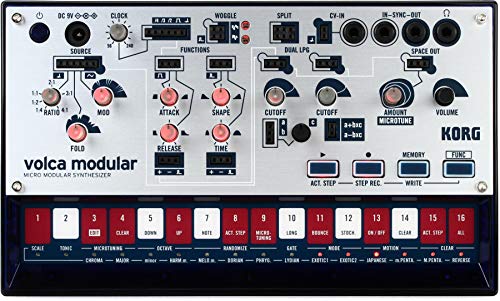
- Eight-module semi-modular design
- 50 patch points for routing experiments
- Built-in sequencer, randomize, and speaker
Best For: Portable patching and West Coast-style synthesis exploration
Fat Analog Semi-Modular Pick
Behringer NEUTRON Analog Semi-Modular Synth

- Dual 3340 analog oscillators
- Default routings for immediate playability
- Five-shape waveform blending and semi-modular patching
Best For: Hands-on analog sound design with quick start operation
Keyboard-Centric Modular Hub
MOOG Grandmother Semi-Modular Analog Synth

- 32-key semi-modular analog keyboard
- 41 patch points plus spring reverb
- Arpeggiator and 256-note sequencer
Best For: Keyboard-focused players wanting modular expandability
Wavetable Power Desktop
Korg modwave Module for advanced wavetable polyphony

- 2 wavetable oscillators
- MIDI 2.0 and polyphonic aftertouch
- Desktop/rackmount design
Best For: Advanced users needing deep wavetable control
Analog Semi-Modular Starter
Moog Mavis semi-modular analog kit with Eurorack support

- 100% analog design
- Eurorack integration in 44HP
- Complete kit with patch cables
Best For: Analog sound seekers building a modular rig
High-End Core Engine
Iridium Core desktop synth with CV and sequencing

- 64-step sequencer and arpeggiator
- 2 high-resolution CV inputs
- Five effects slots per layer
Best For: Studio builders wanting a powerful modular hub
Vintage Modular Studio – Behringer SYSTEM 55 Complete System 55 Modular Synthesizer
If you want a complete modular synthesizer system with a classic 1970s-inspired voice, the Behringer SYSTEM 55 is built for a ready-to-play vintage setup. It arrives pre-assembled with 38 modules, two Eurorack GO cases, and a MIDI-to-CV converter, making it a strong choice when you want a large-format modular rig without starting from scratch.
Best For: Players who want a fully assembled vintage-style modular system with lots of modules and case support.
Pros:
- Pre-assembled complete system with 38 modules
- Includes two EURORACK GO cases and a MIDI-to-CV converter
- Vintage sound profile with multiple filter modules
- Features classic-style components like the 914 fixed filter bank and 992 control voltages module
Cons:
- Large physical footprint and 13 kg weight
- Not a compact or portable starter option
- Best suited to users who want a full modular setup rather than a small synth
The SYSTEM 55 is a serious buy if your priority is a ready-made modular platform with a vintage character. It stands out for its breadth of included modules and its emphasis on classic filter and control sections, giving you a deep patching environment right out of the box.
Beginner Patch Lab – Korg littleBits Synth Kit Modular Synth Starter
The Korg littleBits Synth Kit is a playful way to explore a complete modular synthesizer system without needing soldering, wiring, or prior electronics knowledge. Its 11 modules connect in any order with magnetic Bits pieces, so it is aimed at hands-on experimentation and easy sound building rather than traditional synth programming.
Best For: Beginners, students, and creative users who want an approachable modular synth they can build and reconfigure freely.
Pros:
- 11 different modules for sound creation and processing
- Magnetic connections make patching simple and flexible
- No soldering or wiring required
- Includes a 35-page booklet with 10 project suggestions
Cons:
- More of an educational and creative kit than a traditional performance synth
- Sound-building approach may feel less conventional to experienced users
- Depends on the littleBits module ecosystem
This kit is best treated as an accessible entry point into modular thinking. If you want to learn signal flow by experimenting with a compact, modular analog synthesizer concept, it offers a low-friction way to start making sound.
Compact Semi-Modular Voice – Behringer CRAVE Semi-Modular Analog Synth
The Behringer CRAVE is a compact semi-modular synth built around a pure analog signal path, so it works well as a focused add-on or a first step into modular-style sound design. With its 3340 VCO, classic ladder filter, and 32-step sequencer, it gives you a hands-on analog voice in a small desktop format.
Best For: Players who want a small, affordable semi-modular analog synth with sequencer control.
Pros:
- Pure analog signal path with authentic VCO, VCF, and VCA designs
- 3340 VCO and classic 24 dB ladder filter
- 32-step sequencer for pattern-based ideas
- Supports 16-voice poly chain for expanded setups
Cons:
- Single-unit instrument rather than a full complete modular synthesizer system
- Compact size limits the number of onboard controls and modules
- Best for focused analog voices, not large modular rigs
CRAVE is a good choice if you want analog character and patch-friendly flexibility without committing to a large system. Its sequencer, filter, and pure analog design make it easy to build warm, rich sounds in a straightforward desktop package.
Experimental Hybrid Keys – Arturia MicroFreak Hybrid Synthesizer
The Arturia MicroFreak is a hybrid synth for users who want unusual sound design options in a compact hardware instrument. It is not a complete modular synthesizer system, but it does offer a highly experimental workflow with a versatile digital oscillator, a state-variable filter, and sequencing tools that encourage quick sound discovery.
Best For: Curious musicians who want a small hybrid synth with unusual oscillator modes and creative sequencing.
Pros:
- Versatile digital oscillator with modes like Wavetable and KarplusStrong
- Innovative Spice and Dice sequencer functions
- Records up to four automations
- 12-dB SEM-style state-variable filter that can auto-oscillate
Cons:
- Hybrid design may not satisfy users seeking a fully analog modular system
- Plastic body feels less substantial than metal-bodied instruments
- Focused on experimental sound design rather than a traditional modular layout
MicroFreak is strongest as a compact idea machine for adventurous sound design. If you want an instrument that rewards experimentation more than straightforward subtractive synthesis, its oscillator modes and sequencer tools make it easy to generate fresh sounds fast.
Compact West Coast Starter – Korg Volca Modular Semi-Modular Micro Synth
If you want a complete modular synthesizer system feel in a tiny footprint, the Korg Volca Modular is built for experimentation rather than polished preset work. Its eight modules, 50 patch points, and built-in 16-step sequencer make it easy to explore unusual routing, while the compact battery-or-AC design keeps it practical for travel, desk use, or quick live ideas.
Best For: Players who want an affordable, portable way to explore semi-modular and West Coast-style synthesis.
Pros:
- Eight independent modules support flexible sound design.
- 50 patch points encourage extensive routing and experimentation.
- Built-in 16-step sequencer includes two playback modes plus randomize.
- Compact, lightweight build with built-in speaker for immediate use.
Cons:
- Semi-modular layout may feel less straightforward than a fully normalized synth.
- Small size can be limiting if you want a larger hands-on keyboard or controls.
- Best suited to creative patching, not a full-feature studio command center.
As a modular learning tool, this Volca stands out for encouraging discovery through patching and sequence variation. It is a strong pick when portability and experimentation matter more than breadth of features.
Fat Analog Semi-Modular Pick – Behringer NEUTRON Analog Semi-Modular Synth
The Behringer NEUTRON is a practical choice if you want a complete modular synthesizer system style setup that is ready to play right away. Its semi-modular architecture uses default routings so you can start without patching, while the pure analog signal path, dual 3340 oscillators, and waveform blending give you a wide range of classic-style sounds.
Best For: Musicians who want a hands-on analog semi-modular synth with immediate default operation and deep patching potential.
Pros:
- Dual 3340 analog oscillators deliver a thick, classic analog foundation.
- Default routings let you perform immediately without patch cables.
- Semi-modular design still leaves room for deeper experimentation.
- Waveform control blends across five shapes for broad tonal options.
Cons:
- It is paraphonic, not a fully polyphonic keyboard synth.
- Its rack-style format may be less convenient than a keyboard-first instrument.
- USB Type B connectivity is functional, but not especially expansive on its own.
For players who want analog weight with a modular mindset, the NEUTRON hits a strong balance between instant sound and patch-based exploration. It is especially appealing if you like to shape timbres without starting from a blank patch every time.
Keyboard-Centric Modular Hub – MOOG Grandmother Semi-Modular Analog Synth
The MOOG Grandmother is a strong fit if you want a complete modular synthesizer system experience wrapped around a playable keyboard. It combines 32 velocity-sensitive keys, a built-in arpeggiator and 256-note sequencer, plus 41 patch points and a spring reverb tank, so it can function as both a self-contained instrument and a modular expansion piece.
Best For: Keyboard players who want a semi-modular analog synth that can work standalone or integrate into a larger system.
Pros:
- 32 velocity-sensitive full-size keys make it immediately playable.
- 41 modular patch points support extensive analog interconnectivity.
- Built-in arpeggiator, 256-note sequencer, and spring reverb add performance depth.
- Works with classic MOOG modular gear and Eurorack systems.
Cons:
- Monophonic design limits it to one note at a time.
- Larger size and weight make it less portable than smaller semi-modular units.
- Premium feature set may be more than a casual beginner needs.
This is the most traditional instrument of the three, with the most obvious keyboard focus and the broadest performance features. If you want a semi-modular synth that also feels like a real front-panel instrument, the Grandmother is an easy one to justify.
Wavetable Power Desktop – Korg modwave Module for advanced wavetable polyphony
If you’re building a complete modular synthesizer system with modern digital flexibility, the Korg modwave Module brings wavetable synthesis, high polyphony, and extensive modulation into a desktop/rackmount format. It’s an advanced instrument that fits best in setups where MIDI 2.0 support, polyphonic aftertouch, and deep sound design matter more than a simple hands-on layout.
Best For: Advanced players who want a high-polyphony wavetable desktop synth with MIDI 2.0 and deep modulation.
Pros:
- 2 wavetable oscillators with extensive program memory
- MIDI 2.0 support and polyphonic aftertouch
- Multiple effects and advanced LFO options
- Desktop/rackmount design for flexible placement
Cons:
- Designed for advanced users rather than beginners
- Not a traditional fully patch-cable modular system
Overall, this is a strong choice if your complete modular synthesizer system needs a powerful digital voice with broad performance features and lots of sonic range. It’s especially compelling for players who want deep control in a compact format.
Analog Semi-Modular Starter – Moog Mavis semi-modular analog kit with Eurorack support
The Moog Mavis is a compact semi-modular option for a complete modular synthesizer system, especially if you want true analog tone with easy Eurorack integration. Its 44HP design packs oscillator, filter, envelope, wavefolder, and patching tools into a build-it-yourself kit, making it a practical way to add a Moog voice to a larger setup.
Best For: Players who want an analog semi-modular Moog voice that can work standalone or in Eurorack.
Pros:
- 100% analog design with Moog oscillator and filter circuits
- Includes wavefolder, attenuators, mixer, mults, and sample and hold
- Built-in keyboard with glide and keyboard scaling
- Complete kit included with patch cables, power supply, and tools
Cons:
- Assembly is required
- Compact format may feel limited compared with larger systems
Mavis stands out as a flexible entry point or expansion voice for a modular rig, with enough onboard control to be useful on its own and enough connectivity to grow with your system. If analog character is the priority, it offers a lot in a small footprint.
High-End Core Engine – Iridium Core desktop synth with CV and sequencing
For a complete modular synthesizer system built around a powerful central voice, the Iridium Core delivers a feature-rich desktop engine with advanced sequencing, CV connectivity, and extensive effects routing. It is aimed at users who want a modern synth hub with touchscreen control, macro access, and performance tools for complex patches and studio work.
Best For: Studio and performance users who want a polyphonic desktop synth with CV I/O and deep sequencing.
Pros:
- Advanced arpeggiator and step-sequencer with up to 64 steps
- 2 high-resolution CV inputs plus analog clock in/out
- Five effects slots per layer with flexible routing
- Touchscreen XY control, macro buttons, and assignable pots
Cons:
- Best suited to users comfortable with advanced sound design
- Requires external MIDI/CV gear to function as part of a modular setup
As a modular centerpiece, the Iridium Core offers a lot of control in one unit, from macro performance tools to modulation-friendly connections. It’s a strong fit when you want one module-like desktop synth to anchor a more elaborate system.
How We Picked These Complete Modular Synthesizer System Options
We focused on systems that offer meaningful patching flexibility, strong sound design potential, and practical value for different kinds of buyers. Priority went to instruments that are well suited to learning modular concepts, integrating with other gear, or serving as a serious foundation for a larger setup.
We also considered whether each option is beginner-friendly, performance-ready, desktop-friendly, or best for deep studio experimentation. That matters because the right Complete Modular Synthesizer System for one musician may be too limited, too complex, or too expensive for another.
Quick Comparison: What These Systems Are Best for
Some picks are compact and approachable, designed for immediate hands-on exploration. Others are more capable as core instruments, especially if you want sequencing, expanded modulation, or stronger integration with external gear. In practical terms, think in three buckets: entry-level learning tools, semi-modular performance instruments, and advanced desktop or rack-style sound design platforms.
Key Buying Factors for a Complete Modular Synthesizer System
Patching Depth
Look at how many modules or patch points are included and whether the system encourages experimentation without requiring extra purchases right away.
Sound Engine and Sonic Range
Analog, digital, hybrid, and wavetable designs each offer different strengths. Choose a Complete Modular Synthesizer System that matches the textures you actually want to make, from punchy bass to evolving ambient soundscapes.
Sequencing and MIDI Integration
Built-in sequencing, MIDI-to-CV support, and external sync options can make a system far more useful in a modern setup.
Size and Expandability
Desktop units and semi-modular synths are easier to start with, while larger modular systems are better if you want room to grow over time.
Workflow and Learning Curve
If you are new to modular synthesis, choose an instrument that teaches signal flow clearly. If you already patch regularly, prioritize depth, routing options, and expandability over simplicity.
Who Should Buy Which Complete Modular Synthesizer System?
Beginners usually benefit most from compact or semi-modular designs that make patching intuitive. Intermediate players may want a versatile hybrid or analog instrument that balances playability with experimentation. Advanced users and studio producers should lean toward the most expansive systems, especially if they want a true foundation for a broader modular setup.
In short, the best Complete Modular Synthesizer System is the one that fits your current workflow while still leaving room to grow. Focus on sound, patching flexibility, and integration first, then choose the format that makes those strengths easiest to use every day.