The best looper pedals for home studios make it easier to build parts, practice timing, sketch arrangements, and create full performances without a computer. The right choice depends on whether you prioritize simplicity, long recording times, layered tracks, built-in rhythms, or broader effects.
This roundup includes straightforward loopers for beginners alongside feature-rich pedals with drum machines, tuners, multi-effects, amp modeling, and expanded connectivity. Use the guide below to narrow the options based on your setup and workflow.
Best 10 Looper Pedals for Home Studios Picks for 2026
Best Simple Looper

- Straightforward record, overdub, and playback controls
- 12 minutes of stereo recording time
- 24-segment loop-status indicator
Best For: Beginners and musicians wanting simple home-studio looping
Best Budget Feature Set
LEKATO Looper Pedal With Tuner

- Nine loops and 40 minutes of total recording
- Built-in tuner with continuous switching
- USB WAV import and export
Best For: Computer-connected home studios needing extra loop storage
Best Advanced Multi-Track Option

- Four looping modes with dual-track operation
- Stores 128 loops and over three hours of audio
- Functions as a 2-in/2-out USB audio interface
Best For: Advanced home-studio recording and performance setups
Best With Drum Machine

- Stereo looper with 140 minutes of storage
- 121 drum grooves across 11 genres
- Time stretch, tap tempo, and separate routing
Best For: Songwriters wanting rhythm-backed looping in the studio
Best for Easy Setup

- Five minutes of loop time
- Unlimited overdubs with undo/redo
- True bypass and analog-dry-through
Best For: Dedicated guitar looping and quick home-studio idea capture
Best for Extended Looping
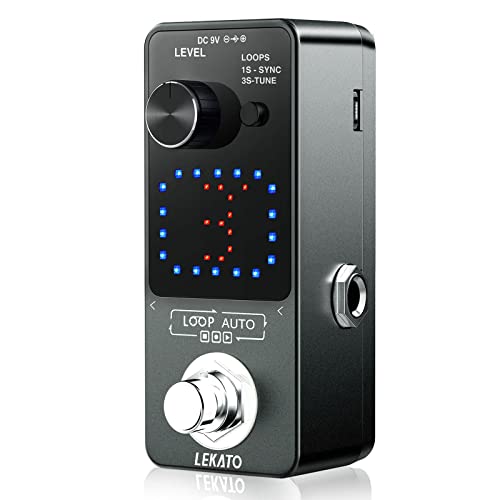
- Three loops and 18 minutes total recording
- Unlimited overdubs with sync and tuner functions
- USB WAV import and export
Best For: Long-form practice, saved ideas, and computer-managed loops
Studio Feature Pick

- 300 minutes of stereo recording across 100 slots
- 220 drum grooves in 11 styles
- USB-C transfer and headphone output
Best For: Home studios wanting drums, storage, and silent practice
Songwriting Flexibility Pick

- Three loop slots and 90 minutes total recording
- Unlimited overdubs for layered parts
- Screen displays status, timing, and progress
Best For: Songwriters arranging verse, chorus, and solo sections
Compact Tone Pick

- Nine loops with 40 minutes total recording
- 48 kHz/24-bit uncompressed audio
- Built-in tuner and USB WAV transfer
Best For: Compact home setups needing clean looping and tuning
Best Simple Looper – BOSS RC-1 Loop Station
The BOSS RC-1 is a straightforward choice for musicians seeking looper pedals for home studios. Its simple controls support recording, playback, overdubbing, and undo/redo, while the 24-segment indicator makes the current loop mode easy to follow.
Best For: Guitarists, bassists, and keyboard players who want an intuitive first looper.
Pros:
- User-friendly operation with dedicated looping functions
- 12 minutes of stereo recording time
- Stereo inputs and outputs with memory retention after power-off
- Includes a 9-volt battery and carries a five-year BOSS warranty
Cons:
- AC adaptor is optional and sold separately
- Offers a more basic feature set than multi-track loopers
The RC-1 favors dependable, uncomplicated looping over extensive storage or advanced routing. It is a practical fit for home-studio musicians who want to build layered phrases without a steep learning curve.
Best Budget Feature Set – LEKATO Looper Pedal With Tuner
The LEKATO looper combines generous recording capacity, a built-in tuner, and USB file transfer in a compact pedal. For looper pedals for home studios, its ability to import and export WAV loops can make it useful for moving ideas between the pedal and a computer.
Best For: Home-studio players who need multiple stored loops, tuning, and computer file management.
Pros:
- Nine loops with up to 40 minutes of total recording time
- Up to 10 minutes for a single recording
- Built-in tuner supports continuous switching
- USB import/export, 48 kHz/24-bit sampling, and unlimited overdubbing
Cons:
- Uses corded power and requires a 9V, 0.6A supply
- Single-knob volume control and one-button foot commands may require practice
With its long recording times and USB workflow, the LEKATO is geared toward experimentation and repeatable studio sessions. It offers more storage-oriented flexibility than a basic looper while remaining focused on core loop functions.
Best Advanced Multi-Track Option – Sheeran Looper +
The Sheeran Looper + is a performance-oriented dual-track unit that also serves as a 2-in/2-out USB audio interface. Among looper pedals for home studios, it stands out for its color display, multiple looping modes, internal storage, and direct DAW or streaming connectivity.
Best For: Advanced creators recording vocals or instruments, managing song-length loops, and integrating looping with a computer.
Pros:
- Four modes: single, multi, sync, and song
- Stores up to 128 loops with over three hours of total audio
- USB audio interface supports recording and streaming
- Includes microphone input, stereo instrument inputs, MIDI, and dual footswitch connectivity
Cons:
- Large and relatively heavy at 1.7 kg
- More complex and performance-focused than a basic practice looper
The LOOPER + is the most capable choice here for layered arrangements and computer-based recording. Its expanded connectivity and storage justify the larger footprint for users who expect their looper to function as part of a broader studio setup.
Best With Drum Machine – MOOER Groove Loop X2
The MOOER Groove Loop X2 combines a stereo looper with an integrated drum machine, giving home-studio players a rhythm foundation alongside phrase recording. It is a strong option among looper pedals for home studios when built-in grooves and tempo control matter as much as looping capacity.
Best For: Musicians who want drum-backed practice, songwriting, and stereo loop recording in one pedal.
Pros:
- 14 save slots with up to 140 minutes of stereo recording
- 121 drum grooves across 11 genres with 11 variations per genre
- Count-in, automatic, and normal recording modes
- Time stretch, tap tempo, separate routing, and audio-file import/export
Cons:
- Requires a 9V DC, 300mA adapter
- Advanced editor and routing features may take time to learn
The Groove Loop X2 is more than a conventional phrase looper: its drum library and synchronization tools can support complete sketching sessions. Separate outputs and editor software add useful flexibility for organized home-studio work.
Best for Easy Setup – TC Electronic Ditto Looper
For guitarists seeking straightforward looper pedals for home studios, the TC Electronic Ditto Looper keeps the workflow focused on recording and layering. It offers five minutes of looping time, unlimited overdubs, and undo/redo functionality in a compact pedal.
Best For: Guitarists who want an intuitive, dedicated looper for practicing, songwriting, and simple studio layering.
Pros:
- Five minutes of loop time with unlimited overdubs
- Undo and redo functions support flexible experimentation
- True bypass and analog-dry-through help preserve the dry signal
- Compact, lightweight design with a single control knob
Cons:
- Requires a separate 9V power supply providing at least 100 mA
- Designed primarily for guitar looping rather than multi-effects processing
The Ditto Looper is a focused choice when you value quick operation and a transparent signal path over extra effects or advanced routing. Its simple feature set can be especially practical in a home studio where fast idea capture matters.
Best All-in-One Workstation – Donner Arena 2000 Multi-Effects Pedal
For home studios that need more than a basic looper, the Donner Arena 2000 combines looping with amp modeling, effects, cabinet simulations, drum rhythms, and recording-friendly connections. Its 60-second looper is part of a broader digital rig designed for practice, demos, and live-style setups.
Best For: Guitarists building versatile home-studio demos or one-person arrangements with effects, drums, looping, and headphone monitoring.
Pros:
- Includes 278 effect types, amp simulations, and cabinet simulations
- 60-second looper plus 40 drum rhythms supports one-person arrangements
- Headphone output is useful for late-night practice and creation
- Offers USB-C, MIDI, Aux In, XLR, and expression-pedal support
Cons:
- More complex and substantially larger than a dedicated looper pedal
- Does not include a battery compartment
- Headphones with an impedance of 32–64 ohms are recommended
The Arena 2000 makes sense if looping is only one part of your studio setup. Its wide selection of effects and connectivity can reduce the need for separate pedals, though users wanting a minimal, immediately intuitive looper may prefer a simpler design.
Best for Extended Looping – LEKATO Looper Pedal
The LEKATO Looper is a practical option among looper pedals for home studios when longer recording time and multiple saved loops matter. It provides three loops, up to six minutes per loop, 18 minutes of total recording time, unlimited overdubbing, and USB transfer for WAV files.
Best For: Guitarists and bassists who want extended loop storage, synchronized recording, tuning, and computer-based loop management.
Pros:
- Three loops with up to six minutes per loop and 18 minutes total time
- Unlimited overdubs with undo, redo, stop, and erase commands
- Sync recording mode and built-in tuner support more controlled practice
- USB import/export and automatic saving allow loop-file management
Cons:
- Requires a separate 9V center-negative power supply
- One-button foot control may require learning multiple foot commands
- Its compact control layout offers fewer dedicated physical controls
With longer recording capacity and USB file transfer, the LEKATO is well suited to developing ideas over multiple sessions. It offers more storage flexibility than a basic single-loop pedal, while remaining focused on looping rather than broad multi-effects processing.
Studio Feature Pick – FLAMMA FF20 Drum Looper
For home studios needing more than basic looping, the FLAMMA FF20 combines a stereo looper, drum machine, display, and file transfer tools. Its 300 minutes of recording, 100 memory slots, and headphone output make it a flexible choice among looper pedals for home studios.
Best For: Solo guitarists, bassists, and home-studio users who want drums, extensive loop storage, and silent practice.
Pros:
- Stores up to 300 minutes across 100 loop slots.
- Includes 220 drum grooves across 11 styles.
- Color screen, USB-C WAV transfer, time stretch, and auto record add useful studio features.
- Headphone output supports quiet practice and monitoring.
Cons:
- Its broader feature set may require more setup than a basic looper.
- Requires a 9V, 300mA power source.
The FF20 is a strong all-in-one option when backing rhythms, deep storage, and computer-friendly file management matter as much as straightforward looping.
Songwriting Flexibility Pick – Donner Triple Looper
The Donner Triple Looper is aimed at players who want separate loop sections without a complicated control layout. With three loop slots, unlimited overdubs, and a status screen, it is a practical choice for songwriting and home-studio practice within the looper pedals for home studios category.
Best For: Guitarists and bassists building verse, chorus, and solo sections with a simple foot-controlled workflow.
Pros:
- Provides three independent loop slots with up to 90 minutes total recording time.
- Unlimited overdubs support layered arrangements.
- Bright screen shows loop status, timing, and recording progress.
- True bypass helps preserve the instrument’s tone when disengaged.
Cons:
- Power supply is not included according to the product notes.
- Storage is limited to three loops compared with higher-capacity models.
- Its one-footswitch design concentrates several commands into foot presses.
The Donner makes sense for focused looping sessions where three organized sections and unlimited layering are more useful than a large library of saved loops.
Compact Tone Pick – LEKATO Looper with Tuner
The LEKATO Looper focuses on compact, straightforward looping while adding a built-in tuner and USB WAV transfer. Its 48 kHz/24-bit uncompressed audio, nine loop locations, and unlimited overdubs make it a capable option for looper pedals for home studios where space and simple operation matter.
Best For: Guitarists and bassists who want a small looper with tuning, overdubbing, and computer file exchange.
Pros:
- Offers nine loops and up to 40 minutes of total recording time.
- Uses 48 kHz/24-bit uncompressed audio with Analog-Dry-Through.
- Includes a built-in tuner with continuous switching.
- USB supports importing and exporting WAV loop files.
Cons:
- One loop can record for up to 10 minutes, with 40 minutes total storage.
- Single-knob operation keeps the design simple but provides fewer dedicated controls.
- Requires a 9V, 300mA power source.
The LEKATO is a sensible compact pick for home recording setups that value clean audio, tuner access, and USB transfers without needing a built-in drum machine.
How We Picked the Best Looper Pedals for Home Studios
We compared these pedals by looking at recording time, loop storage, overdubbing, undo and redo controls, track structure, rhythm features, tuning tools, connectivity, and overall ease of use. For home recording, we also considered stereo operation, signal preservation, screen readability, and whether a pedal can serve more than one role in a compact setup.
The selection covers several use cases: simple practice loopers, dual- and triple-track designs, drum-oriented units, and multi-effects platforms that include looping. Because home studios vary widely, no single pedal is ideal for every guitarist, bassist, or electronic setup.
Quick Comparison
| Best For | What to Prioritize | Product Types to Consider |
|---|---|---|
| Beginners and simple practice | One-switch control, clear status display, reliable bypass | Basic single-loop pedals |
| Song arrangement | Multiple tracks, longer memory, undo and redo | Dual- or triple-loop pedals |
| Rhythm-focused practice | Drum grooves, tempo controls, and sync options | Looper/drum-machine pedals |
| Compact all-in-one rigs | Effects, amp modeling, presets, MIDI, and outputs | Multi-effects units with looping |
Key Buying Factors for Looper Pedals for Home Studios
Loop Time and Storage
Short loop times are sufficient for riffs and practice, while longer recording capacity is more useful for complete song sections. Multiple slots or saved loops matter if you want to preserve ideas instead of replacing them each session.
Track Layout and Foot Control
A basic looper may use one track, whereas dual- or triple-track models let you separate parts and control them independently. Check the footswitch workflow carefully: hands-free recording, stopping, undoing, and redoing are especially important when playing alone.
Drums, Tempo, and Synchronization
Built-in drum grooves can provide a more musical practice experience than a metronome. If you need tightly aligned rhythm and loops, look for tempo controls, quantization, or sync functionality. Drum features can also reduce the need for a separate rhythm device.
Connections and Studio Compatibility
Verify whether the pedal supports stereo input and output, USB transfer, MIDI, XLR connectivity, or external control. True bypass and analog-dry-through can be valuable when preserving your unprocessed guitar signal, while USB may simplify saving or transferring recordings.
Power, Display, and Learning Curve
Confirm the required power supply and current rating before buying. A visible screen can make longer sessions and rhythm programming easier, but simpler pedals often have a faster learning curve and fewer settings to manage.
Who Should Buy Which Looper Pedals for Home Studios?
Choose a straightforward single-loop pedal if you want reliable practice, quick idea capture, and minimal setup. Select a dual- or triple-track model if you build songs in layers or want separate control over rhythm and lead parts. A looper with drums is a better fit for players who practice without a backing track. If you want looping plus effects, amp sounds, recording connections, and MIDI in one unit, a multi-effects pedal can save space and money compared with assembling several separate devices.