A reliable metronome can make acoustic-guitar practice more consistent, whether you are tightening rhythm, learning a new strumming pattern, or building speed gradually. The best choice depends on how much volume you need, whether you want built-in tuning, and how portable your setup should be.
We compare 10 digital, rechargeable, mechanical, and tuner-metronome options to help you find a practical match for home practice, lessons, rehearsals, and performance preparation.
Best 10 Metronomes for Acoustic Guitars Picks for 2026
Best Pocket Practice Hub
Aroma 3-in-1 Digital Metronome Tuner

- Metronome, tuner, and tone generator in one
- 30–260 BPM with 10 beat patterns
- Backlit display and headphone jack
Best For: Portable all-in-one acoustic guitar practice
Best Traditional Choice
Yamaha MP-90BK Pendulum Metronome

- Spring-driven mechanical pendulum
- Rich, deep sound
- Matte finish resists fingerprints
Best For: Classic, focused timing practice
Best Adjustable Digital Combo

- Metronome, tuner, and tone generator
- 30–260 BPM with eight rhythms
- Large angled display and jog dial
Best For: Feature-rich acoustic guitar practice
Best Sound Variety

- Eight selectable metronome sounds
- 19 beat patterns for varied practice
- Memory backup and tuning reference tones
Best For: Flexible rhythm practice and ear training
Rechargeable Versatility
3-in-1 Digital Metronome Tuner

- Rechargeable metronome, tuner, and tone generator
- 30–250 BPM with eight rhythm options
- Pocket-sized design with clip pickup included
Best For: Acoustic guitarists wanting rhythm practice and tuning in one device
Classic Audible Rhythm

- Battery-free wind-up operation
- Audible click and bell ring
- 40–208 BPM with five beat settings
Best For: Beginners and traditionalists practicing in a fixed location
Long-Life Practice Companion

- Up to 400 hours on alkaline batteries
- Larger display and louder buzzer
- Tap tempo, timer, and sound-out modes
Best For: Acoustic guitarists wanting flexible, extended digital practice
Best Rechargeable Practice Metronome
Sondery ProBeat Digital Metronome
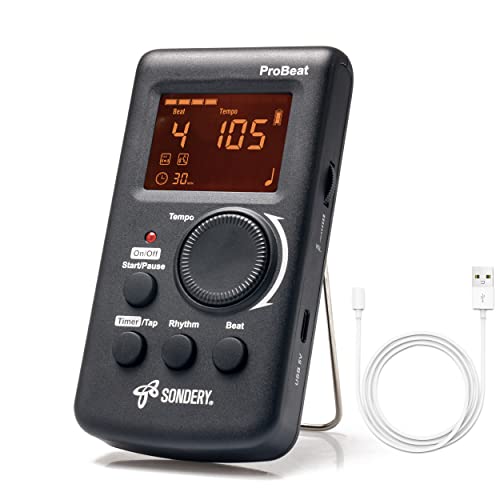
- Rechargeable USB-powered design
- Vocal counting and 10 beat patterns
- LED tempo light and headphone output
Best For: Structured acoustic guitar practice with visual and vocal feedback
Best Tuner-Metronome Combo with Contact Mic
Korg TM-70C Tuner and Metronome

- Includes CM-400 contact microphone
- ±0.1-cent tuning precision
- Bright LCD and adjustable metronome volume
Best For: Players wanting accurate tuning and rhythm practice in one device
Best Compact Tuner-Metronome for Broad Tempo Ranges

- 30–252 BPM tempo range
- Chromatic, transpose, and Sound Out modes
- Compact pocket-friendly design
Best For: Portable acoustic guitar practice with flexible tuning and tempo options
Best Pocket Practice Hub – Aroma 3-in-1 Digital Metronome Tuner
If you want metronomes for acoustic guitars that also reduce the amount of gear in your case, the Aroma AMT-560 combines timing, tuning, and reference tones in a compact digital unit. Its 30–260 BPM range, multiple beat patterns, and backlit display make it practical for daily practice.
Best For: Acoustic guitarists who want a portable metronome, chromatic tuner, and tone generator in one device.
Pros:
- Combines a metronome, tuner, and tone generator in a pocket-sized design.
- Offers 30–260 BPM, 10 beat patterns, and 8 rhythm styles.
- Includes a 45° backlit display, LED cues, adjustable volume, and a headphone jack.
Cons:
- Its tuner is not suitable for piano tuning.
- Requires two AAA batteries.
The AMT-560 is a versatile choice for guitarists who value portability and want both audible and visual timing feedback, especially when practicing in different lighting conditions.
Best Traditional Choice – Yamaha MP-90BK Pendulum Metronome
For players who prefer a traditional approach to metronomes for acoustic guitars, the Yamaha MP-90BK uses a spring-driven pendulum and a rich, deep sound. Its pyramid-style design and matte finish give it a familiar studio and practice-room presence.
Best For: Guitarists who want a classic mechanical metronome with a clear, resonant sound.
Pros:
- Spring-driven pendulum design provides a traditional practice experience.
- Produces a rich and deep metronome sound.
- Matte finish helps resist visible fingerprints.
Cons:
- Does not include the digital tuner or tone-generator functions found on combo units.
- Its larger pyramid-style body is less compact than pocket digital models.
The MP-90BK suits acoustic guitarists who enjoy the visual motion and sound of a mechanical pendulum. Choose it when straightforward, focused timing practice matters more than multifunction convenience.
Best Adjustable Digital Combo – Donner DMT-01 Metronome Tuner
The Donner DMT-01 is a practical option among metronomes for acoustic guitars when you want timing, tuning, and pitch reference in one unit. It supports 30–260 BPM, up to nine beats per measure, and eight rhythms, while its jog dial keeps adjustments straightforward.
Best For: Acoustic guitarists who want an easy-to-control digital practice tool with tuning and tone-generation functions.
Pros:
- Combines a digital tuner, metronome, and tone generator.
- Provides ±0.5-cent tuning accuracy and a sensitive vibration clip.
- Features a large 45° LCD screen and intuitive jog dial.
Cons:
- Requires one AAA battery.
- The supplied details list a USB connector, but do not specify USB charging functionality.
With its broad tempo range, selectable rhythms, and clear display, the DMT-01 is well suited to guitarists who want a feature-rich digital unit without adding separate practice accessories.
Best Sound Variety – Korg KDM-3 Digital Metronome
The Korg KDM-3 stands out among metronomes for acoustic guitars with eight selectable sounds and 19 beat patterns. Its mechanical-style appearance, strong built-in speaker, memory backup, and reference-tone mode make it a flexible practice companion.
Best For: Guitarists who want varied rhythmic sounds, complex beat options, and saved practice settings.
Pros:
- Offers eight sounds, including mechanical metronome, cowbell, rimshot, and voice.
- Provides 19 beat patterns covering triplets, claves, and more.
- Stores tempo, beat, and tuning settings and includes auto power-off.
Cons:
- Uses a CR2 battery.
- Its 3 x 2.5 x 4.5-inch body is less pocket-sized than compact digital units.
The KDM-3 is a strong fit for players who find repetitive clicks distracting or need more rhythmic variety. Its sound-out mode also supports tuning by ear with adjustable A4 calibration from 410–480 Hz.
Rechargeable Versatility – 3-in-1 Digital Metronome Tuner
For guitarists seeking metronomes for acoustic guitars, this rechargeable 3-in-1 unit combines a metronome, tuner, and tone generator in a compact device. It supports microphone, included clip, and direct cable pickup, making it practical for home practice, lessons, and rehearsals.
Best For: Acoustic guitarists who want one portable device for rhythm practice and tuning.
Pros:
- Rechargeable battery with USB charging from a power bank or PC.
- Tempo range of 30–250 BPM, with 0–9 beats and eight rhythms.
- Large color LCD, LED indicator, adjustable volume, and headphone jack.
- Also works with electric guitar, bass, ukulele, violin, mandolin, piano, and wind instruments.
Cons:
- Plastic-and-metal construction may not feel as substantial as a larger mechanical metronome.
- Requires charging rather than operating indefinitely without a power source.
Its broad instrument support and included pickup make this a flexible choice when you want accurate tuning and varied rhythm settings in a pocket-sized format.
Classic Audible Rhythm – Ueteto Mechanical Metronome
This mechanical option gives acoustic guitar players a traditional audible click and bell ring without batteries. Its wind-up design provides a straightforward way to establish tempo while practicing guitar, piano, violin, bass, drums, and other instruments.
Best For: Beginners and players who prefer a battery-free, traditional metronome.
Pros:
- Wind-up mechanism requires no batteries.
- Audible click and bell ring help mark the beat while reading music.
- Tempo range of 40–208 BPM with beat selections of 0, 2, 3, 4, and 6.
- One full wind lasts at least 18 minutes depending on tempo.
Cons:
- Needs rewinding during longer practice sessions.
- At 1.2 pounds, it is less portable than compact digital alternatives.
- It offers fewer beat selections and no tuning function.
Choose this model if you value a clear, familiar mechanical pulse and do not want to manage batteries or charging. Its larger metal construction is better suited to a stable practice-space setup.
Long-Life Practice Companion – Korg MA-2 Digital Metronome
The Korg MA-2 is a compact digital choice for acoustic guitarists who want a clear beat and flexible tempo control. Its larger display, louder buzzer, tap tempo, timer mode, and sound-out mode make it useful for structured daily practice.
Best For: Guitarists who want a dependable digital metronome for extended practice sessions.
Pros:
- Up to approximately 400 hours of continuous operation with alkaline batteries.
- 30% larger display with visible beat indications and a louder electronic buzzer.
- Pendulum, full-step, and tap-tempo modes support flexible rhythm training.
- Offers 0–9 beat settings, eight rhythm types, timer mode, and sound-out mode.
Cons:
- Uses replaceable AAA batteries rather than rechargeable power.
- It is a metronome rather than a combined tuner and metronome.
With its long battery life and clear sound, the MA-2 suits players who want to keep a digital practice tool ready for regular use. Its compact dimensions also make it easy to keep in a guitar case.
Best Rechargeable Practice Metronome – Sondery ProBeat Digital Metronome
For guitarists comparing metronomes for acoustic guitars, the Sondery ProBeat emphasizes quick adjustments and clear feedback. Its rotary dial covers 40–208 BPM, while the color screen, LED tempo light, vocal counting, and multiple sounds support focused practice.
Best For: Acoustic guitar players who want a rechargeable, feature-rich metronome for structured timing practice.
Pros:
- Rechargeable lithium-polymer battery with USB charging.
- Rotary tempo control, tap function, and 10 beat patterns.
- Vocal counting, visual LED tempo indication, timer settings, and headphone output.
Cons:
- Tempo range starts at 40 BPM and tops out at 208 BPM.
- Plastic construction may be less appealing to players seeking a more substantial body.
The ProBeat is a practical choice when you want more than a basic click, especially for timed practice sessions and varied rhythm work. Its compact rechargeable design also suits musicians who practice in multiple locations.
Best Tuner-Metronome Combo with Contact Mic – Korg TM-70C Tuner and Metronome
The Korg TM-70C combines a tuner and metronome in one compact unit, making it a useful option among metronomes for acoustic guitars. Its included CM-400 contact microphone is designed to improve pitch accuracy, while the bright LCD and adjustable metronome volume support everyday practice.
Best For: Acoustic guitarists who want precise tuning and metronome functions in a single portable device.
Pros:
- Includes a CM-400 contact microphone for enhanced pitch accuracy.
- Offers ±0.1-cent tuning precision and chromatic tuning from C1 to C8.
- Bright LCD display, wide metronome tempo range, and volume control.
Cons:
- Its supplied notes do not specify the metronome’s exact tempo limits.
- It is a tuner-metronome combo rather than a dedicated practice-only metronome.
This model is especially convenient for players who regularly alternate between tuning and rhythm work. The contact microphone can help isolate the instrument’s pitch in practice environments.
Best Compact Tuner-Metronome for Broad Tempo Ranges – Korg TM-70T Tuner & Metronome
For shoppers seeking metronomes for acoustic guitars that also support tuning, the Korg TM-70T offers a compact all-in-one design. It provides a 30–252 BPM tempo range, improved metronome sound, and chromatic or transpose tuning modes in a pocket-friendly format.
Best For: Guitarists who value portability, a broad tempo range, and integrated tuning functions.
Pros:
- Wide 30–252 BPM range for slow and fast practice.
- ±0.1-cent tuning precision with chromatic and transpose modes.
- Sound Out mode, adjustable calibration, and improved display visibility.
Cons:
- No contact microphone is listed among the included components.
- Its compact design may provide fewer dedicated controls than a larger metronome.
The TM-70T is a strong fit for players who want one small device for timing, tuning, and ear training. Its broad tempo coverage makes it adaptable as practice speeds change.
How We Picked the Best Metronomes for Acoustic Guitars
We focused on features that matter during real acoustic-guitar practice: dependable tempo control, clear beat indication, audible output, portability, and ease of operation. Because many guitarists want to tune and practice without carrying several accessories, we also considered combination models with chromatic tuners, tone generators, contact microphones, or sound-out modes.
The selection includes compact digital units, rechargeable designs, traditional mechanical metronomes, and advanced tuner-metronome combinations. This range makes it easier to match the device to your practice space, playing level, and preferred workflow.
Quick Comparison
| Type | Best For | Main Advantage |
|---|---|---|
| Basic digital | Everyday practice | Compact controls and flexible tempos |
| Tuner-metronome | Guitarists who want one device | Combines tuning and rhythm practice |
| Rechargeable | Frequent users | Less dependence on disposable batteries |
| Mechanical | Strong visual and audible pulse | Classic operation with no electronic setup |
| Advanced tuner-metronome | Performers and serious students | Contact-mic and specialized tuning features |
Key Buying Factors for Metronomes for Acoustic Guitars
Volume and Beat Clarity
An acoustic guitar can easily mask a quiet metronome. Look for a model with a strong speaker, adjustable volume, a clear visual display, or a headphone-compatible output if you practice in a noisy room.
Tempo Range and Rhythm Options
Basic tempo adjustment is enough for many players, but subdivisions, accent patterns, tap tempo, and different beat settings can make rhythm drills more useful. A wide range also helps as your technique develops.
Tuner Functions
A built-in chromatic tuner is convenient for daily practice. Contact-mic support can improve tuning accuracy in louder environments, while transpose and sound-out modes are helpful for alternate tunings or ensemble work.
Power and Portability
Check whether the unit uses replaceable batteries, USB charging, or another power source. Compact models travel well, while mechanical versions are useful when you want a simple device that is always ready without electronic controls.
Who Should Buy Which Metronomes for Acoustic Guitars?
Choose a compact digital metronome if you want straightforward tempo practice at a desk, in a lesson, or in a gig bag. A tuner-metronome is the better all-in-one choice for guitarists who tune frequently and want fewer accessories. Rechargeable models suit regular players who prefer convenient charging, while a mechanical metronome is ideal if you value a loud, familiar pulse and traditional operation.
For advanced students, performers, and players who practice in varied environments, a model with a contact microphone, sound-out function, or transpose mode offers more control. Before buying, prioritize the feature you will use every session: a clear pulse, fast tuning, portability, or expanded rhythm and tuning options.