The best MIDI keyboard can make composing, arranging, and performing in your DAW feel faster and more natural. This roundup compares 10 controllers across compact, portable, full-size, and feature-rich designs.
Whether you need drum pads and knobs for beat production or a longer keybed for piano parts, these options cover practical studio and home-production needs at several price points.
Best 10 Midi Keyboards for Production Picks for 2026
Compact Beatmaking Powerhouse

- 25 velocity-sensitive mini keys with 10-octave range
- Eight RGB MPC pads and eight assignable 360-degree knobs
- Includes instruments, DAW tools, Melodics, and Splice access
Best For: Portable beatmaking and compact production setups
Essential Full-Size Control

- 49 full-size velocity-sensitive keys
- Pitch/modulation wheels, transport controls, and sustain input
- Includes DAW software, virtual instruments, and lessons
Best For: Straightforward keyboard-led studio production
DAW Workflow Specialist

- 49 keys, 16 polyphonic-aftertouch pads, and nine faders
- Scale, Chord, arpeggiator, sequencing, and clip-launching tools
- Broad DAW integration plus OLED display and NKS support
Best For: Hands-on DAW control and expressive arrangement
Full Piano-Range Foundation

- 88 full-size velocity-sensitive semi-weighted keys
- Pitch/modulation wheels, transport controls, and sustain input
- Includes Ableton Live Lite and multiple virtual instruments
Best For: Piano-style playing and wide-range composition
Portable Beatmaker
M-VAVE K5 25-Key MIDI Controller

- 25 velocity-sensitive keys with 8 RGB pads
- Bluetooth and USB connectivity with built-in battery
- Eight knobs and touch pitch-bend strips
Best For: Mobile producers and compact beatmaking setups
Studio Control Center

- 49 full-size velocity-sensitive keys
- Eight pads, eight knobs, and nine faders
- Includes DAW software and NKS integration
Best For: Studio producers needing range and extensive hands-on control
Hybrid Composer

- 37 keys across three full octaves
- Built-in 64-step drum and melody sequencer
- CV/Gate, MIDI I/O, pads, and eight knobs
Best For: Producers combining DAW work with hardware or modular gear
Best Value 61-Key Controller

- 61 full-size keys for comfortable playing
- DAW integration and broad MIDI compatibility
- Includes Bitwig Studio 8-Track
Best For: Beginners and value-focused producers who want full-size keys
Best Compact Beat-Making Controller

- 25 velocity-sensitive mini keys
- Eight MPC-style pads and eight knobs
- Includes production software and sound content
Best For: Beat makers and compact home-studio setups
Best Full-Size Production Control
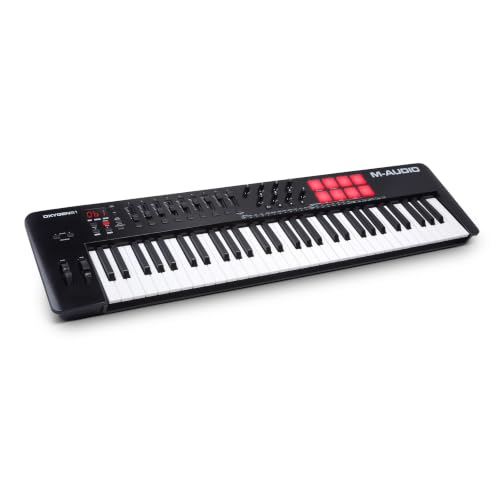
- 61 velocity-sensitive full-size keys
- Pads, knobs, and nine assignable faders
- Includes DAW and virtual-instrument software
Best For: Producers needing full-range keys and extensive tactile DAW control
Compact Beatmaking Powerhouse – Akai MPK Mini IV
For producers seeking compact midi keyboards for production, the Akai Professional MPK Mini IV combines 25 velocity-sensitive mini keys with performance-focused pads, knobs, and software controls. Its portable design suits desktop studios, mobile setups, and beatmaking on the go.
Best For: Beatmakers, beginners, traveling producers, and creators who want pads and hands-on controls in a compact controller.
Pros:
- Eight RGB MPC pads support velocity- and pressure-sensitive finger drumming.
- Eight assignable 360-degree knobs, a color screen, and push-turn encoder provide hands-on control.
- Chord, Scale, and advanced arpeggiator modes encourage quick idea generation.
- Includes a broad virtual instrument collection, DAW software, Melodics trial, and Splice access.
Cons:
- Its 25 mini keys offer less traditional playing space than 49- or 88-key models.
- The compact layout may be less suitable for extended two-handed piano performance.
The MPK Mini IV is a versatile choice when portability and beat-oriented control matter more than a full-size keybed. USB-C, MIDI Out, and mobile-friendly connectivity add flexibility across setups.
Essential Full-Size Control – M-Audio Keystation 49 MK3
The M-Audio Keystation 49 MK3 is a straightforward option among midi keyboards for production, offering 49 full-size velocity-sensitive keys and essential controls for software instruments. Its plug-and-play USB design keeps setup simple for home studios and desks.
Best For: Producers and players who want a practical full-size keybed with basic DAW controls and bundled software.
Pros:
- Forty-nine full-size velocity-sensitive keys provide more playing room than compact controllers.
- Pitch and modulation wheels, octave buttons, and sustain input support expressive playing.
- Volume, transport, and directional controls help manage software without constant mouse use.
- Includes MPC Beats, Ableton Live Lite, virtual instruments, lessons, and other production software.
Cons:
- It has fewer dedicated creative controls than pad- and knob-heavy controllers.
- iOS use requires an Apple to USB Camera Adapter, sold separately.
The Keystation 49 MK3 focuses on the fundamentals: a comfortable key range, familiar performance controls, and uncomplicated computer connectivity. It is a sensible fit when keyboard play is the priority.
DAW Workflow Specialist – Novation Launchkey 49 MK4
The Novation Launchkey 49 MK4 is built for hands-on DAW work, making it a strong contender among midi keyboards for production. Its 49-key layout is paired with 16 polyphonic-aftertouch pads, faders, an OLED display, and creative modes for composing and arranging.
Best For: Producers who want deep DAW interaction, clip launching, sequencing, and expressive pad performance.
Pros:
- Sixteen FSR pads support drumming, clip launching, step sequencing, and chord triggering.
- Scale Mode, Chord modes, and arpeggiator tools help develop ideas quickly.
- Broad integration covers Ableton Live, Logic, Cubase, Reason, Reaper, FL Studio, and Ardour.
- Nine faders, pitch/mod wheels, OLED display, USB-C, and NKS support expand workflow control.
Cons:
- At 9 pounds and over 31 inches wide, it is less convenient for highly portable setups.
- Its many controls may be more than beginners need for a basic keyboard-only workflow.
Choose the Launchkey 49 MK4 when production involves more than playing notes. Its combination of expressive pads, DAW integration, sequencing features, and visual feedback makes it particularly workflow-oriented.
Full Piano-Range Foundation – M-Audio Keystation 88 MK3
For producers who need the range of a traditional piano, the M-Audio Keystation 88 MK3 is a practical choice among midi keyboards for production. It provides 88 full-size velocity-sensitive semi-weighted keys alongside essential DAW and performance controls.
Best For: Pianists, composers, and producers who need broad keyboard range for virtual instruments and realistic parts.
Pros:
- Eighty-eight full-size semi-weighted keys provide complete piano-range coverage.
- Pitch and modulation wheels, octave buttons, and sustain input support expressive performances.
- USB-powered plug-and-play operation avoids drivers and a separate power supply on Mac or PC.
- Includes MPC Beats, Ableton Live Lite, Mini Grand, Xpand!2, Touch Loops, and Velvet.
Cons:
- Its 54.24-inch width and 13.8-pound weight require substantial space.
- The keyboard-focused design has fewer pads and dedicated sound-shaping controls than advanced controllers.
- iOS connectivity requires an Apple to USB Camera Adapter, sold separately.
The Keystation 88 MK3 is best viewed as a spacious performance keyboard rather than an all-in-one pad controller. Its semi-weighted, full-range keybed makes it well suited to piano parts, orchestration, and broad melodic work.
Portable Beatmaker – M-VAVE K5 25-Key MIDI Controller
The M-VAVE K5 is a compact choice for producers who want portable control in a setup built around midi keyboards for production. Its 25 velocity-sensitive keys, drum pads, knobs, and wireless Bluetooth connectivity cover melodic parts, beat making, and hands-on plugin control without taking up much space.
Best For: Mobile producers, beatmakers, and songwriters who want Bluetooth connectivity and a compact controller.
Pros:
- 25 velocity-sensitive keys with 8 RGB backlit velocity-sensitive pads.
- Bluetooth connectivity and a built-in 2,000 mAh battery rated for about 16 hours of use.
- Eight assignable knobs plus pitch-bend touch strips for plugin and mixing control.
- Works with Windows, Mac OS, Android, iOS, and major DAWs listed by the manufacturer.
Cons:
- Its 25-key layout offers less range than larger controllers.
- Mini keys may be less suitable for players who prefer full-size piano-style keys.
- The controller has one USB port.
The K5 stands out when portability and wireless operation matter more than an expansive keyboard range. Its built-in pads and control surface make it a flexible option for sketching ideas and producing away from the main studio.
Studio Control Center – M-AUDIO Oxygen 49 MKV
The M-AUDIO Oxygen 49 MKV is designed for producers who need more playing range and extensive hands-on DAW control. Among midi keyboards for production, it combines 49 full-size velocity-sensitive keys with drum pads, knobs, faders, wheels, and bundled production software.
Best For: Studio producers who want full-size keys, broad control over software instruments, and a larger physical interface.
Pros:
- 49 full-size, velocity-sensitive piano-style keys provide a natural playing response.
- Eight backlit pads with Note Repeat support beat production, clip launching, and triggering.
- Eight assignable knobs and nine assignable faders offer detailed tactile control.
- Includes DAW and instrument software, plus NKS integration and Smart Chord and Smart Scale modes.
Cons:
- Its 32-inch width and 6.7-pound weight make it less portable than compact controllers.
- Connectivity is USB-based, with no Bluetooth listed in the supplied specifications.
- The larger control layout may be more than needed for simple mobile setups.
Choose the Oxygen 49 MKV when keyboard range and studio-style control are priorities. The faders, pads, and bundled software give it a strong fit for arranging, beat production, and detailed DAW workflows.
Hybrid Composer – Akai MPK Mini Plus 37-Key
The Akai Professional MPK Mini Plus adds three octaves of keys, performance pads, sequencing, and hardware connectivity to the midi keyboards for production category. It is a versatile USB controller for producers who want to compose in a DAW while also connecting to modular gear, synthesizers, or other MIDI equipment.
Best For: Producers who want a compact controller with 37 keys, standalone sequencing features, and CV/Gate or MIDI connectivity.
Pros:
- 37-key layout provides three full octaves for melodic and harmonic performance.
- Built-in 64-step sequencer supports separate drum and melody or chord tracks.
- Eight RGB MPC pads, eight assignable knobs, and Chords and Scales modes support performance and production.
- Offers CV/Gate and MIDI I/O in addition to USB, with MPC Beats software included.
Cons:
- The supplied notes specify USB connectivity but do not list Bluetooth.
- Its compact key count provides less range than a 49-key controller.
- It is intended for Windows and Mac DAW setups rather than mobile platforms listed for some competitors.
The MPK Mini Plus is a strong middle ground between a small beatmaking controller and a more capable composition hub. Its sequencer and hardware connections make it especially appealing if your workflow extends beyond computer-based production.
Best Value 61-Key Controller – Nektar SE61
The Nektar SE61 is a practical choice for anyone shopping for midi keyboards for production and wanting a full-size 61-key layout without an overly complex control surface. It works with Mac, Windows PC, Linux, and iOS systems, and includes Nektar DAW integration for several popular music applications.
Best For: Beginners and producers who want full-size keys, broad software compatibility, and strong value.
Pros:
- 61 full-size keys provide a familiar playing layout.
- Nektar DAW integration supports popular DAWs including Logic, Cubase, GarageBand, Reaper, and Studio One.
- Compatible with MIDI music software on Mac, PC, and iOS.
- Includes a Bitwig Studio 8-Track license and sound content package.
Cons:
- Its supplied notes do not list drum pads, knobs, faders, or built-in arpeggiator features.
- USB is the listed connectivity option, so it requires a compatible host device.
The SE61 focuses on the essentials: a spacious keyboard and broad MIDI compatibility. It is especially appealing when playable range and affordability matter more than extensive hands-on beat-making controls.
Best Compact Beat-Making Controller – Akai MPK Mini MK3
The Akai Professional MPK Mini MK3 is a compact option for midi keyboards for production, combining 25 velocity-sensitive mini keys with beat pads, assignable knobs, pitch and modulation control, and a built-in arpeggiator. Its USB-powered design suits small home studios and mobile-style setups using Windows or Mac computers.
Best For: Beat makers, portable setups, and producers who prioritize pads and compact plugin control.
Pros:
- Eight backlit velocity-sensitive MPC-style pads support drum programming, sample triggering, Note Repeat, and Full Level.
- Eight assignable 360-degree knobs provide hands-on control of plugins and synth parameters.
- Built-in arpeggiator and four-way thumbstick add pitch, modulation, and pattern-control options.
- Includes MPC Beats, three virtual instruments, 2GB of sound content, and a Splice trial.
Cons:
- The 25 mini keys offer less playing range than a 61-key controller.
- It is USB-powered and intended for USB-compatible devices rather than standalone operation.
The MPK Mini MK3 packs substantial beat-making functionality into a small footprint. Choose it when portability, pads, and assignable controls are more important than full-size keys.
Best Full-Size Production Control – M-AUDIO Oxygen 61 MKV
The M-AUDIO Oxygen 61 MKV is designed for midi keyboards for production users who want a full-size playing surface plus extensive hands-on DAW control. Along with 61 velocity-sensitive keys, it provides drum pads, knobs, faders, pitch and modulation wheels, Smart Chord and Smart Scale modes, and an arpeggiator.
Best For: Producers who need broad keyboard range and tactile control over instruments, effects, and mixer functions.
Pros:
- 61 velocity-sensitive full-size piano-style keys provide a natural response for virtual instruments.
- Eight beat pads, eight assignable knobs, and nine assignable faders support beat production and DAW control.
- Includes auto-mapping, Smart Chord, Smart Scale, arpeggiator, pitch and mod wheels, and sustain-pedal input.
- Bundled software includes MPC Beats, Ableton Live Lite, two AIR Music Tech instruments, and MPC expansions.
Cons:
- Its full-size 61-key design takes considerably more space than compact controllers.
- The supplied details list USB connectivity and do not indicate standalone operation.
- The listed Windows platform support may require checking compatibility if you use another operating system.
The Oxygen 61 MKV is the most control-oriented option here, pairing a wide keyboard with pads, faders, knobs, and production-focused modes. It is a strong fit for users who want to perform and mix from one controller.
How We Picked the Best Midi Keyboards for Production
We selected these controllers based on the features that matter most in a real production setup: key count, key feel, portability, DAW control, drum pads, assignable knobs, connectivity, and overall workflow value. The list includes compact 25-key models, versatile 37- and 49-key controllers, and full-size 61- and 88-key options.
Compatibility is also important. Most USB MIDI keyboards work with major DAWs, but the depth of integration varies. Before buying, check the included software, operating-system support, and whether your preferred DAW offers dedicated mappings or transport controls.
Quick Comparison
- Best for portability: Akai Professional MPK Mini IV or MPK Mini MK3
- Best compact step up: Akai Professional MPK Mini Plus
- Best for Ableton-style control: Novation Launchkey 49 MK4
- Best 49-key value: M-Audio Keystation 49 MK3
- Best for expanded control: M-Audio Oxygen 49 MKV or Oxygen 61 MKV
- Best for piano-range playing: M-Audio Keystation 88 MK3
- Best simple 61-key controller: Nektar SE61
- Best budget feature mix: M-VAVE 25 Key Controller
Key Buying Factors for Midi Keyboards for Production
Key Count and Available Space
Twenty-five keys are convenient for travel and compact desks, but they may require frequent octave shifts. Thirty-seven keys offer more room for melodies and bass lines without taking over a workspace. Forty-nine keys are a strong middle ground for most producers, while 61 or 88 keys suit piano-focused players and arrangements spanning a wider range.
Key Feel and Playing Style
Light synth-action keys are usually responsive for leads, bass, and fast sequencing. Semi-weighted keys can feel more substantial for chords and expressive parts. If realistic piano technique is a priority, focus on longer keybeds and consider whether the controller provides the response you expect; many MIDI controllers are not fully weighted.
Controls, Pads, and DAW Integration
Knobs, faders, pads, transport buttons, and dedicated software integration can reduce mouse use during production. Choose a pad-equipped model if you build drum patterns, and prioritize knobs or faders if you automate effects, instruments, or mixer levels.
Portability and Connectivity
USB power and USB-C connectivity simplify mobile setups, while Bluetooth can be useful for cable-free work when supported by your devices. Also check the controller’s dimensions, included cables, sustain-pedal input, and whether it requires a powered hub.
Who Should Buy Which Midi Keyboards for Production?
Choose a 25-key controller if desk space, portability, or beat-making is your priority. Choose 37 keys if you want a compact keyboard with more melodic range. Choose 49 keys for the best all-around balance of playability and workspace efficiency.
Choose 61 keys if you regularly play two-handed parts or need a broader range without moving octaves. Choose 88 keys if piano-style playing is central to your workflow. Finally, select a feature-rich controller with pads, knobs, and DAW integration when hands-on arrangement and mixing matter more than keeping the setup minimal.