Choosing among the best MIDI keyboards with pads means balancing playable keys, responsive drum controls, software compatibility, and portability. The right controller can make beat programming and melody writing feel faster and more intuitive.
This roundup compares compact 25- and 32-key models with larger 37- and 61-key options, plus wireless and performance-focused designs. Use the guide below to match the controller’s layout and features to your workflow.
Best 10 Midi Keyboards with Pads Picks for 2026
Compact Beat-Making Pick

- 25 velocity-sensitive mini keys with eight MPC-style pads
- Thumbstick, arpeggiator, and eight assignable knobs
- Includes production software and sound content
Best For: Portable beat making and home-studio production
Workflow-Friendly Choice

- 25 velocity-sensitive keys with 16 RGB-backlit pads
- Adds faders, encoders, display, and browsing controls
- Includes Ableton Live Lite and virtual instruments
Best For: Hands-on production with compact visual controls
Full-Range Production Controller
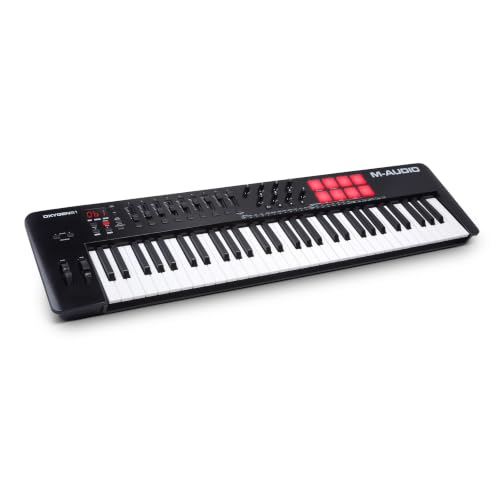
- 61 full-size velocity-sensitive keys
- 16 backlit pads with Note Repeat
- Eight knobs, nine faders, and bundled software
Best For: Studio production requiring range and extensive controls
Wireless Standalone Option
K32 Wireless 32-Key MIDI Keyboard

- 32 keys, eight pads, eight knobs, and OLED display
- Built-in sounds and speakers for immediate play
- BLE MIDI with rechargeable battery and up to six hours of use
Best For: Portable creation, lessons, and wireless performance
Best Compact Production Pick

- 32 velocity-sensitive mini keys
- Eight RGB pads with Note Repeat
- DAW mapping, knobs, and faders
Best For: Compact beat making and DAW control
Best Portable Beginner Controller

- 25 velocity-sensitive slim keys
- 16 RGB pads in two banks
- Software bundle and DAW integration
Best For: Portable production and beginner workflows
Best Standalone Sequencing Features

- 37-key, three-octave keybed
- Eight RGB MPC pads
- Built-in 64-step sequencer and CV/Gate
Best For: Hybrid computer and hardware production
Scale-Smart Portable Pick

- Eight drum pads plus arpeggio, note repeat, and chord functions
- 16 smart scales and OLED display support guided creation
- USB-C, mobile compatibility, and 40 teaching courses
Best For: Beginners and mobile-focused DAW producers
Standalone Beatmaking Choice

- Built-in speaker and 100-plus internal drum and instrument sounds
- Eight backlit MPC pads with arpeggiator and note repeat
- Battery or USB power plus a broad software bundle
Best For: Portable beat making and standalone idea sketching
Wireless Performance Option

- Bluetooth and rechargeable battery offer about 16 hours of use
- Eight RGB pads, eight knobs, and two touch strips
- Works with Windows, Mac, Android, and iOS
Best For: Wireless mobile and multi-device music production
Compact Beat-Making Pick – Akai MPK Mini MK3
The Akai Professional MPK Mini MK3 is a compact choice for shoppers seeking midi keyboards with pads for beat production, software instruments, and home-studio control. Its 25 velocity-sensitive mini keys, eight MPC-style pads, arpeggiator, and assignable knobs provide a focused setup in a portable format.
Best For: Beat makers, home-studio producers, and musicians who want a compact controller with hands-on drum and plugin control.
Pros:
- Eight velocity-sensitive MPC-style pads include Note Repeat and Full Level.
- Four-way thumbstick provides pitch and modulation control.
- Includes an arpeggiator, eight assignable knobs, and a broad software bundle.
- USB-powered and compact for portable setups.
Cons:
- 25 mini keys offer less playing range than larger controllers.
- Requires a USB-compatible device and compatible DAW for software-based use.
The MPK Mini MK3 is a practical option when pads and portability matter more than full-size keys. Its included software and customizable controls also give new producers room to build a flexible workflow.
Workflow-Friendly Choice – Arturia MiniLab 3
The Arturia MiniLab 3 is an approachable option among midi keyboards with pads, combining 25 velocity-sensitive keys with RGB-backlit pads, rotary encoders, faders, and a display. It is designed for hands-on control of instruments, tracks, drums, and software workflows.
Best For: Producers who want a compact all-in-one controller with colorful pads, visual feedback, and bundled music software.
Pros:
- Two banks of eight velocity- and pressure-sensitive RGB pads support drum programming.
- Includes eight rotary encoders, four faders, a clickable browsing knob, and a mini display.
- Features pitch and modulation touch sensors plus a built-in arpeggiator.
- Bundled software includes Ableton Live Lite, Analog Lab Intro, and UVI Model D.
Cons:
- 25 slim keys provide less range than a full-size keyboard.
- The controller is primarily intended for computer-based setups through USB.
The MiniLab 3 stands out for integrating pads, faders, browsing, and visual feedback in a compact controller. Its control layout suits users who want to spend less time reaching for a mouse while producing.
Full-Range Production Controller – M-Audio Oxygen 61 MKV
The M-Audio Oxygen 61 MKV gives shoppers seeking midi keyboards with pads a much larger playing surface without giving up beat and DAW controls. It combines 61 full-size velocity-sensitive keys with 16 backlit pads, assignable knobs, faders, and performance features.
Best For: Producers and keyboard players who need full-size keys, broad range, and extensive hands-on control in a studio setup.
Pros:
- 61 full-size velocity-sensitive keys provide more room for chords, bass lines, and melodies.
- Two banks of eight pads include Note Repeat for beat production and clip launching.
- Eight knobs and nine faders support tactile plugin and DAW control.
- Includes Smart Chord, Smart Scale, arpeggiator, pitch and mod wheels, and production software.
Cons:
- Its 38.4-inch width is less suitable for small desks or frequent travel.
- At 7.6 pounds, it is substantially less portable than mini controllers.
- The supplied details list Windows platforms rather than broad operating-system support.
The Oxygen 61 MKV is the strongest fit here for players who prioritize keyboard range alongside pads. Its larger footprint is justified when faders, knobs, and full-size keys are central to the workflow.
Wireless Standalone Option – K32 Wireless 32-Key MIDI Keyboard
The wireless 32-key MIDI keyboard controller is a distinctive choice among midi keyboards with pads because it combines BLE MIDI, built-in sounds, speakers, and a rechargeable battery. Its 32 keys, eight drum pads, knobs, and OLED display support portable creation beyond a traditional desk setup.
Best For: Mobile creators, learners, teachers, and performers who want wireless flexibility and built-in sound options.
Pros:
- Wireless BLE MIDI and up to six hours of battery life support portable use.
- Built-in sounds and speakers allow music making without immediately connecting a computer.
- Eight assignable knobs, eight drum pads, and an OLED display provide hands-on control.
- Dedicated sound buttons enable quick switching between instruments such as piano, synth, bass, and strings.
Cons:
- The supplied details do not specify the included sound library or complete software compatibility.
- Battery life is limited to up to six hours.
- Wireless pairing may require the Synido BLE Connect app with compatible software.
The K32 is a flexible alternative for users who do not want to be tied to a computer or desk. Its built-in speakers and sounds make it especially practical for ideas, lessons, and casual performance, while the pads and knobs extend its controller functionality.
Best Compact Production Pick – M-AUDIO Oxygen Pro Mini 32
The M-AUDIO Oxygen Pro Mini is a practical choice among midi keyboards with pads when you want more keys than a typical 25-key controller without giving up portability. Its 32 velocity-sensitive mini keys, eight RGB drum pads, and DAW-focused controls support beat making, clip launching, and hands-on software control.
Best For: Producers who want a compact controller with 32 keys, drum pads, and broad DAW integration.
Pros:
- 32 velocity-sensitive semi-weighted mini keys provide a larger range than many compact controllers.
- Eight RGB backlit pads include Note Repeat for beat production and clip launching.
- Includes four knobs, four faders, Smart Chord, Smart Scale, and an arpeggiator.
- Supports automatic mapping for several DAWs and includes MPC Beats and Ableton Live Lite.
Cons:
- Mini keys may not suit players who prefer full-size keys.
- It is USB-powered, so it depends on a connected computer or compatible setup for power.
Choose this model if you need a compact but control-heavy workstation for computer-based production. The combination of 32 keys, eight pads, and assignable controls makes it particularly versatile for arranging and beat-focused workflows.
Best Portable Beginner Controller – Arturia MiniLab 3 Mint Green
The Arturia MiniLab 3 is a portable option among midi keyboards with pads, combining 25 velocity-sensitive slim keys with two banks of eight RGB-backlit pads. Its compact layout, display, browsing knob, and included software make it easy to start producing, practicing, or jamming with a laptop.
Best For: Beginners and mobile producers who want a compact controller with pads and included music software.
Pros:
- Includes 25 velocity-sensitive keys, 16 pads across two banks, eight knobs, and four sliders.
- Built-in arpeggiator, Hold and Chord modes, and pitch and modulation touch sensors expand performance options.
- Offers USB-C, MIDI Out, and integration with Ableton Live, Logic Pro, Reason, Bitwig, and FL Studio.
- Includes Analog Lab V, Ableton Live Lite, UVI Model D, NI The Gentleman, and trial subscriptions.
Cons:
- The 25-key layout provides less range than the 32- and 37-key alternatives.
- Slim keys may feel less substantial to players accustomed to full-size keyboards.
This is a strong fit when portability and a beginner-friendly workflow matter most. Its unusually generous software bundle and dual pad banks add value for users building a compact production setup.
Best Standalone Sequencing Features – Akai MPK Mini Plus 37
The Akai Professional MPK Mini Plus stands out among midi keyboards with pads for its 37-key range and built-in sequencing features. Along with eight RGB MPC pads and eight assignable knobs, it offers CV/Gate and MIDI connectivity for integrating modular gear, sound modules, and synthesizers.
Best For: Producers who need a wider compact keybed, MPC-style pads, and hardware-oriented connectivity.
Pros:
- 37 keys provide three full octaves for melodic and harmonic performance.
- Eight responsive RGB MPC pads support dynamic beat production and performance.
- Built-in 64-step sequencer supports separate drum and melody or chord tracks.
- CV/Gate and MIDI I/O enable connections to modular equipment and external sound sources.
Cons:
- Its deeper sequencing and hardware connectivity may be more than casual users need.
- USB is the listed computer connection, so computer-based setups still require a cable.
The MPK Mini Plus is the most hardware-friendly choice in this group. Its 37 keys, sequencer, pads, and CV/Gate connections make it suitable for producers who want to move beyond basic computer-only MIDI control.
Scale-Smart Portable Pick – Donner DMK 25 Pro
The Donner DMK 25 Pro is a compact option for shoppers seeking midi keyboards with pads, especially if guided scale features and mobile compatibility matter. Its 25 velocity-sensitive keys, eight drum pads, OLED display, and USB-C connection suit portable DAW-based production.
Best For: Beginners and mobile-focused producers who want smart scales, built-in creative controls, and bundled learning resources.
Pros:
- Includes eight drum pads, arpeggio, note repeat, chord functions, and four assignable wheels.
- Smart Dynamic Scale Mode offers 16 scale options for melodies, bass lines, and leads.
- USB-C adapter supports connection to compatible computers, phones, and tablets.
- Includes 40 keyboard-teaching courses and access to four DAW software offerings.
Cons:
- It produces no sound on its own and requires a phone or computer with DAW software.
- Additional adapters may be needed for devices using Micro USB or Lightning connections.
- Its 25-key format is less suitable for players wanting a full piano-style range.
The DMK 25 Pro stands out as a compact learning and songwriting controller rather than a standalone instrument. Its scale assistance and software bundle add value for newcomers, while the pads and transport controls support practical DAW workflows.
Standalone Beatmaking Choice – Akai MPK Mini Play MK3
The Akai MPK Mini Play MK3 is a strong choice among midi keyboards with pads for beat makers who want flexibility away from a computer. It combines 25 dynamic keys, eight velocity-sensitive backlit MPC pads, built-in sounds, a speaker, and USB MIDI control.
Best For: Beat makers, songwriters, and musicians who want standalone playing as well as computer-based production.
Pros:
- Built-in speaker and more than 100 internal drum and instrument sounds allow standalone use.
- Eight velocity-sensitive backlit MPC pads, an arpeggiator, note repeat, and four encoder knobs support performance.
- Can run on batteries or USB power for portable use.
- Includes MPC Beats, AIR Music Tech instruments, Melodics lessons, and a Splice trial.
Cons:
- Batteries are not included.
- USB connectivity is specified for Mac and Windows, rather than mobile platforms.
- The compact 25-key layout offers less playing range than a larger controller.
Unlike many compact MIDI controllers, the MPK Mini Play MK3 does not depend entirely on a DAW because it includes internal sounds and a speaker. That makes it particularly appealing for sketching ideas anywhere, while its USB MIDI functions keep it useful in a studio setup.
Wireless Performance Option – M-VAVE K5 25-Key Controller
The M-VAVE K5 is a practical pick for shoppers comparing midi keyboards with pads and prioritizing wireless portability. It pairs 25 velocity-sensitive keys with eight RGB backlit pads, eight assignable knobs, touch strips, Bluetooth, and a rechargeable battery.
Best For: Producers who want a compact wireless controller for working across computers, phones, and tablets.
Pros:
- Bluetooth connectivity and a 2,000 mAh battery provide up to about 16 hours of wireless use.
- Eight RGB backlit velocity-sensitive pads and eight assignable rotary encoders offer hands-on control.
- Two capacitive touch strips provide pitch-bend and plugin-control options.
- Supports Windows, Mac OS, Android, and iOS, along with major DAWs listed by the manufacturer.
Cons:
- It does not include built-in speakers or internal sounds in the supplied specifications.
- Wireless operation requires managing battery charging and Bluetooth compatibility.
- The 25-key format may feel limited for extended two-handed keyboard parts.
The K5’s main advantage is freedom from a USB cable when composing or performing with compatible devices. Its pads, knobs, and touch strips give it a broad control surface, while smart chord and sound features can simplify practice and live use.
How We Picked These Midi Keyboards with Pads
We focused on controllers that combine a piano-style keyboard with dedicated drum pads, since that layout supports both melodic playing and beat production. We also considered key count, pad quantity and illumination, knob and control assignments, portability, connectivity, software integration, and useful extras such as arpeggiators, scales, displays, speakers, or Bluetooth.
Because buyers have different setups, the selection includes compact travel controllers, mid-size performance models, and a full 61-key option. Features and bundled software can vary by revision or retailer, so confirm the current specifications before purchasing.
Quick Comparison
| Best For | Recommended Style | What to Prioritize |
|---|---|---|
| Portable beat making | 25-key mini controller | Pad response, compact size, USB power |
| More comfortable melodies | 32- or 37-key controller | Extra range, octave controls, arpeggiator |
| Full keyboard parts | 61-key controller | Playable range, zones, DAW controls |
| Travel without a computer | Wireless or speaker-equipped model | Battery life, Bluetooth stability, onboard audio |
Key Buying Factors for Midi Keyboards with Pads
Key Count and Key Feel
Twenty-five keys are easy to carry and work well for bass lines, leads, and octave-shifted parts. Thirty-two or 37 keys provide more room for two-handed ideas, while 61 keys are better for broad arrangements and extended playing. Mini keys save space, but full-size keys generally feel more natural. Check whether the keyboard offers velocity sensitivity and, if important to you, aftertouch or semi-weighted action.
Drum Pads and Controls
Look for velocity-sensitive pads with dependable triggering and clear visual feedback. Backlit or multicolor pads are helpful in dim rooms, while pad banks let you access more samples without expanding the hardware. Knobs, faders, transport buttons, and assignable controls can reduce the need to reach for a mouse, especially when mapped to a DAW or virtual instrument.
Connectivity and Software
USB is the standard connection for computers and tablets, but USB-C can simplify modern setups. Bluetooth is useful for wireless devices, though latency and compatibility may vary. Confirm support for your operating system and preferred DAW, and check what instruments, effects, or learning software are included.
Portability and Power
Compact models are ideal for backpacks and small desks. Battery-powered or rechargeable controllers offer more flexibility, while bus-powered units avoid managing batteries. If you plan to perform, consider build quality, control placement, pad visibility, and whether the keyboard can be mounted or integrated into your existing setup.
Who Should Buy Which Midi Keyboards with Pads?
Choose a 25-key model if portability, beat programming, and quick ideas matter most. These are strong choices for producers working mainly with software instruments and sample-based music.
Choose a 32- or 37-key model if you want a compact controller that feels less restrictive for melodies, chords, and two-handed parts. They suit home studios and performers who still need a manageable footprint.
Choose a 61-key model if you regularly play piano-style arrangements, layered parts, or wide bass-and-melody ranges. The larger size is less travel-friendly but can reduce octave shifting.
Choose a wireless or speaker-equipped option if you value quick setup, mobile practice, or creating away from a computer. For serious recording, verify wireless latency and use a wired connection when timing must be precise.