Choosing the right multitrack recorder can simplify everything from live band tracking to podcast production. The models in this roundup cover mixer-recorders, tabletop studios, digital portastudios, and USB audio interfaces, with different input counts and workflows.
If you need a multitrack recorder with sixteen XLR inputs, pay close attention to the difference between true simultaneous microphone inputs, combo jacks, line inputs, and channels that rely on expansion or USB connectivity. The best fit depends on your recording environment, track count, monitoring needs, and preferred editing workflow.
Best 10 Multitrack Recorder with Sixteen Xlr Inputs Picks for 2026
Best Overall

- 20 inputs and 22-track recording
- Six monitor mixes and built-in effects
- Includes bag, Bluetooth adapter, and XLR cables
Best For: Bands, live engineers, and flexible studio setups
Best USB-C Interface

- 16-in/8-out USB-C connectivity
- Eight mic preamps and 14 total line inputs
- Includes standalone modes, MIDI, and loopback
Best For: Hybrid studios and computer-based production
Best for Live Bands
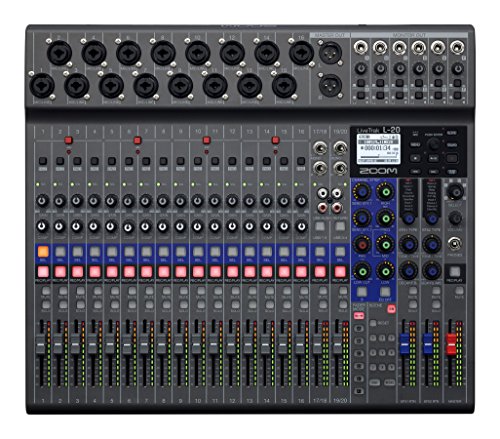
- Records 22 tracks directly to SD card
- Six independent monitor outputs
- Built for live performance and rehearsal use
Best For: Bands needing personalized performer mixes
Best Standalone Portastudio
Tascam DP-24SD Digital Portastudio

- 24-track standalone digital recording
- Built-in effects, mastering, and color screen
- Eight XLR inputs rather than sixteen
Best For: Songwriters wanting a dedicated recording workstation
Best Flexible Mixer-Recorder

- Digital mixer and multitrack recorder in one
- Up to 14 tracks at 24-bit/96kHz
- Physical faders and +70 dB preamps
Best For: Live mixing and high-resolution multitrack recording
Best All-in-One Studio Workflow

- Mixer, recorder, USB interface, and DAW controller
- 12-in/10-out USB audio interface
- Built-in compressor and three-band EQ
Best For: Integrated home-studio recording and production
Best Touchscreen Recorder
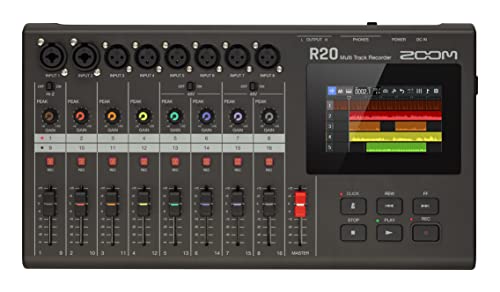
- 16-track recorder with up to eight simultaneous tracks
- Six XLR inputs plus two XLR/TRS combo inputs
- Touchscreen editing with onboard effects and rhythms
Best For: Computer-free demos and tabletop music production
Studio-to-Stage Workhorse

- 16 TASCAM mic preamps
- Up to 24-track SD recording
- Hands-on mixer and USB interface
Best For: Full-band tracking and live-to-studio workflows
Portable Multitrack Option

- 16-channel playback
- Eight XLR/TRS combo inputs
- 135 built-in effects
Best For: Mobile recording and compact home setups
Compact Mixer-Recorder

- 16-track SD recording
- 16-in/14-out USB interface
- 10 monaural XLR/TRS inputs
Best For: Small studios needing mixer, recorder, and DAW integration
Best Overall – Zoom LiveTrak L-20 Bundle
The Zoom LiveTrak L-20 Bundle is a strong choice when you need a multitrack recorder with sixteen XLR inputs—or more—for live shows, rehearsals, and studio work. Its 20-input design, 22-track recording, wireless control, and included accessories make it a versatile all-in-one setup.
Best For: Bands, live engineers, and home studios needing extensive routing and recording features.
Pros:
- 20 inputs with XLR, 1/4-inch, TS line, and RCA connectivity
- Records and plays back 22 tracks at up to 24-bit/96kHz
- Includes carrying bag, Bluetooth adapter, and two 10-foot XLR cables
- Six monitor mixes, built-in effects, compression, and dedicated channel controls
Cons:
- At 18.1 pounds, it is less convenient for frequent transport
- The included warranty is limited to one year
With broad connectivity and a generous track count, the L-20 Bundle is especially practical for larger ensembles and users who want mixing, monitoring, and recording in one unit.
Best USB-C Interface – Fender Quantum LT 16
The Fender Quantum LT 16 is a USB-C interface for buyers who want a multitrack recorder with sixteen XLR inputs—or comparable high-count studio connectivity—alongside computer-based production. It combines eight mic preamps, 14 line inputs, balanced outputs, and standalone modes in a compact rack-style design.
Best For: Hybrid studios integrating microphones, synthesizers, outboard gear, and computers.
Pros:
- 16-in/8-out USB-C interface with eight MAX-HD mic preamps
- Six front-panel XLR/TRS inputs plus eight rear-panel TRS inputs
- Low-latency drivers, loopback, MIDI I/O, and DC-coupled outputs
- Standalone Mixer Mode and Mic Pre Mode add flexibility beyond computer recording
Cons:
- Only six of the listed inputs are front-panel XLR/TRS combo inputs
- Its feature set is oriented toward computer-based studio workflows rather than direct SD recording
The Quantum LT 16 is a capable choice for producers who prioritize extensive I/O, modern USB-C connectivity, and integration with external studio equipment.
Best for Live Bands – Zoom LiveTrak L-20
The Zoom LiveTrak L-20 is built for musicians and podcasters who need a multitrack recorder with sixteen XLR inputs—or a similarly expansive input count—for live performance and rehearsal recording. It records 22 tracks directly to an SD card and provides independent monitor mixes for performers.
Best For: Live bands, rehearsals, and stage setups requiring individualized headphone mixes.
Pros:
- 20 channels and simultaneous 22-track recording at 24-bit/96kHz
- Six independent headphone and line outputs with individual volume control
- 20 onboard effects and low-noise preamps with up to +60dB of gain
- Supports USB audio interface use and wireless iOS control
Cons:
- Its listed operating frequency is 48kHz, despite the supplied 24-bit/96kHz recording claim
- Wireless control requires an iPhone or iPad and compatible setup
For stage-oriented recording, the L-20’s combination of direct SD capture, multiple monitor outputs, and rugged construction makes it a practical live-production hub.
Best Standalone Portastudio – Tascam DP-24SD Digital Portastudio
The Tascam DP-24SD is a standalone digital Portastudio for hands-on multitrack recording. While it has eight XLR inputs rather than sixteen, its 24-track format, onboard effects, mastering tools, and color screen may appeal to users who prefer a dedicated recorder over a computer interface.
Best For: Songwriters and project studios wanting self-contained recording and editing.
Pros:
- Supports 24-track digital recording
- Includes effects, mastering features, and a color screen
- Offers USB 2.0 connectivity and up to 32 hours of digital recording time
Cons:
- Provides eight XLR inputs, so it does not meet a sixteen-XLR-input requirement
- Its listed weight is 13.7 pounds, making it less portable than compact interfaces
- The supplied notes do not specify sample rate or detailed input-routing capabilities
The DP-24SD is best treated as a workflow alternative rather than a direct match for a sixteen-XLR-input recorder. Its appeal is the dedicated Portastudio format and integrated production tools.
Best Flexible Mixer-Recorder – Zoom LiveTrak L12next
The Zoom LiveTrak L12next is a versatile option for musicians seeking a multitrack recorder with sixteen XLR inputs, although this model provides 12 channels rather than 16 XLR inputs. It combines digital mixing and recording, supports up to 14 tracks at 24-bit/96kHz, and offers a 32-bit float mixdown for clip-free results.
Best For: Musicians who want hands-on live mixing, high-resolution multitrack recording, and wireless control options.
Pros:
- Combines a digital mixer with a multitrack recorder.
- Records up to 14 tracks at 24-bit/96kHz.
- Includes +70 dB preamps, Hi-Z, PAD, and +48V phantom power.
- Physical 60mm faders provide direct control over mixes.
Cons:
- Has 12 channels, so it does not meet a strict 16-XLR-input requirement.
- The BTA-1 adapter is required for wireless app control.
The L12next is a strong choice when mixing control and recording quality matter more than having 16 XLR inputs. Its high-gain preamps, generous track count, and physical controls make it practical for live performances and project recording.
Best All-in-One Studio Workflow – Tascam Model 12
The Tascam Model 12 is an all-in-one mixer, 12-track digital recorder, USB audio interface, and DAW controller. It is not a multitrack recorder with sixteen XLR inputs, but its integrated controls and recording functions may suit smaller studio setups that prioritize workflow and connectivity.
Best For: Home studios and musicians who want a combined mixer, recorder, USB interface, and DAW controller.
Pros:
- Combines mixing, multitrack recording, USB interfacing, and DAW control.
- Provides a 12-in/10-out USB audio interface.
- Includes a one-knob compressor and three-band EQ on input modules.
- Offers dual headphone outputs with individual volume and source selection.
Cons:
- Provides 12 channels rather than 16 XLR inputs.
- The supplied notes do not specify the number of XLR inputs.
The Model 12 is better viewed as a compact studio hub than as a direct match for a 16-XLR-input requirement. Its broad feature set is useful for recording, monitoring, and computer-based production in one unit.
Best Touchscreen Recorder – Zoom R20
The Zoom R20 is a computer-free tabletop recorder with 16 tracks and six XLR inputs, making it the closest fit here for shoppers comparing a multitrack recorder with sixteen XLR inputs. It can record up to eight tracks simultaneously and provides touchscreen editing, onboard effects, rhythms, and synth sounds.
Best For: Musicians who want portable, computer-free 16-track recording with touchscreen editing and creative onboard tools.
Pros:
- Supports 16-track projects and up to eight simultaneous tracks.
- Includes six XLR inputs, plus two XLR/TRS combo inputs.
- Records, edits, and mixes through a built-in touchscreen interface.
- Provides onboard effects, 150 rhythm patterns, and an 18-sound synth.
Cons:
- It has six XLR inputs, not sixteen.
- Maximum sample rate is 44.1 kHz.
- It is designed for tabletop use rather than a larger channel-count setup.
The R20 is the strongest match for the 16-track portion of this search, but not for sixteen XLR inputs. Its straightforward touchscreen workflow and built-in musical tools make it especially practical for demos, songwriting, and self-contained project recording.
Studio-to-Stage Workhorse – Tascam Model 24
The Tascam Model 24 is a strong choice when you need a multitrack recorder with sixteen XLR inputs for live sessions, rehearsals, or studio production. Its hands-on analog mixer layout keeps EQ and auxiliary controls immediately accessible, while the built-in recorder captures up to 24 tracks at 24-bit/48kHz to an SD card.
Best For: Musicians and small studios that want a tactile mixer, multitrack recording, and USB DAW connectivity in one unit.
Pros:
- Includes 16 TASCAM mic preamps for recording multiple microphones.
- Records up to 24 tracks simultaneously at 24-bit/48kHz.
- All inputs, outputs, EQ, and auxiliary controls are accessible from the surface.
- Can function as a USB audio interface with a PC or Mac.
Cons:
- Its full-size mixer design may require more setup space than a compact recorder.
- Recording directly to SD is limited to the supported 24-bit/48kHz workflow.
The Model 24 stands out for users who prioritize physical controls and broad input capacity. It is especially practical for tracking full ensembles and moving between studio and stage without changing workflows.
Portable Multitrack Option – Zoom R16
The Zoom R16 is a portable alternative for shoppers seeking a multitrack recorder with sixteen XLR inputs, though it provides eight XLR/TRS combo inputs rather than sixteen. It supports 16-channel playback, eight-channel simultaneous recording, SDHC storage, USB connectivity, and built-in effects in a compact tabletop format.
Best For: Mobile musicians and home recordists who value portability, onboard effects, and straightforward computer integration.
Pros:
- Provides 16-channel playback and eight-channel simultaneous recording.
- Offers eight balanced XLR-1/4-inch combination inputs.
- Includes 135 built-in effects for recording, mixing, and mastering.
- Runs with included AA batteries for portable use.
Cons:
- It has eight combo inputs, not sixteen XLR inputs.
- Simultaneous recording is limited to eight channels.
- 48V phantom power is available on only two tracks.
The R16 is best viewed as a lightweight, flexible recorder rather than a true sixteen-XLR-input solution. Its battery operation, built-in microphones, and effects make it appealing for mobile sessions and compact setups.
Compact Mixer-Recorder – Tascam Model 16
The Tascam Model 16 is suited to buyers comparing a multitrack recorder with sixteen XLR inputs, but its actual configuration is 14 inputs, including 10 monaural XLR/TRS channels and two stereo-paired TRS inputs. It records 16 tracks to SD media, provides punch in/out for up to eight tracks, and works as a 16-in/14-out USB audio interface.
Best For: Small studios and performers needing an all-in-one mixer, SD recorder, and DAW interface with a 16-track workflow.
Pros:
- Records up to 16 tracks in WAV format at up to 48kHz/24-bit.
- Supports SD, SDHC, and SDXC cards meeting the required Class 10 standard.
- Provides 16-in/14-out USB audio transfer with a DAW.
- Uses TASCAM Ultra-HDDA mic preamps on channels 1 through 8.
Cons:
- It has 14 total inputs rather than sixteen XLR inputs.
- Only 10 inputs are monaural XLR/TRS balanced channels; two are stereo-paired TRS inputs.
- Up to eight tracks can use punch in/out simultaneously.
The Model 16 offers a balanced combination of hands-on mixing and digital recording. It is a practical fit when a 16-track recorder matters more than having sixteen dedicated XLR inputs.
How We Picked the Best Multitrack Recorder with Sixteen Xlr Inputs
We compared these recorders and mixer-recorders by input capacity, simultaneous multitrack recording, standalone usability, computer connectivity, monitoring, portability, and control layout. We also considered whether each model is better suited to live tracking, rehearsal capture, podcasting, mobile recording, or a more traditional studio workflow.
One important clarification: the listed products do not all provide exactly sixteen physical XLR microphone inputs. Some offer combo inputs, line inputs, or fewer XLR connections alongside additional channels. Always verify the rear-panel layout and maximum simultaneous input count before buying.
Quick Comparison
- Best for larger live setups: Zoom LiveTrak L-20 or Tascam Model 24.
- Best for computer-based production: Fender Quantum LT, with USB-C connectivity and multiple preamps.
- Best compact mixer-recorder: Zoom LiveTrak L-12next or Tascam Model 12.
- Best standalone tabletop workflow: Tascam DP-24SD or Zoom R20.
- Best portable budget-friendly option: Zoom R16.
Key Buying Factors for a Multitrack Recorder with Sixteen Xlr Inputs
Input Type and Simultaneous Recording
Check how many microphone sources can be recorded at once, not merely the advertised track count. XLR inputs are useful for microphones, while combo inputs may also accept quarter-inch instrument or line connections. A recorder may advertise 16 or 24 tracks but have substantially fewer microphone preamps.
Standalone Versus Computer Workflow
Standalone units record to an SD card or internal media and are useful for rehearsals, live shows, and locations without a computer. USB interfaces are better when you plan to edit, mix, and use plug-ins in a DAW. Some mixer-recorders support both approaches, offering more flexibility.
Monitoring, Routing, and Latency
For bands and podcasts, independent headphone mixes, direct monitoring, and clear routing controls can matter more than headline track count. Confirm how many monitor outputs and headphone mixes are available, especially if multiple performers need separate mixes.
Portability and Storage
Consider weight, power requirements, mounting, carrying options, and recording media. A tabletop recorder is easier to transport than a full mixer, while a larger live mixer may provide more accessible controls and connections.
Who Should Buy Which Multitrack Recorder with Sixteen Xlr Inputs?
Choose the Zoom LiveTrak L-20 or Tascam Model 24 if you need hands-on control for a full band, venue, or rehearsal room. Pick the Fender Quantum LT if your main priority is low-latency computer recording and USB-C integration.
The Zoom L-12next, Tascam Model 12, and Tascam Model 16 suit creators who want mixer-style controls without moving to a larger live-production rig. The Tascam DP-24SD is a strong choice for a self-contained Portastudio experience, while the Zoom R20 balances touchscreen control, portability, and multitrack capability.
For simple mobile recording, basic studio work, or a compact interface-and-recorder combination, the Zoom R16 remains worth considering. Before ordering, match the product’s actual XLR count and preamp capacity to your source list so you do not need extra hardware later.