Choosing the right recorder can make the difference between usable audio and a ruined take. The best portable field recorders balance sound quality, input flexibility, battery life, and simple controls.
In this roundup, we focus on models that fit real-world filming, music capture, voice recording, and content creation without adding unnecessary complexity.
Best 10 Portable Field Recorders Picks for 2026
Run-and-Gun 32-Bit Float Pick
Zoom F3 Professional Field Recorder

- 32-bit float recording for changing levels
- Dual locking XLR inputs for secure setups
- Ultra-low-noise preamps for cleaner capture
Best For: Filmmakers and recordists working in unpredictable conditions
Compact USB-C Everyday Recorder
TASCAM DR-05XP Handheld Recorder

- 32-bit float plus multiple file formats
- Built-in mics handle loud environments
- USB-C audio interface for computer recording
Best For: Handheld recording for music, voice, and video work
Flexible Combo-Input Pick
Zoom H1 XLR 2-Channel Recorder

- 32-bit/96kHz recording for detailed sound
- Two XLR/TRS combo inputs for versatile setups
- OLED waveform display for quick level checks
Best For: Creators who want portable XLR/TRS flexibility
Beginner-Friendly 32-Bit Float Choice
Zoom H1essential Recorder Bundle

- Simple one-button recording with 32-bit float
- Built-in X/Y mics capture up to 120 dB SPL
- Bundle adds windscreen, case, card, and batteries
Best For: New users wanting an easy all-in-one starter kit
Versatile multi-pattern pickup
Zoom H2 Essential Handheld Recorder

- Three built-in mics with nine selectable patterns
- 32-bit float/96kHz recording helps prevent clipping
- USB mic mode and SD backup recording
Best For: Journalists, podcasters, musicians, and field recorders
Portable starter bundle
Zoom H1essential Recorder Bundle
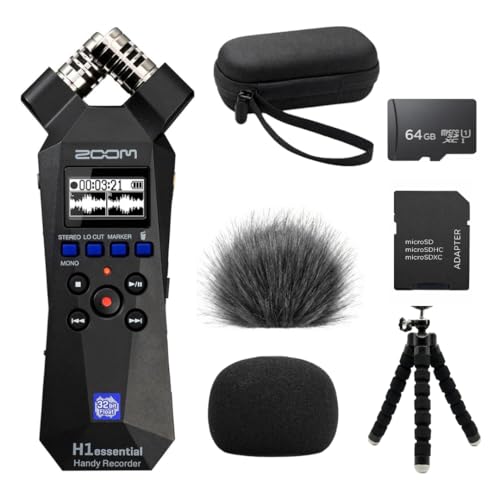
- Bundle includes 64GB card, case, windscreens, and tripod
- 32-bit float X/Y recording up to 120 dB SPL
- USB-C mic mode for PC, Mac, iOS, and Android
Best For: Creators who want a compact recorder bundle with accessories included
Expandable pro input options
Zoom H5 4-Track Handheld Recorder
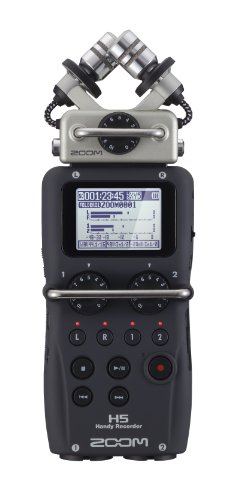
- Interchangeable capsules add flexibility
- Two XLR/TRS inputs with phantom power and pad
- Four-track recording with USB audio interface mode
Best For: Filmmakers and musicians needing modular external input support
Bundle Pick
Zoom H1essential Recorder Bundle with Case & Accessories
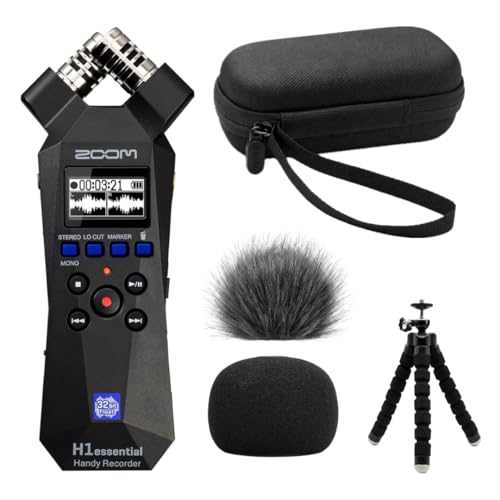
- 32-bit float recording helps prevent clipping.
- Includes case, furry windscreen, foam windscreen, and tripod.
- USB-C mode works with PC, Mac, iOS, and Android.
Best For: Creators who want a ready-to-go handheld recorder bundle for field work and interviews.
Multi-Track Option
Zoom R4 Multi-Track Recorder for Musicians

- Captures up to 4 tracks with bounce-to-track workflow.
- Two XLR/TS combo inputs handle mics, instruments, and keyboards.
- Also works as a USB audio interface and battery-powered recorder.
Best For: Musicians and songwriters who want a battery-powered multi-track recorder with interface capabilities.
Compact Pick
Zoom H1 Essential for Creators

- 32-bit float recording helps avoid clipping.
- X/Y stereo mics suit voices, music, and ambience.
- USB-C mode works for calls, livestreams, and voiceovers.
Best For: Creators who want a compact recorder for video, podcasts, interviews, and ambient sound.
Run-and-Gun 32-Bit Float Pick – Zoom F3 Professional Field Recorder
If you need a portable field recorder that stays composed when levels jump around, the Zoom F3 is built for that kind of work. Its 32-bit float recording, dual locking XLR inputs, and ultra-low-noise preamps make it a strong fit for real-world shoots where you want to capture clean audio without constant level tweaks.
Best For: Filmmakers and recordists who need secure XLR connections and worry-free 32-bit float capture in unpredictable environments.
Pros:
- 32-bit float recording helps capture quiet dialogue and sudden peaks without adjusting levels.
- Dual locking XLR inputs are useful for mounted or larger rig setups.
- Ultra-low-noise preamps aim to keep audio clean in uncontrolled conditions.
- Flexible power options support long days on set or on location.
Cons:
- Designed around XLR workflows, so it is less of an all-in-one handheld solution.
- Best suited to users who already work with external microphones or field rigs.
The F3 is a focused tool rather than a general-purpose recorder, which is exactly why it stands out for demanding production work. If your priority is dependable portable field recorders performance with simple, secure input handling, this is an especially practical choice.
Compact USB-C Everyday Recorder – TASCAM DR-05XP Handheld Recorder
The TASCAM DR-05XP is a compact portable field recorder for people who want straightforward stereo capture with modern connectivity. With 32-bit float, built-in omnidirectional condenser mics, and USB-C audio interface support, it covers music, meetings, voice, and audio-for-video without adding much complexity.
Best For: Users who want a small handheld recorder for everyday stereo recording and direct USB-C computer use.
Pros:
- Flexible recording modes include 32-bit float, 24-bit, 16-bit, and MP3.
- Built-in omnidirectional condenser microphones handle loud sources up to 125 dB SPL.
- USB-C 2-in/2-out interface function adds easy computer recording.
- Lightweight handheld design makes it easy to carry for quick sessions.
Cons:
- Battery life is listed at up to 17.5 hours, which is solid but not class-leading.
- Built-in stereo mics are useful, but it is less expandable than XLR-based recorders.
This is a practical pick if you want one device for simple recording and computer interface duties. For portable field recorders shoppers who value ease of use and versatile formats, the DR-05XP is a sensible, low-fuss option.
Flexible Combo-Input Pick – Zoom H1 XLR 2-Channel Recorder
The Zoom H1 XLR is aimed at users who want a simple portable field recorder with more connection flexibility than a basic stereo unit. It records in 32-bit/96kHz, includes two XLR/TRS combo inputs, and adds an OLED waveform display so you can check levels quickly while working.
Best For: Filmmakers, musicians, and podcasters who need a compact recorder with combo inputs and easy visual level monitoring.
Pros:
- Two XLR/TRS combo inputs support microphones, instruments, and other sources.
- 32-bit/96kHz recording is built for detailed capture.
- OLED waveform display helps you monitor levels at a glance.
- 3.5mm stereo input and headphone output add extra flexibility.
Cons:
- Battery life is listed at about 10 hours, so long sessions may require planning.
- Its feature set is more compact than larger multi-input field recorders.
If you want a portable recorder that stays approachable while still handling more serious input options, the H1 XLR lands in a useful middle ground. It is especially appealing for creators who need portability without giving up XLR/TRS versatility.
Beginner-Friendly 32-Bit Float Choice – Zoom H1essential Recorder Bundle
The Zoom H1essential is one of the easiest portable field recorders to use if you want to press record and move on. Its 32-bit float capture, built-in X/Y microphones, and bundled accessories make it a practical starter-friendly option for musicians, podcasters, filmmakers, and content creators.
Best For: Beginners and everyday creators who want a simple recorder with built-in mics and helpful bundled accessories.
Pros:
- One-button operation keeps the recording process simple.
- 32-bit float recording removes the need to constantly adjust levels.
- Built-in X/Y microphones capture clean audio up to 120 dB SPL.
- Includes useful extras like a windscreen, adapter, USB-C cable, case, microSD card, and batteries.
Cons:
- Built-in mics are convenient, but the unit is less expandable than XLR-based recorders.
- Its 10-hour battery life may be limiting for extended shoot days.
This bundle makes a strong case for people who want an accessible recorder without buying accessories separately. Among portable field recorders, it is especially attractive when simplicity, portability, and a ready-to-use kit matter most.
Versatile multi-pattern pickup – Zoom H2 Essential Handheld Recorder
If you want portable field recorders that can handle interviews, ambience, and music without fiddling with gain, the Zoom H2 Essential is built around that workflow. Its three built-in microphones and nine selectable recording patterns make it adaptable, while 32-bit float capture helps keep takes clip-free at any volume level.
Best For: Journalists, podcasters, musicians, and field recorders who need one handheld unit for a wide range of recording situations.
Pros:
- Three built-in mics with nine recording patterns for flexible pickup.
- 32-bit float/96kHz recording helps avoid clipping and gain adjustments.
- USB microphone mode plus simultaneous SD recording for backup.
- Bluetooth control and multi-unit sync for aligned recordings.
Cons:
- Runs on 2 AA batteries, so you’ll need to manage spare power.
- Uses a simple handheld format rather than expandable input capsules.
For buyers prioritizing versatility and simplicity, this recorder stands out as a practical all-rounder. It focuses on clean capture, easy operation, and useful backup features rather than complex setup.
Portable starter bundle – Zoom H1essential Recorder Bundle
Among portable field recorders, the Zoom H1essential bundle is designed for buyers who want a ready-to-go kit instead of just the recorder. It pairs the handheld unit with a 64GB microSD card, protective case, windscreens, and a flexible tripod, making it easier to start recording vocals, interviews, and ambient sound right away.
Best For: Creators who want a compact recorder bundle with storage and accessories included for travel, interviews, and quick setup.
Pros:
- Includes recorder, 64GB microSD card, case, windscreens, and tripod.
- 32-bit float recording helps capture clean audio without clipping.
- X/Y mics record up to 120 dB SPL and 96kHz sample rate.
- USB-C microphone mode works with PC, Mac, iOS, and Android.
Cons:
- Uses 2 AAA batteries, so runtime depends on battery supply.
- Small 0.96-inch screen is more limited than larger handheld recorders.
This bundle makes sense if you value convenience and accessory coverage over buying each piece separately. It’s a straightforward entry point for field recording, especially when portability and quick deployment matter.
Expandable pro input options – Zoom H5 4-Track Handheld Recorder
If your portable field recorders need more input flexibility, the Zoom H5 is built around interchangeable capsules and XLR/TRS connectivity. It offers four-track simultaneous recording, detachable X/Y mics with shock mounting, and two combo inputs with phantom power and pads, which makes it better suited to more demanding capture setups.
Best For: Filmmakers and musicians who need a handheld recorder with interchangeable capsules and pro-style external inputs.
Pros:
- Interchangeable input capsules expand recording options.
- Two XLR/TRS combo inputs with phantom power and -20dB pad.
- Four-track simultaneous recording for more complex sessions.
- USB audio interface support for PC, Mac, and iPad.
Cons:
- Records directly to SD/SDHC cards up to 32GB, which is more limited than larger-capacity workflows.
- Powered by 2 AA batteries, so battery management still matters in the field.
Compared with simpler handheld models, the H5 is the more flexible option when you need external mics, phantom power, or modular input choices. It’s a strong fit for users who want a recorder that can grow with different production needs.
Bundle Pick – Zoom H1essential Recorder Bundle with Case & Accessories
If you want one of the most flexible portable field recorders for quick capture and travel-ready use, this Zoom H1essential bundle is built around simplicity and clean audio. The 32-bit float recorder helps prevent clipping, while the included furry and foam windscreens plus EVA case make it easier to handle outdoor shoots, interviews, and everyday recording.
Best For: Creators who want a ready-to-go handheld recorder bundle for field work, interviews, and mobile recording.
Pros:
- 32-bit float recording helps avoid clipping and distortion.
- High-quality X/Y mics capture audio up to 120 dB SPL.
- Bundle includes a hard EVA case, furry windscreen, foam windscreen, and flexible tripod.
- USB-C support lets it work as a USB microphone for PC, Mac, iOS, or Android.
Cons:
- Runs on 2 AAA batteries, so you’ll need spares for longer sessions.
- The accessory bundle adds value, but it may be more than minimal users need.
This is a practical pick if you want portable field recorders with extra protection and field-ready accessories right out of the box. It’s especially useful when you need a compact setup that can move from travel audio to interviews without much fuss.
Multi-Track Option – Zoom R4 Multi-Track Recorder for Musicians
For portable field recorders that do more than basic stereo capture, the Zoom R4 is aimed at musicians who want to record, layer, and bounce ideas anywhere. Its 32-bit float design means you can track without constant gain tweaks, and the built-in rhythm patterns make it easier to stay inspired during mobile sessions.
Best For: Musicians and songwriters who want a battery-powered multi-track recorder with interface capabilities.
Pros:
- Records up to 4 tracks and supports bounce workflows to free up channels.
- 32-bit float recording reduces the need to adjust gain.
- Two XLR/TS combo inputs accept microphones, instruments, keyboards, and more.
- Works as a 2-in/2-out USB audio interface and runs on batteries or USB-C.
Cons:
- Designed more for music and layering than simple pocket-style field capture.
- Uses 4 AA batteries, so power management matters on longer outings.
If your portable field recorder needs include sketching songs, capturing rehearsals, or building layers on the fly, the R4 offers a lot of flexibility. It’s a strong choice when recording is only part of the workflow and you also want rhythm, bounce, and interface functions in one unit.
Compact Pick – Zoom H1 Essential for Creators
This Zoom H1essential is a straightforward choice if you need portable field recorders for content creation, interviews, and real-world sound. Its X/Y stereo mics and 32-bit float recording make it easy to capture clear audio for video, podcasting, and ambient recording without overcomplicating the setup.
Best For: Creators who want a compact recorder for video, podcasts, interviews, and ambient sound.
Pros:
- 32-bit float recording helps keep audio clip-free.
- X/Y stereo mics are suited to voices, music, and ambient capture.
- USB-C mic mode supports livestreams, calls, voiceovers, and desktop or mobile recording.
- Lightweight 92 g design is easy to carry for field use.
Cons:
- Uses 2 AAA batteries, so runtime planning is important.
- Battery life is listed at 10 hours, which may be modest for longer days.
For buyers who want a compact recorder that covers a lot of everyday uses, the H1essential keeps the workflow simple. It’s a practical option when you need dependable stereo capture for content, interviews, and ambient audio in a small package.
How We Picked the Best Portable Field Recorders
We prioritized Portable Field Recorders that offer dependable sound quality, practical input options, and easy operation in the field. We also looked for features that matter most to buyers today, including 32-bit float recording, USB-C connectivity, onboard mics, and compact designs that travel well.
Where a recorder is aimed at a specific user, we favored clear use-case fit over feature overload. That means some models are better for solo creators, while others are stronger choices for filmmakers or musicians who need more channel flexibility.
Quick Comparison
For simple stereo capture and voice work, lightweight handheld models are usually the easiest choice. If you want more control for film or multi-source recording, look for XLR/TRS inputs and multi-track support. For creators who value quick setup and safer gain staging, 32-bit float models stand out because they reduce the risk of clipping.
Key Buying Factors for Portable Field Recorders
Input and Track Count
Match the recorder to your workflow. One or two inputs are fine for interviews, run-and-gun video, and basic music capture. If you record multiple sources at once, choose a model with more inputs or tracks.
Recording Format
32-bit float is a major advantage for unpredictable environments because it helps preserve detail when levels spike. Traditional recording can still work well, but it often requires closer attention to gain settings.
Mic Quality and Expansion
Built-in microphones are convenient for ambient sound, notes, and quick capture. External mic support matters more if you want better directionality, cleaner dialogue, or more professional music recording.
Portability and Power
Consider weight, battery type, and whether USB-C power or interface mode is important. A truly portable recorder should be easy to pack, quick to deploy, and reliable during long sessions.
Who Should Buy Which Portable Field Recorders?
Filmmakers often benefit from recorders with XLR inputs and strong multi-channel control. Podcasters and solo creators may prefer compact handheld units with simple operation and onboard mics. Musicians should look for clean preamps, stereo or multi-track capability, and enough flexibility to capture rehearsals, demos, or live sessions without hassle.
If you want the safest all-around choice, start with a 32-bit float model that matches your input needs. If you value speed and simplicity above all else, a smaller handheld recorder may be the better fit.