Choosing the right powered studio monitors can make a bigger difference to your mixes than most plug-ins or upgrades. The best pair should sound honest, fit your room, and work with your workflow.
Below, we focus on practical choices for home studios, desktop setups, and small production rooms, with options that balance accuracy, size, and value.
Best 10 Powered Studio Monitors Picks for 2026
Compact Nearfield Pair
Yamaha HS4 4.5" Black Studio Monitors

- 4.5-inch 2-way powered pair
- Room control and high trim controls
- XLR/TRS, RCA, and stereo mini inputs
Best For: Small studios and desktop creators
Wide-Sweet-Spot Reference
JBL 305P MkII 5" Powered Studio Monitors

- Patented waveguide for precise imaging
- Dual 41W Class-D amplification
- Boundary EQ and HF Trim room controls
Best For: Producers and podcasters wanting wide, accurate monitoring
Classic Studio Pair
Yamaha HS5 5" Powered Studio Monitors

- 5-inch bi-amped nearfield pair
- Neutral tuning for studio monitoring
- XLR and TRS balanced/unbalanced inputs
Best For: Music production and neutral mix referencing
Budget Desktop Pick
Edifier MR4 4" Powered Studio Monitors
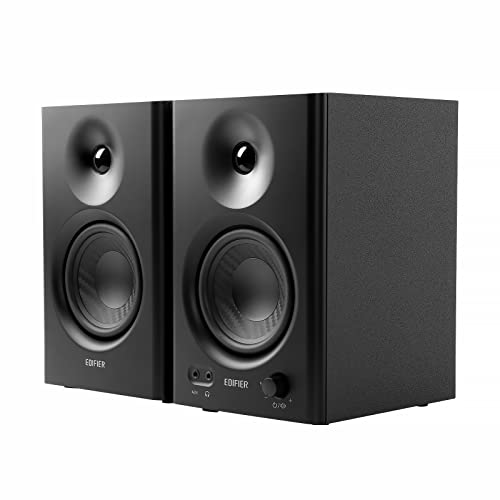
- Near-flat tuning for creator use
- TRS, RCA, AUX, and headphone output
- Monitor and music modes
Best For: Affordable desktop monitoring and home studio use
Compact Desktop Pick
M-AUDIO BX3 3.5" Wired Studio Monitors Pair

- Zero-latency wired monitoring
- 3.5-inch Kevlar woofers and silk dome tweeters
- 1/4-inch, 1/8-inch, and RCA inputs
Best For: Desktop creators needing compact, flexible wired monitors
Accuracy-First Reference Pick
YAMAHA HS5 W 5-Inch Powered Studio Monitor

- Flat, concise reference sound
- 5-inch powered nearfield design
- Matched 2-pack with XLR connectivity
Best For: Mixing and production users who want accurate reference monitors
Desk-Friendly Tuning Pick
Mackie CR3.5 Studio Monitors Pair

- Tone knob for easy voicing changes
- Location switch helps with bass placement
- Includes isolation pads and cables
Best For: Small studio and desktop users who want simple onboard tuning
Reference-Grade Nearfield
Yamaha HS7 7-Inch Powered Studio Monitor Pair

- 7-inch woofer with 95W bi-amp power
- 43Hz–30kHz response for studio work
- Balanced XLR and TRS inputs
Best For: Producers and mixers needing accurate larger nearfield monitors
Compact Desktop Pair
PreSonus Eris 3.5 Powered Studio Monitors

- Compact 3.5-inch desktop-friendly design
- 50W built-in amplification for clear sound
- TRS, RCA, and front aux inputs
Best For: Desktop setups needing compact monitors with flexible connectivity
Full-Size Mixing Pair
Yamaha HS8 8-Inch Powered Studio Monitor Pair

- 8-inch woofer with 120W bi-amp power
- 38Hz–30kHz response for deeper low end
- Sold as a stereo pair with XLR input
Best For: Users wanting larger monitors with stronger bass extension
Compact Nearfield Pair – Yamaha HS4 4.5" Black Studio Monitors
If you want powered studio monitors for a small desk or editing setup, the Yamaha HS4 pair gives you a compact 2-way design with a 4.5-inch woofer and 1-inch dome tweeter. It’s aimed at music production and video editing, with room control and high trim options to help you adapt the sound to your space.
Best For: Small home studios, DAW workstations, and desktop creators who need a compact pair with flexible inputs.
Pros:
- Compact 4.5-inch 2-way design suits tighter desk setups.
- Room control and high trim help tailor the sound to the room.
- Useful input selection: XLR/TRS combo, RCA, and stereo mini.
- Includes speaker cable, stereo mini to RCA cable, and anti-slip pads.
Cons:
- 26 watts max output is modest for larger rooms.
- Smaller woofer size may limit low-end reach versus bigger monitors.
The HS4 is a practical choice if your priority is accurate desktop monitoring in a compact footprint. It’s less about sheer volume and more about giving you a tidy, flexible reference pair for everyday studio work.
Wide-Sweet-Spot Reference – JBL 305P MkII 5" Powered Studio Monitors
The JBL 305P MkII is a strong option if you’re shopping for powered studio monitors with a wide sweet spot and detailed imaging. Its Image Control Waveguide is built for precise listening, while the 5-inch woofer, Slip Stream port, and dual 41-watt Class-D amps give it plenty of studio-ready output for production and podcast work.
Best For: Producers, podcasters, and creators who want a more spacious listening area and room-adjustable monitoring.
Pros:
- Patented Image Control Waveguide supports precise, immersive imaging.
- Dual 41-watt Class-D amplifiers provide robust output.
- Boundary EQ and HF Trim help tune the monitors to the room.
- XLR/TRS inputs add straightforward studio connectivity.
Cons:
- Requires AC power and a wired setup.
- 5-inch monitors may not deliver the deepest bass without a sub.
For a balanced studio monitor pair that emphasizes clarity and placement flexibility, the 305P MkII is easy to recommend. It’s a practical pick when you want accurate monitoring without moving up to a larger cabinet size.
Classic Studio Pair – Yamaha HS5 5" Powered Studio Monitors
The Yamaha HS5 pair is a well-known choice in powered studio monitors for users who want a straightforward nearfield reference. With a 5-inch cone woofer, 1-inch dome tweeter, and bi-amped 2-way design, it’s tuned to emphasize sonic purity without adding extra color to the sound.
Best For: Music production and studio monitoring where a clean, neutral reference matters most.
Pros:
- Bi-amplified 2-way design supports detailed monitoring.
- 5-inch woofer and 1-inch tweeter suit nearfield studio use.
- Room-friendly XLR and TRS inputs accept balanced or unbalanced signals.
- Wide frequency response from 54 Hz to 30 kHz.
Cons:
- 5-inch size may be less ideal for users wanting stronger low-end weight.
- Designed for wired studio use rather than portable listening.
If your priority is a familiar studio reference with a clean presentation, the HS5 remains a solid benchmark. It’s a sensible pick for creators who want to hear their mix plainly and make decisions with confidence.
Budget Desktop Pick – Edifier MR4 4" Powered Studio Monitors
The Edifier MR4 is a practical entry in powered studio monitors for creators who want a compact desktop speaker with a near-flat tuning approach. It uses a 1-inch silk dome tweeter and 4-inch composite woofer, plus simple front-panel controls and multiple inputs for mixers, computers, and tablets.
Best For: Home studio users, personal computer setups, and creators who want an affordable, flexible monitoring pair.
Pros:
- Responsive, nearly flat tuning is aimed at music creators.
- Multiple input options: TRS, RCA, AUX, and front headphone output.
- Dual mode design lets you switch between monitor and music listening.
- Front controls make volume and sound adjustments easy.
Cons:
- 4-inch woofer is better for nearfield use than larger rooms.
- Wired, corded design keeps it focused on desk-based setups.
The MR4 offers a lot of flexibility for the price-focused buyer who still wants a monitor-style listening profile. It’s best viewed as a compact, all-purpose desktop solution rather than a high-output room speaker.
Compact Desktop Pick – M-AUDIO BX3 3.5" Wired Studio Monitors Pair
If you want powered studio monitors for a desk setup, the M-AUDIO BX3 pair focuses on clean wired monitoring in a compact footprint. They’re built for zero-latency playback, and the rear EQ controls plus multiple input options make them easy to adapt to music production, gaming, podcasting, or general desktop audio.
Best For: Desktop creators who need small, wired studio monitors with flexible connections and easy tone shaping.
Pros:
- Zero-latency wired monitoring for recording, streaming, and editing.
- 3.5-inch Kevlar woofers and silk dome tweeters for punchy lows and clear highs.
- Rear 1/4-inch, 1/8-inch, and RCA inputs add broad compatibility.
- Front headphone input is handy for late-night silent mixing.
Cons:
- Small 3.5-inch drivers are better suited to desktops than larger rooms.
- Sound shaping relies on rear-panel controls, so adjustments are less immediate.
Overall, the BX3 is a practical entry-level powered studio monitor choice if you value compact size and versatile wired connectivity over big-room output. The included cables and foam feet make setup straightforward.
Accuracy-First Reference Pick – YAMAHA HS5 W 5-Inch Powered Studio Monitor
The Yamaha HS5 W is a classic-style powered studio monitor built around accuracy, making it a strong option when you want a true nearfield reference rather than a flattering sound. Its flat-response design and high-resolution presentation are aimed at mixing and music production where hearing the source clearly matters most.
Best For: Mixing and production users who want accurate nearfield reference monitors with a proven studio pedigree.
Pros:
- Flat, concise sound image designed for accurate monitoring.
- 5-inch powered nearfield design suited to professional studio use.
- XLR connectivity keeps it aligned with typical studio gear.
- Two-pack bundle provides a matched stereo setup.
Cons:
- Accuracy-first tuning may feel less exciting for casual listening.
- Best suited to studio applications rather than flexible everyday use.
If your priority is hearing mixes as honestly as possible, the HS5 W remains a dependable powered studio monitor option. It is especially appealing for users who want a recognized reference sound in a stereo pair.
Desk-Friendly Tuning Pick – Mackie CR3.5 Studio Monitors Pair
The Mackie CR3.5 is a desk-friendly powered studio monitor pair designed for small studios and everyday production setups. Its tone knob and location switch make it easier to tailor the sound from your desk, while the included isolation pads and cables simplify getting started.
Best For: Small studio and desktop users who want simple onboard tuning and a balanced monitoring approach.
Pros:
- Tone knob lets you adjust voicing directly from the desk.
- Location switch helps correct bass placement near walls or in open spaces.
- Includes isolation pads and cables for a quick setup.
- Compact 3.5-inch pair fits desks and small studios well.
Cons:
- 3.5-inch woofers are a size-focused choice for smaller spaces.
- Single-pair setup is geared more toward compact systems than larger rooms.
For buyers who want powered studio monitors with easy, no-menu tuning, the CR3.5 stands out as a practical desk solution. It’s especially appealing when placement flexibility matters as much as sound quality.
Reference-Grade Nearfield – Yamaha HS7 7-Inch Powered Studio Monitor Pair
The Yamaha HS7 is a strong pick for powered studio monitors if you want a larger nearfield speaker that still stays focused for studio recording and mixing. With a 7-inch woofer, 43Hz–30kHz response, and a bi-amp design, this pair is built to give you a clear view of low end and detail without adding extra fluff.
Best For: Producers and mixers who want a larger powered studio monitor pair for accurate nearfield listening.
Pros:
- 7-inch woofer and 95W bi-amp power support fuller monitoring than small desktop models
- Balanced XLR and TRS inputs accept both balanced and unbalanced connections
- Wide 43Hz–30kHz frequency response suits studio recording and mixing tasks
- Sold as a pair, so you get a complete stereo setup right away
Cons:
- Larger cabinet size may be overkill for very small desks
- No wireless features are listed
Overall, the HS7 is a practical choice when you want a straightforward, wired monitor pair with more scale and low-end reach than compact monitors. It fits best in a room where you can give the speakers enough space to work properly.
Compact Desktop Pair – PreSonus Eris 3.5 Powered Studio Monitors
The PreSonus Eris 3.5 is a compact option in powered studio monitors, designed for small desks where you still want clear stereo sound for music production, gaming, movies, streaming, and everyday listening. Its 3.5-inch woofers, 50 watts of built-in amplification, and onboard tuning controls make it flexible for close-range setups.
Best For: Desktop users who want small powered studio monitors with flexible inputs and easy room tuning.
Pros:
- Compact 3.5-inch design works well on desktops and bookshelves
- 50 watts of built-in amplification delivers clear sound for nearfield listening
- High- and low-frequency tuning controls help tailor sound to the room
- Multiple inputs including TRS, RCA, and front aux make connections easy
Cons:
- 3.5-inch woofers will not reach as deep as larger studio monitors
- Best suited to small rooms and close listening distances
If you need an affordable, space-saving monitor pair for a desk setup, the Eris 3.5 keeps the footprint small while offering useful connectivity and sound-shaping controls. It is a practical all-around pick for mixed-use listening and entry-level studio work.
Full-Size Mixing Pair – Yamaha HS8 8-Inch Powered Studio Monitor Pair
The Yamaha HS8 is the largest option here for powered studio monitors, aimed at users who want more reach and headroom for studio recording. With an 8-inch woofer, 38Hz–30kHz response, and 120W bi-amp power, this pair is built for bigger nearfield setups where low-end clarity matters.
Best For: Studio users who want a larger powered monitor pair with stronger bass extension and more output.
Pros:
- 8-inch woofer and 120W bi-amp system provide strong output
- 38Hz–30kHz frequency response offers deeper low-end reach
- XLR connectivity keeps the setup focused on studio wiring
- Sold as a pair for immediate stereo monitoring
Cons:
- Larger footprint may be too much for tight desk spaces
- XLR cables are not included in the box
The HS8 makes sense when you need more size, power, and bass extension than a compact monitor can provide. It is a solid fit for users with enough room to place full-size monitors properly in a recording environment.
How We Picked the Best Powered Studio Monitors
We prioritized Powered Studio Monitors that are well known for dependable near-field performance, sensible pricing, and room-friendly designs. The goal was to highlight options that suit different desk sizes, budgets, and monitoring needs without drifting into overly specialty choices.
Quick Comparison
Smaller 3.5-inch and 4-inch models are better for compact desks, casual production, and limited listening distances. 5-inch monitors are the most flexible all-around choice for many home studios, while 7-inch and 8-inch models usually deliver more low-end extension and greater output for larger rooms.
Key Buying Factors for Powered Studio Monitors
Room Size and Listening Distance
Match the speaker size to your room. Larger woofers can sound impressive, but in small untreated rooms they may exaggerate bass and make placement harder. Near-field use on a desk typically favors compact models, while bigger rooms can benefit from larger drivers.
Frequency Balance and Accuracy
For mixing, aim for monitors that present a clear midrange and controlled bass rather than hyped lows or bright highs. The most useful Powered Studio Monitors help you hear problems honestly so your mixes translate better on headphones, cars, and consumer speakers.
Inputs and Connectivity
Check that the monitors support the outputs from your audio interface or mixer. Balanced inputs are preferable for reducing noise over longer cable runs, especially in studio environments with multiple devices.
Controls and Placement
Basic EQ or room-adjustment controls can be valuable if your speakers sit near walls or on a desk. Even good monitors need proper placement, isolation, and triangle positioning to perform their best.
Who Should Buy Which Powered Studio Monitors?
If you want the most compact setup, choose smaller monitors for editing, podcasting, or beat-making at close range. For a balanced first studio pair, 5-inch models are often the safest pick. If you need fuller low end or are working in a larger space, 7-inch or 8-inch options are usually the better fit. The right Powered Studio Monitors are the ones that match your room, your budget, and the way you actually listen.