The right projector screen can make a bigger difference than a modest projector upgrade. Screen size, aspect ratio, setup style, and surface quality all affect brightness, clarity, and viewing comfort.
We selected 10 projector screens for different spaces and budgets, including portable folding models, stand-mounted screens, electric designs, and inflatable outdoor options.
Best 10 Projector Screens Picks for 2026
Best Foldable Screen
120-Inch Portable Projector Screen

- 120-inch 16:9 viewing area
- Front and rear projection support
- Lightweight, foldable, washable fabric
Best For: Portable home theaters, presentations, and outdoor movie nights
Best Inflatable Screen

- Huge 16-foot outdoor viewing surface
- Front and rear projection support
- Blower, stakes, tethers, and bag included
Best For: Large backyard gatherings and outdoor events
Best Motorized Screen
120-Inch Electric Projector Screen

- Remote-controlled motorized operation
- 120-inch matte projection surface
- Wall or ceiling drop-down installation
Best For: Permanent home theaters, offices, and classrooms
Best Portable Stand
80-Inch Projector Screen with Stand

- Tool-free portable stand setup
- 80-inch 16:9 viewing surface
- Bag and outdoor stabilizing accessories included
Best For: Camping, picnics, and smaller indoor or backyard movie nights
Best Large Foldable Screen
150-Inch Outdoor Projector Screen

- 150-inch 16:9 display with a 132-by-73-inch viewing area
- Washable, crease-resistant matte fabric
- Lightweight and foldable for indoor or outdoor use
Best For: Large-group movie nights and portable backyard entertainment
Best for Everyday Use
Estgora 14-Foot Outdoor Movie Screen

- Inflates in 60–120 seconds with the included blower
- Supports front and rear projection
- Large 14-foot format for outdoor events
Best For: Large backyard parties and outdoor movie gatherings
Best Tripod Screen
Excelimage 80-Inch Portable Projector Screen
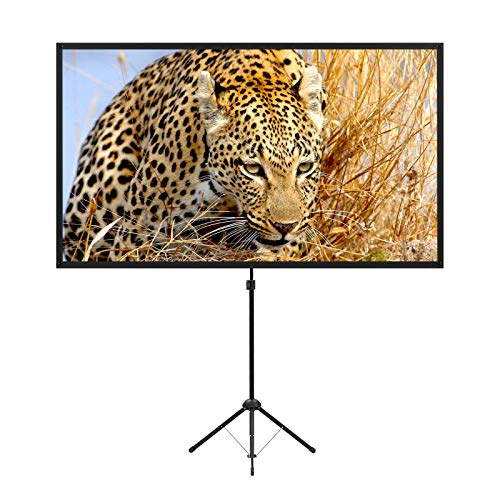
- 80-inch 16:9 screen with 160-degree viewing angle
- Tripod stand and tensioned tubes support a flat surface
- Sets up in about two minutes and includes a carry bag
Best For: Portable home cinema, classrooms, and smaller outdoor spaces
Best Stake-Down Stability

- Widened base accepts ground stakes
- Iron frame includes ropes and stakes
- Wrinkle-free front/rear projection fabric
Best For: Backyard movie nights needing extra outdoor stability
Best Foldable Screen – 120-Inch Portable Projector Screen
This 120-inch option is one of the more flexible projector screens for home theaters, presentations, and outdoor movie nights. Its lightweight, foldable polyester design supports front or rear projection and packs into a bag or suitcase.
Best For: Buyers who want a large, washable screen that is easy to carry and mount in different locations.
Pros:
- Large 120-inch, 16:9 viewing area measuring 104 by 58 inches.
- Supports front and rear projection with a 160-degree viewing angle.
- Foldable, lightweight 1.7-pound design with a claimed anti-crease finish.
- Can be attached with hooks, ropes, brackets, nails, or double-sided tape.
Cons:
- Manual wall mounting requires choosing and installing your own attachment method.
- The large fabric surface may need careful handling and storage despite its foldable design.
This is a practical pick when portability and setup flexibility matter more than a rigid frame or motorized operation. Its washable fabric and double-sided projection support add useful versatility.
Best Inflatable Screen – 16-Foot Backyard Movie Screen
For large outdoor events, this 16-foot inflatable screen gives projector screens a distinctly backyard-friendly format. It includes a blower, frame, stakes, tethers, removable screen, and carry bag, with front and rear projection support.
Best For: Backyard movie nights, parties, weddings, camping trips, and other group events that need a very large viewing surface.
Pros:
- Very large 16-foot screen with a 16:9 ratio and 160-degree viewing angle.
- Supports both front and rear projection for flexible placement.
- Included 110V, 180W blower can inflate the screen in about two minutes.
- Removable screen and machine-washable materials simplify cleaning.
Cons:
- The blower must remain plugged in and running throughout the show.
- Outdoor setup requires stakes, tethers, and suitable space.
- Its 90-day manufacturer warranty is relatively short.
This is the most event-focused option in the group. It offers impressive scale and a complete outdoor setup, but the continuous blower requirement and larger footprint make it less suitable for casual indoor use.
Best Motorized Screen – 120-Inch Electric Projector Screen
This motorized 120-inch screen is designed for buyers who want projector screens to retract neatly when not in use. Its remote-controlled drop-down design mounts to a wall or ceiling and is intended for movies, presentations, and 4K 3D HD projection.
Best For: Dedicated home theaters, offices, and classrooms where remote operation and a clean installation are priorities.
Pros:
- Automatic motorized operation with included remote control.
- Large 120-inch screen for an immersive viewing experience.
- Designed for 4K 3D HD projection with a matte finish.
- Retracts into a ceiling- or wall-mounted configuration to save space.
Cons:
- At approximately 11.79 kg, it is substantially heavier than the portable fabric models.
- Installation requires a suitable wall or ceiling mounting location.
- The listed model uses a 4:3 designation, so buyers should confirm the intended aspect ratio for their setup.
This screen makes the most sense as a semi-permanent installation. It trades easy transport for quieter, smoother everyday operation and convenient storage at the touch of a button.
Best Portable Stand – 80-Inch Projector Screen with Stand
This 80-inch stand-mounted screen offers a balanced choice for portable projector screens. The lightweight aluminum structure assembles without tools, fits into a padded carrying bag, and includes stabilizing accessories for indoor or outdoor viewing.
Best For: Small backyard movie nights, camping, picnics, and households that want a freestanding screen that stores compactly.
Pros:
- Tool-free assembly and disassembly for convenient transport.
- Includes a soft padded carrying bag and weighs about 5.62 pounds according to the product notes.
- 80-inch, 16:9 screen with a 160-degree viewing angle.
- Includes rope, hanging hook, and water bag for added outdoor stability.
Cons:
- The 80-inch size is smaller than the 120-inch and 16-foot alternatives.
- The glossy finish may not suit buyers specifically seeking a matte projection surface.
- Outdoor stability still depends on proper setup, especially in breezy conditions.
This is a sensible middle ground for users who need a real stand but do not want the bulk of an inflatable screen. Its compact storage and tool-free setup make it especially convenient for occasional outdoor use.
Best Large Foldable Screen – 150-Inch Outdoor Projector Screen
For shoppers comparing projector screens for backyard movies or a flexible home theater, this 150-inch AAJK model offers a large 16:9 display in a lightweight, foldable design. Its washable, matte white fabric is designed to resist creasing and supports front or rear projection.
Best For: Large-group movie nights, backyard gatherings, home theaters, classrooms, and presentations.
Pros:
- Large 150-inch format with a 132-by-73-inch viewing area.
- Foldable, portable design weighs 2.8 pounds.
- Washable, nontransparent fabric with a 160-degree viewing angle.
- Can be attached with hooks, brackets, nails, or double-sided tape.
Cons:
- Does not include a stand or inflatable frame.
- Its large size may require careful mounting and storage space.
This screen is a practical choice when maximum viewing area and portability matter more than a freestanding setup. Plan your mounting method before use, especially for outdoor installations.
Best for Everyday Use – Estgora 14-Foot Outdoor Movie Screen
This Estgora inflatable screen is one of the more event-focused projector screens for outdoor movie nights. The included blower inflates it in approximately 60 to 120 seconds, while its 16:9 design supports both front and rear projection.
Best For: Backyard parties, poolside events, camping, weddings, football viewing, and other large outdoor gatherings.
Pros:
- Large 14-foot screen with a 202-by-130-inch overall size.
- Included air blower enables quick inflation without manual pumping.
- Supports both front and rear projection.
- Includes a storage bag and uses a durable 210D Oxford cloth frame.
Cons:
- Requires access to power for the air blower.
- Floor-mounted design needs a sufficiently open setup area.
- Its larger footprint is less convenient for small rooms or compact storage.
Choose this model when creating a prominent outdoor viewing area is the priority. The fast inflation and dual-sided projection make it suited to parties, though the floor space and blower requirement should be part of your planning.
Best Tripod Screen – Excelimage 80-Inch Portable Projector Screen
For buyers who want projector screens that are easier to position and pack away, this 80-inch Excelimage model uses a tripod stand and tensioned aluminum tubes to create a stable viewing surface. It sets up in about two minutes and weighs 8.5 pounds.
Best For: Home cinema, classrooms, garden viewing, backyard use, and portable presentations.
Pros:
- 80-inch 16:9 screen suits many indoor and outdoor spaces.
- Tripod and spring-tensioned tubes help keep the surface flat.
- Sets up and packs down in approximately two minutes.
- Includes a carrying bag and offers a 160-degree viewing angle.
Cons:
- Smaller viewing area than the 150-inch and 14-foot alternatives.
- At 8.5 pounds, it is heavier than a fabric-only screen.
- Manual setup still requires assembling the stand and tubes.
This is a balanced option for shoppers who value straightforward setup and a freestanding structure. Its 80-inch size is easier to accommodate than oversized outdoor projector screens, while the tripod makes placement more flexible.
Best Stake-Down Stability – 120-Inch Outdoor Screen
If outdoor stability is your priority, this 120-inch projector screen uses a widened base plate, ground stakes, windproof ropes, and an all-iron frame to reduce shaking. Its wrinkle-free 16:9 screen supports front and rear projection, while tool-free assembly and a carry bag make it practical for backyard movie nights and portable events.
Best For: Backyard viewers who want a large, portable projector screen with stake-down support instead of relying only on sandbags.
Pros:
- Widened base plate includes holes for ground stakes, reducing the need for heavy sandbags outdoors.
- All-iron bracket, four stakes, and two windproof ropes add support in windy conditions.
- High-density milk-silk fabric is wrinkle-free and supports vivid, uniform color from a 160-degree viewing angle.
- Modular, tool-free setup takes about eight minutes and packs into the included carry bag.
Cons:
- The 120-inch size requires more open space than smaller projector screens.
- The listed warranty is limited to 30 days.
- Projector mounts are not included.
Choose this model when a wide viewing area and a more secure outdoor setup matter most. Its stake-ready base and wind accessories give it an advantage for backyard use, while the foldable frame keeps transport manageable.
Best Complete Tripod Kit – 100-Inch Portable Screen
This 100-inch projector screen is a practical choice for shoppers who want a complete portable setup. It includes a tripod-style stand, sandbag, ground nails, windproof ropes, and a carry bag, while the foldable polyester screen supports both front and rear projection for indoor or outdoor viewing.
Best For: Families and event organizers who want a moderately sized projector screen with included stability accessories and straightforward assembly.
Pros:
- Detachable tripod and crossbar assemble without tools for quick setup.
- Included sandbag, six ground nails, and windproof ropes help stabilize the screen outdoors.
- Foldable, washable polyester milk-silk fabric is designed to resist wrinkles and supports a 160-degree viewing angle.
- Included storage bag makes the 7.5-pound kit easier to transport.
Cons:
- The 100-inch display is smaller than the other screens in this roundup.
- Outdoor setup requires using the sandbag, ropes, and stakes for better stability.
- The product has no listed warranty.
This TOWOND screen balances size, portability, and included accessories. It is a sensible option when you want a ready-to-carry projector screen for home, camping, school, office, or event use without moving up to a larger 120- or 150-inch format.
Best for Maximum Image Size – 150-Inch Cinema Screen
For viewers who want the biggest image in this projector screens roundup, this 150-inch model creates a large 16:9 display for backyard cinema, sports, gaming, or presentations. Its foldable polyester fabric, iron frame, ground nails, ropes, and carrying bag are designed to combine a cinematic viewing area with portable use.
Best For: Large gatherings and home theaters where maximum screen size is more important than compact dimensions.
Pros:
- 150-inch 16:9 screen provides the largest listed viewing area in this selection.
- Thick, opaque, anti-crease fabric is designed to fold without leaving wrinkles and is easy to clean.
- Iron frame, ground nails, and rigging ropes help support outdoor use in light winds.
- No-tool assembly and a heavy-duty carrying bag support portable events.
Cons:
- The 150-inch size needs substantial open space for setup and viewing.
- Its outdoor stability system is specified for light winds, not severe weather.
- The screen is listed with floor mounting, so it may be less convenient where elevated mounting is needed.
This is the strongest pick for an immersive, large-format display. Its size suits backyard cinema and public viewing, but measure your available area first and plan for a larger setup footprint than the 100- and 120-inch alternatives.
How We Picked These Projector Screens
We evaluated the selected screens by matching their stated features to common viewing needs: home theater use, backyard movie nights, camping, parties, and temporary indoor setups. Our comparison focused on screen size, 16:9 compatibility, portability, setup requirements, projection direction, wrinkle or crease resistance, and included accessories.
Because performance depends on the projector, room lighting, viewing distance, and installation quality, advertised specifications should be treated as starting points rather than guarantees. Outdoor users should also consider wind, ground conditions, and access to power.
Quick Comparison
| Screen Type | Best For | Main Advantage | Potential Trade-Off |
|---|---|---|---|
| Foldable portable screen | Indoor or occasional outdoor use | Easy storage and flexible placement | May require careful tensioning |
| Stand-mounted screen | Fast setup at home or outdoors | Self-supporting design | Needs a stable, level surface |
| Electric screen | Dedicated rooms | Convenient retractable operation | Requires suitable mounting and power |
| Inflatable screen | Large backyard gatherings | Very large image area and front/rear projection | Needs blower power, anchoring, and storage space |
Key Buying Factors for Projector Screens
Size and Viewing Distance
Larger is not always better. A 120-inch screen can suit a backyard or spacious room, while an 80- to 100-inch model may be easier to place indoors. Make sure viewers can sit far enough away to see the full image comfortably and confirm that your projector can produce a bright, sharp picture at the chosen size.
Aspect Ratio and Screen Surface
A 16:9 screen is the most versatile choice for modern movies, streaming services, games, and television content. Look for a smooth, evenly tensioned surface to reduce visible waves and hotspots. A screen cannot improve a low-quality source, but an uneven surface can make a good projector look worse.
Setup, Stability, and Storage
Check the total packed size, included carry bag, frame or stand design, and anchoring hardware. Outdoor screens need stakes, tie-downs, or another reliable method of resisting wind. Inflatable models need a continuous power source for the blower, whereas folding and stand-mounted screens are generally simpler for short sessions.
Front and Rear Projection
Front projection is the standard arrangement and usually offers the simplest placement. Rear projection can keep the projector behind the screen and reduce shadows or foot traffic in front, but it requires adequate space behind the screen and a compatible translucent surface.
Who Should Buy Which Projector Screens?
- For a dedicated home theater: Choose an electric screen if you want a clean, retractable installation and have suitable wall or ceiling mounting points.
- For occasional indoor and outdoor viewing: A foldable or stand-mounted 80- to 120-inch screen offers a practical balance of portability and image size.
- For backyard movie nights: Select a larger stand-mounted or inflatable screen, prioritizing anchoring, setup time, and weather conditions over maximum size alone.
- For parties and large groups: An inflatable 14- to 16-foot screen can create a dramatic presentation, provided you have enough open space, blower power, and secure tie-down points.
- For campers and frequent travelers: Favor lightweight designs with compact carrying bags and minimal assembly, even if that means choosing a smaller screen.
Before buying, measure the available area, confirm the projector’s throw distance and brightness, and check whether the package includes the stand, frame, stakes, blower, remote, or mounting hardware you need.