The best samplers for recording make it easier to capture sounds, build beats, and shape ideas without interrupting your creative flow. The right choice depends on whether you need a self-contained sampler, a performance pad controller, or a compact keyboard-based setup.
We compare 10 capable options across portability, sequencing, connectivity, hands-on control, and included software so you can choose a practical fit for your studio, live rig, or mobile workflow.
Best 10 Samplers for Recording Picks for 2026
Best Standalone Pick

- Battery-powered standalone sampler with built-in mic and speaker
- 16 MPC pads, chopping, resampling, and onboard effects
- USB-C, MIDI, line I/O, and microSD support
Best For: Portable DAWless beatmaking and full sampling workflows
Best DAW Controller

- Designed for Studio One and Ableton Live workflows
- 16 RGB velocity- and pressure-sensitive pads
- Assignable controls for samples, loops, effects, and timelines
Best For: Computer-based recording and live software performance
Best Pocket Sound Designer

- Pocket-size sampler with built-in microphone
- Chopping, step sampling, resampling, and chromatic playback
- Granular controls, filters, and envelopes for sound shaping
Best For: Portable sample capture and experimental sound design
Best Simple Sample Pad

- Eight backlit velocity- and pressure-sensitive pads
- Loads 16-bit mono WAV samples from SD or SDHC cards
- USB MIDI, standard MIDI, balanced outputs, and headphone out
Best For: Prepared sample triggering in studio and live setups
Pocket Sampling Pick

- Built-in mic and 3.5 mm line input
- Melodic, drum, sequencing, and effects modes
- Pocket-sized and battery powered
Best For: Portable beat-making and quick sound capture
Ableton Control Pick
APC Mini MK2 MIDI Pad Controller

- 64 RGB pads for clip and sample launching
- Nine assignable faders for hands-on mixing
- USB-powered Ableton Live integration
Best For: Computer-based recording and live Ableton workflows
Expanded Portable Pick
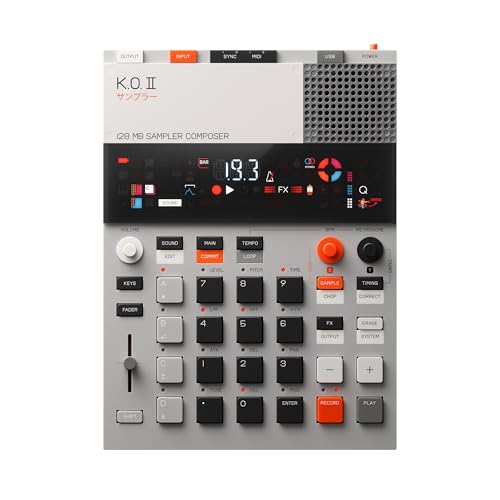
- 128 MB memory and 999 sample slots
- Built-in mic, line input, resampling, and chopping
- Pattern sequencing with stereo and punch-in effects
Best For: Portable track production and live performance
Compact Pad Control
Akai LPD8 USB MIDI Pad Controller

- Eight RGB-backlit MPC-style pads for sample triggering
- Eight assignable knobs and four programmable presets
- Compact, USB-powered design for Mac and PC
Best For: Portable beat making and hands-on DAW control
Expanded Sample Triggering
Donner STARRYPAD MIDI Pad Controller

- Sixteen pads with three banks for up to 48 assignments
- Adds faders, knobs, buttons, Tap Tempo, and Note Repeat
- MIDI input/output and Mac, Windows, Android, and iOS compatibility
Best For: Multi-sample beat production and expanded MIDI control
Keyboard-and-Pad Workflow
Akai MPK Mini MK3 MIDI Controller

- Eight MPC pads for drums, samples, and DAW control
- Twenty-five velocity-sensitive mini keys for melodies and chords
- Includes knobs, joystick, arpeggiator, and production software
Best For: Compact home studios needing keys and sample pads
Best Standalone Pick – Akai MPC Sample
The Akai MPC Sample is a strong choice for anyone seeking samplers for recording without relying on a computer. Its battery-powered standalone design combines sampling, sequencing, effects, storage, and monitoring in one portable unit.
Best For: Beatmakers, DAWless producers, finger drummers, and creators who want a complete portable sampling workstation.
Pros:
- Standalone operation includes a rechargeable battery, built-in speaker, microphone, and microSD storage.
- 16 MPC pads, sample chopping, resampling, timestretching, and more than 60 internal effects support fast workflows.
- USB-C audio/MIDI, MIDI connectivity, line I/O, and smart-device sampling make it flexible for studios and live setups.
Cons:
- Its broad feature set may take time for beginners to learn.
- The MIDI DIN connection requires an adapter, which is not included.
Choose the MPC Sample when portability and computer-free production matter most. It offers a notably complete feature set for developing ideas from captured sound to finished groove.
Best DAW Controller – PreSonus ATOM Pad Controller
The PreSonus ATOM is a computer-focused option for samplers for recording, especially if you already work in Studio One or Ableton Live. Rather than recording samples independently, it provides expressive pad control for triggering samples, loops, effects, and virtual instruments inside compatible software.
Best For: Home producers and performers who want hands-on DAW control with velocity- and pressure-sensitive pads.
Pros:
- Includes tight integration with Studio One Artist and Ableton Live Lite.
- 16 full-size RGB pads offer velocity and pressure sensitivity, with eight assignable pad banks.
- Twenty assignable buttons, four rotary encoders, Note Repeat, and timeline controls expand hands-on production control.
Cons:
- It requires a connected computer or compatible device and does not operate as a standalone sampler.
- Its usefulness depends on supported recording or performance software.
The ATOM makes sense for software-based recording setups where tactile sample and loop triggering is more important than onboard sampling. It is a controller, not a self-contained sample workstation.
Best Pocket Sound Designer – Roland AIRA Compact P-6
The Roland AIRA Compact P-6 is a compact option among samplers for recording when quick capture and experimental sound design are priorities. Its built-in microphone, onboard keyboard, chopping tools, resampling, chromatic playback, and granular controls give it substantial creative range in a pocket-size format.
Best For: Mobile producers and sound designers who want portable sample capture, manipulation, and sequencing.
Pros:
- Built-in microphone enables quick sample capture without external equipment.
- Chopping, step sampling, resampling, and chromatic polyphonic playback support varied workflows.
- Granular parameters plus dedicated filters and envelopes provide detailed sound shaping.
Cons:
- Its compact size may feel less spacious for extended hands-on sessions.
- Sample editing and import/export use the P-6 Sample Tool software on macOS or Windows.
The P-6 is a compelling fit when portability and unusual sound manipulation outweigh the need for a larger control surface. It balances quick sampling with advanced granular experimentation.
Best Simple Sample Pad – Akai MPX8
The Akai MPX8 is a straightforward choice for samplers for recording when you mainly need reliable sample triggering rather than a full production workstation. It loads 16-bit mono WAV files from an SD or SDHC card and adds MIDI control for software or external gear.
Best For: Live performers and producers who need an affordable, compact sample pad for triggering prepared sounds.
Pros:
- Eight backlit velocity- and pressure-sensitive pads support expressive triggering.
- SD/SDHC card loading and the sample kit editor provide practical sample management.
- USB MIDI, standard MIDI input/output, balanced outputs, and a headphone output support studio and live connections.
Cons:
- It supports 16-bit mono WAV samples with a 30 MB maximum sample assignment.
- It is focused on playback and triggering rather than standalone sample recording or advanced editing.
The MPX8 works best as a compact playback and MIDI controller for an existing setup. Consider it when dependable pad triggering is more important than onboard sampling depth.
Pocket Sampling Pick – PO-33 K.O. Micro Sampler
For portable samplers for recording, the PO-33 K.O. offers a remarkably compact way to capture sounds and turn them into beats or melodies. Its built-in microphone and 3.5 mm line input make quick sampling convenient, while the sequencer and effects support complete ideas without a computer.
Best For: Beginners, mobile beat-makers, and anyone who wants a pocket-sized sampler for spontaneous recording.
Pros:
- Samples through the built-in microphone or 3.5 mm line input.
- Includes melodic and drum modes, sequencing, and 16 onboard effects.
- Compact, battery-powered design with built-in speaker and headphone/line output.
Cons:
- Sample memory is limited to 40 seconds.
- Its compact controls may be less suitable for detailed studio workflows.
The PO-33 K.O. is best viewed as an idea-capture and performance tool rather than a full studio workstation. It is highly portable and immediately hands-on, but its limited memory favors short samples and concise arrangements.
Ableton Control Pick – APC Mini MK2 MIDI Pad Controller
The APC Mini MK2 is a strong choice for recording setups built around Ableton Live. Rather than recording audio directly, it gives you hands-on control over clips, loops, vocals, melodic samples, drum racks, and mixer functions from a compact USB controller.
Best For: Ableton Live users who want tactile clip launching, sample triggering, and mixer control in the studio or on stage.
Pros:
- 64 RGB pads provide visual clip feedback and trigger loops, vocals, and samples.
- Eight assignable faders plus a master fader offer hands-on mixer and device control.
- Includes Drum and Note modes, Ableton Live Lite, and plug-and-play USB connectivity.
Cons:
- Requires a computer and is designed around Ableton Live rather than standalone sampling.
- USB-powered operation means it is not a self-contained portable recorder.
The APC Mini MK2 makes sense when your recording workflow already lives in Ableton Live. Its pads and faders can speed up arranging and live performance, but shoppers seeking a standalone sampler should consider a dedicated sampling device instead.
Expanded Portable Pick – EP-133 K.O. II Sampler
The EP-133 K.O. II is one of the more capable portable samplers for recording, combining a built-in microphone and line input with a 128 MB memory, deeper sequencing, resampling, and performance effects. It is designed to move from captured sound to arranged beat quickly, whether you are working at home or performing live.
Best For: Producers who want a portable standalone sampler with more memory, pattern control, connectivity, and performance-focused effects.
Pros:
- Records through the built-in microphone or line input and supports resampling and chopping.
- Offers 128 MB memory, 999 sample slots, and four groups with up to 99 patterns.
- Includes stereo and punch-in effects, MIDI and sync connections, and USB-C power support.
Cons:
- Its broader feature set may require more time to learn than a simpler pocket sampler.
- Battery operation requires four AAA batteries when USB-C power is not used.
With substantially more memory and a more developed sequencer than the smaller K.O. concept, the EP-133 K.O. II is suited to building fuller tracks and performing them. Its portability remains a major advantage, while the expanded workflow gives experienced users more room for arrangement and sound manipulation.
Compact Pad Control – Akai LPD8 USB MIDI Pad Controller
For producers seeking samplers for recording, the Akai LPD8 provides a compact way to trigger samples, loops, drums, and virtual instruments from a computer. Its eight RGB-backlit pads and assignable knobs are useful when you want hands-on control without a full-size controller.
Best For: Mobile producers, beat makers, DJs, and home-studio users who need portable sample triggering and DAW control.
Pros:
- Eight responsive RGB-backlit MPC-style pads trigger samples, loops, and instruments.
- Eight assignable Q-Link knobs provide tactile control over DAW and plugin parameters.
- Four programmable presets simplify switching between mappings.
- USB-powered, plug-and-play operation works with Mac and PC without an AC adapter.
Cons:
- Only eight pads are provided, limiting simultaneous sample layouts compared with larger controllers.
- It requires a computer and compatible music software rather than operating as a standalone sampler.
The LPD8 is a focused choice for recording setups where portability and straightforward pad control matter more than a keyboard or extensive onboard hardware.
Expanded Sample Triggering – Donner STARRYPAD MIDI Pad Controller
The Donner STARRYPAD is a flexible option for producers comparing samplers for recording and wanting more trigger points in a compact controller. Its 16 pads can switch across three banks for up to 48 assignable pad positions, while faders, knobs, and MIDI connectivity add control over a broader setup.
Best For: Beat makers who want multiple pad banks, visual feedback, and extra controls for DAWs or external MIDI equipment.
Pros:
- Sixteen velocity-sensitive pads and three banks provide up to 48 assignable pad positions.
- Two faders, two knobs, three buttons, and a Shift layer expand hands-on control.
- Tap Tempo and Note Repeat support rhythmic performance and sample sequencing.
- Includes Melodics courses and a Cubase LE software kit.
Cons:
- It does not produce sound by itself and requires DAW software.
- The editor controls pad settings but does not record or arrange music.
- Connecting to an iPhone or iPad requires an Apple Lightning-to-USB adapter.
With its large pad count and MIDI input/output, the STARRYPAD suits creators who need more organized sample access than a basic eight-pad controller can provide.
Keyboard-and-Pad Workflow – Akai MPK Mini MK3 MIDI Controller
The Akai MPK Mini MK3 combines sample triggering with a playable mini keyboard, making it a versatile choice among samplers for recording. Eight MPC-style pads handle drums and samples, while the 25 velocity-sensitive keys, knobs, joystick, and arpeggiator support melodic production and virtual-instrument control.
Best For: Home-studio producers who want one compact controller for samples, drums, melodies, virtual instruments, and plugin adjustment.
Pros:
- Eight backlit velocity-sensitive MPC pads include Note Repeat and Full Level functions.
- Twenty-five velocity-sensitive mini keys add melodic and chord-playing capability.
- Eight assignable knobs, a four-way thumbstick, and built-in arpeggiator broaden production control.
- Includes MPC Beats, three virtual instruments, 2GB of sound content, and a Splice offer.
Cons:
- The mini-key format may be less suitable for players who prefer full-size keys.
- It is USB-powered and designed to work with a computer and compatible DAW rather than as a standalone sampler.
The MPK Mini MK3 is the most all-purpose option here for producers who want sample pads without giving up a compact keyboard and broader virtual-instrument control.
How We Picked the Best Samplers for Recording
We evaluated these products by looking at how effectively they support real recording and beatmaking tasks. Key considerations included sampling or sample-triggering capability, pad quality, sequencing features, microphone or audio connectivity, USB and MIDI support, portability, included software, and ease of use. Because this list includes both standalone samplers and MIDI controllers, we also considered whether each device is best suited to independent production or computer-based recording.
A controller does not record or manipulate audio on its own in the same way as a standalone sampler, but it can provide responsive pads, knobs, faders, or keys for controlling a DAW and virtual instruments. That distinction is important when comparing products with very different workflows.
Quick Comparison
- Best for standalone production: Akai MPC Sample Portable Sampler, Roland AIRA Compact P-6, and teenage engineering EP–133 K.O. II.
- Best for ultra-portable sampling: teenage engineering PO-33 K.O.! and Roland AIRA Compact P-6.
- Best for pad-based DAW control: Akai APC Mini MK2, Akai LPD8, Akai MPX8, and PreSonus ATOM.
- Best for a keyboard workflow: Akai MPK Mini MK3.
- Best budget-oriented pad option: Donner MIDI Pad Beat Maker Machine.
Key Buying Factors for Samplers for Recording
Standalone or Computer-Based Workflow
Choose a standalone unit if you want to sample, sequence, and perform without relying on a computer. MIDI controllers are more appropriate if your main setup is Ableton Live, Studio One, another DAW, or software instruments.
Sampling and Audio Inputs
Check how sounds enter the device. Built-in microphones are convenient for quick field recordings, while line or USB audio connections are better for importing cleaner material from instruments, mixers, and computers.
Sequencing and Performance Control
Look for pattern length, effects, quantization, velocity sensitivity, pad layout, and hands-on controls. A compact device may be inspiring for sketches, while a larger controller can offer more precise control during arrangement and live performance.
Portability and Expansion
Battery operation, internal memory, storage options, and USB or MIDI connectivity matter if you plan to travel. Confirm compatibility with your computer and preferred software before buying, especially when a product depends on a DAW.
Who Should Buy Which Samplers for Recording?
Buy a standalone MPC, Roland P-6, or EP–133 K.O. II if you want an instrument that can serve as the center of a hardware setup. Choose the PO-33 K.O.! for inexpensive, highly portable sample sketching. Pick the ATOM, APC Mini MK2, MPX8, LPD8, or Donner controller if you primarily need tactile DAW or drum-pad control. The MPK Mini MK3 is the strongest fit for producers who want both playable keys and pads in one compact controller.