The best soundbars for home studios can simplify monitoring, improve video playback, and add fuller sound without the footprint of a traditional speaker setup.
This roundup compares 10 options across compact designs, wireless surround systems, Dolby Atmos support, dialogue enhancement, connectivity, and subwoofer performance.
Best 10 Soundbars for Home Studios Picks for 2026
Immersive Room-Filling Pick
TCL S65K 5.1 Atmos Soundbar System

- 5.1 system with wireless surrounds
- Dolby Atmos and DTS:X support
- AI room calibration and wireless subwoofer
Best For: Larger studios needing immersive surround sound
Best Tuning Flexibility
ULTIMEA Poseidon M30 2.1 Soundbar

- 10-band app EQ with 121 presets
- Wireless subwoofer for flexible placement
- HDMI ARC, optical, and Bluetooth 6.0
Best For: Users who want app-based EQ control
Best All-in-One Design

- 3.1 all-in-one bar with built-in bass
- Dolby Atmos and DTS:X support
- Dedicated dialogue channel and sound modes
Best For: Simple, space-saving studio entertainment setups
Best Compact Choice

- Compact stereo design for small spaces
- Dialogue mode and bass boost
- Bluetooth, HDMI-ARC, optical, and AUX
Best For: Small studios prioritizing simple, clear TV audio
Best Immersive Setup

- 5.1-channel Dolby Atmos without rear speakers
- 10-band EQ and extensive app presets
- Wired subwoofer with 300W peak output
Best For: Cinematic home studios needing flexible tuning
Best Compact Smart Option
Bose Smart Dolby Atmos Soundbar

- Compact five-transducer all-in-one design
- TrueSpace processing expands stereo and 5.1 content
- Bluetooth, AirPlay 2, Spotify Connect, and Chromecast
Best For: Small studios wanting simple streaming and voice control
Best Budget Subwoofer Pairing
Saiyin Sound Bar with Subwoofer
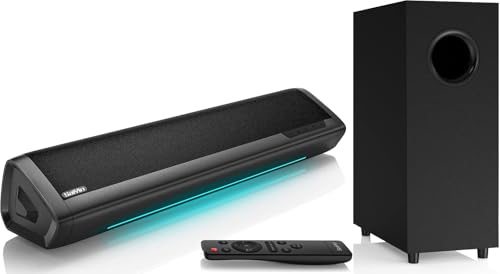
- Dedicated subwoofer for deeper bass
- Optical, AUX, and Bluetooth connectivity
- Includes cables, remote, and mounting hardware
Best For: Affordable small-room entertainment and playback
Versatile Surround Pick

- Wireless rear speakers and subwoofer
- Dolby Audio and DTS compatibility
- App-based bass, treble, and mid EQ
Best For: Entertainment-focused home studios needing an all-in-one surround setup
Budget Connectivity Pick
Maraawa 120W Soundbar with Subwoofer

- 120W output with wired subwoofer
- Bluetooth 5.3, ARC, optical, and AUX
- Desktop or wall-mountable slim design
Best For: Small studios needing flexible connections at a modest price
Cinematic Detail Pick

- 5.1-channel system with rear speakers
- Dolby Atmos and DTS:X support
- Dedicated center channel for dialogue
Best For: Hybrid studios used for immersive movies, streaming, and music playback
Immersive Room-Filling Pick – TCL S65K 5.1 Atmos Soundbar System
For home studios that also serve as movie and gaming rooms, the TCL S65K is a full surround package rather than a basic bar. Its Dolby Atmos, DTS:X, wireless surround speakers, wireless subwoofer, and AI room calibration make it a strong option when you want soundbars for home studios with a wide, immersive presentation.
Best For: Larger home studios and multipurpose rooms where immersive surround sound and substantial bass matter.
Pros:
- Includes a wireless subwoofer and wireless surround speakers for a complete 5.1 setup.
- Supports Dolby Atmos and DTS:X spatial audio.
- AI Sonic Auto Room Calibration tailors the sound to the room.
- Offers Bluetooth, USB, Wi-Fi, and HDMI connectivity.
Cons:
- The 27-pound system and multiple speakers require more setup space than compact bars.
- Its feature set may be more than needed for a small studio focused on simple stereo playback.
The S65K is the most expansive choice here, especially if your studio doubles as an entertainment space. Its room calibration and dedicated surround hardware add flexibility, though the larger system is less minimal than an all-in-one soundbar.
Best Tuning Flexibility – ULTIMEA Poseidon M30 2.1 Soundbar
The ULTIMEA Poseidon M30 is a practical pick among soundbars for home studios when app-based control and adjustable sound matter more than surround channels. Its 10-band equalizer, extensive presets, wireless subwoofer, and dialogue processing let you shape the 2.1 system for music, games, movies, or general monitoring.
Best For: Studio users who want detailed EQ control and flexible wireless bass placement.
Pros:
- The app provides a 10-band equalizer and 121 preset EQ matrices.
- Wireless subwoofer placement avoids an audio cable between the bar and subwoofer.
- VoiceMX processing is designed to keep dialogue clear.
- Supports HDMI ARC, optical, and Bluetooth 6.0.
Cons:
- It is a 2.1-channel stereo system, without the surround speakers or Atmos/DTS:X listed for the TCL system.
- The compact system’s 240-watt peak output is specified for room-filling playback, not necessarily studio reference monitoring.
Choose the Poseidon M30 if hands-on sound customization is a priority. The app gives it unusual flexibility for its class, while the wireless subwoofer adds low-end impact without complicating placement.
Best All-in-One Design – Amazon Fire TV Soundbar Plus
The Amazon Fire TV Soundbar Plus keeps the setup simple with a single all-in-one 3.1 bar and built-in bass. For home studios that need a streamlined entertainment system, it combines Dolby Atmos, DTS:X, a dedicated dialogue channel, Bluetooth, and HDMI eARC/ARC connectivity without a separate subwoofer.
Best For: Small to medium studios where easy setup, clear dialogue, and built-in bass are priorities.
Pros:
- All-in-one 3.1 design includes built-in bass.
- Supports Dolby Atmos and DTS:X.
- Dedicated center dialogue channel helps sharpen conversations.
- Includes Movie, Music, Sports, and Night sound modes.
Cons:
- It does not include a wireless subwoofer or separate surround speakers.
- The supplied notes focus on TV-oriented connectivity and features rather than detailed studio EQ controls.
The Fire TV Soundbar Plus is a sensible middle ground for a clean studio setup. It delivers more channel separation and spatial processing than a basic stereo bar while avoiding the extra components of a full surround system.
Best Compact Choice – Bose TV Speaker Soundbar
The Bose TV Speaker is the simplest and most compact option among these soundbars for home studios. Its two angled full-range drivers, dialogue enhancement, Bluetooth, HDMI-ARC, optical, and AUX inputs make it well suited to a small workspace where clear speech and easy placement matter more than surround effects.
Best For: Compact studios and desks needing straightforward TV audio, Bluetooth playback, and dialogue clarity.
Pros:
- Compact 23.38-inch-wide design stands just over 2 inches tall.
- Dialogue mode and bass boost are available from the included remote.
- Supports Bluetooth, HDMI-ARC, optical, and AUX connections.
- Can be expanded with a compatible Bose Bass Module 500 or 700.
Cons:
- It is a stereo soundbar with a listed 35-watt maximum output, so it lacks Atmos and multichannel surround features.
- A compatible Bose bass module requires a separate purchase.
- Wall brackets are sold separately.
The Bose TV Speaker is best when footprint and simplicity are the deciding factors. It will not create the immersive field of the larger systems, but its compact design and speech-focused controls make it easy to integrate into a small studio.
Best Immersive Setup – ULTIMEA Poseidon M60
For home studios that also handle films, gaming, or demonstrations, the ULTIMEA Poseidon M60 brings a wide 5.1-channel presentation without requiring rear speakers. Its Dolby Atmos support, wired subwoofer, and app-based EQ provide useful flexibility for tuning a compact listening space.
Best For: Home studios needing cinematic impact, clear dialogue, and adjustable sound control.
Pros:
- 5.1-channel Dolby Atmos design creates an immersive sound field without rear speakers.
- VoiceMX processing is designed to keep dialogue distinct from music and effects.
- App control includes a 10-band graphic EQ, 121 presets, and adjustable surround levels.
- Dedicated wooden subwoofer and 300W peak output add substantial low-end impact.
Cons:
- The wired subwoofer requires more placement and cable planning.
- Its feature set is oriented toward home theater as much as studio monitoring.
The Poseidon M60 is a strong choice when you want a soundbar for home studios that can also deliver an expansive, bass-heavy presentation for entertainment. Its extensive app adjustments are helpful, though serious mixing work may still call for dedicated nearfield monitors.
Best Compact Smart Option – Bose Smart Dolby Atmos Soundbar
The Bose Smart Dolby Atmos Soundbar is a compact choice for soundbars for home studios where desk or shelf space is limited. It combines upward-firing drivers, TrueSpace processing, strong dialogue enhancement, and broad wireless streaming support in one unit.
Best For: Small studios that prioritize convenient streaming, voice control, and clear spoken content.
Pros:
- Five-transducer acoustic design includes two upward-firing drivers for spacious sound.
- TrueSpace upmixes stereo and 5.1 content for a more enveloping presentation.
- A.I. Dialogue Mode helps balance voices against surrounding audio.
- Supports Bluetooth, AirPlay 2, Spotify Connect, Chromecast, Alexa, and app control.
Cons:
- It is an all-in-one bar without a dedicated subwoofer included.
- Some advanced surround expansion options require separately sold Bose Ultra Open Earbuds.
This Bose model suits a streamlined studio setup where ease of use matters as much as sound coverage. It is particularly practical for editing video, streaming reference material, and general listening, although users seeking pronounced sub-bass may want a system with a separate woofer.
Best Budget Subwoofer Pairing – Saiyin Sound Bar with Subwoofer
The Saiyin Sound Bar with Subwoofer is a straightforward option among soundbars for home studios, especially when you want a separate bass unit without a complicated setup. Optical, auxiliary, and Bluetooth connections make it easy to use with a TV, computer, or mobile device.
Best For: Budget-conscious desktop or small-room setups needing simple connectivity and deeper bass.
Pros:
- Dedicated subwoofer provides fuller, punchier low-frequency response than a bar alone.
- Offers Bluetooth, optical, and auxiliary connection options for computers and TVs.
- Three EQ modes cover news, movie, and music listening.
- Includes optical and auxiliary cables, mounting hardware, and a replacement remote.
Cons:
- The system uses stereo output rather than Dolby Atmos or multichannel surround.
- The subwoofer must connect to the soundbar’s SUB OUT port to work correctly.
- Three EQ modes offer less detailed adjustment than a graphic equalizer.
The Saiyin is best viewed as an accessible entertainment and playback system rather than a precision monitoring solution. Its included subwoofer and flexible inputs make it useful for casual studio listening, presentations, and media work on a modest budget.
Versatile Surround Pick – LG S40TR 4.1-Channel Soundbar
The LG S40TR is a practical choice among soundbars for home studios when you want a broader listening setup without adding a separate AV receiver. Its wireless rear speakers and subwoofer create a 4.1-channel system, while Dolby Audio, DTS Digital compatibility, and app-based equalizer controls support movies, music, and general monitoring.
Best For: Home studio users who want an all-in-one surround system with flexible speaker placement and simple LG TV integration.
Pros:
- Includes wireless rear speakers and a wireless subwoofer for a fuller soundstage.
- Dolby Audio and DTS Digital compatibility support movies, music, and shows.
- The LG Soundbar App provides bass, treble, and mid-range adjustment.
- Clear Voice Plus and smart up-mixing can improve dialogue and two-channel playback.
Cons:
- Its surround-oriented design may be more than needed for a compact stereo-focused studio.
- Advanced WOW Orchestra features are intended for use with a compatible LG TV.
The S40TR stands out for buyers who value immersive playback and easy setup. It is less focused on minimalist nearfield monitoring, but its wireless rear speakers, subwoofer, and basic EQ controls make it adaptable for entertainment-led studio spaces.
Budget Connectivity Pick – Maraawa 120W Soundbar with Subwoofer
The Maraawa KY-2020E is a straightforward option among soundbars for home studios, combining a slim soundbar with a wired subwoofer and 120W of stated output. Bluetooth 5.3, ARC, optical, and AUX connections make it suitable for switching between a TV, computer, projector, or mobile device.
Best For: Buyers who want an affordable, space-saving soundbar system with broad wired and Bluetooth connectivity.
Pros:
- Offers Bluetooth 5.3, ARC, optical, and AUX input options.
- Included wired subwoofer provides dedicated low-frequency output and stable synchronization.
- Slim design supports desktop placement or wall mounting.
- Setup and control are handled with included mounting hardware and remote.
Cons:
- The subwoofer is wired, which limits placement flexibility compared with wireless systems.
- The supplied specifications identify compatibility primarily with televisions, so studio-device integration may require the appropriate input cable.
This model is a sensible fit for small workspaces where connection flexibility matters more than advanced room correction or detailed studio-monitor features. Its wired subwoofer favors dependable synchronization, while the multiple inputs simplify everyday use across several sources.
Cinematic Detail Pick – Sony BRAVIA Theater System 6
The Sony BRAVIA Theater System 6 is a strong option among soundbars for home studios when immersive playback and clear dialogue are priorities. Its 5.1-channel layout combines three front-firing speakers, a dedicated center channel, rear speakers, and a subwoofer, with Dolby Atmos and DTS:X support for compatible content.
Best For: Home studios that double as movie or streaming rooms and need a complete 5.1-channel system with strong dialogue-focused features.
Pros:
- Complete 5.1-channel package includes rear speakers and a subwoofer.
- Dolby Atmos and DTS:X support can add cinematic height and surround effects.
- Dedicated center speaker is designed to improve dialogue clarity.
- BRAVIA Connect app offers control of volume, profiles, and advanced settings.
Cons:
- The full speaker package requires more space and setup than a standalone soundbar.
- Voice Zoom 3 benefits require a compatible BRAVIA TV.
- Its emphasis on cinema and surround playback may not suit users seeking compact nearfield monitoring.
The Theater System 6 is best viewed as a home-studio entertainment centerpiece rather than a dedicated production monitor. It offers the most complete surround arrangement in this group, along with app control, dialogue enhancement, and wireless Bluetooth music streaming.
How We Picked the Best Soundbars for Home Studios
We focused on features that matter in a small production, editing, or listening space: intelligible midrange, useful bass control, connection flexibility, compact installation, and predictable everyday operation. The lineup includes all-in-one soundbars as well as systems with wireless subwoofers and rear speakers, so you can match the setup to your room and workflow.
Because a soundbar is not a replacement for properly positioned nearfield studio monitors, we also considered whether each system is better suited to casual reference checks, media playback, client presentations, or immersive entertainment. HDMI ARC or eARC, optical input, Bluetooth, dialogue modes, and app-based controls can make a meaningful difference when switching between a computer, television, streaming device, and other sources.
Quick Comparison
| Best for | What to prioritize | Suitable setup |
|---|---|---|
| Small desk or editing room | Compact cabinet, clear dialogue, low-volume balance | All-in-one soundbar |
| Immersive media playback | Dolby Atmos or DTS:X, subwoofer, rear channels | 5.1 or larger system |
| Music and casual monitoring | Balanced voicing, Bluetooth, adjustable bass | Soundbar with subwoofer |
| Voice-heavy video work | Dialogue enhancement and center-channel clarity | 3.1-channel model |
Key Buying Factors for Soundbars for Home Studios
Sound Profile and Reference Use
For editing dialogue, prioritize a clean center image and restrained bass rather than maximum impact. A system with adjustable bass and a dedicated dialogue mode is easier to use at modest volume. If you mix music professionally, use studio monitors or headphones for final decisions and treat the soundbar as a secondary consumer reference.
Channels, Subwoofers, and Room Size
Compact two- or three-channel bars suit desks, bedrooms, and smaller editing rooms. Wireless subwoofers add low-end extension but require placement near an outlet and may excite room modes. Rear speakers can create a wider presentation, though they need additional space, power, and setup time.
Connections and Control
HDMI ARC or eARC is generally the most convenient television connection, while optical is useful for older displays and computers. Bluetooth helps with quick playback, but wired connections are preferable for consistent latency. Check whether the included remote, mobile app, voice control, and equalizer settings fit your workflow.
Dolby Atmos and Processing
Atmos and other surround formats can improve films and games, but virtual height effects depend heavily on ceiling height, room layout, and seating position. Do not pay for immersive processing if your main priority is accurate stereo monitoring at a desk.
Who Should Buy Which Soundbars for Home Studios?
Choose a compact all-in-one model if you want a simple upgrade for dialogue, streaming, and occasional editing in a small room. Select a 3.1-channel bar when speech clarity is central to your work. A system with a wireless subwoofer is better for music, film, and fuller low-frequency playback, while a 5.1 setup with rear speakers suits larger rooms and buyers who want convincing surround sound.
For a flexible home studio, look for HDMI ARC or eARC, optical input, Bluetooth, independent bass adjustment, and a dialogue mode. Before buying, measure the desk or media console, confirm clearance for the display, and verify that wireless components can be positioned where power outlets are available.