Choosing the right processor can make a live sound system clearer, louder, and far easier to control. A good speaker management processor for live sound helps shape crossover points, align drivers, tame harsh frequencies, and protect your amps and speakers.
Below, we focus on practical options for DJs, small venues, touring rigs, and larger stage systems, so you can match the right model to your setup and budget.
Best 10 Speaker Management Processor for Live Sound Picks for 2026
Premium Rack-Mount Control
dbx DriveRack 260 2x6 I/O Loudspeaker Management System

- 2-in/6-out loudspeaker management system
- Crossover, EQ, compression, limiting, and delay
- AFS feedback suppression with setup wizard
Best For: FOH engineers and installers needing an all-in-one live sound processor
Budget PC-Tuned Crossover Processor
2 Input 6 Output Audio Processor with LCD and PC Setup
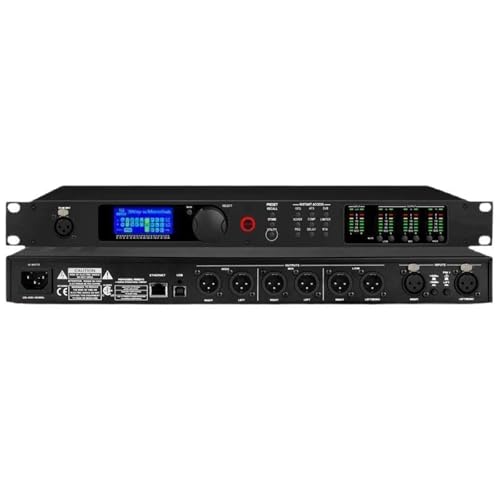
- 2-in/6-out processor with LCD screen
- Graphic EQ, 8-band parametric EQ, crossover, and delay
- Noise gate helps reduce noise and howling
Best For: DJs and live performers who want configurable speaker processing with PC setup
High-Precision Digital Control
Behringer ULTRADRIVE DCX2496LE Loudspeaker Management System

- 2 inputs and 6 outputs for flexible routing
- 24-bit/96 kHz converters for clean signal integrity
- Dynamic EQ and parametric EQ on inputs and outputs
Best For: Users wanting high-resolution 2x6 loudspeaker management for live sound
Front-Panel Controlled System Processor
Ashly Protea 3.6SP 3 x 6 Loudspeaker System Processor

- 3-in/6-out loudspeaker system processor
- Front-panel parameter control
- LCD screen for setting visibility
Best For: Installers and technicians who prefer hands-on rack processor control
Flagship Dante-Ready DSP
Dual-Input, Six-Output Speaker Management

- Dual-input, six-output architecture
- Dante network integration
- 24-bit/192kHz processing
Best For: Large live events and complex PA systems
Rackmount Classic DSP
Ashly Protea 4.8SP Loudspeaker Processor

- 4-in/8-out loudspeaker processing
- Front-panel LCD parameter control
- Rackmount metal construction
Best For: Installed pro audio systems and stage racks
Event-Ready Digital DSP
Dual-Input, Six-Output Speaker Control

- 260-channel DSP processing
- Dante networking support
- Rugged heat-resistant housing
Best For: Complex live-event PA and stage systems
Precision DSP Crossover Control
Peavey VSX 26e 2-Channel Loudspeaker Manager

- Digital EQ, delay, and limiting for PA tuning
- Multiple filter types and crossover alignments
- Linked stereo channels and built-in signal generator
Best For: Live sound reinforcement and installed PA systems
Rack PA Tuning Utility
Driver Rack PA2 2-In/6-Out Loudspeaker Processor

- Graphic LCD for easier setup and monitoring
- Stereo output limiter for system protection
- Delay and pink noise tools for PA tuning
Best For: Basic live sound tuning and loudspeaker protection
All-in-One DSP Matrix
DP-26 2-In/6-Out Digital Audio Processor

- Crossover, EQ, limiter, mixer, and delayer in one unit
- PC control with USB and RS485 connectivity
- 96 kHz DSP with detailed GEQ/PEQ processing
Best For: Advanced line array and multi-channel live sound systems
Premium Rack-Mount Control – dbx DriveRack 260 2×6 I/O Loudspeaker Management System
If you need a speaker management processor for live sound that can handle system tuning, protection, and feedback control in one rack unit, the dbx DriveRack 260 is built for that job. Its 2-in/6-out architecture gives you the routing flexibility to manage crossover settings, EQ, limiting, and delay for a wide range of venue setups.
Best For: FOH engineers, installers, and live sound teams that want an all-in-one loudspeaker management system with feedback suppression and system protection.
Pros:
- 2-input/6-output design supports full system management for multi-speaker setups.
- Includes crossover, 28-band graphic EQ, parametric EQ, compression, and limiting.
- Patent-pending AFS helps reduce feedback in unpredictable live environments.
- Setup wizard and DriveWare GUI make configuration faster for installs and soundchecks.
Cons:
- Rack-mount, corded design is geared toward installed or dedicated live sound rigs.
- More advanced than a simple processor, so it may be overkill for basic systems.
The DriveRack 260 is a strong choice when you want one processor to manage speaker tuning and protection without piecing together separate tools. It is especially practical for engineers who value feedback suppression, delay alignment, and guided setup in a live sound workflow.
Budget PC-Tuned Crossover Processor – 2 Input 6 Output Audio Processor with LCD and PC Setup
This speaker management processor for live sound is aimed at users who want practical system tuning tools with PC-based setup. It combines a mixer-style processor approach with crossover functions, graphic EQ, 8-band parametric EQ, delay, and limit controls for shaping a live or installed audio system.
Best For: DJs, studio users, and live performance setups that need a configurable processor with LCD control and computer-based adjustment.
Pros:
- 2-input/6-output design fits flexible speaker management layouts.
- Includes graphic EQ, 8-band parametric EQ, crossover, delay, and limit tools.
- LCD screen and dedicated buttons make parameter checks more direct.
- Noise gate adds anti-howling and noise reduction utility.
Cons:
- Product notes emphasize computer software setup, so it may require more configuration time.
- Best suited to users comfortable working with digital processor menus and software.
For buyers who want a feature-packed processor without a lot of guesswork, this model covers the basics of live system control well. It makes the most sense in settings where PC setup, on-device LCD monitoring, and crossover tuning are part of the workflow.
High-Precision Digital Control – Behringer ULTRADRIVE DCX2496LE Loudspeaker Management System
If you are shopping for a speaker management processor for live sound and want a precision-focused digital option, the Behringer ULTRADRIVE DCX2496LE is designed around flexible routing and clean signal handling. With 2 analog inputs and 6 analog outputs plus 24-bit/96 kHz conversion, it is built for detailed crossover and EQ work in serious sound systems.
Best For: Live sound users who want a 2×6 loudspeaker management system with high-resolution conversion and flexible EQ tools.
Pros:
- 2 analog inputs and 6 analog outputs provide broad routing flexibility.
- 24-bit/96 kHz A/D and D/A converters support high signal integrity.
- Dynamic EQ and parametric EQ are available on inputs and outputs.
- Compact 2 kg design is easier to integrate into rack-based systems.
Cons:
- Notes focus on core processing features rather than guided setup tools.
- Limited product details may make it harder to judge front-panel workflow at a glance.
The DCX2496LE stands out for buyers who prioritize precision and flexible signal processing over extra automation features. It is a solid fit for systems where high-resolution digital conversion and detailed EQ control matter most.
Front-Panel Controlled System Processor – Ashly Protea 3.6SP 3 x 6 Loudspeaker System Processor
The Ashly Protea 3.6SP is a straightforward speaker management processor for live sound when you want a 3-in/6-out loudspeaker system processor with direct front-panel control. Its LCD screen and parameter controls make it suitable for users who prefer hands-on adjustment during tuning or installation.
Best For: Installers and live sound technicians who want a simple 3-in/6-out processor with front-panel control.
Pros:
- 3-in/6-out format provides useful routing for loudspeaker system management.
- Front-panel parameter control makes on-site adjustments more accessible.
- LCD screen supports clear viewing of settings while tuning.
Cons:
- Supplied notes are brief, so feature depth is less detailed than competing models.
- May appeal more to users who want direct controls than advanced automation.
The Protea 3.6SP is a practical option if your priority is direct, rack-based control over a live sound system. It fits best in setups where a clear interface and basic loudspeaker processing format matter more than a long list of extras.
Flagship Dante-Ready DSP – Dual-Input, Six-Output Speaker Management
If you’re shopping for a speaker management processor for live sound, this dual-input, six-output digital audio processor is built for large-scale stage performances and complex PA routing. It combines advanced crossover processing, 24-bit/192kHz audio support, and Dante network integration to help keep multi-speaker systems organized and sounding clean.
Best For: Large-scale live events, stage crews, and PA systems that need Dante networking and flexible multi-output control.
Pros:
- Dual-input, six-output design supports complex speaker management setups.
- Dante connectivity adds low-latency network audio integration.
- 24-bit/192kHz processing targets studio-grade live sound quality.
- Rugged housing and heat-resistant components suit demanding environments.
Cons:
- Geared toward professional applications, so it may be more processor than a simple venue needs.
- Setup may be less straightforward for users who do not already work with Dante or DSP routing.
Overall, this model is positioned as a complete speaker management processor for live sound where reliability, network integration, and detailed processing matter most. If your rig needs advanced routing and high-resolution audio handling, it fits that brief well.
Rackmount Classic DSP – Ashly Protea 4.8SP Loudspeaker Processor
The Ashly Protea 4.8SP is a practical speaker management processor for live sound when you want a rackmount loudspeaker processor with front-panel control. Its 4-in/8-out layout, LCD screen, and balanced stereo output make it a straightforward fit for professional audio applications in studios or on stage.
Best For: Rack-mounted pro audio systems that need 4-in/8-out processing with front-panel control.
Pros:
- 4-in/8-out loudspeaker processing supports flexible routing.
- Front-panel parameter control with LCD screen makes on-device adjustment easier.
- Rack mount metal enclosure suits installed professional systems.
- Designed for professional audio applications in studios and stages.
Cons:
- Audio latency is listed at 682 milliseconds, which may concern timing-sensitive users.
- Its feature set is more focused on core processing than modern networked workflows.
For users who want a dependable rack processor with physical controls and a clear output layout, the 4.8SP keeps the emphasis on straightforward system management. It is a solid option when the priority is installation-friendly loudspeaker processing rather than extra networking features.
Event-Ready Digital DSP – Dual-Input, Six-Output Speaker Control
This professional digital audio processor is aimed at live sound users who need a complete speaker management processor for large-scale events and stage performances. With dual-input, six-output handling, 260-channel processing, Dante networking, and 24-bit/192kHz support, it is built for demanding PA setups that need both flexibility and high-fidelity transmission.
Best For: Large live events and stage systems that need high-precision DSP with Dante support.
Pros:
- 260-channel digital processing supports detailed system control.
- Dual-input, six-output design suits multi-speaker live sound setups.
- Dante connectivity supports low-latency networked audio transmission.
- Rugged, heat-resistant construction is intended for demanding environments.
Cons:
- Best suited to complex systems rather than simple speaker setups.
- The product notes emphasize processing and connectivity, not beginner-oriented controls.
As a speaker management processor for live sound, this model mirrors the priorities of a modern professional rig: flexible routing, high-resolution audio, and network integration. It should appeal most to production teams that want a robust DSP core for larger performances.
Precision DSP Crossover Control – Peavey VSX 26e 2-Channel Loudspeaker Manager
If you need a speaker management processor for live sound, the Peavey VSX 26e is built around practical control for tuning a PA with digital EQ, delay, limiting, and crossover settings. It supports balanced inputs, multiple filter types, and linked channels, making it a solid fit for venues and installs that need straightforward system protection and alignment.
Best For: Live sound reinforcement, venues, and installed PA systems that need precise DSP control.
Pros:
- Includes digital EQ, delay, and limiting control for speaker and amp protection.
- Offers PEQ, low-shelf, hi-shelf, low-pass, high-pass, and all-pass filter types.
- Supports Butterworth, Bessel, and Linkwitz-Riley crossover alignments up to 48 dB/oct.
- Built-in signal generator with sine, white noise, and pink noise for system tuning.
Cons:
- Designed for two audio channels, so it is best suited to simpler stereo systems.
- Feature set is focused on core loudspeaker management rather than broader processing extras.
This is a good choice if you want a reliable, no-frills DSP processor for tuning and protecting a live sound system. The linked-channel option and generator tools make setup more efficient in practical venue work.
Rack PA Tuning Utility – Driver Rack PA2 2-In/6-Out Loudspeaker Processor
The Driver Rack PA2 is a practical speaker management processor for live sound when you want core system-shaping tools in one rack unit. Its graphic LCD, stereo output limiter, speaker fine-tuning delay, and pink noise generator are aimed at making PA setup and alignment more manageable.
Best For: Live sound setups that need basic loudspeaker management, tuning, and protection tools.
Pros:
- Graphic LCD display helps with setup and monitoring.
- Stereo output limiter adds an important layer of protection.
- Speaker fine-tuning delay supports system alignment.
- Pink noise generator is useful for basic tuning tasks.
Cons:
- Supplied notes list fewer detailed processing specs than some competing units.
- Best suited to straightforward PA control rather than advanced customization.
This model keeps the focus on essentials, which can be an advantage if you want a simpler path to getting a live system sounding consistent. It is a sensible pick for users who value tuning aids and limiter protection over a long feature list.
All-in-One DSP Matrix – DP-26 2-In/6-Out Digital Audio Processor
The DP-26 is a feature-heavy speaker management processor for live sound, combining crossover, EQ, limiter, delayer, filter, matrix, and mixer functions in one 1U rack unit. With PC control software, USB and RS485 connectivity, and detailed per-channel delay and filter options, it is designed for users who want flexible loudspeaker management for line array and other multi-channel systems.
Best For: Line array systems and advanced live sound setups that need extensive DSP control.
Pros:
- Combines crossover, equalizer, limiter, delayer, filter, matrix, and mixer functions.
- Offers PC control software plus panel-based operation for flexible setup.
- Supports up to 250 machines via RS485 and remote control over long distances.
- Includes 96 kHz sampling, 32-bit DSP, and detailed GEQ/PEQ processing.
Cons:
- Feature depth may be more than needed for simpler PA rigs.
- Best value is tied to users who will actually use the more advanced control options.
If you need more than a basic crossover box, the DP-26 offers a broad toolkit for shaping and managing a complex sound system. Its combination of onboard controls and computer-based editing makes it a strong fit for technical users and larger deployments.
How We Picked the Best Speaker Management Processor for Live Sound
We prioritized systems that offer the core tools live engineers actually use: crossover control, EQ, delay, limiting, routing flexibility, and reliable output configuration. We also favored units with straightforward setup, enough I/O for common PA layouts, and features that help protect loudspeakers in demanding conditions.
Quick Comparison
In this category, the biggest differences are channel count, processing depth, control method, and how easy the unit is to integrate into an existing rig. Some models are better suited to compact DJ systems, while others are built for multi-way line arrays, installed sound, or larger live events.
Key Buying Factors for a Speaker Management Processor for Live Sound
I/O and System Size
Start with your speaker layout. A 2-in/6-out processor is often enough for stereo tops plus subs or a basic three-way system, while 4-in/8-out models give you more routing options for complex rigs. Make sure the processor can handle your current setup and leave room for future expansion.
Processing Tools
Look for essential features such as crossover filters, parametric EQ, graphic EQ, delay, polarity control, and limiting. Auto-EQ can be helpful for quick tuning, but manual control still matters for dialing in a system to the room.
Control and Workflow
Some units are designed for front-panel setup, while others offer PC software for deeper adjustment. If you tune systems often, software control can speed up editing and save presets for different venues or events.
Protection and Sound Quality
A strong Speaker Management Processor for Live Sound should do more than just route audio. Proper limiting and delay alignment can reduce driver stress, improve coherence, and help your PA sound more consistent at higher volumes.
Who Should Buy Which Speaker Management Processor for Live Sound?
Choose a simpler 2-in/6-out processor if you run DJ systems, small clubs, rehearsal spaces, or portable PA rigs and want dependable control without unnecessary complexity. Step up to a more advanced or higher-channel-count model if you manage line arrays, multi-zone systems, or larger stage productions where precise routing and tuning are essential.
If you want the best balance of flexibility and ease of use, prioritize a model with strong onboard processing, clear control layout, and enough outputs to match your system today and tomorrow.