Adding speakers to multiple rooms should not force your amplifier to handle an unsafe load. The best speaker selector switches with impedance matching make it easier to distribute one or more audio sources while protecting connected equipment.
This roundup compares 10 options across zone count, power handling, source flexibility, volume control, and installation-friendly features, so you can choose the right switch for a home theater, whole-home audio system, or smaller multi-room setup.
Best 10 Speaker Selector Switches with Impedance Matching Picks for 2026
Best for Large Multiroom Setups

- Connects up to eight stereo zones
- Built-in protection maintains at least 5 ohms
- Supports up to 200 watts per channel with protection disabled
Best For: Large home or business audio installations
Best Simple A/B/C/D Option
Pyle 4-Channel Speaker Selector

- Connects up to four speaker pairs
- Push-button plug-and-play operation
- Handles 100 watts per channel with 8-ohm systems
Best For: Straightforward four-pair stereo setups
Best for Secure Installations
OSD Audio ISS4 4-Zone Selector
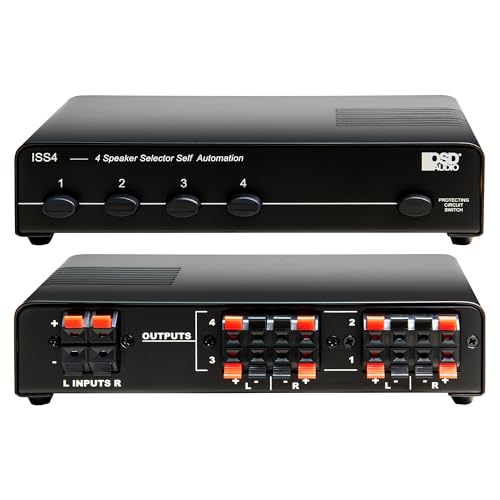
- Selectable impedance protection for multiple speaker pairs
- Individual on/off controls for four zones
- Removable screw-down Phoenix connectors
Best For: Permanent cabinet or rack-mounted four-zone systems
Best High-Capacity Dual-Source Pick
Monoprice SS-Pro 12 Speaker Selector

- Supports 12 speaker pairs or listening zones
- Impedance-matching transformers distribute power safely
- Front-panel selection between two sources
Best For: Large multi-zone systems with dual-source control
Multi-Zone Control
Pyle PSLSW6 6-Channel Speaker Selector

- Controls up to six speaker pairs
- Independent volume for each pair
- Overload protection circuitry
Best For: Six-pair home theater and multi-room systems using 8-ohm speakers
RMS Power Pick
Sequence Way 100W Impedance-Matching Selector

- 100W RMS per channel
- Automatic impedance protection
- Removable 14-gauge wire connectors
Best For: Installations prioritizing RMS power handling and basic protected switching
Flexible Zone Switching
Monoprice SS-6 Premium Selector
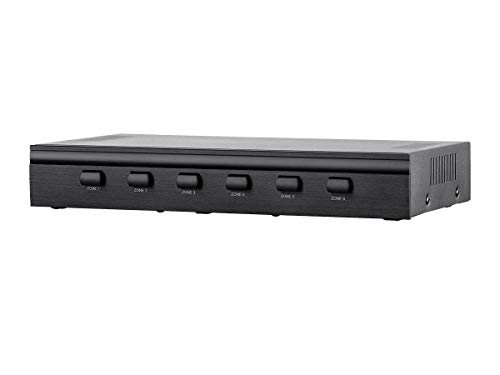
- Six individual zone on/off buttons
- Automatic impedance protection
- Supports 12- to 16-AWG wire
Best For: Multi-zone systems requiring flexible wiring and protected amplifier connections
High-Capacity Zone Control

- Eight speaker-pair outputs
- For 4- or 8-ohm speakers
- 100W/channel RMS capacity
Best For: Large multi-room speaker systems
Simple Four-Zone Protection

- Four-channel speaker selector
- Automatic impedance protection
- 100W RMS per channel
Best For: Basic four-zone audio distribution
Four-Zone Volume Control
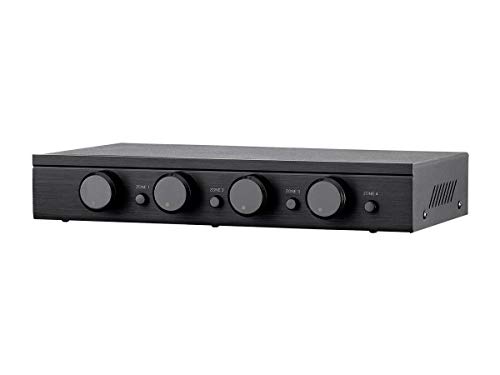
- Four zones with volume controls
- Automatic impedance protection
- 100W continuous per channel
Best For: Multi-room systems needing per-zone volume adjustment
Best for Large Multiroom Setups – 8-Channel Speaker Selector
For larger homes or businesses, the Monoprice 108230 is a practical choice among speaker selector switches with impedance matching. It connects up to eight stereo zones and uses built-in circuitry to keep the amplifier’s overall impedance from dropping below 5 ohms when multiple zones are selected.
Best For: Installations needing up to eight stereo speaker zones and flexible power handling.
Pros:
- Supports up to eight stereo speaker zones.
- Impedance-matching protection helps maintain at least 5 ohms at the amplifier.
- Handles up to 100 watts per channel with protection enabled, or up to 200 watts with it disabled.
- Includes channel-identification stickers for easier zone labeling.
Cons:
- The protection circuitry must be disabled to reach the 200-watt-per-channel rating.
- No warranty is listed in the supplied details.
Choose this model when zone capacity is the priority. Its eight-channel design offers more expansion than typical four-zone selectors, while the impedance protection adds useful safeguards for multi-speaker installations.
Best Simple A/B/C/D Option – Pyle 4-Channel Speaker Selector
The Pyle PSS4 is a straightforward option for shoppers comparing speaker selector switches with impedance matching for smaller systems. Its push-button design connects up to four separate speaker pairs and supports speaker wire up to 14 gauge.
Best For: Simple four-pair stereo setups using speakers with a minimum impedance of 8 ohms.
Pros:
- Connects up to four separate speaker pairs.
- Push-button operation supports easy plug-and-play setup.
- Accepts speaker wire up to 14 gauge.
- Handles up to 100 watts per channel with 8-ohm speaker systems.
Cons:
- Designed for speakers with a minimum impedance of 8 ohms.
- Offers four channels rather than the higher zone counts of larger selectors.
The PSS4 makes sense when you want basic front-panel control without a complex installation. Confirm your speakers meet the 8-ohm minimum before choosing it for a multi-pair system.
Best for Secure Installations – OSD Audio ISS4 4-Zone Selector
The OSD Audio ISS4 combines four-zone switching with selectable impedance protection, making it a solid contender among speaker selector switches with impedance matching. Its removable Phoenix connectors and screw-down terminals are designed to make speaker-wire installation more secure and manageable.
Best For: Multi-room systems needing four zones, individual zone controls, and rack- or cabinet-friendly installation.
Pros:
- Distributes audio to four listening zones and can play any pair.
- Selectable impedance-matching protection supports multiple speaker pairs from one amplifier.
- Individual on/off selectors provide control for each zone.
- Low-profile steel construction fits cabinets or equipment racks.
Cons:
- Protection-enabled output is rated at up to 70 watts per channel.
- It is a corded unit rather than a passive-looking cable accessory.
With its sturdy construction, removable connectors, and five-year limited warranty, the ISS4 is well suited to a permanent four-zone installation where connection security matters as much as switching convenience.
Best High-Capacity Dual-Source Pick – Monoprice SS-Pro 12 Speaker Selector
The Monoprice SS-Pro 12 is built for extensive distributed audio, supporting up to 12 pairs of speakers or listening zones. For shoppers seeking speaker selector switches with impedance matching and source flexibility, it adds audiophile-grade impedance-matching transformers and a front-panel source-selection switch.
Best For: Large installations requiring 12 zones or speaker pairs and two selectable sources.
Pros:
- Supports up to 12 speaker pairs or listening zones.
- Front-panel push-buttons provide individual zone control.
- Audiophile-grade impedance-matching transformers help distribute power safely.
- Includes a front-panel switch for choosing between two sources.
Cons:
- Its 12-zone capacity may be more than needed for smaller systems.
- The supplied details do not specify a protection-enabled per-channel wattage rating.
Select the SS-Pro 12 when expansion and dual-source operation outweigh the need for a compact selector. It is the most suitable of these options for a broad multi-zone audio layout with centralized controls.
Multi-Zone Control – Pyle PSLSW6 6-Channel Speaker Selector
The Pyle PSLSW6 is a practical choice when you need speaker selector switches with impedance matching-style system protection for a multi-room or home theater setup. It controls up to six speaker pairs, supports 8-ohm speakers, and adds independent volume adjustment for each connected pair.
Best For: Users who want six-zone speaker selection with per-pair volume controls and a compact tabletop design.
Pros:
- Controls up to six speaker pairs, individually or in combination.
- Provides independent volume controls for each speaker pair.
- Handles up to 100 watts maximum per channel and accepts speaker wire up to 14 AWG.
- Includes overload protection circuitry and push-button speaker selection.
Cons:
- Specified for 8-ohm impedance speakers, limiting flexibility with lower-impedance setups.
- Uses screw-type terminals rather than quick-connect inputs.
- Power rating is listed as 100 watts maximum, not RMS.
Choose this model if zone-by-zone volume control matters as much as speaker switching. Its six-pair capacity is useful for larger installations, while the 8-ohm requirement should be checked before purchase.
RMS Power Pick – Sequence Way 100W Impedance-Matching Selector
The Sequence Way selector is a straightforward option for shoppers comparing speaker selector switches with impedance matching. It is rated for 100 watts RMS per channel and includes automatic impedance protection circuitry for multi-speaker installations.
Best For: Installations where 100-watt RMS handling, automatic impedance protection, and compact rack-friendly dimensions are priorities.
Pros:
- Supports 100 watts RMS per channel.
- Includes automatic impedance protection circuitry.
- Removable screw connectors accept 14-gauge speaker wire.
- Offers a stated 20 Hz to 22,000 Hz frequency response.
Cons:
- The supplied specifications do not identify the number of speaker zones or pairs.
- No individual zone volume controls are listed.
- Its 1 7/8-inch by 11 1/2-inch by 7-inch dimensions may require checking available space.
This is a focused choice for buyers who want clearly stated RMS power handling and automatic protection without documented extra controls. Confirm the required zone count before selecting it for a larger distributed-audio system.
Flexible Zone Switching – Monoprice SS-6 Premium Selector
The Monoprice SS-6 is designed for safely controlling multiple speaker pairs from one amplifier, making it a strong option among speaker selector switches with impedance matching protection. It combines automatic protection with individual zone buttons, broad wire compatibility, and support for floating-ground or bridged amplifier configurations.
Best For: Multi-zone systems needing individual on/off controls and compatibility with 12- to 16-AWG speaker wire.
Pros:
- Provides automatic impedance protection circuitry.
- Offers individual on/off buttons for six zones.
- Supports 12- to 16-AWG speaker wire through heavy-duty screw connectors.
- Includes isolated left/right circuit grounds for floating-ground or bridged amplifiers.
Cons:
- Listed 100-watt RMS capacity is per channel, so system requirements should be checked carefully.
- Impedance limits vary by speaker and selection combination.
- Individual zone switching is provided, but individual volume controls are not listed.
The SS-6 stands out when installation flexibility and amplifier protection are more important than per-zone volume adjustment. Review the stated impedance limits for your exact speaker combination, especially when selecting multiple zones at once.
High-Capacity Zone Control – Russound PRO-8 HP
Russound PRO-8 HP Eight Pair Speaker Selector with Impedance Matching 100W/Channel
Check Price On AmazonFor larger multi-room systems, the Russound PRO-8 HP is a speaker selector switch with impedance matching that supports up to eight speaker pairs from one amplifier. Its rear-mounted matching selector is designed for 4- or 8-ohm speakers, while the built-in subsonic filter and 100-watt-per-channel RMS rating add useful system protection and capacity.
Best For: Installations needing control of up to eight speaker pairs with selectable impedance matching.
Pros:
- Supports eight speaker pairs.
- Designed for 4- and 8-ohm speakers.
- 100 watts per channel RMS with a built-in subsonic filter.
- Color-coded detachable 14-gauge snap connectors simplify wiring.
Cons:
- Its eight-zone capacity may be more than smaller systems require.
- Impedance matching is adjusted through a rear-mounted selector.
The PRO-8 HP is the most suitable choice here when zone count and amplifier capacity matter more than a compact four-zone design.
Simple Four-Zone Protection – Monoprice SS-4
The Monoprice SS-4 is a straightforward four-channel speaker selector switch with impedance matching through automatic impedance protection. It lets one amplifier safely control multiple speaker pairs, with individual zone buttons, 100-watt RMS-per-channel capacity, and support for 12-16 AWG speaker wire.
Best For: Four-zone systems that need simple on/off control and automatic impedance protection.
Pros:
- Automatic impedance protection circuitry.
- Individual on/off buttons for each zone.
- Handles up to 100 watts RMS per channel.
- Isolated left/right grounds support floating-ground or bridged amplifiers.
Cons:
- Does not include individual zone volume controls.
- Limited to four speaker zones.
- Supports 12-16 AWG wire rather than a wider stated range.
Choose the SS-4 when you want practical four-zone switching and impedance protection without adding per-zone volume adjustment.
Four-Zone Volume Control – Monoprice SSVC-4.1
The Monoprice SSVC-4.1 combines four-zone switching with individual volume controls, making it a flexible speaker selector switch with impedance matching for distributed audio. Automatic impedance protection, 100 watts per channel continuous handling, and support for 12-18 AWG speaker wire suit systems where each zone needs separate adjustment.
Best For: Four-zone installations requiring both individual on/off switching and local volume control.
Pros:
- Individual volume controls and zone on/off buttons.
- Automatic impedance protection circuitry.
- 100 watts per channel continuous and 200 watts per channel peak handling.
- Supports 12-18 AWG speaker wire.
Cons:
- Provides four zones rather than the Russound’s eight.
- Its added volume-control hardware makes it heavier at 6.9 pounds.
- Requires corded electric power.
The SSVC-4.1 is the stronger fit when separate zone volume adjustment is a priority and four speaker outputs are sufficient.
How We Picked the Best Speaker Selector Switches with Impedance Matching
We evaluated these Speaker Selector Switches with Impedance Matching by looking at the features that matter most in real installations: number of speaker zones, rated power handling, impedance-protection design, source compatibility, independent zone controls, volume adjustment, and support for common speaker-wire gauges. We also considered whether each model suits a compact stereo system, a larger whole-home setup, or a more demanding home theater installation.
Because published specifications can vary by manufacturer and test conditions, treat power ratings as a planning reference rather than a guarantee of continuous output. Your amplifier’s minimum impedance, connected speaker impedance, and listening volume remain important.
Quick Comparison
| Best For | What to Prioritize |
|---|---|
| Small multi-room system | Four zones, simple on/off controls, compact installation |
| Larger whole-home audio | Six to eight zones, higher power handling, impedance protection |
| Separate listening levels | Independent zone volume controls |
| Two-source systems | Dual-input or dual-source switching |
| Custom wiring | Terminals that accept heavier 12–16 AWG speaker wire |
Key Buying Factors for Speaker Selector Switches with Impedance Matching
Zone Count and Expansion
Choose a selector with enough outputs for the rooms or speaker pairs you plan to use. Four-zone models work well for apartments and smaller homes, while six- and eight-zone units provide more flexibility for whole-home audio. Leave room for future speakers if the installation is difficult to access later.
Impedance Protection
When several speaker pairs play at once, their combined load can stress an amplifier. Impedance matching helps keep the connected load within a safer range, but it does not replace checking amplifier and speaker specifications. Confirm that the selector’s protection method is appropriate for your amplifier and intended speaker impedance.
Power Handling
Compare continuous or RMS ratings where available, rather than relying only on peak figures. The selector should comfortably accommodate your amplifier’s real output and your typical listening level. Avoid assuming that a higher wattage rating automatically improves sound quality.
Controls and Source Flexibility
Individual zone on/off buttons are useful for controlling which rooms play audio. If rooms need different listening levels, choose a model with independent volume controls or pair the selector with in-wall volume controls. Dual-source designs are helpful when two amplifiers or audio sources must feed separate zones.
Installation Details
Check terminal layout, enclosure size, ventilation, and supported wire gauge before buying. Use appropriate speaker cable, avoid loose connections, and place the selector where its controls remain accessible without trapping heat.
Who Should Buy Which Speaker Selector Switches with Impedance Matching?
Choose a four-zone selector for a straightforward living room, patio, kitchen, or bedroom setup. Choose a six- or eight-zone model if you are wiring several rooms or want spare capacity. Choose a dual-source unit when separate audio sources are central to your system. Choose volume-control functionality when rooms regularly need different levels. For the safest match, confirm your amplifier’s impedance requirements and the selector’s rated power before connecting multiple speaker pairs.