Fast external storage can make a major difference when editing 4K and 8K footage, moving large project files, or working directly from an external drive. The right enclosure lets you reuse an NVMe or SATA SSD while matching your computer’s ports, workflow, and performance needs.
We selected 10 standout SSD enclosures for video editing, including USB4 and 40Gbps models, dual-interface options, rugged designs, hubs, readers, and multi-drive enclosures. Use the guide below to narrow the choices by speed, compatibility, capacity, and portability.
Best 10 SSD Enclosures for Video Editing Picks for 2026
Maximum-Capacity Pick
ORICO 40Gbps Four-Bay NVMe Enclosure

- Four-bay M.2 NVMe design
- Up to 32TB total capacity
- Active cooling for sustained workloads
Best For: Editors needing multi-drive NVMe capacity
Easy-Install Pick
Yottamaster 40Gbps NVMe Enclosure

- Tool-free NVMe installation
- Typical speeds of 2,800–3,200 MB/s
- Active cooling with visible status indicators
Best For: Editors wanting a simple, compact single-drive enclosure
Rugged High-Speed Pick

- 20Gbps USB-C 3.2 Gen 2x2 interface
- Supports NVMe and SATA M.2 drives
- IP68 and MIL-STD-810H tested protection
Best For: Editors needing durable, high-speed portable storage
Mobile Creator Hub
ACASIS Magnetic NVMe Enclosure

- 10Gbps NVMe storage connection
- Built-in HDMI, USB-C hub, and PD pass-through
- Magnetic, tool-free design for mobile workflows
Best For: Mobile video creators using compatible iPhone, iPad, or Mac devices
Versatile Budget Option
SABRENT Tool-Free M.2 Enclosure
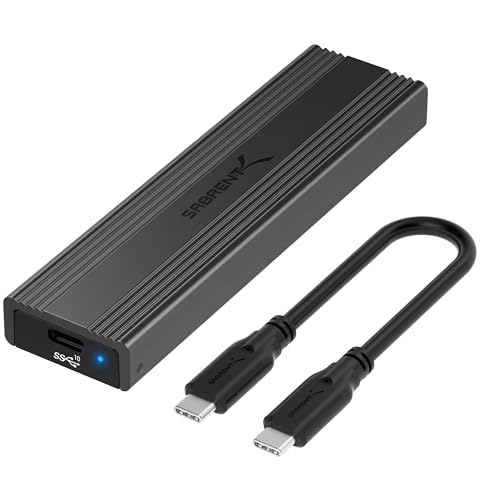
- Supports M.2 NVMe and SATA SSDs
- Tool-free installation for quick drive swaps
- 10Gbps USB-C with slim aluminum housing
Best For: Editors repurposing bare M.2 drives for portable storage
Best Compact NVMe Pick

- Tool-free M.2 NVMe installation
- USB 3.2 Gen 2 at up to 10Gbps
- Aluminum design with thermal pad
Best For: Portable single-drive editing and transfer setups
Best Multi-Drive Performance

- Four NVMe bays and up to 32TB capacity
- 40Gbps USB-C connectivity
- Active cooling and hot-swappable design
Best For: Large, desk-based editing libraries and heavy transfers
Best SATA/NVMe Compatibility

- Supports compatible NVMe and SATA M.2 SSDs
- Includes USB-C and USB-A cables
- Aluminum shell with thermal pads
Best For: Flexible single-drive use across newer and older USB computers
Maximum-Capacity Pick – ORICO 40Gbps Four-Bay NVMe Enclosure
For editors managing multiple NVMe drives, the ORICO 8848U4 is one of the most expansive ssd enclosures for video editing. Its four-bay design supports up to 32TB total, while USB 4.0 connectivity and active cooling are suited to demanding transfer sessions.
Best For: Video professionals and DIT users who need multi-drive NVMe capacity in a portable enclosure.
Pros:
- Supports four M-Key NVMe SSDs in 2230, 2242, 2260, and 2280 sizes.
- Up to 32TB total capacity, with up to 8TB per drive.
- Aluminum housing, cooling fan, and ventilation support sustained workloads.
- Compact, shock-resistant solid-state design with fan noise below 30 dB.
Cons:
- SSD storage is not included.
- Its four-drive configuration is larger and more specialized than a single-drive enclosure.
- Single-disk operation is specified at up to 10Gbps despite the 40Gbps overall bandwidth rating.
The 8848U4 stands out when capacity and multi-drive flexibility matter more than a simple plug-and-play setup. It is a strong fit for large project libraries, provided you supply compatible NVMe drives.
Fast Portable Pick – SABRENT USB4 NVMe SSD Enclosure
The SABRENT EC-U4TN is a compact choice among ssd enclosures for video editing, pairing USB4 with transfer rates up to 3,900 MB/s. Its tool-free installation and active cooling make it practical for editors who move large project files between compatible computers.
Best For: Mobile creators who want a fast, single-drive NVMe enclosure for Windows or macOS.
Pros:
- USB4 performance reaches up to 3,900 MB/s; Thunderbolt 3/4 performance reaches up to 2,700 MB/s.
- Tool-free installation supports PCIe NVMe drives from 2230 through 2280.
- Works with USB4, Thunderbolt 3/4, and USB-C hosts without drivers or external power.
- Integrated fan and aluminum/ABS construction help maintain performance during large transfers.
Cons:
- Does not support SATA M.2 SSDs.
- Actual speed depends on the SSD, host port, cable, and workload.
- Supports one drive rather than a multi-drive storage array.
With broad host compatibility and a lightweight 8-ounce build, the EC-U4TN is a sensible everyday editing companion. Choose it when portability and straightforward NVMe installation are higher priorities than expanded bays.
RAID Workflow Pick – ORICO Four-Bay 2.5-Inch Enclosure
The ORICO 8848RC3 brings flexible storage management to the ssd enclosures for video editing category. It supports multiple 2.5-inch SSD or HDD drives, seven RAID modes, card slots, and USB expansion, making it useful for editors handling footage, backups, and camera media in one setup.
Best For: Video editors and photographers who need RAID flexibility, card access, and expandable multi-drive storage.
Pros:
- Supports RAID 0, 1, 3, 5, 10, JBOD, and CLEAR modes.
- Holds up to four 2.5-inch drives, with up to 40TB total capacity stated.
- Includes two USB 3.2 10Gbps ports plus SD and TF card slots.
- Supports daisy-chaining up to three devices for expanded storage.
Cons:
- It does not support 3.5-inch drives.
- 5Gbps is specified through a SATA interface, while 10Gbps applies when connected to a PSSD.
- Its RAID and multi-drive setup may be more involved than a single SSD enclosure.
This enclosure is aimed at organized production workflows rather than minimal travel kits. Its RAID choices and built-in card connectivity can help consolidate editing storage and on-location media handling.
Easy-Install Pick – Yottamaster 40Gbps NVMe Enclosure
The Yottamaster YD006 is a convenient single-drive option for ssd enclosures for video editing. It uses USB4 or Thunderbolt 4 connectivity, offers tool-free installation, and typically delivers 2,800 to 3,200 MB/s in real-world use when paired with a suitable host and cable.
Best For: Editors who want quick NVMe installation, visible status indicators, and active cooling in a compact enclosure.
Pros:
- Supports Thunderbolt 4 and USB4 connectivity with plug-and-play use.
- Tool-free design accepts 2230, 2242, 2260, and 2280 NVMe SSDs.
- ASM2464PD controller provides stated overcurrent and overheating protection.
- Transparent cover shows the activity LED and fan status.
Cons:
- It is a single-drive enclosure.
- Real-world speeds are lower than the 40Gbps interface headline and vary by setup.
- Best performance requires a 40Gbps-rated cable and compatible host.
The YD006 balances speed with an especially simple installation process. Its clear cover and active fan are useful touches for users who want to monitor the enclosure during sustained editing transfers.
Rugged High-Speed Pick – ASUS TUF Gaming A2
For editors who need durable SSD enclosures for video editing, the ASUS TUF Gaming A2 combines USB-C 3.2 Gen 2×2 connectivity with broad M.2 compatibility. It supports both NVMe PCIe and SATA drives in 2242, 2260, and 2280 sizes, with transfer rates of up to 20Gbps.
Best For: Video editors who want a rugged enclosure for desktop, laptop, or mobile project storage.
Pros:
- USB-C 3.2 Gen 2×2 supports speeds up to 20Gbps.
- Accepts M.2 NVMe PCIe and SATA SSDs in three common lengths.
- Aluminum construction, thermal pad, silicone protection, and IP68/MIL-STD-810H testing add durability.
- Q-Latch enables screw-free SSD installation and swapping.
Cons:
- SSD is not included.
- Its 279 g weight is higher than some slim portable enclosures.
The TUF Gaming A2 is a strong choice when protection and compatibility matter as much as speed. Its 20Gbps interface and thermal design suit demanding file transfers, while the rugged exterior is useful for editors who travel with their working drives.
Mobile Creator Hub – ACASIS Magnetic NVMe Enclosure
The ACASIS Magnetic NVMe Enclosure combines an M.2 NVMe enclosure with a USB-C hub, HDMI output, and PD pass-through charging. For mobile editors, it is among the more flexible SSD enclosures for video editing, with a 10Gbps connection intended for photos, files, and high-bitrate 4K ProRes footage.
Best For: iPhone, iPad, and Mac users building a compact storage and connectivity setup for mobile content creation.
Pros:
- Combines NVMe storage, USB-C connectivity, HDMI, and PD pass-through charging.
- Magnetic design suits compatible phones and magnetic accessories.
- Tool-free, compact design is convenient for travel and remote editing.
- 10Gbps performance is designed to handle high-bitrate 4K ProRes footage.
Cons:
- SSD and charger are not included.
- New SSDs must be formatted, and drives larger than 1TB or multiple connected devices may benefit from external power.
- It supports M.2 NVMe drives rather than the broader NVMe-and-SATA compatibility of some enclosures.
This ACASIS model is best viewed as a mobile editing accessory rather than a simple drive case. Its hub features and magnetic form factor can streamline phone-based workflows, but users should plan for formatting and possible external power needs.
Versatile Budget Option – SABRENT Tool-Free M.2 Enclosure
The SABRENT EC-SNVE is a straightforward option for editors converting an existing M.2 drive into portable storage. It supports both NVMe and SATA M.2 SSDs in 2242, 2260, and 2280 sizes, making it a versatile entry among SSD enclosures for video editing.
Best For: Editors who want a slim, tool-free enclosure for bare M.2 NVMe or SATA SSDs.
Pros:
- Supports both M.2 NVMe and SATA drives in three lengths.
- Tool-free installation makes drive changes quick.
- USB 3.2 Type-C offers up to 10Gbps and up to 1000MB/s in real transfers.
- Aluminum housing and thermal pad help move heat away from the drive.
Cons:
- SSD is not included.
- There is no clearance for a pre-installed heatsink.
- It does not support 2.5-inch SATA drives or mSATA.
The EC-SNVE is a practical choice for repurposing spare M.2 drives without needing tools or external power. Its 10Gbps ceiling is below the ASUS model’s interface speed, but its NVMe-and-SATA support and slim design keep it flexible for everyday editing transfers.
Best Compact NVMe Pick – SABRENT EC-PNVO
For creators who need one of the more portable ssd enclosures for video editing, the SABRENT EC-PNVO combines USB 3.2 Gen 2 connectivity with an aluminum thermal design. Its tool-free flip-open build makes it convenient for upgrades, drive cloning, troubleshooting, and transporting a single NVMe SSD.
Best For: Editors who want a compact, bus-powered enclosure for one M.2 NVMe drive and fast everyday transfers.
Pros:
- Supports M.2 NVMe SSDs in 2230, 2242, 2260, and 2280 sizes.
- USB-C 10Gbps connectivity delivers up to 1,250MB/s transfer rates.
- Tool-free installation and an aluminum top help simplify setup and heat management.
Cons:
- Supports NVMe drives only; M.2 SATA SSDs are not compatible.
- Holds one SSD rather than offering multi-drive expansion.
The EC-PNVO is a straightforward choice for a single high-speed scratch disk, project drive, or transfer drive. Its 10Gbps ceiling is below the performance of the multi-bay Thunderbolt-compatible option, but its smaller footprint and tool-free access are useful for mobile workflows.
Best Multi-Drive Performance – TERRAMASTER D4 SSD
The TERRAMASTER D4 SSD is designed for demanding ssd enclosures for video editing workflows, with four M.2 NVMe bays, a 40Gbps USB-C interface, and support for up to 32TB total capacity. It can reach up to 3,224MB/s with four specified SSDs, making it suited to large projects and high-volume transfers.
Best For: Video editors who need several NVMe drives, substantial capacity, and faster-than-10Gbps external storage on a desk-based setup.
Pros:
- Four tool-free, hot-swappable M.2 NVMe 2280 slots support up to 8TB per drive.
- 40Gbps connectivity is compatible with Thunderbolt 3, 4, and 5 as well as USB4.
- Active cooling, temperature sensors, and quiet standby operation help manage sustained workloads.
- Works with Windows, Mac, Linux, Android, and iOS devices.
Cons:
- It has no built-in RAID; software RAID requires third-party tools.
- Requires its included power adapter, so it is less portable than bus-powered enclosures.
- Supports M.2 NVMe 2280 drives rather than the broader range of sizes supported by some single-drive cases.
The D4 SSD is the most capable option here for editors building a large external media pool. Its multi-drive design and cooling system are valuable for sustained work, though buyers should plan their storage layout carefully because RAID is not built in.
Best SATA/NVMe Compatibility – SSK SHE-C325 PRO
The SSK SHE-C325 PRO is a flexible choice among ssd enclosures for video editing because it accepts compatible M.2 NVMe PCIe and SATA drives. Its USB 3.2 Gen 2 interface, aluminum shell, included thermal pads, and both USB-C and USB-A cables make it practical for connecting one SSD to a range of computers.
Best For: Editors who want one enclosure that can work with supported M.2 NVMe or SATA drives and older USB hosts.
Pros:
- Supports compatible M.2 NVMe PCIe and SATA M-Key/B+M-Key SSDs in 2242, 2260, and 2280 sizes.
- Includes USB-C and USB-A cables for broader host compatibility.
- Aluminum construction and two thermal pads assist portability and heat dissipation.
- Supports UASP and TRIM and operates without an external power supply.
Cons:
- Does not support M.2 PCIe AHCI drives, mSATA SSDs, Wi-Fi cards, or capture cards.
- Its 10Gbps interface is slower than the TERRAMASTER D4 SSD’s 40Gbps connection.
- SSD and file-system compatibility still depend on the host system, and a new drive must be formatted.
The SHE-C325 PRO is a sensible general-purpose pick when drive compatibility and included cables matter more than maximum throughput. It offers useful flexibility for moving between systems, while its single-drive, 10Gbps design is best suited to moderate editing and transfer demands.
How We Picked These SSD Enclosures for Video Editing
We focused on the factors that matter most in real editing workflows: interface bandwidth, SSD compatibility, sustained performance, cooling, installation convenience, portability, and expansion features. The lineup includes compact single-drive enclosures for mobile editing, 10Gbps options for everyday footage, and USB4 or 40Gbps models suited to demanding transfers and high-bitrate media.
We also considered flexibility. Some enclosures support both NVMe and SATA M.2 drives, while others provide multiple bays, RAID-style storage, USB hubs, card-reading features, or rugged protection. Because advertised speeds depend on the host computer, cable, SSD, and workload, theoretical bandwidth should be treated as a comparison point rather than a guaranteed result.
Quick Comparison
| Type | Best For | What to Check |
|---|---|---|
| USB4 or 40Gbps NVMe | 4K/8K editing and large project transfers | USB4 or Thunderbolt compatibility, heat management |
| 10Gbps NVMe | General editing and backups | Host port speed and included cable |
| NVMe and SATA combo | Mixed drive collections | Supported key types and protocol limitations |
| Multi-bay enclosure | Desktop media libraries | Drive count, RAID support, power requirements |
| Rugged portable model | Travel and on-location production | Drop, water, and dust protection |
Key Buying Factors for SSD Enclosures for Video Editing
Interface and Real-World Speed
USB 3.2 Gen 2 typically provides up to 10Gbps, while USB 3.2 Gen 2×2 can reach 20Gbps and USB4 or compatible Thunderbolt connections can offer up to 40Gbps. Your computer must support the same standard to benefit from the enclosure’s maximum rating. A fast SSD in a slower enclosure will be limited by the enclosure interface.
Drive Compatibility
Confirm whether the enclosure accepts M.2 NVMe, SATA M.2, or both. Check the supported lengths, such as 2230, 2242, 2260, or 2280, along with keying requirements. NVMe and SATA drives use different protocols, so a model that supports both is especially useful when reusing older storage.
Heat, Power, and Reliability
Video transfers can sustain heavy activity for long periods. Look for a metal body, thermal pad, heatsink, or other cooling design to reduce throttling. Multi-drive units generally need external power, while bus-powered models are more portable but can draw significant power from laptops and phones.
Portability and Workflow Features
For mobile editors, prioritize compact dimensions, a secure cable connection, and meaningful protection against drops or moisture. Desktop editors may benefit more from multiple bays, RAID capabilities, USB hubs, card readers, or convenient tool-free installation.
Who Should Buy Which SSD Enclosures for Video Editing?
Choose a USB4 or 40Gbps NVMe enclosure if you regularly move large camera originals, edit high-bitrate 4K or 8K footage, or want the shortest transfer times from a compatible computer.
Choose a 10Gbps enclosure for a cost-effective everyday scratch disk, proxy drive, project shuttle, or backup device. It is often sufficient for many 4K workflows and works with a broad range of computers.
Choose a dual NVMe/SATA model if you have SSDs from different systems or want to reuse both newer NVMe drives and older SATA storage. Choose a rugged enclosure for travel, field production, and environments where accidental drops or exposure to dust and water are realistic risks.
Choose a multi-bay enclosure when you need a larger desktop media pool rather than a pocket-sized drive. Before buying, verify operating-system support, RAID behavior, cooling, and whether the unit requires a dedicated power adapter.