If you want a synthesizer workstation with sequencer, the best options do more than generate sounds. They help you sketch ideas quickly, build full patterns, and stay in creative flow without a computer.
This roundup focuses on versatile instruments for beat-making, sound design, and performance, with picks that balance portability, sequencing power, and real-world usability.
Best 10 Synthesizer Workstation with Sequencer Picks for 2026
Portable 61-Key Workstation

- 61-key synth-action keybed
- Step and MIDI sequencers
- Mic/line inputs with audio recorder
Best For: Players who want a lightweight workstation for sequencing and recording ideas
Mobile All-in-One Sequencer

- Advanced sequencer for quick arrangement
- Onboard sampling with built-in mic
- Battery-powered with built-in speaker
Best For: Creators who want portable sequencing and sampling anywhere
Experimental Hybrid Sequencer
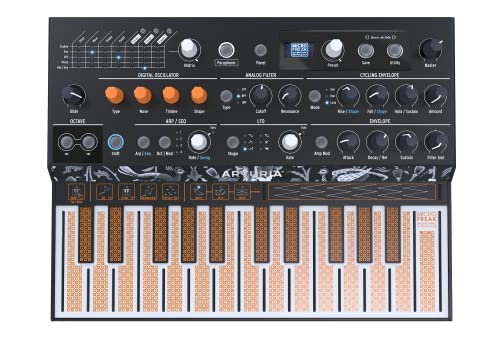
- 17 oscillator modes and analog filter
- Spice and Dice sequencer functions
- CV, USB, and MIDI connectivity
Best For: Sound designers and adventurous players seeking compact experimentation
Professional Clip Workstation

- 8-track groovebox with clip sequencing
- Zen-Core synths and onboard sampling
- 128-step sequencer with extensive effects
Best For: Producers and performers building full songs and live sets
Desktop Performance Pick
Roland SH-4d Compact Desktop Synthesizer

- 11 OSC models and four synth parts
- 128-pattern multitimbral sequencer with motion recording
- 32 knobs, four sliders, and onboard FX
Best For: Hands-on desktop sound design and live pattern work
Retro Game Sound Pick
Sonicware Liven MEGA SYNTHESIS

- 320 FM game sounds and 64 PCM drum kits
- 6-track sequencer for retro-style composition
- Compact, portable build with 10 FX types
Best For: Chiptune-inspired composing on a portable box
Analog Sequencing Pick

- Two analog oscillators with sub-oscillator
- Pattern-based step sequencer and arpeggiator
- 64 factory patches with 128-patch storage
Best For: Analog bass and lead work with quick sequencing
Retro Boutique Synth

- Authentic JD-800 sound modeling
- 2-part 64-step polyphonic sequencer
- USB-C audio, MIDI, and portable tabletop format
Best For: Compact Roland-style sound design and sequenced sketching
Portable MIDI Hub

- Built-in 64-step sequencer
- MIDI/CV/Gate control for hardware and modular gear
- 37 keys, 8 pads, and DAW transport controls
Best For: Hybrid studios needing a compact sequencing controller
Micro Polysynth

- 4-voice polyphonic micro-synth
- 64-step sequencer with hands-on performance tools
- USB-C audio/MIDI and 4.5-hour battery
Best For: Portable synthesis and quick pattern-based jamming
Portable 61-Key Workstation – Korg Kross 2-61
If you want a synthesizer workstation with sequencer features in a full-size, gig-friendly format, the Korg Kross 2-61 is built for sketching songs, triggering patterns, and handling basic recording tasks. Its 61-key synth-action keybed, step and MIDI sequencers, mic/line inputs, and onboard audio recorder make it a practical all-in-one option for writing on the move.
Best For: Players who want a lightweight 61-key workstation for sequencing, sampling input, and mobile song ideas.
Pros:
- 61-key synth-action keybed for hands-on playing
- Step and MIDI sequencers for building patterns and song ideas
- Mic/line inputs plus onboard audio recorder add flexibility for capturing audio
- Compact 3.8 kg build suits portable use
Cons:
- Not as compact as smaller groovebox-style units
- Focused more on workstation workflow than deep performance controls
- Keyboard feel is synth-action rather than weighted
The Kross 2-61 is a sensible choice if you want a straightforward workstation that combines keyboard playability with sequencing and recording tools. It looks especially useful for players who need one instrument to cover composing, demoing, and basic capture without overcomplicating the setup.
Mobile All-in-One Sequencer – Yamaha SEQTRAK
The Yamaha SEQTRAK is a compact synth workstation with sequencer functionality aimed at fast idea capture anywhere you can carry it. With drums, synths, sound design, sequencing, an advanced sequencer, onboard sampling, built-in speaker, microphone, and rechargeable battery, it is designed to keep the creative process moving without needing a studio setup.
Best For: Creators who want a highly portable sketchpad for sequencing, sampling, and beat-making on the go.
Pros:
- Advanced sequencer supports intuitive composition and arrangement
- Onboard sampling with built-in microphone helps capture sounds quickly
- Built-in speaker and rechargeable battery support portable use
- Compact, lightweight body is easy to carry
Cons:
- Built around a mobile workflow rather than a traditional keyboard workstation
- No full-size keybed listed in the supplied details
- Best suited to idea creation, not a large hardware production rig
If portability matters most, the SEQTRAK stands out as a modern synth workstation with sequencer tools that encourage quick creation. It is a strong fit for spontaneous songwriting, sound capture, and beat construction when you want everything in one small device.
Experimental Hybrid Sequencer – Arturia MicroFreak
The Arturia MicroFreak is a compact synth option for players who want a synthesizer workstation with sequencer-style creativity in a small, experimental package. Its 17 oscillator modes, analog filter, polyphonic aftertouch touch-plate keyboard, and built-in step sequencer functions make it a flexible tool for sound design and pattern building.
Best For: Sound designers and adventurous players who want a compact hybrid synth with sequencer tricks.
Pros:
- 17 oscillator modes cover a wide range of hybrid sounds
- Spice and Dice sequencer functions add random variation and pattern generation
- Polyphonic aftertouch touch-plate keyboard responds to expression per note
- CV, USB, and MIDI connectivity expands integration options
Cons:
- 25-key layout is limited for players who want a larger keyboard
- Touch-plate keyboard may not suit everyone
- More focused on experimental synthesis than traditional workstation features
The MicroFreak works well when you want unusual sounds and sequencer-driven experimentation in a compact format. It is less of a classic all-in-one workstation and more of a creative instrument for building fresh patterns and textures.
Professional Clip Workstation – Roland MC-707
The Roland MC-707 is a professional music production workstation built around an 8-track groovebox workflow and clip-based sequencing. With Zen-Core synths, onboard sampling, 128 clips, a 128-step step sequencer, and extensive effects, it is aimed at users who want to build and perform complete songs without a computer.
Best For: Producers and performers who want a hands-on groovebox for full song creation and live sets.
Pros:
- 8-track groovebox design supports complete song building
- Clip-based sequencing with 128 clips offers flexible arrangement
- Zen-Core synths and onboard sampler broaden sound creation
- Large effects section includes track and master processing
Cons:
- More complex and performance-oriented than a simple keyboard workstation
- No built-in keys for playing melodies directly
- May be more than casual users need for basic sequencing
If you want a serious synth workstation with sequencer power for arranging and performing, the MC-707 delivers a deep groovebox workflow. Its strength is combining synthesis, sampling, clips, and effects into one computer-free production hub.
Desktop Performance Pick – Roland SH-4d Compact Desktop Synthesizer
If you want a synthesizer workstation with sequencer features that feels immediate to use, the Roland SH-4d is built for hands-on sound design and fast pattern building. It combines 11 OSC models, four independent synth parts, a dedicated rhythm part, and a multitimbral pattern sequencer so you can sketch ideas, shape tones, and refine arrangements without digging through menus.
Best For: Players and producers who want a compact desktop synth for studio sound design, live performance, and quick sequenced ideas.
Pros:
- 11 OSC models for a wide range of sound-design options
- Multitimbral sequencer with 128 patterns, real-time recording, step entry, and motion recording
- Hands-on panel with 32 knobs, four sliders, and lots of direct controls
- Extensive onboard FX, including per-tone MFX plus global effects
Cons:
- Desktop format may not suit players who want full-size keys
- Designed around pattern workflows rather than linear song construction
- Plastic body may feel less substantial than heavier keyboard workstations
The SH-4d stands out if you value tactile control and a flexible sequencer in a compact format. Its USB-C audio/MIDI interface also makes it easier to move ideas into a DAW, which adds practical studio value.
Retro Game Sound Pick – Sonicware Liven MEGA SYNTHESIS
The Sonicware Liven MEGA SYNTHESIS is a strong fit if you want a synthesizer workstation with sequencer functions centered on retro game music creation. It is designed to recreate a 16-bit video game console sound, with 320 FM game sounds, 64 PCM drum kits, a 6-track sequencer, and 10 effects types for building nostalgic patterns quickly.
Best For: Writers and hobbyists who want chiptune-style composing tools and a lightweight, portable sequencer.
Pros:
- Built around retro game-inspired FM and PCM synthesis
- 6-track sequencer for arranging parts
- 320 FM game sounds and 64 PCM drum kits included
- Very portable at 790g with compact dimensions
Cons:
- AC adapter is not included
- Smaller control surface than larger desktop workstations
- Focus is specialized, so it may be less versatile for non-retro styles
This model makes the most sense when the goal is fast, characterful sequencing with a very specific sound palette. The included overlay sheet for FM editing also helps keep the workflow focused.
Analog Sequencing Pick – Novation Bass Station II
The Novation Bass Station II is a practical choice if you want a synthesizer workstation with sequencer-style inspiration in a focused analog monosynth. Its two oscillators, sub-oscillator, multi-mode filter options, and pattern-based arpeggiator/step sequencer make it easy to build bass lines, leads, and rhythmic ideas that stay centered in a compact instrument.
Best For: Synth players who want an analog monosynth for bass, leads, and quick pattern-based sequencing.
Pros:
- Two analog oscillators plus sub-oscillator for thick sound creation
- Pattern-based step sequencer and arpeggiator for fast idea building
- Classic filter plus 24dB Acid Filter for broad tonal shaping
- Includes 64 factory patches and room for 128 patches total
Cons:
- Monosynth design limits it to one note at a time
- Sequencer is pattern-based rather than a full workstation arranger
- 25-key format is compact rather than performance-sized
If your priority is punchy analog tone with an easy onboard sequencer, the Bass Station II delivers a focused workflow. It is especially appealing for players who want quick access to classic bass and lead sounds without a larger workstation layout.
Retro Boutique Synth – Roland JD-08 Sound Module
If you want a synthesizer workstation with sequencer flavor in a compact desktop format, the Roland JD-08 focuses on authentic JD-800 sound with modern conveniences. It gives you 108 original waveforms, layered tone structure, built-in effects, and a two-part 64-step polyphonic sequencer for hands-on pattern work.
Best For: Players who want a compact, authentic Roland boutique synth for sound design and sequenced ideas.
Pros:
- Authentic JD-800 sound modeling with 108 original waveforms
- Two-part 64-step polyphonic sequencer with motion recording and random pattern generation
- Expanded polyphony up to 128 voices, depending on patch load
- Detailed multi-effects section with editable distortion, chorus, delay, reverb, and more
Cons:
- Keyboard sold separately, so it is not a self-contained playing surface
- Compact tabletop design may feel limited for players wanting a full-size synth
- Sequencer is powerful, but still centered around short 64-step pattern workflow
The JD-08 is a strong pick if you value character, portability, and the classic Roland sound engine over a larger all-in-one workstation layout. It is especially appealing for sound programmers who want a boutique module with sequencing built in.
Portable MIDI Hub – Akai MPK Mini Plus Controller
The Akai Professional MPK Mini Plus is a practical synth workstation with sequencer features if you want a compact controller that can drive hardware or software setups. It combines 37 keys, 8 MPC pads, MIDI/CV/Gate connectivity, and a built-in 64-step sequencer for recording drum parts, melodies, and chords without a computer.
Best For: Producers who want a portable controller with sequencing and broad studio connectivity.
Pros:
- Built-in 64-step sequencer for drums, melodies, or chords
- MIDI, CV, and Gate I/O for controlling synthesizers, modular gear, and sound modules
- 37 mini keys, 8 RGB MPC pads, and transport controls for hands-on production
- NKS integration plus included MPC Beats software and sound content
Cons:
- It is a controller, not a standalone sound-producing synthesizer
- Mini keybed may not suit players who prefer full-size keys
- Sequencer is limited to one drum track and one melodic/chord track
This model makes sense if your priority is sequencing control and connectivity rather than onboard synthesis. It is especially useful in hybrid setups where you want one compact device to trigger software, hardware, and modular gear.
Micro Polysynth – Roland S-1 Tweak Synth
The Roland AIRA Compact S-1 is a tiny synthesizer workstation with sequencer features built for fast sketching and portable jamming. Inspired by the SH-101, it offers 4-voice polyphony, oscillator manipulation tools, D-Motion control, and a 64-step sequencer, all in an ultra-light battery-powered unit.
Best For: Musicians who want an ultra-portable synth for quick sequencing and experimental sound design.
Pros:
- 4-voice polyphonic micro-synth with SH-101-inspired character
- 64-step sequencer for building riffs and patterns on the go
- Hands-on controls with Osc Draw, Chop, and D-Motion performance tools
- USB-C audio and MIDI plus up to 4.5 hours of battery power
Cons:
- Very small format may not suit players wanting a full workstation interface
- 4-voice polyphony is limited for dense chords and layered parts
- Battery life is useful, but still finite for extended sessions
The S-1 is a strong choice if portability and immediacy matter more than a large feature set. It works well as a sketchpad synth for ideas, patterns, and experimental tones wherever you are.
How We Picked These Synthesizer Workstation with Sequencer Options
We prioritized instruments that make composing fast and practical: dependable sequencers, strong sound engines, usable hands-on controls, and features that support both writing and performing. We also favored models that offer good value for different workflows, from compact mobile sketchpads to more complete production centers.
Quick Comparison: What Matters Most
Some picks are better as all-in-one grooveboxes, while others are more focused synths with strong pattern tools. If you want a full Synthesizer Workstation with Sequencer, look for deeper track counts, song arrangement features, sampling, and better connectivity. If you mainly need a portable idea generator, a smaller unit with a solid step sequencer may be the smarter choice.
Key Buying Factors for a Synthesizer Workstation with Sequencer
Sequencer Depth
Check how many tracks, steps, patterns, and scenes the unit can handle. Basic step sequencing is great for riffs and drums, while more advanced sequencing helps with full arrangements and live transitions.
Sound Engine and Synthesis Types
Analog, digital, wavetable, FM, hybrid, and sample-based engines each suit different needs. Choose based on whether you want classic basses, modern textures, or flexible sound design.
Performance and Editing Workflow
Knobs, pads, screens, and shortcut-heavy interfaces can make a big difference. A fast workflow matters if you want to capture ideas before they disappear.
Portability and I/O
Battery power, built-in speakers, MIDI, CV/Gate, USB, and audio outputs all affect where and how you can use the instrument. Mobile creators may value compact size, while studio users may care more about routing and integration.
Who Should Buy Which Synthesizer Workstation with Sequencer?
Choose a compact groovebox or desktop synth if you want quick pattern creation and easy portability. Pick a workstation-style model if you need broader sequencing, sampling, and arrangement tools. If you already have controllers or a DAW, a sequencer-equipped synth module or keyboard controller may be the best fit. For live performers, prioritize immediate controls and reliable pattern switching; for studio users, focus on sound design depth and connectivity.
In short, the best Synthesizer Workstation with Sequencer is the one that matches your creative pace. If it helps you finish ideas faster, it is the right choice.