Building a home studio does not require a room full of hardware. The right combination of a synthesizer, MIDI controller, audio interface, and ergonomic workspace can give you a capable setup for composing, recording, and performing.
This roundup covers 10 flexible options for different budgets and workflows, including standalone-style instruments, compact controllers, keyboard stands, and studio desks. Use the guide below to match your available space and production goals with the right equipment.
Best 10 Synthesizers for Home Studios Picks for 2026
Versatile Workstation Synth

- Class-compliant USB audio and MIDI
- 128-note polyphony for complex sequences
- Motif engine with advanced voice control
Best For: Home producers needing a 49-key production keyboard
Compact Recording Hub

- USB interface for Windows and macOS
- Supports sample rates up to 192 kHz
- Includes three useful software titles
Best For: Producers adding computer recording to a compact setup
Space-Saving Studio Workstation

- Fits a typical 49-key controller
- Raised platform supports monitor speakers
- 175-pound support capacity
Best For: Apartment studios needing an organized compact desk
Adjustable Desktop Riser
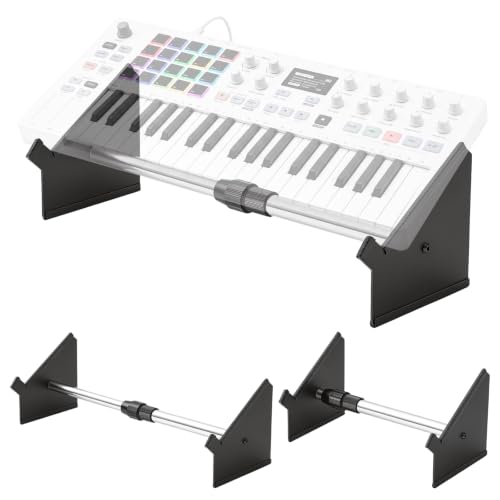
- Expands from 10.6 to 18.6 inches
- 30-degree ergonomic viewing angle
- Non-slip pads improve stability
Best For: Creators elevating compact synths and controllers
Compact Keyboard Synth

- Full-size velocity-sensitive keys
- Polyphonic aftertouch
- Ultra-thin 0.99 kg design
Best For: Space-conscious home studios needing expressive keys
Studio Furniture Pick
Solid Wood Recording Studio Desk

- Solid wood construction
- Pull-out piano tray
- Multi-level gear organization
Best For: Permanent home studios with keyboard and monitor gear
Controller Choice
Arturia MiniLab 3 25-Key MIDI Keyboard

- Eight RGB pads and hands-on controls
- Arpeggiator and Chord mode
- Software bundle and USB-C connectivity
Best For: Computer-based production and portable DAW control
Best Expandable Setup

- Adjustable two-tier design for multiple keyboards
- 250-lb base and 60-lb upper-tier capacity
- Includes stability and cable-adjacent accessories
Best For: Two-keyboard home studios needing flexible seated or standing placement
Best Portable Controller

- 25 velocity-sensitive keys with eight RGB pads
- Bluetooth and USB connectivity with rechargeable battery
- Eight knobs and touch strips for plugin control
Best For: Portable software-synth control and beat production
Best Simple Pick
Solid Wood Desk with Piano Tray
- Solid wood workstation with slide-out keyboard shelf
- Dedicated levels for monitors and audio interfaces
- Cable channels and non-slip feet support a tidy setup
Best For: Permanent, organized keyboard-based home studios
Versatile Workstation Synth – Yamaha MX49
The Yamaha MX49 is a practical choice among synthesizers for home studios when you want a compact production keyboard with strong sequencing and computer connectivity. Its class-compliant USB connection carries both audio and MIDI without requiring separate drivers or external devices.
Best For: Home producers who need a 49-key synthesizer for software-based recording, live play, and detailed voice layering.
Pros:
- USB audio and MIDI provide plug-and-play computer connectivity.
- 128-note polyphony supports live playing and full 16-track sequences.
- Motif sound-engine features support layering, zoning, switching, and control of up to eight elements.
- Virtual Circuit Modeling recreates vintage effects and signal processors.
Cons:
- Its 49-key format requires more desk or stand space than a compact controller.
- The supplied notes do not specify onboard speaker functionality.
The MX49 stands out as an all-purpose production keyboard, especially for creators who want one USB connection for recording stereo audio and 16 channels of MIDI.
Compact Recording Hub – Arturia MiniFuse 2
The Arturia MiniFuse 2 is an audio interface rather than a synthesizer, but it can be a useful companion for synthesizers for home studios. Its USB connection works with Windows and macOS computers, and it supports recording at sample rates up to 192 kHz.
Best For: Home-studio musicians who need a small computer-connected interface to support recording and software production.
Pros:
- Compact 3.9-by-7.9-by-1.65-inch design suits limited workspaces.
- Compatible with Windows and macOS systems.
- Supports sample rates up to 192 kHz.
- Includes Ableton Live Lite, Analog Lab Intro, and GUITAR RIG 6 LE software.
Cons:
- The supplied details list one audio channel, so it may be limiting for multi-output hardware setups.
- It is an audio interface, not a sound-generating synthesizer.
Choose the MiniFuse 2 when your home-studio setup already includes a synthesizer and you need a compact interface with bundled software for computer recording.
Space-Saving Studio Workstation – Monoprice Stage Right Desk
Monoprice Recording Studio Desk - with Raised Platform and Keyboard Tray, Black - Stage Right
Check Price On AmazonThe Monoprice Stage Right desk gives synthesizers for home studios a dedicated workstation without requiring a large room. Its 31.5-inch width accommodates a typical 49-key MIDI controller, while the raised platform and pullout tray help organize speakers and keyboard gear.
Best For: Apartment-based producers who want an organized desk for a MIDI keyboard, monitor speakers, and essential recording equipment.
Pros:
- Compact footprint measures 31.5 inches wide and 24 inches deep.
- Pullout keyboard tray keeps the controller accessible but stowable.
- Raised platform can hold recommended 5-inch monitor speakers without separate stands.
- Supports up to 175 pounds and includes assembly tools and hardware.
Cons:
- The compact tray is intended for a typical 49-key controller, not larger keyboards.
- Assembly is required.
- The supplied notes list no warranty.
This desk is a practical foundation for a small home studio, combining keyboard storage and speaker placement in a relatively narrow footprint.
Adjustable Desktop Riser – Konohan Synth Stand
The Konohan Synth Stand is a useful desktop accessory for synthesizers for home studios, particularly when several compact devices share one workspace. Its adjustable 10.6-to-18.6-inch frame accommodates synthesizers, samplers, drum machines, and MIDI controllers.
Best For: Producers and beat makers who want to elevate compact desktop instruments and improve visibility on a crowded studio desk.
Pros:
- Adjustable length supports a range of desktop equipment.
- Anti-slip pads help reduce shifting and wobbling.
- Six-inch elevation and 30-degree angle improve viewing and control.
- Lightweight 2.6-pound design helps keep the setup portable.
Cons:
- It is designed for desktop equipment rather than full-size keyboards.
- The stand adds only one elevated equipment tier.
The Konohan stand is a simple way to reclaim desk space and make compact synthesizers or controllers easier to see and reach during extended production sessions.
Compact Keyboard Synth – ESI Xsynth 25-Key Synthesizer
ESI Xsynth Ultra-Thin 25-Key Synthesizer with Integrated Master Keyboard and Audio/MIDI Interface
Check Price On AmazonThe ESI Xsynth is a compact option for producers comparing synthesizers for home studios. Its ultra-thin design, full-size velocity-sensitive keys, polyphonic aftertouch, and USB-C connection suit space-conscious setups.
Best For: Home-studio musicians who want a slim 25-key synthesizer with expressive keyboard response.
Pros:
- Full-size velocity-sensitive keys support dynamic playing.
- Polyphonic aftertouch adds expressive control.
- Ultra-thin body measures only 1.18 inches deep and weighs 0.99 kg.
- Includes a 3-year warranty.
Cons:
- Only 25 keys are provided, so it may not suit players needing a wider range.
- The supplied notes do not specify onboard sounds or detailed audio/MIDI features.
Choose the Xsynth when desk space and expressive key response matter more than a larger keyboard. Its compact footprint makes it easy to integrate into a focused home setup.
Studio Furniture Pick – Solid Wood Recording Studio Desk
This solid wood workstation is a practical foundation for synthesizers for home studios, especially when a keyboard, monitors, speakers, and audio interface need dedicated space. Its pull-out piano tray and cable channels help keep the production area organized.
Best For: Home producers who need a sturdy desk with a slide-out keyboard shelf and multi-level gear storage.
Pros:
- Solid wood construction provides a durable, stable feel.
- Pull-out piano tray accommodates a keyboard when playing and tucks away afterward.
- Multi-level layout creates space for monitors, speakers, and audio interfaces.
- Hidden cable channels, non-slip feet, and a robust frame support a tidy, stable setup.
Cons:
- Its 47.2-inch width and 23.6-inch depth require substantial floor space.
- This is studio furniture rather than a synthesizer or keyboard instrument.
- The supplied dimensions and size information vary, so confirm the measurements before ordering.
This desk makes sense for a permanent home production station where stability and organization are priorities. It is especially useful for setups built around a keyboard and several pieces of studio hardware.
Controller Choice – Arturia MiniLab 3 25-Key MIDI Keyboard
The Arturia MiniLab 3 is a compact controller for producers choosing synthesizers for home studios around a computer-based workflow. It combines 25 velocity-sensitive slim keys with RGB pads, knobs, sliders, performance modes, USB-C, MIDI out, and included production software.
Best For: Bedroom producers and creators who want hands-on DAW control, software instruments, and portable performance features.
Pros:
- Eight RGB pads, eight rotary encoders, and four sliders provide hands-on control.
- Built-in arpeggiator, Chord mode, Hold mode, and transposition support creative workflows.
- Compact 25-key design includes USB-C and MIDI out connectivity.
- Includes Arturia Analog Lab and Ableton Live Lite, plus a 5-year warranty.
Cons:
- Its 25 slim keys offer less playing range than a full-size keyboard.
- It is a MIDI keyboard controller, not a standalone synthesizer with built-in sound generation.
- Computer compatibility is central to its listed workflow.
The MiniLab 3 is a strong fit when tactile DAW control and included software are more important than standalone synthesis. Its small footprint also makes it easy to move between a home desk and other setups.
Best Expandable Setup – Dual-Tier Keyboard Stand
For synthesizers for home studios, the Liquid Stands Dual Piano Keyboard Stand adds a practical second tier without requiring a permanent workstation. Its adjustable Z-style frame supports a main keyboard plus a smaller synth or MIDI controller, with seated or standing height options.
Best For: Home-studio musicians who need flexible two-keyboard positioning for synths, digital pianos, or MIDI controllers.
Pros:
- Two adjustable levels accommodate multiple keyboards or synths.
- Base supports up to 250 pounds, while the top tier supports up to 60 pounds.
- Height and width adjustments support seated or standing use.
- Includes anti-skid pads, adjustable feet, a headphone hook, and anchoring straps.
Cons:
- At 24 pounds, it may be less convenient to move than a simpler single-tier stand.
- The top tier has a lower 60-pound load limit than the base.
This is a strong choice when your home studio setup includes two keyboards and you want adjustable ergonomics. Its heavy-duty construction and included stability accessories also make it suitable for studio, home, or stage use.
Best Portable Controller – M-VAVE 25-Key MIDI Keyboard
For synthesizers for home studios, the M-VAVE 25-key controller offers a compact way to play software instruments and shape sounds. It combines velocity-sensitive keys, drum pads, knobs, touch controls, Bluetooth, and USB connectivity in a portable design.
Best For: Producers, songwriters, and beat makers who want a portable controller for virtual synthesizers and music-production software.
Pros:
- Includes 25 velocity-sensitive keys, eight RGB drum pads, and eight assignable knobs.
- Bluetooth connectivity and a built-in 2,000 mAh battery provide up to about 16 hours of use.
- Compatible with Windows, Mac OS, Android, and iOS, along with several major DAWs.
- Smart chord and smart sound features can support practice and performance.
Cons:
- The 25-key layout is compact but offers less playing range than a full-size keyboard.
- It controls software synthesizers rather than functioning as a standalone synthesizer.
This controller is well suited to a computer-based home studio where portability and hands-on software control matter. Its pads, knobs, and touch strips give you more ways to work with plugins than a basic mini keyboard.
Best Simple Pick – Solid Wood Desk with Piano Tray
For synthesizers for home studios, this solid wood recording desk provides a dedicated workstation for a keyboard, monitors, speakers, and audio interfaces. Its slide-out piano tray keeps the keyboard accessible while helping the main work surface remain organized.
Best For: Home producers who want a permanent, organized desk for a keyboard-based recording setup.
Pros:
- Solid wood construction is designed for a stable, durable workstation.
- Pull-out keyboard tray lets you bring the instrument forward for playing and tuck it away afterward.
- Multi-level layout provides dedicated space for monitors, speakers, and audio interfaces.
- Hidden cable channels and non-slip feet help reduce clutter and movement.
Cons:
- Its 47.2-inch width and 23.6-inch depth require dedicated floor space.
- The fixed desk format is less portable than a folding stand or compact controller.
This desk is a practical foundation for a more permanent home studio. It is especially useful when you want your keyboard and production hardware arranged together rather than spread across separate surfaces.
How We Picked These Synthesizers for Home Studios
We evaluated the selected products according to their usefulness in a realistic home-production environment. Key considerations included keyboard size, portability, control layout, connectivity, expandability, construction, and how well each item fits into a compact desk-based workflow.
Because “synthesizer” can describe both a sound-generating instrument and a controller used with software, this selection includes both categories. It also includes supporting equipment—such as interfaces, stands, and studio furniture—that can make a larger difference to usability than another instrument alone.
Quick Comparison
| Best For | Look For | Most Suitable Options |
|---|---|---|
| All-in-one keyboard production | Built-in sounds, full connectivity, playable keybed | Yamaha MX49BK, ESI Xsynth |
| Software-based production | MIDI controls, pads, knobs, USB connection | Arturia MiniLab 3, M-VAVE 25 Key |
| Recording and monitoring | Reliable inputs, outputs, and low-latency USB | Arturia MiniFuse 2 |
| Compact organization | Stable platforms, adjustable width, cable clearance | Konohan stand, Liquid Stands |
| Dedicated studio workspace | Keyboard tray, raised platform, storage, solid construction | Monoprice desk, solid-wood workstation |
Key Buying Factors for Synthesizers for Home Studios
Sound Engine Versus MIDI Control
A hardware synthesizer generates sounds on its own, while a MIDI controller sends performance data to a computer or another instrument. Choose a sound-generating keyboard if you want immediate playability without relying on software. Choose a controller if you prefer virtual instruments and want more hands-on control over your DAW.
Key Count and Playing Style
Compact 25-key models are easy to place on a desk and work well for bass lines, leads, sequencing, and mobile production. A 49-key keyboard offers more room for two-handed parts and may be a better long-term choice for musicians who want one central instrument.
Connectivity and Compatibility
Check whether the product supports USB, MIDI, audio input and output, Bluetooth, or a combination of these connections. Confirm operating-system and software compatibility before buying, especially when using older studio hardware or a tablet-based setup.
Workspace, Ergonomics, and Expansion
A keyboard tray or adjustable stand can improve playing height and free space for monitors and other equipment. Measure your desk, controller, and cable connections carefully; an instrument that technically fits may still be uncomfortable if controls are blocked.
Who Should Buy Which Synthesizers for Home Studios?
- Choose the Yamaha MX49BK if you want a larger keyboard with onboard sounds for composing, rehearsal, and general production.
- Choose the ESI Xsynth if a thin, compact keyboard with integrated audio and MIDI functions suits a small or portable setup.
- Choose the Arturia MiniLab 3 for a polished software-production workflow with pads, knobs, and bundled music software.
- Choose the M-VAVE controller if you want an affordable compact controller with wireless flexibility and performance controls.
- Add the MiniFuse 2 when recording microphones or instruments and monitoring through studio headphones or speakers.
- Choose a stand or studio desk when comfort, organization, and available surface area are limiting your current setup.
For most beginners, the best approach is to buy for the workflow you use now rather than the largest possible setup. Prioritize the keyboard feel and connections you need, then add stands, interfaces, and furniture as your home studio grows.