The best synthesizers for recording can add basses, leads, pads, chords, and experimental textures to a production without requiring a large studio setup. This roundup spans analog polysynths, compact groove-focused instruments, tabletop modules, and MIDI controllers.
Use the guide below to match your workflow, preferred sound, keyboard needs, and budget with the right type of instrument for recording.
Best 10 Synthesizers for Recording Picks for 2026
Classic Analog Power

- Two wavefolding VCOs plus sub-oscillator
- 32 full-size keys with velocity and aftertouch
- 64-step sequencer, CV, MIDI, and USB-C
Best For: Hands-on mono basses, leads, and analog sound design
Portable Chord Creation

- Four-voice JUNO-60 ACB engine
- 100 chord sets and 64 user patterns
- USB-C audio/MIDI with delay and reverb
Best For: Portable chord progressions and quick electronic sketches
Polyphonic Analog Centerpiece
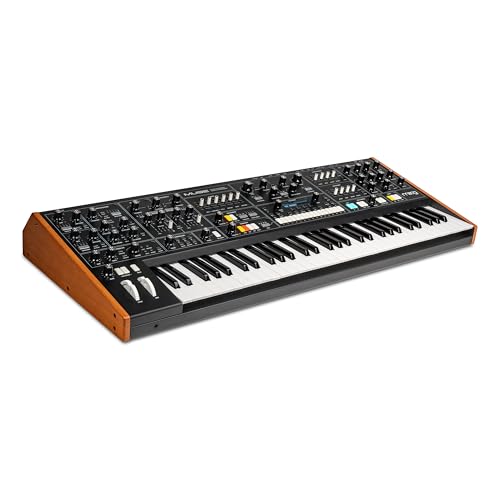
- Eight analog voices with dual filters
- 61 keys, bi-timbral operation, and 64-step sequencing
- Stereo Diffusion Delay for spacious textures
Best For: Studio-centered polyphonic analog arrangements and sound design
DAW Control Companion

- 25 velocity-sensitive keys and RGB pads
- Arpeggiator, chord mode, knobs, and sliders
- Includes Analog Lab and Ableton Live Lite
Best For: Compact computer-based production and virtual synth control
Analog Polyphony Pick
Sequential Fourm Compact Polyphonic Analog Synthesizer

- 37-key polyphonic analog synth with two VCOs
- Polyphonic aftertouch and modulation matrix
- Built-in sequencer and arpeggiator
Best For: Expressive studio players wanting hands-on analog polyphony
Controller and Sequencer Pick
Akai MPK Mini Plus 37-Key MIDI Controller

- 37-key USB MIDI keyboard for DAW workflows
- CV/Gate and MIDI I/O for external gear
- 64-step sequencer, pads, knobs, and transport controls
Best For: Computer-based producers controlling software and hardware instruments
Compact Sound Module Pick
Roland JD-08 Tabletop Boutique Synthesizer

- JD-800-inspired sound modeling with 108 waveforms
- Two-part 64-step polyphonic sequencer
- Extensive onboard effects and up to 128 voices
Best For: Compact studios needing layered digital sounds and sequencing
Best Pocket Pick

- Portable analog-style synth with three octaves
- Stylus control is simple and distinctive
- 3.5mm output supports computer recording
Best For: Beginners and retro-sound experiments
Best Compact Sound Design Pick

- Compact mini synthesizer for small workspaces
- MIDI connectivity for compatible gear
- Alloy-steel body construction
Best For: Space-conscious MIDI-based setups
Best Feature-Rich Portable Pick
M-VAVE Wireless FM Synthesizer

- Six-operator FM engine with 32 algorithms
- 128 presets, effects, arpeggiator, and sequencer
- USB, Bluetooth, and 3.5mm MIDI options
Best For: Portable FM production and MIDI workflows
Classic Analog Power – MOOG Messenger
The MOOG Messenger is a strong choice among synthesizers for recording when you want hands-on control, a focused monophonic analog voice, and substantial low-end character. Its two wavefolding VCOs, sub-oscillator, flexible ladder filter, and full-size expressive keys suit basses, leads, and studio sound design.
Best For: Producers and performers seeking a portable, full-size-key monosynth with deep analog shaping and modern sequencing.
Pros:
- Two variable-shape VCOs, sync, FM, and a sub-oscillator provide broad analog tones.
- 32 velocity- and aftertouch-sensitive full-size keys support expressive playing.
- Includes a 64-step sequencer, arpeggiator, 256 presets, and USB-C MIDI.
- CV connectivity and external filter input support broader studio setups.
Cons:
- Monophonic architecture is less suited to playing chords.
- Its 27.6-inch width and 5.14 kg weight may be substantial for highly portable setups.
Messenger balances classic MOOG character with useful modern workflow features. It is especially compelling if your recordings need tactile basses, leads, and evolving mono sequences rather than full polyphonic arrangements.
Portable Chord Creation – Roland AIRA Compact J-6
The Roland AIRA Compact J-6 is a compact option for synthesizers for recording, particularly when portability and fast chord-building matter. Its four-voice JUNO-60 engine, chord library, programmable sequencer, and USB-C audio/MIDI interface make it practical for sketching parts and integrating with a computer.
Best For: Mobile producers and electronic musicians who want quick chord progressions, arpeggios, and JUNO-inspired sounds.
Pros:
- Four-voice JUNO-60 engine delivers authentic Roland ACB sound.
- 100 chord sets and 64 user patterns encourage fast songwriting.
- Arpeggio and phrase styles add rhythmic movement without extensive programming.
- USB-C provides class-compliant audio and MIDI connectivity.
Cons:
- Its compact design is less suited to traditional full-size keyboard performance.
- It has four voices, limiting larger polyphonic arrangements.
The J-6 favors immediacy over extensive synthesis controls. It works well as a portable songwriting tool, chord sequencer, or compact source of warm, analog-like parts for a recording setup.
Polyphonic Analog Centerpiece – MOOG Muse
The MOOG Muse is aimed at producers who want a substantial centerpiece among synthesizers for recording. Its eight analog voices, bi-timbral design, dual filters, stereo VCAs, sequencer, and diffusion delay provide a broad platform for chords, layered parts, evolving textures, and performance-oriented sound design.
Best For: Studio musicians and sound designers needing expressive polyphony, deep analog architecture, and onboard sequencing.
Pros:
- Eight analog voices provide room for substantial polyphonic arrangements.
- Each voice combines two VCOs, a modulation VCO, dual VCFs, and stereo VCA.
- Chord memory, arpeggiation, and a polyphonic 64-step sequencer support performance workflows.
- Stereo Diffusion Delay adds multi-tap, diffusion, and filter-based effects.
Cons:
- At 39 inches wide and 32 pounds, it is a studio-focused instrument rather than a lightweight portable option.
- Only two patch banks are reserved for user patches within its 256-patch memory.
Muse is the most expansive recording instrument in this group. Its size and weight favor a dedicated studio position, but the eight-voice analog engine and stereo processing can cover everything from foundational chords to complex animated textures.
DAW Control Companion – Arturia MiniLab 3
The Arturia MiniLab 3 is a controller rather than a standalone synthesizer, but it can be useful alongside synthesizers for recording in a computer-based setup. Its 25 velocity-sensitive keys, pads, knobs, fader, arpeggiator, chord mode, MIDI output, and included software provide an accessible way to play and control virtual instruments.
Best For: Bedroom producers and mobile creators who need compact DAW control and an affordable way to play software synths.
Pros:
- 25 velocity-sensitive keys offer a compact performance surface.
- Eight RGB pads, eight encoders, and four sliders provide hands-on control.
- Built-in arpeggiator, chord mode, and transposition support quick idea generation.
- Includes Arturia Analog Lab and Ableton Live Lite software.
Cons:
- It is a MIDI controller and does not contain a standalone hardware synth engine.
- The 25-key format may feel limited for two-handed playing.
MiniLab 3 makes the most sense when your recording setup is centered on a laptop or desktop. It offers practical control over software instruments, while its compact size and included software help keep a small production rig flexible.
Analog Polyphony Pick – Sequential Fourm Compact Polyphonic Analog Synthesizer
For musicians seeking synthesizers for recording, the Sequential Fourm combines a 37-key layout with polyphonic analog sound generation. Its two VCOs, modulation matrix, dual ADSR envelopes, and built-in sequencing tools provide hands-on control for studio parts and sound design.
Best For: Recording musicians who want a full-size compact analog synthesizer with polyphonic aftertouch and onboard sequencing.
Pros:
- 37-key polyphonic analog design supports melodic and chordal parts.
- Includes two VCOs, two ADSR envelopes, and a modulation matrix for shaping sounds.
- Polyphonic aftertouch adds expressive performance control.
- Built-in sequencer and arpeggiator support composition and pattern creation.
Cons:
- Its 28-inch width may require more desk space than a tabletop module.
- The supplied connector information lists HDMI, which may require checking compatibility with your recording setup.
The Fourm is the strongest choice here for players who want an actual polyphonic analog instrument rather than a controller or sound module. Its extensive performance features make it well suited to recording expressive synth parts.
Controller and Sequencer Pick – Akai MPK Mini Plus 37-Key MIDI Controller
The Akai MPK Mini Plus is a practical option for recording setups that rely on a DAW or external sound sources. This 37-key USB MIDI controller adds pads, assignable knobs, CV/Gate and MIDI I/O, plus a standalone 64-step sequencer for flexible production workflows.
Best For: Home producers who need a portable keyboard controller for DAW control, software instruments, modular gear, and hardware synthesizers.
Pros:
- 37-key keybed provides three octaves for melodic and harmonic performance.
- USB, MIDI, and CV/Gate connectivity supports computers and external gear.
- Built-in 64-step sequencer includes separate drum and melody or chord tracks.
- Eight RGB MPC pads, eight assignable knobs, and transport controls expand hands-on control.
Cons:
- It is a MIDI controller, not a self-contained synthesizer with its own sound engine.
- Its USB-powered design requires a computer or compatible studio connection for typical operation.
Choose the MPK Mini Plus when your recording system is centered on software or external modules. It offers broader production control than a basic keyboard, but you will need separate sound sources to generate audio.
Compact Sound Module Pick – Roland JD-08 Tabletop Boutique Synthesizer
For compact synthesizers for recording, the Roland JD-08 provides a tabletop sound module based on the JD-800. It offers 108 waveforms, extensive effects, an arpeggiator, and a two-part polyphonic sequencer in a small enclosure.
Best For: Studio musicians who want a compact tabletop module for layered digital sounds, sequences, and effects-rich parts.
Pros:
- Includes 108 original waveforms, 64 original presets, and 21 new presets.
- Two-part, 64-step polyphonic sequencer supports motion recording and pattern storage.
- Up to 128 voices are available depending on patch load, with two-part multitimbral operation.
- Offers editable distortion, phaser, spectrum, enhancer, delay, chorus, and reverb effects.
Cons:
- The K-25M keyboard is sold separately, so the module does not provide an included keyboard.
- Its compact controls may be less suitable for players seeking a conventional full-size keyboard instrument.
The JD-08 is a space-saving way to add detailed, effects-heavy synth textures to a recording setup. It is especially appealing when sequencing and sound design matter more than having an integrated keyboard.
Best Pocket Pick – Stylophone Original
The Stylophone Original is a highly portable choice for anyone exploring synthesizers for recording. Its distinctive analog sound, touch-sensitive playing surface, headphone output, and 3.5mm connection make it useful for quick ideas, experimentation, and adding retro character to a computer-based setup.
Best For: Beginners, mobile music makers, and producers seeking compact vintage-style sounds.
Pros:
- Compact, battery-powered design with a built-in speaker and headphone socket
- Iconic analog sound with three octaves and optional vibrato
- 3.5mm connectivity for recording into a computer or other gear
- Simple stylus-based interface that is easy to learn
Cons:
- Small playing surface may not suit conventional keyboard technique
- Requires three AA batteries for portable use
- Includes a 30-day parts warranty
The Stylophone is less suited to complex sequencing than larger synthesizers, but its unusual interface and warm, retro character can make recorded parts stand out. It is an accessible entry point for playful sound design and compact recording setups.
Best Compact Sound Design Pick – Behringer PHARA-O MINI
The Behringer PHARA-O MINI is a compact synthesizer for recording setups where space and straightforward connectivity matter. Its alloy-steel construction, small footprint, and MIDI connector make it a practical option for integrating a dedicated mini synth into a broader music workflow.
Best For: Producers wanting a small, MIDI-connected synthesizer for compact studio setups.
Pros:
- Compact dimensions are convenient for limited desk space
- MIDI connector supports integration with compatible equipment
- Alloy-steel body material offers a solid-feeling construction
Cons:
- Supplied notes do not specify onboard sounds, effects, or sequencing features
- No battery operation or built-in speaker is listed
- Limited published information makes feature comparisons difficult
The PHARA-O MINI may appeal to buyers who prioritize a small hardware footprint and MIDI connectivity, but its supplied specifications reveal less about the sound engine than the other options here. Confirm the available controls and outputs before choosing it as a primary recording instrument.
Best Feature-Rich Portable Pick – M-VAVE Wireless FM Synthesizer
The M-VAVE Wireless Portable FM Synthesizer packs substantial sound-design and sequencing capability into a small, battery-powered instrument. For synthesizers for recording, its six-operator FM engine, preset library, effects, arpeggiator, sequencer, and multiple MIDI options provide several ways to create and capture parts.
Best For: Producers who want portable FM synthesis, onboard pattern tools, and flexible MIDI integration.
Pros:
- Six operators and 32 algorithms support detailed FM sound design
- Includes 128 presets, six effects, an arpeggiator, and a 16-step sequencer
- Battery operation, built-in speaker, and compact silicone keys support portable use
- USB MIDI, Bluetooth MIDI, and 3.5mm MIDI connections offer flexible integration
Cons:
- FM synthesis may require more sound-design learning than simpler instruments
- The compact 27-key layout may be limiting for extended keyboard parts
- Plastic and silicone construction may feel less substantial than metal hardware
This is the most capable option for users who want a self-contained portable workstation rather than only a sound source. Its combination of FM architecture, effects, looping tools, and three MIDI connection types makes it especially adaptable for sketching and recording away from a full studio.
How We Picked the Best Synthesizers for Recording
We selected these instruments across several recording use cases rather than treating every synthesizer as interchangeable. The lineup includes true analog and digital synthesizers, compact tabletop modules, portable instruments, and MIDI keyboard controllers that rely on software for sound generation. We considered sound-design flexibility, polyphony, sequencing, connectivity, portability, hands-on controls, and how easily each option can fit into a modern computer-based studio.
Because recording needs vary, the best choice depends on whether you want an independent sound source, a playable keyboard, a compact sketchpad, or a controller for virtual instruments.
Quick Comparison
- Best for deep analog performance: MOOG Muse or Sequential Fourm.
- Best for monophonic basses and leads: MOOG Messenger.
- Best compact chord-focused option: Roland AIRA Compact J-6.
- Best tabletop sound module: Roland JD-08.
- Best controller for software instruments: Arturia MiniLab 3 or Akai MPK Mini Plus.
- Best ultra-portable and playful instruments: Stylophone, Behringer PHARA-O MINI, or M-VAVE FM Synthesizer.
Key Buying Factors for Synthesizers for Recording
Sound Engine and Synthesis Style
Analog instruments are often chosen for their immediate controls and characterful oscillator, filter, and envelope behavior. Digital and FM instruments can provide sharper textures, complex modulation, presets, and broader sound ranges. A controller such as the MiniLab 3 or MPK Mini Plus does not produce sound by itself, so budget for compatible software and an audio interface if needed.
Polyphony and Playing Format
Monophonic synths play one note at a time and excel at basses and leads. Polyphonic models are better for chords, layered pads, and richer arrangements. Check the key count, velocity response, pad layout, and whether the instrument is designed for traditional playing, step sequencing, or pattern creation.
Recording Connections and Workflow
Look for the outputs and control connections your setup requires, including USB, MIDI, audio outputs, sync, and headphones. A built-in sequencer can make a compact instrument useful without a DAW, while direct audio connectivity may simplify recording. Also confirm whether presets, effects, and software bundles support your existing workflow.
Size, Controls, and Expandability
Small instruments are easy to keep beside a computer or take on the road, but reduced controls and keyboards may limit performance. Larger synthesizers generally offer more expressive control and room for sound shaping. Consider stands, pedals, external controllers, and desk space before buying.
Who Should Buy Which Synthesizers for Recording?
Choose the MOOG Messenger for Focused Mono Sounds
It suits producers who primarily need expressive basses, leads, and sequences from a dedicated analog instrument.
Choose the MOOG Muse or Sequential Fourm for Chord-Based Production
These are stronger fits for players who want analog polyphony, hands-on sound design, and an instrument that can carry substantial harmonic parts.
Choose a Roland Compact Instrument for Space-Saving Production
The J-6 is a practical choice for chord ideas and portable songwriting, while the JD-08 is better suited to producers seeking a compact sound module with sequencing and effects.
Choose Arturia or Akai When Software Is Your Main Studio
The MiniLab 3 and MPK Mini Plus make sense for producers who already use virtual synthesizers and want tactile keys, pads, knobs, and transport-oriented control without buying another standalone sound engine.
Choose the Mini Portable Options for Experimentation
Stylophone, PHARA-O MINI, and the M-VAVE FM Synthesizer are useful for travel, quick sketches, unusual textures, and accessible entry points. They are best viewed as complementary instruments unless their compact workflow matches your entire recording setup.