Choosing among today’s synthesizers means balancing sound design, key feel, portability, workflow, and budget. The right instrument might be a pocket-sized sketchpad, a flexible desktop-style keyboard, or a full-size performance centerpiece.
This roundup compares 10 standout options across those categories, helping beginners, producers, and live players find a synthesizer that fits the way they actually make music.
Best 10 Synthesizers Picks for 2026
Experimental Hybrid Pick
Arturia MicroFreak Synthesizer Keyboard
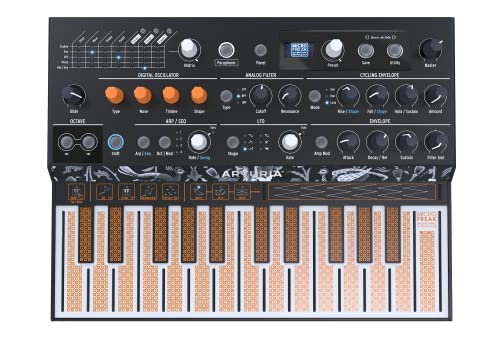
- 17 digital oscillator modes with an analog filter
- Touch keyboard with per-note pressure and poly-aftertouch
- CV, MIDI, USB, and creative sequencing tools
Best For: Advanced experimental sound designers and modular users
Portable Sampling Hub
Akai Professional MPC Sample Portable Sampler

- Standalone operation with battery, speaker, microphone, and microSD
- 16 MPC pads with chopping, timestretching, and resampling
- Four FX processors with 60 effect types
Best For: Portable beatmaking and DAWless sampling
Analog Sound Design Powerhouse
MOOG Subsequent 37 Paraphonic Analog Synthesizer

- Dual analog oscillators plus sub oscillator and noise generator
- 37 semi-weighted velocity- and aftertouch-sensitive keys
- Extensive controls, presets, MIDI, USB, and CV/GATE
Best For: Experienced players focused on hands-on analog synthesis
Compact Controller Choice
Akai Professional MPK Mini MK3 MIDI Keyboard

- 25 velocity-sensitive mini keys with eight MPC pads
- Eight assignable knobs and pitch/modulation thumbstick
- USB-powered with arpeggiator and software bundle
Best For: Home studios controlling virtual synthesizers and beats
Analog Powerhouse

- Two wavefolding VCOs plus sub-oscillator
- 32 velocity- and aftertouch-sensitive keys
- Sequencer, presets, CV, MIDI, and USB-C
Best For: Analog-focused performers and producers
Production Command Center

- 37 keys across three full octaves
- CV/Gate, MIDI, and USB connectivity
- Pads, knobs, DAW controls, and 64-step sequencing
Best For: Compact computer and hardware production setups
Portable FM Explorer
M-VAVE Wireless FM Synthesizer

- Six operators and 32 FM algorithms
- Battery-powered with built-in speaker
- 128 presets, effects, sequencer, and MIDI options
Best For: Portable music-making and FM synthesis exploration
Best Live Performance Synthesizer

- Over 3,800 ZEN-Core sounds
- Portable 61-key design
- Eight-track sequencer and WAV import
Best For: Gigging musicians and versatile keyboardists
Best Piano-Style Synthesizer
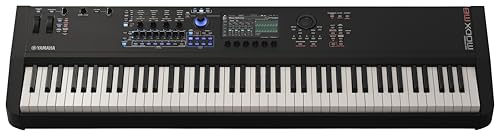
- 88-key graded-hammer action
- Three powerful sound engines
- Touchscreen and hands-on controls
Best For: Professional pianists and studio performers
Best Pocket Synthesizer

- Iconic vintage analog sound
- Pocket-sized battery-powered design
- Easy stylus-based playing surface
Best For: Beginners, collectors, and retro-sound enthusiasts
Experimental Hybrid Pick – Arturia MicroFreak Synthesizer Keyboard
The Arturia MicroFreak is one of the most distinctive synthesizers for experimental sound design in a compact format. Its digital oscillator engines, resonant analog filter, pressure-sensitive touch keyboard, modulation matrix, and CV connectivity make it a flexible choice for exploring unusual textures and evolving sequences.
Best For: Advanced users who want hybrid synthesis, expressive control, and modular or DAW integration in a lightweight instrument.
Pros:
- Offers multiple oscillator modes spanning wavetable, physical modeling, vocoder, noise, and more.
- 25-key touch keyboard supports per-note pressure and poly-aftertouch.
- Includes sequencing, automation, Spice and Dice randomization, and a 5×7 modulation matrix.
- Provides USB, MIDI, CV, pitch, gate, and pressure connectivity.
Cons:
- Its 25-key touch-plate design may not suit players seeking traditional moving keys.
- The advanced sound-design feature set may require a learning period.
The MicroFreak stands out among synthesizers for combining unconventional performance control with broad sound-shaping options. It is especially compelling when portability and experimentation matter more than a conventional keyboard experience.
Portable Sampling Hub – Akai Professional MPC Sample Portable Sampler
The Akai Professional MPC Sample is a portable production device for sampling, sequencing, and beatmaking without a computer. As an alternative to traditional synthesizers, it focuses on turning recorded sounds into grooves with onboard chopping, effects, pads, storage, and battery-powered standalone operation.
Best For: Beatmakers, DAWless creators, finger drummers, and producers who want a compact sampling workflow they can use almost anywhere.
Pros:
- Works standalone with a rechargeable battery, built-in speaker, microphone, and microSD storage.
- Includes 16 MPC pads, sample chopping, timestretching, repitching, resampling, and over 100 factory kits.
- Provides four internal effects processors with 60 effect types and dedicated controls.
- Offers USB-C audio/MIDI, line I/O, headphone output, sync out, and MIDI connectivity via adapter.
Cons:
- It is a sampler and production hub rather than a conventional synthesizer keyboard.
- The MIDI DIN adapter is not included.
Choose the MPC Sample if hands-on sampling and portable beat production are higher priorities than playing traditional synthesizers. Its self-contained design is practical for sketching ideas, performing, or building grooves away from a DAW.
Analog Sound Design Powerhouse – MOOG Subsequent 37 Paraphonic Analog Synthesizer
The Moog Subsequent 37 is a substantial analog synthesizer for players who want hands-on control and rich, complex tones. Its 37 semi-weighted keys, dual variable waveshape oscillators, sub oscillator, analog noise, modulation busses, and extensive panel controls support detailed sound shaping in the studio or on stage.
Best For: Experienced synthesists seeking deep analog sound design, expressive key control, and flexible studio connectivity.
Pros:
- Provides 40 knobs and 74 switches for direct access to synthesis and sequencing controls.
- Includes two variable waveshape oscillators, a square-wave sub oscillator, noise generator, and external filter feedback.
- 37 semi-weighted keys offer velocity and aftertouch, with 2-note paraphonic operation.
- Includes 256 presets, MIDI, USB, audio I/O, headphones, and CV/GATE inputs.
Cons:
- Its approximately 10 kg weight and larger dimensions make it less portable.
- The deep control set may be more than beginners need.
The Subsequent 37 is a strong choice among synthesizers when tactile analog control and tonal depth are the goal. Its paraphonic keyboard and CV/GATE connections add flexibility, while the extensive panel makes detailed adjustments immediate.
Compact Controller Choice – Akai Professional MPK Mini MK3 MIDI Keyboard
The Akai Professional MPK Mini MK3 is a compact USB MIDI controller for playing virtual synthesizers and producing beats in a computer-based setup. It combines 25 velocity-sensitive mini keys with MPC-style pads, assignable knobs, a pitch/modulation thumbstick, and a built-in arpeggiator.
Best For: Home-studio producers, beatmakers, and beginners who need an affordable, portable controller for software synthesizers and DAWs.
Pros:
- Compact 25-key design includes velocity-sensitive keys, eight pads, and eight 360-degree knobs.
- Built-in arpeggiator offers adjustable resolution, range, and modes.
- Pitch and modulation thumbstick provides hands-on control of virtual instruments.
- Includes MPC Beats, virtual instruments, sound content, NKS integration, and an editor.
Cons:
- It does not generate sounds independently and requires a USB-compatible device and software.
- Mini keys may feel less natural than full-size or semi-weighted synthesizer keys.
For controlling software synthesizers without taking up much desk space, the MPK Mini MK3 is a practical starting point. Its pads and knobs also make it more versatile than a basic mini keyboard, particularly for beat-focused workflows.
Analog Powerhouse – MOOG Messenger
The MOOG Messenger is a full-featured choice for musicians and producers who want classic analog synthesizers sound in a portable, performance-ready format. Its two wavefolding oscillators, sub-oscillator, versatile ladder filter, and hands-on controls offer substantial scope for basses, leads, and experimental patches.
Best For: Performers and producers seeking a premium monophonic analog synthesizer with expressive keys, deep modulation, and extensive connectivity.
Pros:
- Two variable-shape VCOs, sync, frequency modulation, and a sub-oscillator provide broad analog tones.
- 32 full-size semi-weighted keys include velocity and aftertouch for expressive playing.
- Built-in 64-step sequencer, arpeggiator, 256 presets, and CV, MIDI, and USB-C connectivity.
- Resonance Bass Compensation helps maintain a full-bodied sound across the filter range.
Cons:
- Monophonic design limits it to one note at a time.
- Its feature-rich design and metal construction may be more than casual players need.
The Messenger stands out when tactile control, analog character, and live-ready connectivity matter more than polyphony. It is a particularly strong fit for serious sound design and bass-focused performance setups.
Production Command Center – Akai MPK Mini Plus
The Akai Professional MPK Mini Plus is a versatile controller for producers building synthesizers-based workflows around a computer, modular setup, or external sound module. Its 37-key layout, pads, knobs, sequencing features, and CV/Gate connections support both hands-on production and hardware integration.
Best For: Home-studio producers who want a compact MIDI controller with keys, pads, DAW controls, sequencing, and hardware connectivity.
Pros:
- 37-key layout provides three full octaves for melodic and harmonic performance.
- CV/Gate and MIDI I/O connect modular gear, synthesizers, and sound modules.
- Built-in 64-step sequencer supports separate drum and melody or chord tracks.
- Includes RGB MPC pads, assignable knobs, Chords and Scales modes, and DAW transport controls.
Cons:
- It is a MIDI keyboard controller rather than a standalone synthesizer with its own sound engine.
- USB connectivity and included software are oriented primarily toward computer-based setups.
The MPK Mini Plus is a practical choice when you need one compact surface to play, sequence, mix, and control external synthesizers. Its CV/Gate support also makes it more adaptable than a basic USB keyboard.
Portable FM Explorer – M-VAVE Wireless FM Synthesizer
The M-VAVE Wireless Portable FM Synthesizer brings synthesizers sound design into a compact, battery-powered format. With six FM operators, 32 algorithms, built-in effects, a speaker, and wireless MIDI, it is designed for experimenting and composing away from a conventional studio.
Best For: Beginners, mobile creators, and performers who want portable FM sounds with built-in playback and MIDI flexibility.
Pros:
- Six operators and 32 algorithms provide genuine FM synthesis control.
- Battery operation, built-in speaker, and compact 27-key design support portable use.
- Includes 128 presets, six effects, an arpeggiator, and a 16-step sequencer.
- USB MIDI, Bluetooth MIDI, and 3.5mm MIDI connections support multiple workflows.
Cons:
- Its silicone keys and compact form may feel less substantial than full-size keyboards.
- The FM-focused engine may be less immediately intuitive than simpler subtractive synthesizers.
This M-VAVE is appealing as a grab-and-go sound source for sketching, learning FM synthesis, or adding compact textures to a setup. Its speaker, battery, presets, and multiple MIDI options make it unusually self-contained for its size.
Best Live Performance Synthesizer – Roland JUNO-D6
The Roland JUNO-D6 is a practical choice for musicians who need versatile synthesizers sounds in a portable, gig-ready keyboard. Its 61 synth-action keys, intuitive controls, USB-C connectivity, and extensive ZEN-Core library suit both live performance and studio work.
Best For: Gigging musicians, keyboardists, and creators who want broad sounds in a lightweight 61-key instrument.
Pros:
- Offers over 3,800 onboard sounds, including pianos, organs, and synths.
- Lightweight 12.8-pound design with USB-C mobile battery power support.
- Includes an eight-track sequencer and WAV sample import.
- Expandable through Roland Cloud Sound Packs and Wave Expansions.
Cons:
- Synth-action keys may not provide the weighted feel pianists prefer.
- The supplied package includes the synthesizer only.
The JUNO-D6 balances portability, sound variety, and hands-on performance features. It is especially appealing when fast access to stage-ready sounds matters more than piano-style key action.
Best Piano-Style Synthesizer – Yamaha MODX M8
The Yamaha MODX M8 is designed for pianists who want synthesizers capabilities without giving up a realistic playing feel. Its 88-key graded-hammer action, three sound engines, touchscreen workflow, and hands-on controls make it suited to detailed performance and production.
Best For: Professional players, pianists, and studio musicians seeking expressive 88-key control and broad sound design options.
Pros:
- 88-key graded-hammer action provides heavier low keys and lighter high keys.
- Three engines cover analog-style, FM, and realistic instrument sounds.
- Eight faders, a Super Knob, color touchscreen, and dedicated display knobs support hands-on editing.
- ESP integrates MODX M sounds with a DAW workflow.
Cons:
- At 40.5 pounds, it is less portable than smaller synthesizers.
- Its professional feature set may be more than beginners need.
The MODX M8 stands out when authentic piano-style playability and advanced synthesis are equally important. Its lightweight-for-an-88-key design helps, but it remains better suited to planned transport than casual portability.
Best Pocket Synthesizer – Stylophone Original
The Stylophone Original is a compact way to explore synthesizers without the size or complexity of a full keyboard. Its touch-sensitive metal surface, stylus control, vintage analog sound, and battery operation make it accessible for beginners, collectors, and portable music-making.
Best For: Beginners, casual players, retro-sound fans, and anyone wanting a pocket-sized electronic instrument.
Pros:
- Produces an iconic warm, vintage sound with three octaves and optional vibrato.
- Stylus-based touch surface is simple and approachable.
- Fits in a pocket, runs on three AA batteries, and includes a speaker and headphone socket.
- Can connect to a computer or other gear through a 3.5mm stereo cable.
Cons:
- Its compact touch interface is less versatile than a full-size keyboard.
- Requires three AA batteries for portable use.
- The listed warranty is limited to 30 days for parts.
The Stylophone is more of a playful musical instrument than a comprehensive production synthesizer. Its low-friction controls and distinctive retro character make it a fun entry point or portable sound experiment.
How We Picked These Synthesizers
We selected instruments across several common use cases rather than treating one type of synthesizer as universally best. The lineup includes compact controllers, portable samplers, analog monosynths and paraphonic instruments, performance keyboards, digital sound sources, and approachable pocket models.
Our comparison focuses on practical buying criteria: sound-generation options, keyboard size and playability, portability, sequencing or sampling features, connectivity, onboard controls, learning curve, and suitability for studio or stage use. A larger feature list is not automatically an advantage if it makes an instrument difficult to operate or unnecessarily expensive for your setup.
Quick Comparison
| Best For | Look For | Typical Strength |
|---|---|---|
| Beginners | Simple controls and presets | Fast learning and experimentation |
| Producers | Sampling, sequencing, and DAW connectivity | Complete beat-making workflow |
| Analog enthusiasts | Hands-on oscillators, filters, and modulation | Distinctive, immediate sound shaping |
| Performers | Full-size keys, reliable controls, and presets | Live playability and arrangement flexibility |
| Travel musicians | Low weight, battery operation, or built-in speaker | Portable music-making anywhere |
Key Buying Factors for Synthesizers
Sound Engine
Analog synths are valued for hands-on control and character, while digital, FM, wavetable, and sample-based instruments can offer broader timbral variety. Consider whether you want to create sounds from scratch, modify presets, or trigger recorded material.
Keys and Playability
Mini keys save space but can feel restrictive for two-handed playing. A 37-key layout offers a useful compromise, while 61 or 88 keys are better suited to serious performance. Weighted or hammer-action keyboards may feel more natural for pianists but add size and weight.
Workflow and Connectivity
Check for USB MIDI, traditional MIDI ports, audio inputs, outputs, sequencing, arpeggiation, and sampling tools. If the instrument will work with a computer, confirm that its connections and software support match your existing setup.
Portability and Power
For mobile sessions, prioritize compact dimensions, durable construction, battery operation, and—when useful—a built-in speaker. Studio-focused instruments can justify a larger footprint when they provide deeper controls and better playability.
Who Should Buy Which Synthesizers?
Beginners should favor an accessible keyboard or pocket synthesizer with clear controls and useful presets. Electronic producers may benefit most from a sampler or a controller paired with music software. Analog sound designers should look for dedicated oscillators, filters, modulation controls, and expressive performance features.
Live performers will generally want a dependable full-size keyboard with fast preset access and a broad sound palette. Pianists and arrangers should prioritize key count and action, while traveling musicians should choose the smallest instrument that still supports their preferred workflow. Before buying, confirm dimensions, power requirements, included accessories, and whether the device is a standalone instrument or requires a computer.