Tube compression is prized for adding thickness, glue, and smooth dynamic control without stripping a track’s natural character. If you want that warm, musical feel, the right unit can make a noticeable difference fast.
Below, we’ve rounded up 10 of the best options for 2026, from classic optical designs to versatile channel strips for recording, mixing, and live use.
Best 10 Tube Audio Compressors Picks for 2026
Heritage Pick
Heritage Audio Tubesessor Optical Tube Compressor

- 1-channel optical tube compressor
- Transformer-balanced I/O
- Tube saturation and sidechain filters
Best For: Engineers wanting compression plus tonal shaping
Classic Clone
Klark Teknik 2A-KT LA-2A Style Tube Compressor

- Affordable LA-2A-style optical compression
- Premium tubes with MIDAS transformers
- Balanced XLR/TRS I/O and VU metering
Best For: Budget-minded users seeking classic smooth leveling
Studio Strip
Warm Audio WA-2A Optical Tube Compressor

- 1-channel tube optical compressor
- All-discrete signal path
- Custom photocell with Cinemag transformers
Best For: Classic optical compression in a dedicated studio unit
Channel Strip Choice
PreSonus STUDIOCHANNEL Tube Channel Strip

- Tube preamp plus VCA compressor
- Three-band EQ in a 1U rack unit
- Mic, instrument, and line inputs
Best For: Users wanting an all-in-one tube channel strip
Studio-Ready Optical Pick
Warm Audio WA-1B Optical Compressor

- Tube optical compressor with analog signal path
- Warm, balanced, versatile sound profile
- Single-channel rackmount unit with knob controls
Best For: engineers who want a warm, rackmount tube optical compressor
Flexible Tube Blend Choice
ART Solo VLA Single Channel Multi-Voice Compressor

- Selectable tube or solid-state control
- Variable blend of dry and compressed signal
- Optical isolator design with +4dBu/-10dBV modes
Best For: buyers who want blend control and switchable tube or solid-state behavior
Channel Strip Value
Universal Audio LA-610 Mk II Tube Channel Strip

- Vacuum tube preamp with EQ and optical compressor
- One-channel strip with XLR input
- Built for all-in-one tracking chains
Best For: recordists who want preamp, EQ, and optical compression in one unit
Classic FET Rack Compressor
76-KT Classic FET-Style Compressor

- Modeled after the iconic 1176LN
- Discrete path with Class-A output amp
- MIDAS transformers and all-button mode
Best For: classic 1176-style compression with vintage character
Tube Channel Strip
dbx676FX Tube Mic Preamp Channel Strip
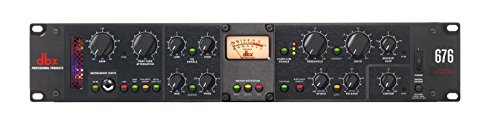
- Tube preamp with 250-volt Class-A design
- Includes compressor/limiter and 3-band EQ
- Front-panel instrument input and VU meter
Best For: vocal tracking and all-in-one studio channel control
Dual-Channel Rack Compressor
Black Dynamic Processor 1U Rack Compressor

- Dual-channel with Overeasy compression
- Noise gate plus sidechain insert
- 1U rackmount with XLR/TRS connectivity
Best For: studio, live, and streaming dynamics control
Heritage Pick – Heritage Audio Tubesessor Optical Tube Compressor
If you’re comparing tube audio compressors for a polished analog front end, the Heritage Audio Tubesessor stands out as a single-channel optical design with transformer-balanced I/O, sidechain filter options, and a built-in tube saturation section. It’s a straightforward choice when you want compression plus some extra harmonic character in one unit.
Best For: Engineers and studios that want a feature-rich tube compressor with saturation and sidechain shaping.
Pros:
- 1-channel optical tube compression for focused tracking or mix-bus duties.
- Transformer-balanced input and output connections.
- Multiple sidechain filter settings for more control over compression behavior.
- Tube saturation section adds extra analog coloration.
Cons:
- Single-channel format may be limiting for stereo workflows.
- Larger chassis and heavier build may take more rack or shelf space.
Overall, the Tubesessor is aimed at users who want more than basic gain reduction from their tube audio compressors. The added sidechain and saturation tools make it a practical pick if you want compression with tone-shaping flexibility built in.
Classic Clone – Klark Teknik 2A-KT LA-2A Style Tube Compressor
Among tube audio compressors, the Klark Teknik 2A-KT is built as an affordable homage to the Teletronix LA-2A, with optical compression, premium tubes, and custom MIDAS transformers. It’s a strong option if you want the familiar smooth, musical style of classic leveling without the vintage price tag.
Best For: Buyers who want LA-2A-style tube compression at a more accessible price.
Pros:
- Modeled after the legendary LA-2A for smooth optical compression.
- Uses premium tubes and vintage lag-free optical attenuator technology.
- Custom-designed MIDAS input and output transformers.
- Balanced XLR and 1/4" TRS connections with classic VU metering.
Cons:
- Single-channel design only.
- Classic control set offers less direct tweakability than more feature-heavy compressors.
The 2A-KT is a practical buy for anyone chasing the sound and workflow of a classic optical tube compressor. Its combination of recognizable tone, balanced I/O, and straightforward operation makes it easy to place in a studio or live rack.
Studio Strip – Warm Audio WA-2A Optical Tube Compressor
If you’re shopping tube audio compressors for classic optical leveling, the Warm Audio WA-2A brings a 1-channel tube design with an all-discrete signal path, custom optical photocell, and Cinemag transformers. It fits well when you want a dedicated compressor that leans into traditional analog workflow and sound.
Best For: Track and mix engineers who want a classic tube optical compressor with high-quality transformer-based design.
Pros:
- 1-channel tube optical compressor for focused compression tasks.
- All-discrete signal path for a more traditional analog design.
- Custom optical photocell and Cinemag transformers.
- XLR connectivity for standard studio integration.
Cons:
- Single-channel format may not suit stereo compression needs.
- Fewer control options than multi-function channel strips.
The WA-2A is a good fit if your priority is straightforward tube compression with classic optical behavior and quality transformer components. It’s the kind of unit that makes sense when you want a dedicated compressor rather than a more complex all-in-one strip.
Channel Strip Choice – PreSonus STUDIOCHANNEL Tube Channel Strip
For buyers comparing tube audio compressors that do more than compression alone, the PreSonus STUDIOCHANNEL combines a Class A 12AX7 vacuum-tube preamp, VCA compressor, and three-band EQ in a single 1U rack unit. It’s a practical option if you want one device that can handle mic, instrument, and line sources.
Best For: Studio users who need a tube channel strip with compressor and EQ in one rack space.
Pros:
- Class A tube preamp with tube drive for added front-end character.
- Built-in VCA compressor with auto attack/release and soft/hard knee.
- Three-band EQ plus high-pass filter, pad, phantom power, and polarity reverse.
- Mic, instrument, and line inputs in a rugged 1U rack-mount chassis.
Cons:
- Compressor is VCA-based rather than a dedicated tube optical design.
- Single-channel format limits it to one source at a time.
The STUDIOCHANNEL is best viewed as an all-in-one recording tool rather than a pure compressor purchase. If you want tube tone, compression, and EQ together, it offers a compact and flexible studio setup.
Studio-Ready Optical Pick – Warm Audio WA-1B Optical Compressor
If you’re comparing tube audio compressors for a smoother, more controlled vocal or instrument chain, the Warm Audio WA-1B brings a tube optical design with a warm, balanced, and versatile sound profile. It is a single-channel unit with analog signal handling and knob-based control, built for rackmount use in a corded setup.
Best For: Engineers who want a portable rackmount tube optical compressor with a warm, balanced character.
Pros:
- Tube optical compression design for classic leveling behavior
- Warm, balanced, versatile sound profile
- Single-channel format for focused tracking or mixing duties
- Includes rackmount chassis and compressor unit
Cons:
- Single-channel unit limits stereo applications without a second unit
- Requires corded electric power
- Rackmount format is less convenient than compact desktop gear
Overall, the WA-1B is a straightforward choice if you want the tube compression character associated with optical dynamics control in a dedicated hardware format. Its design stays focused on warm, analog compression rather than extra features.
Flexible Tube Blend Choice – ART Solo VLA Single Channel Multi-Voice Compressor
Among tube audio compressors, the ART Solo VLA stands out for its selectable MultiVoice tube or solid-state control and its variable blend of compressed and uncompressed signal. It uses an optical isolator path, supports +4dBu/-10dBV level modes, and is built around a mastering-quality audio signal path.
Best For: Users who want a single-channel compressor with selectable tube or solid-state character and blend control.
Pros:
- Selectable MultiVoice tube/solid-state control
- Variable blend between uncompressed and compressed signals
- Optical isolator design for smooth dynamics control
- Level mode switching for +4dBu and -10dBV systems
Cons:
- Single-channel design is not ideal for stereo work on its own
- Corded electric power only
- Tube-based design may be more elaborate than simple utility compressors
This is a practical pick if you want more control over how compression is mixed into the signal and prefer the option to switch between tube and solid-state behavior. It offers a lot of flexibility without moving away from a focused one-channel format.
Channel Strip Value – Universal Audio LA-610 Mk II Tube Channel Strip
If you want tube audio compressors as part of a broader front-end chain, the Universal Audio LA-610 Mk II combines a vacuum tube microphone, instrument, and line preamp with EQ and an optical compressor in one channel strip. That makes it a practical all-in-one option for tracking, especially when you want preamp and compression in the same hardware path.
Best For: Recordists who want a one-channel tube channel strip with preamp, EQ, and optical compression.
Pros:
- Combines vacuum tube preamp, EQ, and optical compressor
- Supports microphone, instrument, and line inputs via XLR
- Single-channel channel-strip format simplifies tracking chains
- Backed by a 2-year warranty
Cons:
- Single channel only
- Larger and heavier than a simple compressor
- Focused on channel-strip use rather than standalone compression only
For users who need compression plus front-end tone shaping, the LA-610 Mk II is the most complete package here. It is less of a dedicated compressor and more of a full tube channel strip with optical dynamics control built in.
Classic FET Rack Compressor – 76-KT Classic FET-Style Compressor
If you’re shopping for tube audio compressors style dynamics with a more aggressive, vintage-flavored character, the Klark Teknik 76-KT is built around a classic FET design modeled after the iconic 1176LN. It uses a completely discrete signal path, Class-A line-level output amplification, and MIDAS transformers, making it a strong pick for engineers who want a character compressor for professional audio applications.
Best For: Engineers who want a classic 1176-style compressor for tracking, mixing, and adding character.
Pros:
- Classic FET-style design modeled after the 1176LN D and E revisions
- Completely discrete signal path with Class-A line-level output amplifier
- Custom-built MIDAS input and output transformers
- Push-button compression ratios plus all-button mode for flexible control
Cons:
- More of a character compressor than a transparent utility processor
- Requires understanding of attack and release settings to get the best results
This is a straightforward choice if your priority is classic compression tone rather than added features. The 76-KT focuses on core analog-style dynamics control and vintage-inspired behavior, which is exactly what many users want from this category.
Tube Channel Strip – dbx676FX Tube Mic Preamp Channel Strip
The dbx DBX676FX is a tube mic preamp channel strip that combines a high-voltage Class-A tube preamp with compression, limiting, and 3-band parametric EQ. For buyers comparing tube audio compressors, this is a practical all-in-one option if you want preamp tone and dynamics control in a single rack unit.
Best For: Vocalists, home studios, and live rigs that need tube preamp warmth plus built-in dynamics and EQ.
Pros:
- High-voltage Class-A tube preamp with a 250-volt design
- Built-in compressor/limiter and side chain insert
- 3-band parametric EQ with sweepable mids
- XLR and 1/4-inch I/O with front-panel instrument input
Cons:
- 2U rack size takes more space than a single-space processor
- May be more channel strip than some users need if they only want compression
Choose this model if you want a more complete front end for recording or live use, not just compression alone. Its tube stage, meter, EQ, and connectivity make it especially useful when one rack unit needs to cover several jobs.
Dual-Channel Rack Compressor – Black Dynamic Processor 1U Rack Compressor
If you need tube audio compressors alternatives for studio, live, or streaming setups, this dual-channel dynamic processor is built around practical controls rather than vintage coloration. It offers Overeasy compression, auto attack/release settings, a noise gate, and sidechain insert support in a compact 1U rackmount format.
Best For: Users who want a flexible dual-channel compressor for vocals, instruments, streaming, and live sound.
Pros:
- Dual-channel design with Overeasy compression and auto attack/release
- 1U rackmount format with XLR/TRS inputs and outputs
- Built-in noise gate with LED indicators for gain reduction and thresholds
- Sidechain insert for targeted low-end control
Cons:
- Not a tube unit, so it is less about tube warmth and more about flexible dynamics control
- Sound-shaping options are focused on compression and gating rather than extra processing
This is a strong pick when you want a clean, feature-rich dynamics tool that fits a lot of real-world jobs. The dual-channel layout and routing options make it especially useful for setups that need efficient compression without taking up much rack space.
How We Picked These Tube Audio Compressors
We focused on units that deliver practical compression behavior, useful sonic character, and strong value for different studio setups. Priority went to versatility, build quality, channel format, and how well each model fits common recording and live workflows.
Quick Comparison
Some of these Tube Audio Compressors are purpose-built optical designs for smooth leveling, while others are channel strips that combine compression with preamps, EQ, or saturation. If you want the simplest classic compressor sound, a dedicated optical unit is often the best route. If you need a front-end solution, a channel strip may be a smarter buy.
Key Buying Factors for Tube Audio Compressors
Compression Style
Optical compressors are known for gentle, program-dependent leveling. FET-style units respond faster and can sound more assertive. Choose the response that matches your source: vocals and bass often benefit from smoother control, while drums and aggressive material may call for faster attack behavior.
Channel Strip Vs. Standalone Compressor
If rack space and routing simplicity matter, a channel strip can be a strong all-in-one choice. If you already have a preamp and EQ chain, a standalone compressor keeps the signal path cleaner and more focused.
Noise, Headroom, and Gain Staging
Tube circuitry can add pleasing harmonics, but it should not add excessive hiss or limit your usable headroom. Look for solid metering, straightforward controls, and enough input/output flexibility to integrate cleanly with your interface or console.
Use Case
For tracking vocals, bass, and acoustic instruments, smooth and forgiving compression is usually ideal. For mixing or live sound, consider how quickly you can dial in repeatable settings and whether stereo or dual-channel operation is important.
Who Should Buy Which Tube Audio Compressors?
Choose a dedicated optical compressor if your goal is classic warmth and simple operation. Pick a tube channel strip if you want compression plus preamp and EQ in one rack unit. If you need a more modern control workflow for studio, live, or streaming applications, a flexible dual-channel processor may be the better fit.
In short, the best Tube Audio Compressors are the ones that match your source material, workflow, and gain-staging needs—not just the ones with the most features.