JOYO JF-33 analog delay review: this pedal is aimed at guitarists who want a mild, mellow delay voice without turning their board into a science project.
If you are asking whether the JOYO JF-33 review points to a sensible budget choice, the listing makes a clear case.
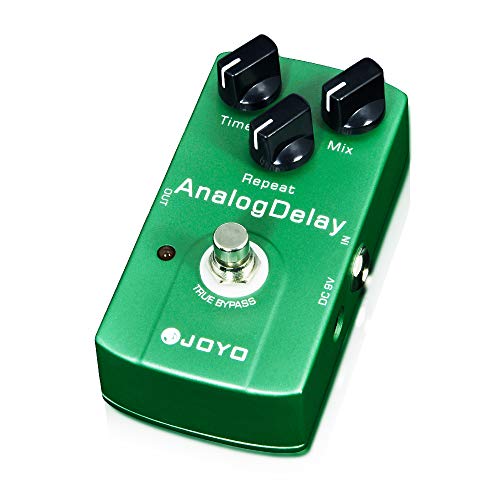
JOYO JF-33 Review Summary
The JOYO JF-33 is a straightforward choice for players who want a delay pedal with a warm character, true bypass switching, and a simple, compact hardware build.
Based on the listing, it looks best for guitarists who value usable tone and a no-drama footprint more than deep editing or studio-style feature density.
Verdict: a practical low-friction delay pedal for players who want the basic sound and a durable enclosure, not a crowded feature set.
Review Scorecard
| Category | Score | Buyer assessment |
|---|---|---|
| Delay character | 8/10 | The listing emphasizes a mild, mellow delay voice, which is exactly what many players want from an analog-flavored echo. |
| Transparency | 8/10 | True bypass is called out, so the pedal is positioned to stay out of the way when disengaged. |
| Build quality | 7/10 | The aluminum-alloy housing suggests a solid, board-friendly enclosure. |
| Simplicity | 9/10 | This is clearly a focused pedal rather than a menu-heavy multi-effect unit. |
| Practicality | 8/10 | Small form factor, LED status indicator, and standard pedal format make it easy to integrate. |
| Value fit | 8/10 | The brand and feature set point toward an accessible option for players who want core delay without excess. |
Key Features and Specifications of JF-33 Analog Delay
The key selling point of the JOYO JF-33 is its “mild and mellow” digital circuit delay voice, marketed as an analog-style delay effect for electric guitar.
That tells you the intended use case right away: adding repeat trails that support the part instead of dominating it.
The listing also highlights true bypass, which matters for any player trying to preserve tone when the effect is off.
In practical terms, that is one of the clearest signs this pedal is built for a pedalboard, not just a casual desktop demo.
Other useful details from the product record:
- Brand: JOYO
- Model / name: JF-33 “Analog” Delay
- Use case: electric guitar delay effect
- Enclosure: whole aluminum-alloy housing
- Finish: stoving varnish finish
- Indicator: small LED flash indicator shows working state
- Brand positioning: over a decade of pedal, amp, wireless, controller, metronome, and tuner experience
The listing also recommends using a reliable power adapter that meets the pedal’s working current requirements, and it specifically mentions an extra JOYO original adapter as the safe option.
That is not unusual for compact pedals, but it does matter for buyers who want fewer noise problems and fewer compatibility surprises.
Pros and Cons of JF-33 Analog Delay
Pros
- Mellow delay voicing should suit rhythm work, lead support, and ambient layering without sounding overbearing.
- True bypass is a meaningful benefit if you care about signal integrity when the pedal is off.
- Aluminum-alloy housing is a good sign for everyday pedalboard wear.
- Small LED indicator makes stage and rehearsal use easier at a glance.
- Focused feature set keeps the pedal approachable for players who do not want to manage extra modes.
Cons
- The listing does not show deep control options, so players wanting detailed delay shaping may find it too basic.
- The product copy leans hard on tone language but gives limited technical detail, which makes it harder to compare against more feature-rich delay pedals.
- Buyers who need precise, studio-grade delay editing or tap-tempo style convenience should probably look at other models.
Who Should Buy JF-33 Analog Delay?
The JF-33 makes sense for guitarists who want a simple delay pedal with a warm personality and do not want to pay for unnecessary complexity.
If your goal is to thicken solos, widen clean parts, or add a little space to a dry amp tone, this kind of pedal is usually the right direction.
It is also a reasonable fit for players building a first board or replacing a noisy, flimsy older pedal.
The true bypass claim, metal housing, and compact format all point toward a pedal that is easy to live with on a practical board.
You should probably skip it if you are looking for:
- multi-parameter delay design
- preset memory
- detailed rhythmic subdivision controls
- experimental sound design tools
- a studio workstation feel in stompbox form
In other words, the JF-33 is for players who want a usable delay sound first and feature depth second.
Delay Tone and Real-World Use
Mild Repeat Character
The strongest tonal cue in the listing is the description of the pedal as “mild and mellow.” That suggests a delay that is meant to blend into the guitar sound rather than cut through with sharp digital edges.
For most players, that is a positive if they want repeats that feel supportive instead of distracting.
True Bypass in a Guitar Chain
True bypass matters most when you are sensitive to how a pedal affects the clean path of your signal.
The JF-33 is positioned as a pedal that minimizes tone loss when disengaged, which is a useful selling point for board builders who keep several effects in line.
Compact Hardware on a Pedalboard
The aluminum-alloy enclosure and small indicator light suggest a pedal that is meant to sit on a working board, not just on a desk.
That is a basic point, but it matters: pedals that are physically durable and easy to read are the ones players keep using.
Power and Noise Considerations
The product copy’s note about using a proper power adapter is worth taking seriously.
Even when a pedal is straightforward, bad power is a common source of noise, so a buyer who wants the cleanest result should plan for a compatible supply rather than improvising.
Alternatives to JF-33 Analog Delay
If you want to compare the JF-33 with other commonly bought delay options on Amazon, these are sensible starting points:
- BOSS DD-8 Digital Delay
- TC Electronic Flashback Delay
- MXR Carbon Copy Analog Delay
- NUX Time Core Delay
Those alternatives make sense because they cover the main decision forks: more flexibility, a more established analog-delay benchmark, or a different budget tier.
If you are comparing strictly on feel and simplicity, the JF-33’s appeal is that it stays focused on the core delay job.
Is JF-33 Analog Delay Worth It?
Yes, if you want a basic, warm-leaning delay pedal with true bypass and a durable metal enclosure, the JF-33 looks like a sensible buy.
It is not trying to be the most advanced delay on the market, and that is part of the appeal.
If you need a compact pedal that does one job cleanly and keeps the interface simple, this is the kind of model worth considering.
If you need deep control or feature breadth, look at the alternatives first.
For everyone else, the JF-33 appears to be a straightforward, practical delay choice.