Mini Volume & Wah Pedal review is for guitarists who want one compact pedal to cover both wah and volume duties.
If you need a small board-friendly unit with classic wah flavor and active signal handling, this one is easy to evaluate.
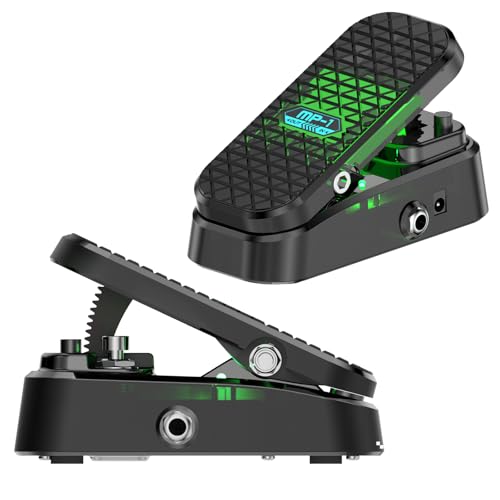
Mini Volume & Wah Pedal Review Summary
The Mini Volume & Wah Pedal makes sense for players who value function-per-square-inch more than flashy extras.
Its core appeal is straightforward: a pure analog wah effect, active volume control, a shielded RM-type inductor, and a compact chassis with LED status feedback.
That combination is useful because it targets two common pedalboard problems at once.
First, some wah pedals take up too much room for the number of sounds they provide.
Second, basic volume pedals can introduce tone loss or feel less stable than players want.
This model is clearly designed to reduce both concerns without complicating the layout.
Best fit: guitarists building a crowded board, players who want a backup wah that is easy to transport, and musicians who prefer an all-in-one stompbox for stage or practice use.
Less ideal: players who want a larger treadle feel, deep vintage-authentic modeling options, or a pedal with many adjustable voicing controls.
Review Scorecard
| Category | Score | Editorial rationale |
|---|---|---|
| Space efficiency | 9/10 | Compact footprint and dual wah/volume function make it easy to justify on a crowded board. |
| Tone potential | 8/10 | Pure analog wah design and RM-type shielded inductor point toward classic wah character. |
| Signal handling | 8/10 | The active volume circuit is specifically intended to minimize tone loss and keep the signal clean. |
| Control feel | 7/10 | The 23° wide-angle stroke suggests usable control range, though the small format may not suit everyone. |
| Stage visibility | 8/10 | Dual-color LED indicators make mode status easier to read at a glance. |
| Portability | 9/10 | Lightweight, compact construction is a strong advantage for travel and small rigs. |
| Versatility | 8/10 | Combining wah and volume functions expands usefulness without adding another pedal. |
Key Features and Specifications of Mini Volume & Wah Pedal
The listing centers on a dual-function design: wah effect plus active volume control in a single compact enclosure.
That is the main differentiator and the reason this pedal is worth considering over a single-purpose wah or a separate volume pedal.
The wah side is described as pure analog and built around a customized RM-type shielded inductor.
In practical buyer terms, that matters because wah pedals live or die by their sweep character and noise behavior.
The listing explicitly ties the inductor choice to interference reduction and a fuller tone, which is the kind of feature players should look for when comparing compact wah units.
The volume side is active rather than passive.
That is important because active volume circuits are usually selected to help preserve signal integrity.
For players who dislike the dulling effect that can happen with simpler volume solutions, this is one of the strongest reasons to shortlist the pedal.
The control layout also looks purpose-built for real use rather than decoration.
The treadle uses a 23° wide-angle stroke, and the surface includes anti-slip treatment plus rubber pads to improve foot placement.
A translucent body and dual-color LED indicators round out the practical design, especially for dim stages.
| Spec or feature | What the listing says | Buyer meaning |
|---|---|---|
| Function | Wah effect + active volume control | Replaces two pedals with one compact unit. |
| Circuit type | Pure analog wah | Better fit for players who want a traditional response. |
| Inductor | RM-type shielded inductor | Aimed at richer tone and less interference. |
| Volume design | Active volume circuit | Intended to reduce tone loss. |
| Treadle range | 23° wide-angle stroke | Broader control range than very shallow mini pedals. |
| Surface | Anti-slip tread with rubber pads | More stable foot placement during performance. |
| Indicators | Dual-color LED | Easier mode/status visibility. |
| Form factor | Compact, lightweight | Better for travel and tight pedalboards. |
Pros and Cons of Mini Volume & Wah Pedal
Pros
- Two useful functions in one pedal. Wah and volume duties are both covered, which is practical for minimalist rigs.
- Analog wah design. Players who prefer a traditional wah response have a clearer reason to consider it.
- Active volume circuit. The listing directly addresses tone loss, which is a real concern for many volume pedal users.
- Compact footprint. It should fit boards where a full-size wah would be inconvenient.
- Helpful visibility. LED indicators make it easier to confirm mode at a glance.
- Stable underfoot. Anti-slip tread and rubber pads are sensible details, not filler.
Cons
- Small format may not suit everyone. Players who like a larger, more classic treadle feel may prefer a full-size pedal.
- Limited published detail. The listing gives useful core features but not much about sweep range, impedance behavior, or switching specifics.
- No deep tonal customization shown. Buyers looking for multiple voicings or advanced shaping controls will want a different class of pedal.
- Best value depends on dual-use needs. If you only need wah or only need volume, the combined design may be unnecessary.
Who Should Buy Mini Volume & Wah Pedal?
This pedal is a good match for players who want to keep their rig lean.
If your board is tight and you still want both wah expression and volume control available on demand, the dual-function layout is the main selling point.
It also suits gigging guitarists who care about transport and setup speed.
A compact pedal is simply easier to carry, easier to place, and less awkward to fit around other essentials like drive, delay, and tuner pedals.
The active volume circuit makes it especially appealing to players who are sensitive to tone loss.
That includes people who use the volume pedal for swells, clean-up control, or dynamic transitions and want the signal to stay as intact as possible.
It is less compelling for purists who want a large, dedicated wah with a very specific vintage feel.
It is also not the best first choice for buyers who prefer lots of knobs, preset options, or highly specialized voicing controls.
If you know you only need a classic-sized wah, a dedicated model may be a better fit.
Wah and Volume Control Behavior
Dual-Use Layout
The strongest design decision here is obvious: one pedal replaces two jobs.
That saves space, but it also makes the unit more flexible than a single-purpose wah for players who move between rhythm control and expressive leads.
Sweep and Foot Feel
The 23° wide-angle stroke suggests a more deliberate control range than ultra-flat mini pedals.
That should help with smoother transitions, although the compact chassis still means buyers should expect a more constrained physical feel than on a large treadle.
Tone Preservation
The active volume circuit is important because volume pedals are often judged by what they do to the signal when they are not fully open.
The listing’s emphasis on minimizing tone loss is exactly the kind of promise volume-pedal buyers should look for.
Stage Readability
The translucent shell and dual-color LED indicators add practical value.
They do not change the tone, but they do improve usability on a dark stage or in a rehearsal room where quick status checks matter.
Alternatives to Mini Volume & Wah Pedal
If you want a more established wah platform, consider a Dunlop Cry Baby.
It is a standard benchmark for players who want a straightforward dedicated wah.
If you want a premium alternative with a similarly compact, performance-oriented reputation, look at a Vox V847.
It is a familiar name for classic wah buyers.
If your priority is volume control first and wah second, search for a Ernie Ball volume pedal.
That route makes sense when dedicated volume feel matters more than consolidation.
If you want a modern multi-effect board approach instead of a single combo pedal, a Line 6 Helix style unit may cover wah and volume in a broader system.
That is a different spend and a different workflow, but it is the right comparison for players consolidating several effects at once.
Is Mini Volume & Wah Pedal Worth It?
Yes, if your priority is compact practicality. The Mini Volume & Wah Pedal is worth considering when you want classic-style wah character, active volume control, and a board-friendly footprint in one unit.
It is not the best pick for everyone. If you want a larger treadle, more detailed control options, or a highly specialized wah voice, a dedicated full-size pedal may fit better.
For the buyer it is designed for, though, the logic is solid: one compact pedal, two common control tasks, and several details aimed at keeping the experience usable onstage. If that is the balance you want, this is a sensible product to shortlist.