Choosing the right stage snake cable for live sound can simplify setup, reduce clutter, and make signal routing far more reliable on busy stages.
This roundup focuses on practical options for bands, venues, churches, studios, and mobile rigs that need clean multicore connections without guesswork.
Best 10 Stage Snake Cable for Live Sound Picks for 2026
Low-Profile 12-Channel Stage Box
Seismic Audio 100 ft XLR Snake

- Low-profile stage box reduces footprint
- Individually shielded conductors help reject noise
- Labeled sends/returns and color-coded fantail simplify setup
Best For: Live sound rigs needing a compact 12-channel, 100-foot snake
Compact 8-Channel Multicolor Snake

- Eight-channel bundle reduces cable clutter
- Color-coded connectors help track channels fast
- Multilayer shielding and metal ends support stable signal
Best For: Small live, recording, or studio setups needing a portable 8-channel snake
24-Channel Pro Stage Box

- 24 channels support larger live sound setups
- 50-foot run works for many stage-to-mix distances
- Labeled inputs and returns simplify routing
Best For: Large live sound or studio rigs needing many XLR lines in one snake
Balanced 8-Channel Stage Run

- Eight channels in one balanced multicore cable
- 50-foot run suits stage-to-mixer setups
- Metal connectors and labels support secure, easy use
Best For: Venues and live performance setups needing an 8-channel labeled snake
Road-Ready 16-Channel Stage Box
16-Channel Low Profile XLR Snake, 100 Feet

- 16 channels with labeled sends and returns
- Low-profile stage box reduces footprint
- 100-foot cable with color-coded fantail
Best For: Larger live sound rigs needing a durable, long-run snake
Compact Pro Stage Snake
12-Channel 25' XLR Snake with TRS Returns

- 12 channels with XLR fanout and TRS returns
- Steel box and flexible PVC jacket
- Numbered, color-coded connectors for faster setup
Best For: Smaller stage, studio, or recording setups with TRS returns
Simple 8-Channel Live Sound Snake
8-Channel Shielded XLR Cable, 25 Feet

- 8 channels for multiple audio signals
- Shielding helps reduce EMI and RFI
- Color-marked connectors for quick identification
Best For: Compact live sound and recording setups with short cable runs
Road-Ready 12-Channel Analog Snake
100' Stage XLR with TRS Returns

- 12 XLR sends with 4 return lines
- 100-foot reach for larger stages
- Braided cable with UL specification
Best For: Larger live sound setups needing long-distance mic runs and returns
Compact 8-Channel Live Sound Snake
Low Profile XLR Splitter, 25 ft

- 8 XLR channels in a compact 25-foot run
- Numbered connectors help speed setup
- Circuit board design aims to reduce noise
Best For: Smaller stages, rehearsal rooms, and quick patching jobs
Heavy-Duty 32-Channel Stage Snake
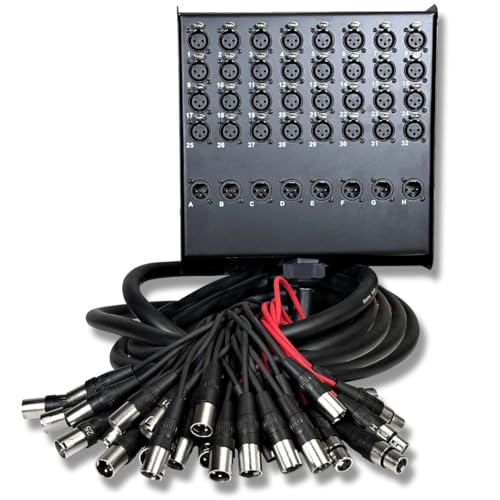
- 32 sends with 8 returns for large rigs
- Steel stage box with circuit board design
- Individually shielded pairs and labeled fanout
Best For: Large live sound productions needing high channel count and durability
Low-Profile 12-Channel Stage Box – Seismic Audio 100 ft XLR Snake
If you need a stage snake cable for live sound with a compact footprint, this 12-channel Seismic Audio option is built for bigger setups that still need tidy routing. The low-profile stage box, individually shielded conductors, and labeled send/return layout make it a practical choice for fast stage wiring and cleaner signal runs.
Best For: Live sound rigs that want a low-profile 12-channel snake with labeled routing and a 100-foot run.
Pros:
- Low-profile stage box helps reduce clutter on stage.
- Individually shielded conductors are designed to reject outside noise.
- Numerically labeled stage box and color-coded fantail can speed setup and tear down.
- Nickel-plated XLR returns are suited to pro mixers and power amps.
Cons:
- 100-foot length may be more cable than smaller venues need.
- Built as a 12-channel snake, so it may be more than simple compact jobs require.
This is a strong pick when you want a road-ready stage snake cable for live sound and value clear labeling, solid shielding, and a low-profile footprint over minimal size.
Compact 8-Channel Multicolor Snake – EBXYA 25 ft XLR Patch Cable
For smaller live sound setups, this stage snake cable keeps eight channels bundled into one flexible run, which can help cut down on cable clutter. The multicolor connectors, multilayer shielding, and locking metal hardware are aimed at making it easier to identify lines and keep signals stable in live, recording, or studio use.
Best For: Small to mid-size live sound, recording, or studio setups that need an 8-channel XLR snake in a short 25-foot run.
Pros:
- Eight-channel design replaces multiple single cables with one bundled run.
- Color-coded XLR connectors make channel identification easier.
- Multilayer shielding is designed to reduce RF and EMI noise.
- Heavy-duty zinc alloy shell and self-locking connector add durability.
Cons:
- 25-foot length may be too short for larger stage layouts.
- Male-to-female patch style may not fit every snake system configuration.
If you want a portable stage snake cable for live sound with clear labeling and noise-resistant construction, this EBXYA model is a sensible short-run option.
24-Channel Pro Stage Box – Harmony Audio 50 ft XLR Snake
This stage snake cable is built for larger live sound jobs where channel count matters more than compact size. With 24 channels, a 50-foot run, and clearly labeled inputs and returns, it suits users who need an organized way to move many XLR lines between stage and mix position.
Best For: Larger live sound or studio setups that need a 24-channel stage box with labeled returns and a 50-foot cable.
Pros:
- 24-channel layout supports high-count stage and recording setups.
- 50-foot length fits many typical stage-to-control-position runs.
- 100% shielded XLR cable is designed for cleaner signal handling.
- Labeled inputs and A/B/C/D returns help simplify setup.
Cons:
- At 27.7 pounds, it is relatively heavy to move and store.
- May be more snake than smaller gigs need.
If you need a robust stage snake cable for live sound with plenty of channels and clear labeling, this Harmony Audio box is geared toward serious multi-line routing.
Balanced 8-Channel Stage Run – GEARit 50 ft XLR Snake
When you want a stage snake cable for live sound that handles eight channels without creating a mess, this GEARit model is designed for straightforward stage-to-mixer runs. The 50-foot length, metal XLR connectors, OFC conductors, and clear channel labels make it a practical fit for venues, monitoring, or recording use.
Best For: Stage-to-mixer runs, venues, and live performance setups that need an 8-channel balanced XLR snake with clear labeling.
Pros:
- Eight balanced channels in one cable help reduce setup clutter.
- 50-foot length suits many stage-to-mixer and monitor runs.
- Metal XLR connectors are built to lock securely in place.
- Channel labels make signal identification easier in low-light spaces.
Cons:
- Male-to-male configuration may not suit every routing need.
- Designed around 8 channels, so it is not ideal for larger multi-input jobs.
For buyers comparing a stage snake cable for live sound, this one stands out for its simple 8-channel layout, clearly labeled connectors, and solid hardware for repeated use.
Road-Ready 16-Channel Stage Box – 16-Channel Low Profile XLR Snake, 100 Feet
If you need a stage snake cable for live sound that keeps a large setup organized, this 16-channel Seismic Audio model is built around a low-profile stage box and clearly numbered sends and returns. The 100-foot run and color-coded fantail make it easier to place the box where it works best while keeping the stage tidier.
Best For: Larger live sound rigs that need a road-ready, low-profile snake with labeled channels and a long 100-foot reach.
Pros:
- 16 channels with numerically labeled sends and returns for easier setup.
- Low-profile stage box helps reduce footprint on stage.
- Individually shielded conductors are designed for clear sound and noise rejection.
- Nickel-plated XLR return connectors support use with pro amps and mixers.
Cons:
- 100-foot length may be more than smaller rooms need.
- Primarily aimed at larger multi-channel live sound setups.
This is a strong pick if your priority is a durable, clearly labeled snake with plenty of channels and a long reach. The low-profile stage box and color-coded fantail should help simplify both setup and teardown.
Compact Pro Stage Snake – 12-Channel 25' XLR Snake with TRS Returns
For a stage snake cable for live sound that keeps a compact rig neat, this 12-channel Pro Stage XLR snake pairs a steel box with numbered, color-coded connectors. The 25-foot length makes it easier to manage in smaller stage, studio, or recording setups, while the shielding and flexible PVC jacket are geared toward clean, practical use.
Best For: Smaller live sound, recording, or studio setups that need a compact snake with clear labeling and TRS returns on the box.
Pros:
- 12 channels with male/female XLR fanout and parallel 1/4-inch TRS returns on the box.
- Numbered and color-coded connectors help speed up routing.
- Steel stage box is built for rugged, long-term use.
- Flexible PVC jacket is designed to resist tangles and bends.
Cons:
- 25-foot length may be limiting for larger stages.
- Fewer channels than larger live sound snakes.
This model makes sense when you want a compact, straightforward snake that keeps connections easy to identify. Its short run and rugged box are better matched to smaller, more controlled setups than to big stage layouts.
Simple 8-Channel Live Sound Snake – 8-Channel Shielded XLR Cable, 25 Feet
If you want a straightforward stage snake cable for live sound, this 8-channel PRORECK option focuses on clean signal handling in a compact 25-foot format. The shielded design, copper core, and color-marked connectors are aimed at making multi-channel routing easier without adding unnecessary complexity.
Best For: Compact live sound, studio, or multi-track recording setups that need an 8-channel shielded snake with quick identification.
Pros:
- 8 channels allow multiple audio signals to run at once.
- Shielding helps reduce EMI and RFI interference.
- Copper core supports strong signal transmission with minimal loss.
- Color-marked connectors and numbers make routing quicker.
Cons:
- 25-foot length is best suited to shorter runs.
- Fewer channels than larger stage snakes.
This snake is a practical fit when you need stable wired connectivity and clear channel identification in a smaller footprint. It is less about maximum channel count and more about reliable, easy-to-manage performance for modest rigs.
Road-Ready 12-Channel Analog Snake – 100' Stage XLR with TRS Returns
If you need a stage snake cable for live sound with serious reach, this 100-foot Seismic Audio model is built for larger setups that need 12 XLR sends and 4 return lines. It’s aimed at recording, stage, and studio use, and the braided cable design plus UL specification make it a practical choice for fixed or mobile rigs.
Best For: Larger bands, venues, and production setups that need 12 mic lines with return capability over a 100-foot run.
Pros:
- 12 XLR sends plus 4 returns for flexible live sound routing
- 100-foot length suits wider stage-to-FOH distances
- Braided cable construction and UL spec add confidence for regular use
- Includes both XLR and 1/4" TRS return options in the box
Cons:
- 36.6-pound weight may be more than smaller rigs need
- Best suited to larger channel counts, not compact setups
This is a strong fit when you want a long, traditional snake with multiple sends and return flexibility. The 12×4 layout gives it enough routing capacity for demanding stage work without moving into overly specialized territory.
Compact 8-Channel Live Sound Snake – Low Profile XLR Splitter, 25 ft
This stage snake cable for live sound is a compact 25-foot PRORECK splitter built around an 8-channel XLR layout. It uses a low-profile stage box with numbered connectors and a circuit board design meant to provide a solid connection and reduce external noise in live, recording, and studio applications.
Best For: Smaller live rigs, rehearsal spaces, and recording setups that want a shorter 8-channel XLR snake with easy labeling.
Pros:
- 8-channel layout keeps small to mid-size setups organized
- Numbered connectors on both the box and fantail simplify patching
- Circuit board design is intended to reduce external noise
- 25-foot length is practical for tighter stages and studios
Cons:
- Shorter reach than full-size stage snakes
- Only 8 channels, so it may not suit larger bands or productions
For users who want a straightforward snake without extra bulk, this model keeps the footprint manageable while still covering common live sound needs. The low-profile format and clear labeling make it especially useful when speed and simplicity matter.
Heavy-Duty 32-Channel Stage Snake – Low Profile Steel Box, 25 ft
When you need a stage snake cable for live sound with a much higher channel count, this Seismic Audio 32-channel model is designed for demanding stage, studio, and recording work. It combines a 25-foot trunk, 32 XLR male sends, and 8 XLR female returns with a heavy-duty steel stage box and circuit board technology for cleaner, clearer audio.
Best For: Large productions, full bands, and installed or mobile rigs that need 32 sends and 8 returns in a road-ready package.
Pros:
- 32 sends and 8 returns support complex live sound routing
- Heavy-duty steel stage box is built for road use
- Circuit board technology and individually shielded pairs support clean audio
- Numbered and color-coded fantail makes setup easier
Cons:
- 25-foot length may be too short for larger venue spacing
- Heavier build may be more than small rigs need
This is the most feature-packed option in the group for high-channel-count work. If your priority is cleaner organization and durable hardware in a shorter run, it offers a very capable stage-box setup for live sound and studio use.
How We Picked the Best Stage Snake Cable for Live Sound
We focused on channel count, cable length, connector quality, shielding, labeling, and box or circuit-board design. For live use, dependable strain relief and clear channel identification matter just as much as raw channel capacity. We also favored options that fit common stage layouts, from compact rehearsal setups to larger FOH-to-stage runs.
Quick Comparison
The right Stage Snake Cable for Live Sound depends on how many inputs and returns you need, how far the run must travel, and whether you prefer XLR-only or XLR-plus-TRS configurations. Shorter 8-channel models suit small gigs and portable rigs, while 12-, 16-, 24-, and 32-channel options are better for larger mixes and permanent installs.
Key Buying Factors for Stage Snake Cable for Live Sound
Channel Count and Returns
Match the snake to your mixer and stagebox needs first. If you only need mic and line inputs, a send-focused model may be enough. If you route monitor mixes, playback, or submixes, look for return channels as well.
Length and Layout
Longer runs are useful when the mixer sits at front of house or in a control area, but excess length can add weight and make coiling harder. Choose the shortest length that still gives safe cable routing and slack for stage movement.
Build Quality
Look for metal connectors, reinforced boxes, and clearly marked channels. For a Stage Snake Cable for Live Sound, rugged construction helps it survive repeated setup, teardown, and transport.
Signal Handling
Balanced multicore designs help reduce hum and interference over longer distances. Shielding and solid conductor quality are especially important in noisy venues with lighting, power runs, and dense wiring.
Labeling and Workflow
Numbered or color-coded channels speed up patching and troubleshooting. That can save time during changeovers and reduce mistakes when multiple engineers or band members are handling setup.
Who Should Buy Which Stage Snake Cable for Live Sound?
Small bands, rehearsal rooms, and mobile recording setups usually do best with 8-channel snakes in 25- to 50-foot lengths. Medium-size clubs, churches, and project studios often benefit from 12- or 16-channel models, especially if monitor returns are needed. Large productions, fixed installs, and fuller front-of-house rigs should consider 24- or 32-channel options for more flexible routing and future expansion.
If you want the simplest choice, start by counting your current inputs, then add a few channels for growth. The best Stage Snake Cable for Live Sound is the one that matches your real workflow today while leaving room for the next show.