A parametric studio equalizer gives you precise control over frequency, gain, and bandwidth, making it easier to shape sound without guesswork.
In this 2026 roundup, we focus on flexible EQ options for studio, home audio, and car-audio use, so you can match the right tool to your setup and budget.
Best 10 Parametric Studio Equalizer Picks for 2026
Studio Rack EQ
dbx 530 Compact, Professional Parametric EQ

- Classic dbx 905-inspired 3-band design
- Bell or shelf options on low and high bands
- Adjustable Q for detailed shaping
Best For: 500-series studio users who want compact parametric control
Car Audio Control Hub
Skar Audio SKA7EQ 7 Band 1/2 DIN EQ
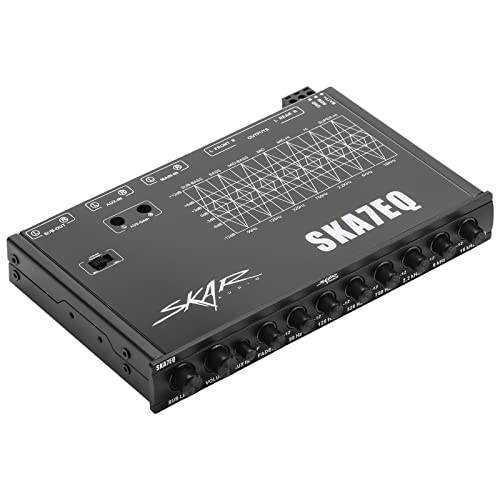
- 7 fully adjustable EQ bands
- Aux input with variable gain control
- 7V max RCA outputs with fader control
Best For: Car audio systems needing flexible pre-amp EQ and output control
Live Sound Graphic EQ
dbx 231s Dual Channel 31-Band Equalizer

- Dual-channel 31-band constant Q EQ
- Switchable 6 or 12 dB boost/cut
- Front bypass and XLR/TRS connections
Best For: Live sound or installed systems needing detailed graphic EQ
Compact Car EQ
CT Sounds CT-7EQ 7 Band 1/2 Din EQ
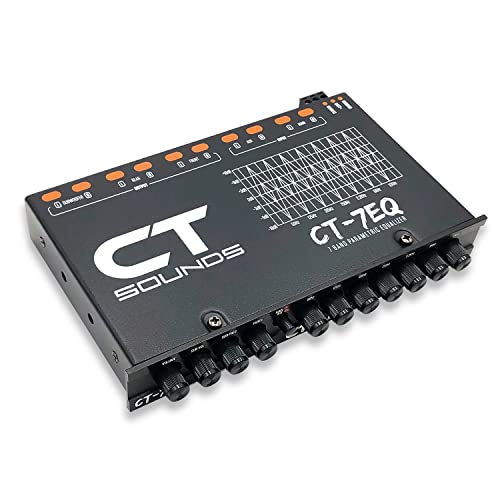
- 7-band parametric car EQ
- Bass, mid, treble, and sub bass controls
- Includes mounting brackets and hardware
Best For: Car audio setups needing compact tuning with strong low-end control
Studio-Grade Rack EQ with Analyzer
20-Band Graphic EQ with 31-Band Spectrum Display
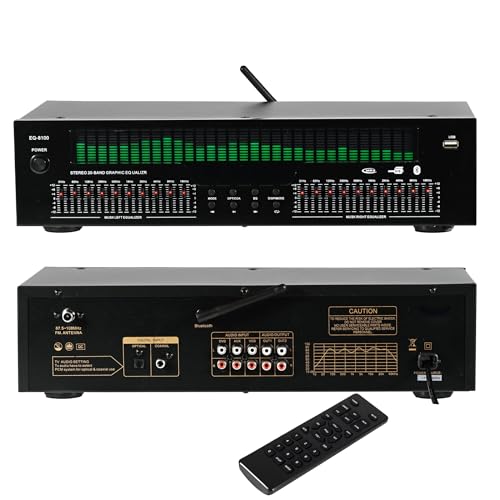
- 20-band EQ with real-time 31-band spectrum display
- Optical, coaxial, USB, Bluetooth, and RCA connections
- 1U aluminum rack design with auto-save presets
Best For: Studio, DJ, and stage users who want visual tuning and flexible inputs
Clean HiFi Tone Shaper
9-Band Stereo EQ Preamp for Home Audio

- 9-band EQ from 20Hz to 16kHz for tone shaping
- 111dB SNR and 0.001% THD for clean playback
- RCA inputs/outputs plus bypass and balance controls
Best For: Home stereo listeners who want a clean, compact EQ preamp
Flexible Dual-Channel Rack EQ
15-Band Stereo Graphic Equalizer

- 15 bands per channel with ±12dB adjustment
- LOW-CUT and BYPASS switches for easier tuning
- XLR and 1/4-inch TRS inputs/outputs for pro setups
Best For: Live sound, installations, and studios needing rack-mounted EQ control
Desktop EQ with VU Meter

- 5-band tone control for quick sound correction
- Bluetooth 5.0 for wireless playback
- Dual VU meters add visual monitoring
Best For: Home stereo and desktop users who want easy tone shaping with a retro-style meter display.
Rackmount Graphic EQ
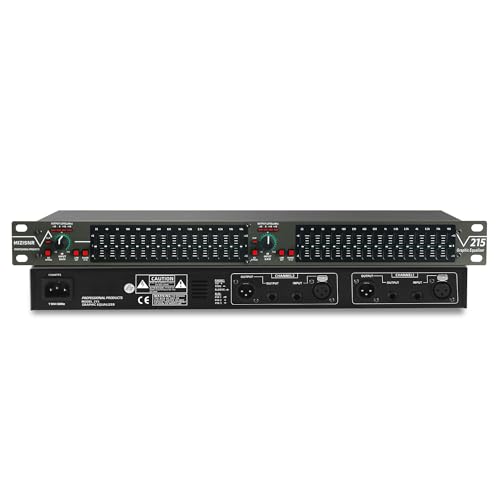
- 15 bands per channel with ±12dB adjustment
- LOW-CUT switch helps reduce rumble and hum
- 1U rack design with XLR and TRS I/O
Best For: DJs and live audio setups that need a rackmount dual-channel EQ.
Digital Studio EQ
31-Band Dual Channel Processor

- 31-band dual-channel EQ for detailed shaping
- PC software adds fine-tuning control
- 10 presets, bypass, and noise reduction
Best For: Studio and live users who want detailed digital control and software tuning.
Studio Rack EQ – dbx 530 Compact, Professional Parametric EQ
If you want a parametric studio equalizer built for rack-based signal shaping, the dbx 530 keeps things compact while still giving you the control points you need. It follows the classic dbx 905 3-band concept, with selectable bell or shelf filters on the low and high bands and adjustable Q on each band for more precise tone work.
Best For: Engineers and home-studio users who want a compact 500-series parametric EQ with flexible filter shaping.
Pros:
- Based on the classic dbx 905 3-band parametric EQ
- Selectable bell or shelf filters on the low and high bands
- Adjustable Q on each band for tighter control
- Compact 500-series format for rack use
Cons:
- Only one unit is included
- Designed for 500-series setups, so it is not a standalone desktop EQ
Overall, the dbx 530 is a straightforward choice when you need hands-on parametric EQ control in a space-saving format. Its filter options and Q adjustment make it a practical fit for detailed shaping rather than broad, one-knob correction.
Car Audio Control Hub – Skar Audio SKA7EQ 7 Band 1/2 DIN EQ
For car systems that need a practical parametric studio equalizer-style control center, the Skar Audio SKA7EQ adds flexible tuning in a 1/2 DIN layout. It offers 7 fully adjustable bands, aux input with variable gain, and high-voltage RCA outputs, making it useful when you want to balance the front, rear, and subwoofer sections of your system.
Best For: Car audio builds that need multiple EQ bands, aux input flexibility, and strong pre-amp output control.
Pros:
- 7-band EQ with fully adjustable -12 dB to +12 dB bands
- Aux input with variable gain control
- High-voltage RCA outputs rated up to 7V
- Built-in fader control plus front, rear, and subwoofer outputs
Cons:
- Made specifically for car audio, not studio use
- 1/2 DIN format may not fit every dash without planning
This model is best if you want more detailed tuning than a basic car stereo offers. With dedicated controls for multiple bands and sub level management, it gives you a lot of adjustment headroom in a compact in-dash package.
Live Sound Graphic EQ – dbx 231s Dual Channel 31-Band Equalizer
If your priority is a proven graphic equalizer rather than a parametric studio equalizer, the dbx 231s gives you dual-channel 31-band control with straightforward live-sound utility. It includes constant Q bands, switchable 6 or 12 dB boost/cut ranges, and a front-panel bypass switch, which makes it easy to compare processed and unprocessed audio.
Best For: Live sound and installed audio setups that need detailed 31-band graphic EQ control.
Pros:
- Dual 31-band, 1/3-octave constant Q design
- Switchable 6 dB or 12 dB boost/cut ranges
- Front-panel bypass switch for quick comparison
- XLR and TRS inputs and outputs
Cons:
- Graphic EQ format, not a parametric EQ
- Larger 19-inch rack size than compact units
The dbx 231s is a solid choice when you need broad, precise frequency management across two channels. It is less about surgical parametric work and more about reliable, hands-on system tuning.
Compact Car EQ – CT Sounds CT-7EQ 7 Band 1/2 Din EQ
The CT Sounds CT-7EQ is a compact parametric studio equalizer-style option for car audio users who want more control over key frequency ranges. It divides 20Hz to 20kHz into seven bands and adds bass, mid, and treble adjustment, plus sub bass controls at 43Hz and 60Hz.
Best For: Drivers building a car audio system that needs flexible band control and extra bass tuning.
Pros:
- 7-band parametric equalizer design
- Frequency range divided from 20Hz to 20kHz
- Dedicated bass, mid, treble, and sub bass adjustments
- Includes installation brackets and hardware
Cons:
- Made for car audio rather than studio monitoring
- Only a 1-year manufacturer warranty
For mobile systems, the CT-7EQ gives you a useful amount of tonal control without taking much dash space. It stands out most when you want to fine-tune the overall balance and the low end in a single in-line unit.
Studio-Grade Rack EQ with Analyzer – 20-Band Graphic EQ with 31-Band Spectrum Display
If you want a parametric studio equalizer-style control surface for system tuning, this 20-band graphic EQ gives you broad frequency shaping plus a 31-band spectrum analyzer for real-time feedback. It is built to sit in a rack, connect into optical, coaxial, USB, and RCA-based setups, and support everything from studio monitors to live-stage and home-theater chains.
Best For: Studio engineers, DJs, and home audio users who want detailed EQ control with visible spectrum feedback.
Pros:
- 20-band graphic EQ with a 31-band spectrum analyzer for live frequency monitoring
- Optical, coaxial, USB, Bluetooth, and RCA connectivity for flexible integration
- 1U aluminum chassis designed for rack use, touring, or permanent installs
- Auto-save presets and color-coded controls make quick switching easier
Cons:
- Not a true parametric EQ; it uses graphic bands instead
- Feature-rich design may be more than needed for simple stereo setups
This is a strong choice if you need an EQ that does more than basic tone shaping and also gives you a visual readout for system tuning. It fits well in studio, DJ, and stage environments where routing options and quick preset recall matter.
Clean HiFi Tone Shaper – 9-Band Stereo EQ Preamp for Home Audio
For buyers searching for a parametric studio equalizer alternative in a compact home system, this 9-band stereo EQ preamp focuses on clean tone shaping rather than flashy extras. It offers precise control from 20Hz to 16kHz, strong signal specs, and simple RCA hookup, making it easy to slot into a stereo chain for music, movies, or gaming.
Best For: Audiophiles and home stereo users who want quiet, transparent EQ control in a simple preamp form.
Pros:
- 9-band EQ covers 20Hz to 16kHz for bass, mid, and treble shaping
- 111dB SNR and 0.001% THD support clean, low-distortion playback
- 2 RCA inputs and outputs make source switching straightforward
- Bypass and balance controls add easy everyday usability
Cons:
- Limited to 9 bands, so it offers less detailed shaping than larger EQ units
- RCA-only connectivity may not suit more complex pro audio rigs
This model stands out when the priority is clean audio and practical control, not a rack full of features. It is a solid fit for home systems where you want to fine-tune tone without adding noticeable noise or distortion.
Flexible Dual-Channel Rack EQ – 15-Band Stereo Graphic Equalizer
If you are comparing a parametric studio equalizer to a more traditional rack graphic EQ, this dual-channel 15-band model is aimed at precise system correction and live-use reliability. With adjustable gain and decay, a LOW-CUT switch, and balanced XLR plus 1/4-inch TRS I/O, it is designed for straightforward installation in studio, installation, or performance setups.
Best For: Live sound, audio installations, and studio users who need rack-mount EQ with practical noise control.
Pros:
- 15 bands per channel with up to ±12dB adjustment for detailed shaping
- LOW-CUT switch helps reduce wind noise, rumble, and electrical hum
- BYPASS switch simplifies setup and troubleshooting
- XLR balanced and 1/4-inch TRS I/O support flexible integration
Cons:
- Uses graphic EQ bands rather than a true parametric layout
- Single-purpose rack design may be more than casual home users need
This EQ is well suited to users who want dependable channel-by-channel control and easy rack installation. It is especially practical when low-frequency cleanup and compatibility with pro connections matter more than extra digital features.
Desktop EQ with VU Meter – Douk Audio 5 Band EQ Preamp
If you want a parametric studio equalizer-style control for a home stereo or desktop setup, the Douk Audio EQ5 Tone gives you straightforward 5-band shaping with Bluetooth convenience. Its five fixed bands, bypass switch, and balance control make it easy to correct speaker quirks, tame room issues, or quickly compare processed versus direct sound.
Best For: Home stereo listeners and desktop users who want simple tone shaping, Bluetooth input, and a visual VU meter.
Pros:
- 5-band EQ with independent op-amp processing for 75Hz, 400Hz, 800Hz, 4KHz, and 10KHz
- Bluetooth 5.0 adds wireless playback convenience
- Dual 45mm VU meters provide real-time signal monitoring
- Bypass and balance controls add practical day-to-day flexibility
Cons:
- Only five bands, so it is less detailed than a true multi-band studio EQ
- Best suited to compact setups rather than rack-based systems
- Requires DC 5V power, which may limit placement options
This is a good pick if you want an approachable EQ preamp that focuses on easy adjustment and visual feedback rather than deep studio precision. The upgraded bass response and VU meter enhancements make it especially appealing for casual listening setups.
Rackmount Graphic EQ – EQ-215 Dual Channel 15-Band
For buyers comparing a parametric studio equalizer to a more traditional graphic design, the EQ-215 offers hands-on dual-channel control with 15 bands per side. Its 1U rack format, low-cut switch, and bypass function make it a practical fit for live sound, audio installations, or a home rack where precise but familiar EQ moves matter.
Best For: DJs, live audio users, and rack systems that need dual-channel graphic EQ with flexible I/O.
Pros:
- 15-band dual-channel layout with adjustable range of ±12dB per band
- LOW-CUT switch helps reduce wind noise, rumble, and hum
- Standard 1U rack-mount design simplifies installation
- XLR balanced and 1/4″ TRS input/output support broad compatibility
Cons:
- Graphic EQ format offers less frequency targeting than a true parametric design
- Rack-mount focus makes it less convenient for portable desktop use
- Designed more for system tuning than for casual one-box listening
This model makes sense when you need reliable, visible control in a professional-style format. It is especially useful for users who want to clean up low-frequency problems and keep a signal chain easy to debug with bypass access.
Digital Studio EQ – 31-Band Dual Channel Processor
If you need a parametric studio equalizer alternative with much finer control, this 31-band digital EQ offers detailed left-right shaping, PC tuning, and a spectrum analyzer display. It is built for users who want to manage sound in studio or live environments while keeping setup flexible through XLR, stereo L/R, and TRS connections.
Best For: Studio and live-sound users who want detailed digital EQ control, presets, and software-based tuning.
Pros:
- Dual-channel 31-band EQ allows detailed frequency shaping
- PC software support makes fine-tuning more precise
- 10 presets plus bypass mode support quick comparisons
- DSP noise reduction helps clean up background noise
Cons:
- Digital workflow may be more involved than a simple analog EQ
- More feature-rich than necessary for basic home stereo tweaks
- Setup may take longer if you want to use the PC tuning features
This is the most control-oriented option in the group, with enough band count and software support to suit more demanding users. The LED display, preset storage, and noise reduction make it a strong fit when you need repeatable results and clearer system management.
How We Picked These Parametric Studio Equalizers
We looked for models that offer practical EQ control, clean signal handling, and the feature set buyers actually use most. That includes band count, channel configuration, noise performance, connectivity, rack or desktop format, and whether the unit is better suited to studio monitoring, home stereo tuning, or car audio integration.
We also favored units with straightforward controls and clear use cases. A good Parametric Studio Equalizer should help you make targeted adjustments quickly, not force you into a complicated setup for basic tone shaping.
Quick Comparison: Which Type Fits Your Setup?
Not every EQ on this list serves the same purpose. Graphic EQs are often better for broad tonal shaping and fast visual adjustments, while parametric-style controls are ideal when you want more exact frequency targeting. Dual-channel units work well for stereo systems, and rack-mount designs are usually the best fit for studio or installed audio.
If you are tuning speakers, headphones, or a home stereo, focus on signal quality and usable controls. If you are building a studio or rack system, prioritize channel separation, low noise, and consistent hardware layout.
Key Buying Factors for a Parametric Studio Equalizer
Band Count and Control Precision
More bands can give you finer tonal shaping, but only if the layout is intuitive. For precise correction, look for controls that let you target problem frequencies without overprocessing the entire mix.
Signal Quality and Noise Floor
Clean audio matters more than extra features. Check for low distortion, strong signal-to-noise performance, and stable outputs if you want transparent EQ adjustments.
Connectivity and System Match
Make sure the unit matches your source and destination gear. RCA inputs and outputs are common for home and car systems, while rack-style units may suit mixer chains, interfaces, or installed audio rigs.
Form Factor and Workflow
Choose a physical layout that fits where you will use it. Desktop and half-rack models are convenient for compact spaces, while full rack units are often easier to integrate into a permanent setup.
Who Should Buy Which Parametric Studio Equalizer?
If you want precision for recording or playback correction, choose the model that offers the cleanest control and best stereo matching. If your priority is simple tone shaping for home listening, a straightforward graphic EQ may be the easiest option. Car audio buyers should focus on compact units with the right input/output configuration and reliable preamp control.
In short, the best Parametric Studio Equalizer for you is the one that fits your signal chain, gives you enough control to solve real problems, and stays easy enough to use regularly.