A good graphic equalizer can make a live system easier to tune, faster to correct, and more predictable at the gig.
Below, we focus on rack-friendly options that suit live sound setups, from simple dual-channel EQs to feature-rich digital models with spectrum displays.
Best 10 Graphic Equalizer for Live Sound Picks for 2026
Rack-Ready 15-Band Control
Rockville REQ215 Dual 15-Band Graphic Equalizer

- Dual 15-band EQ per channel
- XLR I/O with sub output and crossover
- Low-cut, bypass, and output LEDs
Best For: DJs, churches, and small live sound rigs
31-Band Precision
dbx 231s Dual Channel 31-Band Equalizer

- Dual 31-band, 1/3-octave EQ
- 6 dB or 12 dB boost/cut ranges
- LED ladders and front bypass switch
Best For: Engineers needing detailed rack EQ for live sound
Digital EQ Hub
EQ8100 20-Band Graphic Equalizer with Spectrum Display
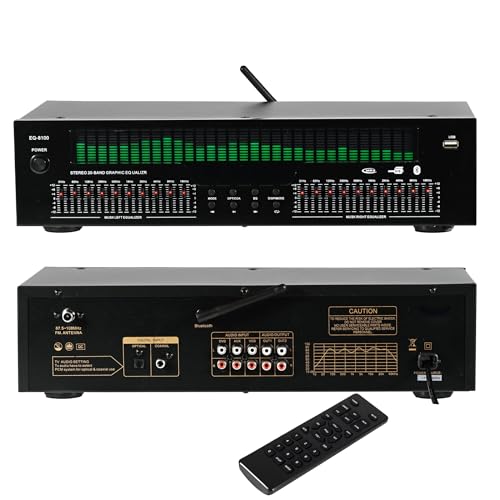
- 20-band EQ with 31-band spectrum analyzer
- Bluetooth, USB, optical, and coaxial inputs
- 1U aluminum rack chassis with presets
Best For: Mixed-use systems needing digital inputs and visual EQ feedback
Simple Dual-Channel Tuning
EQ-215 15-Band Stereo Graphic Equalizer

- Dual 15-band stereo EQ
- LOW-CUT and BYPASS switches
- XLR balanced and TRS I/O
Best For: Basic live sound tuning and rack debugging
Studio-Ready 31-Band Control
EQ31SUB Digital Graphic Equalizer
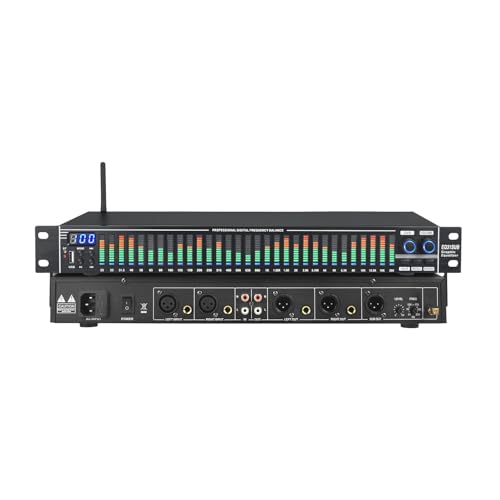
- 31-band EQ for detailed frequency shaping
- LED spectrum display for real-time monitoring
- Noise reduction plus XLR/RCA/6.35 mm support
Best For: Live sound rigs, DJs, and flexible pro-audio setups
Dual-Channel Precision

- Dual-channel 31-band EQ with ±6 to ±12 dB range
- LOW-CUT and BYPASS switches for cleaner operation
- 4-segment LED ladders for level monitoring
Best For: Stereo live applications, installations, and studio EQ control
Smart Control with Memory
FX-888 Dual-Channel 31-Band Digital EQ

- Dual-channel 31-band DSP EQ with spectrum indication
- PC control plus save-and-recall functions
- TRS, RCA, XLR, and balanced connections
Best For: Users wanting digital control, presets, and broad connectivity
Rack-Mount Precision EQ
15-Band Dual-Channel Graphic Equalizer

- 15 bands per channel with ±12dB control
- Low-cut feature and bypass switch for easy tuning
- XLR and 1/4" TRS inputs plus dedicated bass output
Best For: DJs, live sound users, and rack installs that need simple manual EQ control
Visual DSP Mixer EQ
31-Band Digital Spectrum Equalizer

- 31-band EQ with real-time LED spectrum display
- 10 presets, bypass mode, Bluetooth 5.2, and USB playback
- XLR and TRS I/O with independent bass output
Best For: KTV, studio, DJ, and home audio users who want visual feedback and digital convenience
PC-Tuned Pro EQ
31-Band Dual-Channel Graphic Equalizer

- Dual-channel 31-band EQ with PC software tuning
- Large LED screen plus 10 presets and bypass mode
- DSP noise reduction and flexible XLR/TRS/L/R connections
Best For: Sound engineers and advanced users who want software-assisted EQ and cleaner output
Rack-Ready 15-Band Control – Rockville REQ215 Dual 15-Band Graphic Equalizer
If you want a graphic equalizer for live sound that gives you practical control without a complicated setup, the Rockville REQ215 is built for that job. Its dual 15-band layout lets you shape two channels with constant Q filtering, while the low-cut filter, sub output, and bypass switch make it easy to tune a room, manage rumble, and compare changes quickly.
Best For: DJs, churches, karaoke rigs, and small live sound setups that need balanced XLR connections and flexible EQ control.
Pros:
- Dual 15-band, 1/3-octave control across 25 Hz–16 kHz
- Dedicated subwoofer output with 30 Hz–200 Hz crossover control
- Balanced XLR inputs and outputs for cleaner signal handling
- Low-cut filter, bypass switch, and output LEDs for live use
Cons:
- Only offers 15 bands per channel, not a full 31-band layout
- Best suited to rack-based systems rather than portable tabletop use
The REQ215 is a straightforward option for users who need solid live sound control with practical stage-friendly features. It balances routing flexibility and tonal shaping in a rugged 1U-style format.
31-Band Precision – dbx 231s Dual Channel 31-Band Equalizer
The dbx 231s is a classic graphic equalizer for live sound when you need finer control across a full 31-band layout. With dual channels, constant Q bands, switchable boost/cut ranges, and a front-panel bypass, it is designed for straightforward system tuning and quick comparisons during setup or showtime.
Best For: Live sound engineers and rack systems that need detailed 1/3-octave equalization with professional monitoring features.
Pros:
- Dual 31-band, 1/3-octave constant Q equalization
- Switchable 6 dB or 12 dB boost/cut ranges
- Front-panel bypass switch for fast A/B checks
- Input and output level monitoring with 4-segment LED ladders
Cons:
- No subwoofer output or crossover controls listed
- Uses a traditional rack format, so it is less compact than smaller units
The 231s focuses on the essentials: accurate frequency shaping, dependable routing, and easy visual feedback. It is a strong fit when live sound work calls for more detailed EQ control than a 15-band unit can offer.
Digital EQ Hub – EQ8100 20-Band Graphic Equalizer with Spectrum Display
The EQ8100 takes a more feature-heavy approach to graphic equalizer for live sound setups, combining 20-band EQ control with a 31-band spectrum analyzer and digital connectivity. If you want a rack unit that can work across stage, studio, and home theater sources, its optical, coaxial, USB, and Bluetooth support gives it broad integration options.
Best For: Users who want a rack-mounted equalizer with spectrum monitoring and digital input options for mixed-use audio systems.
Pros:
- 20-band graphic EQ with real-time 31-band spectrum analyzer
- Optical, coaxial, USB, RCA, and Bluetooth connectivity
- Ultrathin 1U aluminum chassis for rack installation
- Auto-save presets and display tools for quick adjustments
Cons:
- Feature set is broader than a simple live-sound EQ
- Notes emphasize multiple use cases beyond stage use, so it may be more complex than needed for basic setups
This model is best viewed as a flexible audio processing hub rather than a basic equalizer. It offers plenty of routing and display features, but buyers should want those extras to justify the added complexity.
Simple Dual-Channel Tuning – EQ-215 15-Band Stereo Graphic Equalizer
For buyers seeking a graphic equalizer for live sound with familiar controls and no extra complexity, the EQ-215 keeps things focused. Its dual 15-band design, LOW-CUT switch, BYPASS switch, and XLR/TRS connectivity cover the core needs of stereo EQ shaping in a standard 1U rack format.
Best For: Users who want a straightforward stereo rack equalizer for basic live sound tuning and system debugging.
Pros:
- Dual-channel 15-band EQ with ±12 dB adjustment per band
- LOW-CUT switch helps reduce low-frequency noise
- BYPASS switch makes machine debugging simpler
- XLR balanced and 1/4-inch TRS input/output support
Cons:
- Only 15 bands per channel, so it is less detailed than 31-band units
- No subwoofer output or analyzer display listed
The EQ-215 is a practical, no-frills option for basic stereo equalization in rack systems. It focuses on the features most users actually need during setup and troubleshooting.
Studio-Ready 31-Band Control – EQ31SUB Digital Graphic Equalizer
If you need a graphic equalizer for live sound that offers detailed tonal shaping, the EQ31SUB gives you 31 bands of adjustment, real-time LED spectrum monitoring, and built-in noise reduction. Its mix of XLR, RCA, and 6.35 mm connections makes it easy to slot into PA systems, mixers, instruments, or home stereo setups.
Best For: Live sound rigs, DJs, and users who want flexible 31-band tuning with multiple input options.
Pros:
- 31-band graphic equalizer for precise control across low, mid, and high frequencies
- LED spectrum display gives real-time visual feedback on audio levels and EQ status
- DSP noise gate and suppression help reduce hiss and improve clarity
- XLR, RCA, and 6.35 mm I/O support broad system compatibility
Cons:
- Rugged metal build adds weight compared with more compact units
- Designed for wired pro-audio integration rather than simple plug-and-play use
This model stands out for users who want hands-on frequency control plus live visual monitoring in a durable enclosure. It looks especially practical for stage, studio, or DJ setups where fine EQ adjustment matters.
Dual-Channel Precision – EQ-231 31-Band Stereo EQ
For buyers comparing a graphic equalizer for live sound, the EQ-231 focuses on stereo control, low-frequency cleanup, and straightforward operation. Each channel offers 31 bands with adjustable gain and decay, while the LOW-CUT and BYPASS switches add practical control for live or installed systems.
Best For: Stereo live applications, audio installations, and studio users who want detailed dual-channel EQ control.
Pros:
- Dual-channel 31-band design with adjustable range from ±6 dB to ±12 dB
- LOW-CUT switch helps reduce wind noise, rumble, hum, and other low-frequency noise
- BYPASS switch makes troubleshooting and A/B checking easier
- 4-segment LED ladders provide gain reduction and output monitoring
Cons:
- At 6.69 pounds, it is heavier than some other rack-style options
- Best suited to wired audio setups with balanced/unbalanced connections
This is a solid pick if you want a more traditional stereo equalizer workflow with useful monitoring and cleanup features. The combination of dual-channel control and low-cut filtering makes it well suited to live and installed audio systems.
Smart Control with Memory – FX-888 Dual-Channel 31-Band Digital EQ
The FX-888 is a graphic equalizer for live sound that combines dual-channel synchronized control, LED spectrum indication, and noise reduction in a portable chassis. It also adds PC control connection plus save-and-recall functionality, making it appealing if you want more modern control alongside standard pro-audio connectivity.
Best For: Users who want a digitally controlled stereo EQ with PC connectivity and preset recall.
Pros:
- Dual-channel synchronized 31-band DSP EQ with LED spectrum indication per band
- Noise gate noise reduction helps clean up the signal
- Supports TRS, RCA, XLR, and balanced XLR Cannon connections
- Save-and-recall plus PC control connection add flexible operation
Cons:
- Feature set may be more advanced than what a basic live rig needs
- Still a wired unit, so it requires integration into an existing audio chain
Compared with more traditional rack equalizers, this model leans into digital convenience and stored settings. That makes it a strong choice when you want repeatable EQ control and broader source compatibility.
Rack-Mount Precision EQ – 15-Band Dual-Channel Graphic Equalizer
If you need a graphic equalizer for live sound that gives you quick, practical control, this 15-band dual-channel unit focuses on straightforward tone shaping and flexible routing. It offers dedicated left/right adjustment, low-cut control, bypass mode, and a subwoofer output, making it a solid fit for users who want hands-on sound correction without overcomplicating the rack.
Best For: DJs, live sound users, and installers who want a rack-mount EQ with simple control and bass management.
Pros:
- 15 bands per channel with up to ±12dB adjustment for detailed tuning
- Low-cut control helps reduce unwanted low-end noise
- XLR balanced and 1/4" TRS connections for flexible setup
- Dedicated bass output adds extra low-frequency control
Cons:
- Not as feature-rich as digital units with presets or spectrum displays
- Best suited to users comfortable with manual EQ adjustment
Overall, this model is a practical analog-style option for rack systems where dependable channel-by-channel equalization matters. It keeps the workflow simple while still offering enough control for live playback, installs, and stereo sound shaping.
Visual DSP Mixer EQ – 31-Band Digital Spectrum Equalizer
For buyers comparing a graphic equalizer for live sound, this 31-band digital model stands out with real-time LED spectrum indication, preset storage, and broad input/output compatibility. It adds Bluetooth 5.2, USB playback, and intelligent noise reduction, so it works well when you want visual feedback and easier day-to-day operation in a rack system.
Best For: KTV setups, studios, DJs, and home audio users who want a digital EQ with visual monitoring and preset recall.
Pros:
- 31-band EQ with real-time LED spectrum display for easy monitoring
- 10 preset modes plus EQ bypass for quick switching and comparison
- Bluetooth 5.2 and USB playback add modern source options
- XLR balanced and 1/4" TRS connections support flexible integration
Cons:
- Digital workflow may be more than some users need for basic setups
- Heavier than the simpler 15-band option
This unit is a good choice if you value visibility and convenience as much as sound shaping. The spectrum display and preset memory make it easier to manage changes quickly, especially in environments where repeatable tuning matters.
PC-Tuned Pro EQ – 31-Band Dual-Channel Graphic Equalizer
This graphic equalizer for live sound is built for users who want detailed control and a cleaner signal path, with dual-channel 31-band adjustment, PC tuning, and DSP noise reduction. The large LED screen and 10 presets make it easier to work quickly, while the flexible XLR, L/R, TRS, and 3.5mm connectivity supports both studio and live applications.
Best For: Sound engineers, performers, and home audio users who want deep EQ control with software-assisted tuning.
Pros:
- Dual-channel 31-band EQ with included PC software for fine-tuning
- Large LED screen provides clear real-time status and control feedback
- 10 presets and bypass mode make A/B comparisons simple
- DSP noise reduction helps reduce background noise while keeping audio clear
Cons:
- Software-based tuning may be unnecessary for users who prefer a simple hands-on EQ
- More advanced than basic rack equalizers, so setup can take longer
For users who want a more technical approach to equalization, this model offers strong flexibility and useful visual feedback. It balances live-sound readiness with software control, making it a versatile option when precision matters.
How We Picked the Best Graphic Equalizer for Live Sound
We prioritized units that make sense in a Graphic Equalizer for Live Sound setup: dependable channel layout, practical band counts, rack-mount form factors, and useful control ranges for taming harshness, room buildup, and feedback-prone frequencies. We also looked for pro audio connectivity, straightforward front-panel operation, and features that help in real-world venues rather than just on paper.
Quick Comparison
For live use, 15-band EQs are often quicker and simpler, while 31-band models offer finer control for system tuning and feedback management. Dual-channel designs are ideal for stereo mains or separate monitor mixes. Digital models with spectrum displays can help with visualization, but analog units often remain the easiest to operate under pressure.
Key Buying Factors for Graphic Equalizer for Live Sound
Band Count
Choose 15-band if you want broad tonal shaping and simple workflows. Choose 31-band if you need narrower cuts and more precise correction across a venue or monitor chain.
Channels and Routing
Dual-channel EQ is the most versatile choice for live sound because it supports stereo mains, left/right processing, or two independent mixes. Check whether the unit offers subwoofer output, low-cut filtering, or link/sync functions if your system needs them.
Controls and Readability
Clear fader spacing, visible center detents, and easy-to-read labeling matter on dark stages. Spectrum displays can be useful, but they should complement—not replace—your ears and measurement tools.
Noise Floor and Connectivity
Balanced XLR or TRS connections are preferred in pro audio because they help reduce interference over longer cable runs. For live reinforcement, low noise and stable gain staging matter more than flashy extras.
Who Should Buy What
If you run simple PA or DJ rigs, a 15-band analog model is often enough and easier to dial in quickly. If you manage house sound, monitors, or more demanding venues, a 31-band dual-channel equalizer gives you finer control. If you want visual feedback and additional processing features, consider a digital model with spectrum display and noise-reduction tools. For budget-conscious buyers building a basic rack, a straightforward stereo EQ is usually the best place to start.
In short, the best Graphic Equalizer for Live Sound is the one that matches your band count, channel needs, and workflow without adding unnecessary complexity.