The best wireless in-ear monitor systems give singers and musicians a clearer, more consistent monitor mix without the cable clutter of traditional wired setups. The right system can improve mobility on stage while helping performers hear vocals, instruments, and timing cues.
These 10 options cover compact personal-monitoring kits, stereo 2.4 GHz systems, UHF models with adjustable channels, and multi-bodypack packages for bands and larger productions. Compare channel capacity, range, latency, battery life, and setup requirements before choosing.
Best 10 Wireless in Ear Monitor Systems Picks for 2026
Best Plug-and-Play Pick

- 2.4GHz wireless with less than 5ms latency
- Rechargeable battery lasts up to five hours
- Supports XLR and 1/4-inch TS inputs
Best For: Solo performers and small bands wanting simple, portable monitoring
Best for Four-Person Bands
Phenyx Pro PTM-33-4B Wireless IEM

- Four independent UHF monitoring channels
- Includes four receivers and in-ear earphones
- Rackmountable transmitter with loop outputs
Best For: Bands and worship teams needing multiple personal mixes
Best RF Stability Features

- 5.8GHz true diversity wireless connection
- Smart channel scan for faster setup
- Supports up to six channels
Best For: Performers who need stable RF performance across venues
Best Adjustable-Frequency Value

- 50 selectable UHF frequencies
- Separate inputs and pass-through outputs
- Up to 164-foot operating range
Best For: Churches, conferences, and performers needing flexible mono monitoring
Best Multi-Performer Value

- Four bodypacks and earphones included
- Up to 330 feet in open spaces
- PLL UHF, limiter, and IR sync
Best For: Small bands and church groups needing four mono monitor feeds
Best Compact Stereo Option
- Stereo or mono transmission
- Automatic pairing and multi-receiver support
- Over five hours of rechargeable battery life
Best For: Rehearsals and small gigs requiring portable stereo monitoring
Best for Larger Bands
8-Bodypack UHF Mono IEM System

- Eight bodypacks and earphones included
- Two channels with 2x40 UHF frequencies
- Up to 330 feet in open spaces
Best For: Larger bands and productions needing eight mono monitor feeds
Best Value 2.4GHz System

- 24-bit/48KHz audio with low noise and delay
- Automatic pairing and mono/stereo switching
- Up to six receivers and 10-hour battery life
Best For: Church teams, bands, and performers wanting a complete starter kit
Best Channel Flexibility

- 16 adjustable UHF channels for interference management
- Includes earphones with six ear-tip sets
- Metal construction and rechargeable 1000mAh battery
Best For: Performers needing frequency flexibility in busy wireless environments
Best Low-Latency Multi-Receiver System

- Under 4.5ms mono latency with 24-bit/48KHz audio
- One transmitter supports up to four receivers
- 6–8-hour battery claim and 100-foot open-area range
Best For: Bands and performers needing shared monitoring with multiple receivers
Best Plug-and-Play Pick – Xvive U4 Wireless IEM System
If you want a straightforward wireless in ear monitor system for rehearsals, studio work, or live performances, the Xvive U4 is designed for quick setup. Its 2.4GHz connection supports uncompressed audio, low latency, and up to six simultaneous channels.
Best For: Solo performers and small bands seeking a compact, easy-to-use monitoring system.
Pros:
- Less than 5ms latency with 24-bit/48kHz audio
- Rechargeable battery provides up to five hours of use
- Supports balanced XLR and unbalanced 1/4-inch TS inputs
- Metal housing and built-in limiter help with durability and distortion control
Cons:
- Battery life is limited to about five hours
- Operates in mono rather than stereo
- Not water resistant
The U4 is a practical choice when portability and simple operation matter most. It offers useful audio specifications and fast pairing without the complexity of a larger rack-based system.
Best for Four-Person Bands – Phenyx Pro PTM-33-4B Wireless IEM
The Phenyx Pro PTM-33-4B is a wireless in ear monitor system built around four independent monitoring channels. Its integrated transmitter station accepts four left/right input groups and provides loop outputs, allowing a four-member band to use separate mixes.
Best For: Bands, worship teams, and stage productions that need multiple performers monitored from one transmitter.
Pros:
- Includes four UHF bodypack receivers and earphones
- Provides four standalone mixes with no stated audio delay
- Offers 4×25 UHF frequencies for interference management
- Includes rackmount hardware and supports IR receiver syncing
Cons:
- Mono monitoring only
- Best operating range depends on clear line of sight
- Thick walls, glass, and metal can reduce distance
This system is particularly well suited to groups that need several performers covered at once. The rack-friendly transmitter and included receivers make it a more complete multi-user package than a basic single-beltpack kit.
Best RF Stability Features – Xvive U45 True Diversity IEM
For shoppers comparing advanced wireless in ear monitor systems, the Xvive U45 combines 5.8GHz transmission with true diversity reception. Its dual-antenna receiver, smart channel scan, and support for up to six channels are aimed at maintaining a dependable connection during changing stage setups.
Best For: Performers and bands that prioritize RF stability, quick channel selection, and flexible mixer connections.
Pros:
- True diversity reception with a dual-antenna receiver
- Smart channel scan helps identify a suitable local channel
- 24-bit/48kHz audio with less than 5ms latency
- Accepts balanced XLR and 1/4-inch TS outputs with selectable input modes
Cons:
- Battery life is rated at about five hours
- Does not include stated water resistance
- Provides mono wireless monitoring
The U45 stands out for its RF-focused design and flexible connectivity. It is a strong option when you regularly move between venues and want channel scanning and diversity reception in a compact system.
Best Adjustable-Frequency Value – Phenyx Pro PTM-11 UHF IEM
The Phenyx Pro PTM-11 is a practical wireless in ear monitor system for users who want broad frequency selection and a simple mono setup. Its UHF transmitter offers 50 adjustable frequencies, separate outputs, and an operating range of up to 164 feet under suitable line-of-sight conditions.
Best For: Church services, conferences, broadcasters, and performers needing flexible single-user monitoring.
Pros:
- 50 selectable UHF frequencies support multi-system setups
- Separate left/right inputs and pass-through outputs simplify routing
- Up to 164 feet of operation in suitable conditions
- Includes a bodypack, earphone, carrying case, and rackmount kit
Cons:
- Mono monitoring only
- Signal range can be reduced by walls, glass, and metal
- Uses AA batteries in the bodypack
The PTM-11 offers useful routing and frequency flexibility without requiring a multi-receiver package. It is a sensible fit for straightforward vocal or program monitoring where mono audio is sufficient.
Best Multi-Performer Value – 4-Pack UHF Mono IEM System
For bands, church groups, and small production teams comparing wireless in ear monitor systems, this four-receiver UHF package offers practical coverage and simple stage monitoring. Its PLL-based transmission, selectable frequencies, and IR syncing are designed to keep setup and connections manageable.
Best For: Small bands, church groups, MCs, and sound teams needing four mono monitor feeds.
Pros:
- Includes one transmitter, four bodypacks, and four in-ear earphones.
- Offers up to 330 feet of open-space range and zero-latency monitoring.
- Provides 2×40 preset frequencies, IR sync, a limiter, and status indicators.
Cons:
- Mono monitoring does not provide stereo separation.
- Range can be reduced by thick walls, glass, or metal obstacles.
- The supplied system is not described as having active noise cancellation.
This is a sensible choice when four performers need a coordinated, cable-free monitor setup. Its UHF range and included accessories make it more suitable for organized stage use than casual personal listening.
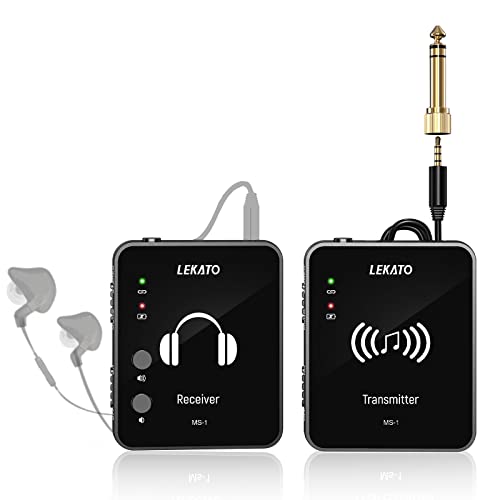
Best Compact Stereo Option – LEKATO MS-1 2.4GHz IEM
The LEKATO MS-1 is a compact option for shoppers seeking wireless in ear monitor systems for rehearsals, studios, and smaller gigs. It supports stereo or mono transmission, automatic pairing, and one-transmitter-to-many-receiver operation without requiring channel selection.
Best For: Band rehearsals, small and medium gigs, and users who want rechargeable stereo monitoring.
Pros:
- Supports true stereo transmission with a one-key stereo/mono switch.
- One transmitter can work with multiple receivers, supporting up to six sets simultaneously.
- Offers under 12 ms latency, 24-bit/48 kHz audio, and more than five hours of battery life.
- Automatic pairing simplifies setup.
Cons:
- Its stated wireless range is 100 feet in open areas, shorter than the UHF systems listed here.
- Stereo operation requires a stereo audio source and stereo cable.
- Rechargeable battery life is limited to over five hours per charge.
Choose the MS-1 when portability and stereo flexibility matter more than maximum range. It is especially convenient for rehearsal rooms and small stages where quick pairing and rechargeable operation are useful.
Best for Larger Bands – 8-Bodypack UHF Mono IEM System
For larger groups comparing wireless in ear monitor systems, this two-channel UHF package supplies eight bodypack receivers and eight earphones. PLL technology, selectable frequencies, IR syncing, and a rack-mount-style metal transmitter support a more organized stage or studio installation.
Best For: Larger bands, stage productions, churches, and sound teams needing up to eight mono bodypacks.
Pros:
- Includes eight bodypack receivers and eight in-ear earphones.
- Provides two channels, 2×40 preset UHF frequencies, and a 520–580 MHz frequency range.
- Offers up to 330 feet of open-space coverage with zero-latency mono monitoring.
- Metal transmitter, LCD display, IR sync, limiter circuitry, and receiver status indicators support professional use.
Cons:
- Mono monitoring lacks stereo imaging.
- Obstacles such as thick walls, glass, and metal can affect range.
- The system is not water resistant.
This is the strongest fit of the three for a larger ensemble because it supplies eight complete receiver-and-earphone sets. Its two-channel design and rack-oriented transmitter are useful when several performers need dependable shared monitoring.
Best Value 2.4GHz System – M6S Stereo Wireless IEM
The M6S is a practical choice among wireless in ear monitor systems for church services, stage work, and rehearsals. Its 2.4GHz connection, 24-bit/48KHz processing, automatic pairing, and selectable mono/stereo input keep setup straightforward while delivering clear audio with bass response.
Best For: Church teams, bands, and performers who want a ready-to-use system with included in-ear headphones.
Pros:
- 24-bit/48KHz audio processing with low noise and low delay.
- Automatic transmitter-to-receiver pairing simplifies setup.
- Up to 10 hours of battery life and support for up to six receivers per transmitter.
- Includes in-ear headphones, cable, and 6.35mm adapter.
Cons:
- Uses the 2.4GHz band rather than offering adjustable UHF channels.
- The included earphones may not suit every performer’s preferred fit or sound.
With its long claimed runtime, multi-receiver support, and complete starter bundle, the M6S is a well-rounded option for small to medium performance setups.
Best Channel Flexibility – BE-3W UHF Wireless IEM
The BE-3W stands out among wireless in ear monitor systems for users who need more control over frequency selection. Its UHF design includes 16 adjustable channels for managing interference, while the metal transmitter and bodypack receiver provide a portable setup for studios, bands, DJs, and live performances.
Best For: Performers and audio users who need selectable channels and included noise-isolating earphones.
Pros:
- 16 adjustable channels help avoid interference from other devices.
- UHF circuitry and an intelligent noise-reduction chip support stable, high-fidelity monitoring.
- Includes six ear-tip sets and passive noise isolation rated up to 33dB.
- Rechargeable 1000mAh battery charges in about two hours.
Cons:
- Claimed operating time is about five hours per charge.
- Includes an XLR-to-6.35mm adapter, but connection requirements should be checked for your specific mixer or interface.
The BE-3W is a strong fit when channel selection matters more than maximum battery endurance, particularly for environments with several wireless devices in use.
Best Low-Latency Multi-Receiver System – LEKATO MS-02 Wireless IEM
The LEKATO MS-02 is a flexible pick among wireless in ear monitor systems for rehearsals, recording, and small or medium stages. It offers mono latency below 4.5ms, 24-bit/48KHz audio, one-transmitter-to-four-receiver support, and a claimed 100-foot open-area range. Note that earbuds are not included.
Best For: Bands, singers, and educators who need multiple receivers and fast, low-latency monitoring.
Pros:
- Mono transmission latency is specified at under 4.5ms.
- One transmitter can send to up to four receivers.
- Offers mono/stereo switching, one-key mute, and five-level receiver volume control.
- Provides a claimed 6–8 hours of operation and a 100-foot open-area range.
Cons:
- Earbuds must be purchased separately.
- Its 2.4GHz system has no adjustable channel count listed in the supplied specifications.
- Pairing multiple receivers requires repeating the button-based pairing process.
The MS-02 is especially appealing for coordinated monitoring across several performers, provided you already have compatible earbuds or plan to buy them separately.
How We Picked the Best Wireless in Ear Monitor Systems
We selected systems suited to real rehearsal, worship, studio, and live-performance needs. The lineup includes single-user kits, multi-channel UHF systems, stereo wireless options, and packages designed to serve several performers from one transmitter. We focused on practical specifications such as transmission band, channel flexibility, receiver count, operating range, battery design, connection format, and portability.
Because wireless performance depends on venue layout and local interference, no single system is ideal for every stage. The best choice balances the number of users and monitor mixes you need with the simplicity, range, and budget appropriate for your setup.
Quick Comparison
| System type | Best suited to | Main advantage | Watch for |
|---|---|---|---|
| Compact 2.4 GHz | Solo performers and small groups | Simple pairing and portability | Potential congestion in busy wireless environments |
| UHF mono | Live bands and larger stages | Channel flexibility and range | More setup and frequency planning |
| Stereo IEM | Performers needing detailed mixes | Better separation and spatial control | Higher cost and more complex routing |
| Multi-bodypack packages | Bands, choirs, and production teams | Several users from one system | Shared mix limitations on mono systems |
Key Buying Factors for Wireless In-Ear Monitor Systems
Mono Versus Stereo
Mono systems are usually easier to configure and work well when several performers share one monitor mix. Stereo systems can provide left-right placement and more precise control, but your mixer must support the required outputs and each performer may need an individual mix.
Frequency Band and Interference
UHF systems often offer adjustable channels for managing interference and coordinating multiple systems. The 2.4 GHz band is convenient and license-free in many regions, but it can be busier around Wi-Fi routers and other consumer wireless devices. Check local regulations and venue requirements before purchasing.
Capacity, Range, and Latency
Count the bodypack receivers you need now, then allow room for expansion. Confirm that the stated range fits your stage and that latency is low enough for vocals and rhythm-sensitive playing. Line-of-sight conditions, walls, and competing signals can reduce advertised range.
Battery and Connectivity
Look for rechargeable packs, clear battery indicators, and enough runtime for a full performance plus soundcheck. Verify input and output connectors, transmitter mounting options, earphone compatibility, and whether the package includes the cables and adapters your mixer requires.
Who Should Buy Which Wireless in Ear Monitor Systems?
Solo performers and small acoustic acts should prioritize compact systems with automatic pairing, low setup time, and a lightweight receiver. Bands and worship teams may benefit from UHF channel selection or multi-bodypack packages, especially when several performers need monitoring at once. Performers who rely on detailed instrument placement should consider stereo systems, provided their mixer can supply suitable stereo mixes. Touring and production users should favor durable metal hardware, dependable frequency coordination, replaceable or long-lasting batteries, and enough range for the venues they regularly play.
Before ordering, confirm the number of transmitters and receivers included, the available frequencies, connector types, and whether the product is intended for mono or stereo operation. Those details matter more than headline range claims when building a reliable monitoring setup.