Choosing the right wireless in-ear monitor system can improve stage clarity, reduce cable clutter, and help performers hear a consistent mix. The best setup depends on more than advertised range: frequency stability, latency, stereo operation, bodypack design, and the number of receivers all matter.
This roundup compares 10 stereo wireless in-ear monitor systems suited to different budgets and performance needs, from compact 2.4GHz and 5.8GHz kits to UHF systems with selectable frequencies, rack-mountable transmitters, and multi-bodypack configurations.
Best 10 Stereo Wireless in Ear Monitor Systems Picks for 2026
Best Overall

- True stereo sound with four monitoring modes
- Sub-5ms latency for tightly timed performances
- 5.8GHz connection with smart channel scanning
Best For: Performers wanting flexible, low-latency stereo monitoring
Best for Audio Detail

- 24-bit/48kHz stereo audio with selectable stability
- Five EQ presets help reduce the occlusion effect
- USB recording, color display, and charging case
Best For: Performers and creators seeking adjustable, high-resolution monitoring
Best Multi-Performer Kit

- Includes four receivers for group monitoring
- Up to 230-foot UHF range with 200 channels
- Bluetooth 5.3 supports tracks and click playback
Best For: Bands and teams equipping multiple performers at once
Best Battery Life

- Up to 12 hours of stated battery life
- Automatic pairing for quick setup
- Clip-on receiver with built-in volume buttons
Best For: Mobile performers needing long runtime and simple controls
Most Flexible Mix Control
Dual-Transmitter Stereo IEM System

- Mix and True Stereo modes for adaptable monitoring
- Common-plus-private mixes for multiple performers
- 5ms latency and up to 500ft open-field range
Best For: Live performers and audio teams needing customized stereo or shared cue mixes
Best Professional Feature Set

- Stereo/mono modes with EQ, limiter, and balance controls
- 89 tunable frequencies support up to five systems
- Metal transmitter with rack-mount kit and carrying case
Best For: Stage, studio, worship, lecture, and exhibit setups
Best Simple Rechargeable Setup

- Automatic transmitter-receiver pairing
- Up to 10 hours of rechargeable battery life
- Supports up to six receivers per transmitter
Best For: Small stages, churches, rehearsals, and easy-to-deploy monitoring
Long-Range UHF Pick

- 530–580MHz UHF with 100 selectable frequencies
- Includes two bodypack receivers and earphones
- Expandable receiver setup with stereo monitoring
Best For: Stage, studio, speech, and presentation setups needing two bodypacks
Low-Latency 2.4GHz Pick

- Less than 5ms latency with stereo/mono switching
- Automatic pairing and up to 164-foot range
- Rechargeable battery rated for 10–12 hours
Best For: Solo performers and bands wanting simple, long-running monitoring
Expandable Band Pick
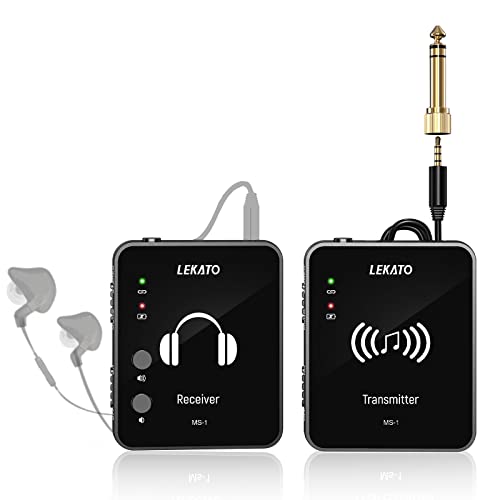
- One transmitter supports multiple receivers
- Stereo/mono switching with less than 12ms latency
- 100-foot open-area range and 5+ hour battery
Best For: Bands, churches, rehearsals, and small gigs needing shared monitoring
Best Overall – Xvive U45D Stereo IEM System
The Xvive U45D is a strong choice among stereo wireless in ear monitor systems for performers who want a wide stereo image, quick setup, and very low latency. Its 5.8GHz connection, automatic channel scanning, and four monitoring modes make it adaptable for live stages, rehearsals, and worship settings.
Best For: Musicians, singers, and worship teams needing flexible stereo monitoring with near-wired timing.
Pros:
- True stereo monitoring provides clear separation and an immersive soundstage.
- Sub-5ms latency helps keep vocals and instruments tightly synchronized.
- Smart channel scanning and 5.8GHz transmission support stable operation.
- Stereo, Left, Right, and Mix modes accommodate different monitoring workflows.
Cons:
- The package includes one transmitter and one receiver, so additional performers require more equipment.
- No noise-control feature is listed.
The U45D balances professional-focused features with straightforward operation. It is especially appealing when low latency and flexible feed control matter more than extended battery or multi-user capability.
Best for Audio Detail – NUX B-7 Pro Stereo IEM
The NUX B-7 Pro stands out among stereo wireless in ear monitor systems with 24-bit/48kHz audio, selectable stability levels, and five earphone EQ presets. Its display, USB recording function, and charging case add useful versatility for performers and creators.
Best For: Musicians and content creators who want adjustable monitoring, high-resolution audio, and recording support.
Pros:
- 24-bit/48kHz stereo audio and a 20Hz–20kHz frequency response support detailed monitoring.
- Five EQ presets help address the boomy or muffled sound associated with the occlusion effect.
- Three stability settings let users prioritize latency or resistance to interference.
- USB audio recording captures the monitor feed for review or sharing.
Cons:
- Maximum operating range is listed at up to 165 feet, shorter than some UHF alternatives.
- Battery life is rated at up to six hours.
- The system is not water resistant.
The B-7 Pro is a feature-rich option for users who value sound customization and visibility. Its EQ presets and recording function make it more useful beyond the stage, though the shorter battery rating may require planned recharging.
Best Multi-Performer Kit – XTUGA SEM200 Wireless IEM
The XTUGA SEM200 is designed for groups that need multiple bodypacks from one stereo wireless in ear monitor system. It includes four receivers, offers 200 tunable UHF channels, and supports stereo or mono monitoring, making it practical for bands, churches, and larger stage setups.
Best For: Bands, worship teams, and production groups that need four performers equipped in one package.
Pros:
- Four receivers are included for whole-band or team monitoring.
- UHF transmission offers a stated range of up to 230 feet.
- Two hundred tunable channels help support multi-system setups.
- Bluetooth 5.3 streaming supports backing tracks, click tracks, and intermission music from a phone.
Cons:
- The bundled multi-receiver design may be excessive for solo performers.
- The notes do not specify battery runtime.
- Bluetooth streaming and wireless monitoring may require careful setup in complex environments.
The SEM200’s main advantage is scale: it provides four bodypacks and long-range UHF operation in one kit. Choose it when several performers need the same source, rather than when you only need a compact one-receiver system.
Best Battery Life – AOKEO AK-680 Stereo IEM
The AOKEO AK-680 is a practical pick among stereo wireless in ear monitor systems for rehearsals and extended performances. It combines 5.8G wireless transmission, automatic pairing, receiver volume controls, and up to 12 hours of stated battery life in a lightweight clip-on design.
Best For: Singers, instrumentalists, and home creators who prioritize long runtime and simple operation.
Pros:
- Up to 12 hours of continuous playtime supports long rehearsals and back-to-back gigs.
- Automatic pairing enables quick plug-and-play setup.
- Receiver volume buttons allow convenient level adjustments while performing.
- Included cables and adapters support mixers, interfaces, laptops, and other audio gear.
Cons:
- The supplied details do not specify an operating range.
- Although the product title identifies 5.8G stereo monitoring, the technical details list UHF wireless technology.
- No noise-control feature is listed.
The AK-680 focuses on convenience rather than extensive configuration. Its long battery rating and belt-clip receiver make it a sensible option for mobile performers who want minimal setup and on-body volume control.
Most Flexible Mix Control – Dual-Transmitter Stereo IEM System
This stereo wireless in ear monitor system is designed for performers and audio teams who need more than a basic shared monitor mix. Its dual transmitters support independent left and right channels, while Mix Mode and True Stereo Mode let users tailor how those channels are heard.
Best For: Live performers, rehearsals, sound engineers, and setups requiring shared cues plus private monitor mixes.
Pros:
- Mix Mode blends Channels A and B with adjustable balance control.
- True Stereo Mode supports independent left and right monitoring, including one-sided muting.
- Auto-scan and one-key sync help locate and lock onto a clean frequency.
- Includes two rechargeable batteries, a charging dock, hard case, adapters, and charging cable.
Cons:
- The more advanced dual-transmitter setup may be more involved than necessary for simple mono monitoring.
- Rated 500-foot range is specified for open-field conditions.
With 5ms latency, up to 500 feet of open-field range, and flexible common-plus-private routing, this system is particularly capable for technically demanding live monitoring. Its interchangeable battery setup is also useful for extended sessions.
Best Professional Feature Set – Phenyx Pro PTM-10 Stereo IEM
The Phenyx Pro PTM-10 is a practical stereo wireless in ear monitor system for stage, studio, lecture, and exhibit use. Its selectable 900MHz frequencies, stereo/mono switching, and rack-ready metal transmitter provide useful flexibility for organized professional setups.
Best For: Performers, worship teams, speakers, studios, and venues that need adjustable monitoring and rack-mountable hardware.
Pros:
- Offers stereo and mono modes, plus EQ, balance, limiter, PAD, and lock functions.
- Provides 89 tunable frequencies and supports up to five systems simultaneously.
- Includes XLR and 6.3mm inputs, LCD status display, carrying case, earbuds, and rack-mount kit.
- 900MHz operation is specified with coverage up to 160 feet/50 meters.
Cons:
- The stated operating range is shorter than some larger-stage wireless systems.
- The included system uses AA batteries for the bodypack receiver.
This is a well-rounded choice when installation features and signal-management controls matter as much as stereo sound. The tunable frequency selection and professional connectivity make it especially suitable for multi-system environments.
Best Simple Rechargeable Setup – M6S 2.4GHz Wireless IEM
The M6S offers a straightforward stereo wireless in ear monitor system for church services, stage performances, and band practice. Its transmitter and receiver pair automatically, and the rechargeable design avoids the need for disposable batteries during regular use.
Best For: Small performance teams, churches, rehearsals, and users who prioritize easy setup and rechargeable operation.
Pros:
- Automatic pairing eliminates manual channel setup after powering on.
- One-button mono/stereo switching supports different monitoring situations.
- Built-in rechargeable batteries provide up to 10 hours after a full charge.
- One transmitter can pair with multiple receivers, with up to six units supported simultaneously.
Cons:
- Its 2.4GHz wireless design may be less suitable for users specifically seeking UHF operation.
- The package includes one transmitter, one receiver, and one pair of in-ear headphones rather than a larger multi-receiver kit.
- The supplied notes list battery life as up to 10 hours, with an approximately three-hour charge time.
For users who want a compact system with minimal configuration, the M6S is easy to understand and quick to deploy. Its 24-bit/48kHz processor, automatic pairing, and multi-receiver support make it a convenient option for smaller wireless monitoring setups.
Long-Range UHF Pick – Debra PRO ST-102
For buyers comparing stereo wireless in ear monitor systems for stage, studio, speech, or instruction, the Debra PRO ST-102 stands out for its UHF design and included dual bodypack receivers. Its 530–580MHz PLL system offers 100 selectable frequencies, with a stated range of up to 80 meters and farther reach in open environments.
Best For: Performers, presenters, and small-to-large venue setups needing two included listeners and flexible UHF frequency selection.
Pros:
- Includes one transmitter and two bodypack receivers with earphones.
- Offers 100 selectable frequencies in the 530–580MHz UHF band.
- Provides stereo separation, sound isolation, and a stated range of up to 80 meters.
- Can connect with additional bodypack receivers, according to the supplied details.
Cons:
- The system weighs 1.72 kg, making it less travel-light than the compact 2.4GHz options.
- Its supplied headset and receiver setup may be more equipment than a solo user needs.
- The notes list both wireless and infrared/Bluetooth specifications, so buyers should confirm the exact connectivity details before ordering.
The ST-102 is a feature-rich choice when two performers or listeners need monitoring from one transmitter. Its UHF frequency flexibility and expandable receiver design are especially useful for organized stage or presentation environments.
Low-Latency 2.4GHz Pick – JCANOL M6S
The JCANOL M6S is a straightforward option among stereo wireless in ear monitor systems, pairing a transmitter and receiver automatically over 2.4GHz. It supports stereo or mono input, offers less than 5ms latency, and provides up to 164 feet of receiving distance for rehearsals, studio work, and live performance.
Best For: Solo performers or bands wanting plug-and-play monitoring, quick automatic pairing, and extended battery life.
Pros:
- Automatic pairing gets the transmitter and receiver ready with minimal setup.
- Supports up to 10 simultaneous channels without cross-interference, according to the supplied notes.
- Provides less than 5ms latency, 24-bit/48kHz audio, and a 20Hz–20kHz frequency response.
- Rechargeable battery provides a stated 10–12 hours of use per charge.
Cons:
- The package includes only one transmitter and one receiver, so additional users require more sets.
- The system is not water resistant.
- It requires compatible 3.5mm or 6.35mm audio connections.
With automatic pairing, low latency, and a long stated battery runtime, the M6S is a practical choice for musicians who want an uncomplicated wireless monitoring setup. Its stereo/mono switch also adds flexibility for different signal sources.
Expandable Band Pick – LEKATO MS-1
The LEKATO MS-1 is designed for band rehearsal, church, studio, and small-gig use. As one of the more expandable stereo wireless in ear monitor systems in this group, it supports multiple receivers from one transmitter, automatic pairing, stereo transmission, and a stated 100-foot open-area range.
Best For: Small or medium-sized bands and groups that need several performers to monitor one transmitter.
Pros:
- One transmitter can pair with multiple receivers, with up to six sets supported simultaneously according to the notes.
- Supports true stereo transmission and one-key stereo/mono switching.
- Offers 2.4GHz wireless operation, less than 12ms latency, and 24-bit/48kHz audio.
- Automatic pairing simplifies setup for rehearsals and small performances.
Cons:
- Battery life is rated at more than five hours, shorter than the M6S’s stated runtime.
- The stated wireless range is 100 feet in an open area, so larger venues may require a longer-range system.
- Stereo operation requires a stereo audio source and stereo cable.
The MS-1 makes the most sense when several performers need the same monitor feed without separate transmitters. Its expandable design and stereo support are useful for rehearsals and smaller live setups, provided the five-hour-plus battery rating fits the performance schedule.
How We Picked the Best Stereo Wireless in Ear Monitor Systems
We focused on the features that most affect real-world monitoring: stereo transmission, operating band, latency, signal range, pairing procedure, receiver quantity, and setup flexibility. We also considered whether each system is better suited to solo performers, bands, worship teams, rehearsal rooms, or installed live-sound rigs.
Published specifications are useful starting points, but actual performance depends on venue layout, radio congestion, antenna placement, walls, and competing wireless equipment. Treat stated range as an ideal maximum rather than a guarantee.
Quick Comparison
- Lowest-latency focus: Look for systems advertising sub-5ms performance, especially for singers and musicians who need tight timing.
- Simple setup: Automatic pairing and channel scanning reduce configuration time for rehearsals and smaller events.
- Multiple performers: Multi-bodypack kits or one-to-many designs are more practical for bands and teams sharing a monitor mix.
- Professional installation: UHF systems with selectable frequencies, rack mounting, and stronger antenna options can offer greater deployment flexibility.
- Portable use: Clip-on receivers and compact 2.4GHz or 5.8GHz systems are convenient for mobile performers and practice spaces.
Key Buying Factors for Stereo Wireless In-Ear Monitor Systems
Frequency and Interference
2.4GHz systems are widely available and typically easy to use, but they share spectrum with Wi-Fi and Bluetooth. 5.8GHz systems may encounter less congestion in some environments, although walls and distance can affect higher-frequency signals. UHF models can provide selectable channels and useful flexibility, but local frequency rules and coordination requirements matter.
Latency and Audio Quality
Low latency helps vocals and instruments feel synchronized with the live performance. Stereo transmission is important when the monitor mix uses left-right placement, while bit depth and sample rate provide a useful indication of digital audio quality. Confirm that the transmitter and receiver support the same stereo mode and connectors you plan to use.
Range, Battery Life, and Comfort
Check practical operating distance, battery runtime, charging method, and bodypack weight. A receiver that is technically powerful but uncomfortable or difficult to recharge may be a poor choice for long sets. Also verify whether the kit includes earbuds, headsets, antennas, cables, or only the wireless hardware.
Expandability and Controls
Consider how many performers need a feed now and later. One-to-many systems, extra bodypack support, independent volume controls, channel scanning, and multiple monitoring modes can make a setup easier to grow.
Who Should Buy Which Stereo Wireless in Ear Monitor Systems?
Solo performers and small venues should prioritize quick pairing, low latency, compact receivers, and straightforward controls. A 2.4GHz or 5.8GHz kit may be the simplest fit.
Bands and worship teams should look for multiple bodypacks, dependable channel management, and enough range for the stage layout. One-to-many systems can reduce the cost and complexity of distributing a shared mix.
Professional live-sound users may prefer selectable-frequency UHF systems with rack-mounting options, stronger coordination tools, and more installation flexibility.
Studios and rehearsal spaces should focus on clean stereo audio, automatic setup, comfortable receivers, and reliable performance around existing wireless equipment. Before buying, confirm connector compatibility, local frequency requirements, and whether additional transmitters or receivers are available.