The right looper pedal can turn a solo guitar or vocal performance into a layered arrangement, but live use demands more than simply recording and playing back a phrase. Timing controls, footswitch placement, storage, connectivity, and reliability all matter when you are performing in real time.
We selected 10 looper pedals for live performances across beginner-friendly, compact, stereo, drum-equipped, and multi-track designs. Use the comparison and buying advice below to match your setup, workflow, and stage requirements with the right feature set.
Best 10 Looper Pedals for Live Performances Picks for 2026
Best Beginner Pick

- Simple record, overdub, playback, and undo/redo controls
- 12 minutes of stereo recording time
- Clear 24-segment loop status indicator
Best For: Guitar, bass, and keyboard players wanting straightforward live looping
Best Minimalist Choice

- Five minutes of looping with unlimited overdubs
- True bypass and analog-dry-through
- Compact, guitar-focused design
Best For: Guitarists seeking simple, transparent live looping
Best With Rhythms

- 110 drum grooves and 10 metronome settings
- 40 slots with 160 minutes of total capacity
- USB import/export, tap tempo, and fade-out
Best For: Solo performers wanting rhythms and extensive loop storage
Best Advanced Performance Model

- Dual-track looping with four performance modes
- Stores 128 loops and over three hours of audio
- Color display, USB interface, and microphone input
Best For: Gigging multi-instrumentalists, vocalists, and street performers
Most Versatile

- 77 slots and approximately 300 minutes of stereo recording
- Auto Record and adjustable Fade Out for smoother transitions
- Stereo I/O with external footswitch support
Best For: Performers needing extensive storage and flexible live control
Best for Simplicity

- Dedicated footswitch control for hands-free operation
- Compact modern pedal design
- Runs on 9V power
Best For: Players wanting a focused, uncomplicated looping setup
Best Visual Feedback
Donner Triple Looper with Screen

- Three loops with 90 minutes of total recording time
- Bright display shows status, progress, and timing
- Unlimited overdubs with auto save and true bypass
Best For: Solo performers who want clear feedback and simple controls
Feature-Rich Live Looping

- 100 slots and 300 minutes of storage
- 220 drum patterns with DrumMatch
- Auto-record, count-in, and split drum output
Best For: Solo performers needing looping and drum accompaniment
Flexible Multi-Looping
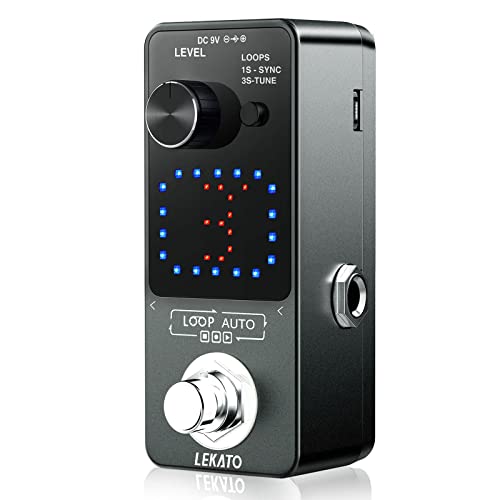
- Three loops with 18 minutes total recording
- Synchronous recording and unlimited overdubs
- Built-in tuner and USB WAV transfer
Best For: Guitarists and bassists using multiple live loop phrases
Simple Compact Looping

- Five minutes of looping with unlimited overdubs
- Compact aluminum-alloy construction
- 24-bit audio and USB WAV transfer
Best For: Minimalist performers and beginners needing basic live looping
Best Beginner Pick – BOSS RC-1 Loop Station
For musicians seeking user-friendly looper pedals for live performances, the BOSS RC-1 keeps the workflow straightforward. Its dedicated stompbox controls support recording, playback, overdubbing, and undo/redo, while the loop indicator shows the current mode at a glance.
Best For: Guitar, bass, and keyboard players who want a simple, dependable looping setup.
Pros:
- Intuitive 24-segment loop indicator displays Rec, Overdub, and Play modes.
- Provides up to 12 minutes of stereo recording time.
- Retains recorded phrases even after the pedal is powered off.
- Offers stereo inputs and outputs plus battery or optional PSA-series adapter power.
Cons:
- The included 9V battery lasts approximately 4.5 hours.
- The AC adapter is sold separately.
The RC-1 is a practical choice when reliability and ease of operation matter more than advanced storage or rhythm features. Its uncomplicated controls make it easy to incorporate into a live pedalboard.
Best Minimalist Choice – TC Electronic Ditto Looper
The TC Electronic Ditto is a compact option for musicians comparing looper pedals for live performances. Designed for guitarists, it focuses on the essentials: five minutes of looping, unlimited overdubs, undo/redo, true bypass, and analog-dry-through.
Best For: Guitarists who prefer a small, transparent-sounding looper with a focused control set.
Pros:
- Offers five minutes of loop time with unlimited overdubs.
- Includes undo and redo functionality.
- True bypass and analog-dry-through help preserve the dry signal path.
- Compact design is convenient for space-conscious pedalboards.
Cons:
- A 9V power supply providing at least 100 mA is required and not included.
- Its feature set is primarily focused on guitar-oriented looping.
Ditto is a strong fit for players who want an uncomplicated live looper without extra rhythm or storage functions. Its transparent signal approach makes it especially suitable for a direct guitar setup.
Best With Rhythms – Donner Circle Looper
The Donner Circle combines looping and drum-machine functions for performers who want more rhythmic support from their looper pedals for live performances. It provides stereo recording, a display with timing information, tap tempo, fade-out, and substantial onboard storage.
Best For: Solo performers who want drum grooves, metronome options, and multiple saved loops in one pedal.
Pros:
- Includes 110 drum grooves across 11 music styles and 10 metronome settings.
- Stores up to 40 loops, with four minutes per slot and 160 minutes total capacity.
- Bright screen shows loop mode, progress, and timing.
- Supports USB import/export and automatically saves recorded files when powered off.
Cons:
- The required 9V center-negative, 500 mA power adapter is not included.
- An external footswitch is supported but not included.
With its integrated rhythms and large memory capacity, the Circle is more performance-oriented than a basic looper. It is particularly useful for solo acts building layered arrangements with a consistent pulse.
Best Advanced Performance Model – Sheeran Looper +
The Sheeran Looper + is built for performers who need advanced control from looper pedals for live performances. Its dual-track design, full-color display, four looping modes, microphone input, and USB audio interface support complex sets involving instruments and vocals.
Best For: Gigging musicians, street performers, and multi-instrumentalists who need dual-track looping and onboard storage.
Pros:
- Provides single and dual-track modes, including single, multi, sync, and song workflows.
- Stores up to 128 loops with more than three hours of total audio.
- Includes a full-color display, RGB loop status ring, and two rugged pedals.
- Works as a 2-in/2-out USB audio interface and runs for over six hours on four AA batteries under typical use.
Cons:
- Its larger 6.24-by-8.52-inch footprint and 1.7 kg weight may require extra pedalboard space.
- The unit uses a more complex feature set than a basic single-track looper.
- A one-year manufacturer warranty is listed.
The Looper + is the most capable option here for structured live arrangements, vocals, and multi-instrument setups. Its storage, connectivity, and battery operation make it well suited to demanding stage or street-performance workflows.
Most Versatile – MOOER Looper X2 Stereo Looper
For players seeking looper pedals for live performances, the MOOER Looper X2 combines stereo recording, extensive storage, and hands-free control options in a compact pedal. Its 77 save slots and approximately 300 minutes of recording time make it well suited to organized sets and longer arrangements.
Best For: Performers who need substantial loop storage, stereo operation, and advanced live-looping controls.
Pros:
- 77 save slots across 11 banks, with approximately 300 minutes of stereo recording time.
- Auto Record and adjustable Fade Out functions support smoother live transitions.
- 44.1kHz/24-bit recording, stereo I/O, and support for importing and exporting audio files.
- External footswitch support expands track-cycling and performance control.
Cons:
- Its broader feature set may require more setup and learning than a basic looper.
- It requires a 9V center-negative adapter rated at 300mA.
The Looper X2 is a strong choice when flexibility and capacity matter more than minimal controls. Separate recording and playback volume controls, true bypass, and stereo connectivity give it useful stage-ready versatility.
Best for Simplicity – TC Electronic DITTO 2 LOOPER
The TC Electronic DITTO 2 LOOPER is a straightforward option for guitarists comparing looper pedals for live performances. Its dedicated footswitch control and compact modern design make it a practical fit for players who want a focused looping setup without a long list of controls.
Best For: Guitarists who prioritize a simple, foot-operated looper for live use.
Pros:
- Dedicated footswitch control is suited to hands-free operation.
- Compact dimensions help it fit neatly on a pedalboard.
- Uses a standard 9V power requirement.
Cons:
- The supplied notes do not specify recording time, loop storage, or overdub capabilities.
- The listed hardware interface is 3.5mm audio rather than the 1/4-inch interface commonly used by many guitar pedals.
The DITTO 2 is best considered when uncomplicated operation and pedalboard space are your main priorities. Buyers who need detailed loop capacity or connectivity specifications should verify those features before purchasing.
Best Visual Feedback – Donner Triple Looper with Screen
The Donner Triple Looper is a practical pick among looper pedals for live performances, especially when visible loop status matters. Its bright screen shows recording progress and timing, while three independent loop slots provide room for separate song sections or layered arrangements.
Best For: Solo performers, buskers, and beginners who want clear visual feedback and straightforward looping control.
Pros:
- Three loop slots provide up to 90 minutes of total recording time, with up to 30 minutes per loop.
- Bright screen displays loop status, progress, and timing during performance.
- Unlimited overdubs support layered guitar or bass arrangements.
- Auto Save preserves loops after powering off, and true bypass helps maintain tone when disengaged.
Cons:
- The power supply requirement is 9V DC, center negative, 500mA; the supplied notes indicate that a power supply is not included.
- Its three-slot design offers less storage organization than the MOOER Looper X2.
With a screen, simple one-footswitch operation, and unlimited overdubs, the Donner emphasizes accessibility during live playing. It is a particularly approachable choice for building verse, chorus, and solo parts without complex navigation.
Feature-Rich Live Looping – MOOER GL100 Drum Looper
For performers seeking looper pedals for live performances with rhythm support, the MOOER GL100 combines looping and drum-machine features in one compact unit. Its extensive storage, auto-recording, count-in, and quantized alignment can help make hands-off live transitions more consistent.
Best For: Solo performers who want loop creation, drum accompaniment, and organized song storage in one pedal.
Pros:
- Stores up to 100 slots with 300 minutes of total memory.
- Includes 220 drum patterns and DrumMatch for automatic groove and BPM matching.
- Auto Rec, count-in, and end synchronization help reduce timing gaps.
- Stereo/mixed inputs, split drum output, time stretching, and USB-C editing add flexibility.
Cons:
- Its many functions and touchscreen controls may require more setup than a basic looper.
- A 9V, 300mA power source is required.
The GL100 is the most versatile option here for live artists who want backing rhythms and substantial preset storage. It is especially compelling when separate drum and loop amplification or computer-based file management matters.
Flexible Multi-Looping – LEKATO SYNC Looper Pedal
The LEKATO SYNC Looper is a practical choice among looper pedals for live performances when you want multiple saved loops, continuous overdubbing, and a built-in tuner. Synchronous recording lets you enter recording during playback, while the visual loop indicator helps track phrase progress.
Best For: Guitarists and bassists who need several loop locations and hands-free overdubbing during performances.
Pros:
- Provides three loops with up to six minutes per loop and 18 minutes total recording time.
- Supports unlimited overdubs with foot commands for undo, redo, stop, and erase.
- 48kHz/24-bit recording and Analog-Dry-Through are designed to preserve tone quality.
- USB import/export, automatic file saving, and a built-in tuner support preparation and practice.
Cons:
- The 9V central-negative power supply is required and is not included.
- It offers less total storage than the MOOER GL100.
With three loop memories and synchronized recording, this LEKATO model balances live control with useful file management. It suits players who want more flexibility than a single-loop pedal without adding a drum machine.
Simple Compact Looping – LEKATO ONE Looper Pedal
For players who prefer straightforward looper pedals for live performances, the LEKATO ONE focuses on essential controls in a small aluminum-alloy enclosure. It offers five minutes of looping, unlimited overdubbing, and USB transfer without adding extra effects or complex menus.
Best For: Beginners and minimalist performers who want a compact pedal for basic live overdubbing.
Pros:
- Provides five minutes of looping with unlimited overdubbing.
- Simple single-knob operation controls loop playback volume.
- 24-bit uncompressed audio and Analog-Dry-Through support a clean dry signal.
- USB enables WAV upload and download, and the aluminum-alloy body is compact and sturdy.
Cons:
- It has less recording capacity and fewer loop functions than the three-loop LEKATO model.
- The simple design does not include a built-in tuner or drum machine.
The LEKATO ONE is a focused, low-complexity option for performers who mainly need one loop and quick foot control. Its small footprint and essential feature set make it easy to integrate into a basic pedalboard.
How We Picked These Looper Pedals for Live Performances
We focused on features that affect real-world stage use: recording and overdub control, loop capacity, footswitch operation, visual feedback, bypass behavior, stereo connectivity, storage, and added rhythm or effects functions. The selection includes straightforward loopers for first-time users as well as models designed for layered arrangements and more flexible live workflows.
Because product specifications vary, confirm the current manual and power requirements before buying. A pedal that looks feature-rich may still be less suitable for a fast-paced set if its controls are difficult to operate with your feet.
Quick Comparison
| Best For | Look For | Featured Options |
|---|---|---|
| Simple live looping | One-button control and clear status indicators | BOSS RC-1, TC Electronic DITTO LOOPER |
| Layered arrangements | Multiple tracks, undo/redo, and generous memory | Sheeran Looper +, Donner Triple Looper, MOOER X2 |
| Drum-backed performances | Built-in rhythms, tap tempo, and sync controls | Donner Circle, MOOER GL100 |
| Compact pedalboards | Small footprint and uncomplicated operation | TC Electronic DITTO 2, LEKATO ONE |
Key Buying Factors for Looper Pedals for Live Performances
Control and Timing
Look for dependable start, stop, overdub, undo, and redo commands. A dedicated stop control or clearly separated footswitches can prevent mistakes during a song. Quantization, automatic timing assistance, or sync functions may also help, but simple manual control is often faster once you are comfortable with it.
Loop Memory and Track Layout
Check total recording time, the number of independent loops or tracks, and whether loops remain available after power-down. Single-track pedals are usually easier to learn, while dual- or triple-track models support verses, choruses, bass lines, and layered transitions more effectively.
Connections and Sound Quality
Analog dry-through and true bypass can help preserve your instrument’s direct signal. Stereo inputs and outputs are useful for stereo effects, keyboards, or a dual-amp rig. Also verify whether the pedal accepts your preferred instrument level and whether external footswitches, MIDI, headphones, or USB are supported.
Rhythms, Effects, and Stage Visibility
Built-in drum patterns can provide a useful backing groove without additional gear, but they add controls to learn. Bright loop indicators, readable screens, and easy-to-find tap-tempo controls are valuable under stage lighting. Always consider power supply compatibility and leave enough space to press switches accurately.
Who Should Buy Which Looper Pedals for Live Performances?
Choose the BOSS RC-1 or a compact DITTO model if you want a dependable, uncomplicated looper for basic accompaniment. Consider the Sheeran Looper +, Donner Triple Looper, or MOOER X2 if your performances rely on several independent layers and hands-free arrangement changes. For solo artists who want rhythm support, the Donner Circle and MOOER GL100 combine looping with drum-machine features. LEKATO models are worth considering when you want affordable looping with features such as tuning, synchronization, or multiple effects.
Before ordering, map the pedal’s controls to your actual set list. If you primarily build one repeating rhythm, prioritize simplicity and reliable timing. If you create complete arrangements onstage, spend more attention on track management, memory, synchronization, and external-control options.