The best digital synthesizers make it easier to explore sound design, performance, sequencing, and music production without committing to a large studio setup. This roundup covers versatile keyboards, compact FM instruments, MIDI controllers with built-in sounds, and unusual portable options.
Whether you want a first synthesizer, a travel-friendly creative tool, or a more capable instrument for serious sound design, compare the controls, connectivity, key feel, and workflow before choosing.
Best 10 Digital Synthesizers Picks for 2026
Hybrid Sound Explorer

- 37-key hybrid digital-and-analog synthesizer
- Six-voice polyphony with USB connectivity
- Includes MiniFreak VST counterpart
Best For: Portable experimental sound design and beginner-friendly synthesis
Accessible Music Maker

- 61 touch-sensitive keys for expressive playing
- Over 1,000 ZEN-Core sounds
- Accompaniment, chord sequencing, and built-in speakers
Best For: Beginners creating songs, performances, and arrangements quickly
Portable FM Pattern Lab

- Six-operator FM engine with 128 presets
- Rechargeable battery and built-in speaker
- 16-step sequencer with USB, Bluetooth, and 3.5mm MIDI
Best For: Portable FM sound design, sequencing, and MIDI control
Beatmaking Travel Companion

- 25-key USB MIDI controller with built-in sounds
- MPC pads, arpeggiator, knobs, and OLED display
- Battery-capable design with built-in speaker
Best For: Portable beatmaking, songwriting, and beginner music production
Quirky Portable Pick

- Touch-sensitive stem with roughly four octaves per setting
- Wah and vibrato controls for expressive play
- 3.5mm output for headphones, speakers, or amps
Best For: Beginners, gifts, and playful portable performance
DAW Production Hub

- 37-key controller with pads, knobs, and performance modes
- Built-in 64-step sequencer for drums and melodic parts
- USB, MIDI, and CV/Gate connectivity
Best For: Computer-based music production and external gear control
Experimental Sound Designer
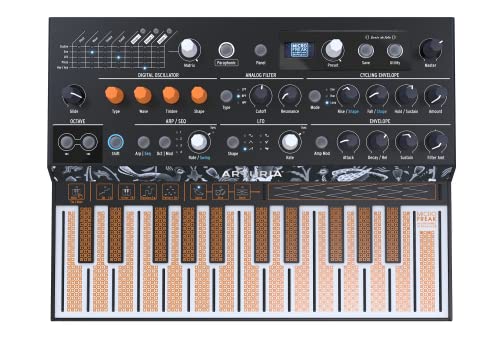
- Hybrid digital oscillator and analog-filter architecture
- Pressure-sensitive 25-key touch keyboard
- CV, USB, and MIDI connectivity for flexible integration
Best For: Advanced electronic sound design and modular experimentation
Best Portable FM Synthesizer

- Six-operator FM engine with 128 presets
- Rechargeable, speaker-equipped portable design
- Sequencer, arpeggiator, effects, and MIDI
Best For: Portable FM sound design and beat-making
Best Pocket Synthesizer

- Pocket-sized design with retro analog-style sound
- Stylus interface spans three octaves
- Built-in speaker and headphone connection
Best For: Beginners, gifts, and portable retro sounds
Best Wind-Style Synthesizer

- Ten built-in wind and instrument tones
- Adjustable blowing sensitivity and fingerstyles
- Rechargeable, portable, and MIDI-compatible
Best For: Wind players and expressive portable practice
Hybrid Sound Explorer – Arturia MiniFreak
Arturia MiniFreak 37 Key Polyphonic 6-Voice Hybrid Synthesizer Keyboard (Standard, 37 Key)
Check Price On AmazonThe Arturia MiniFreak is a compact 37-key choice for exploring digital synthesizers with a hybrid digital-and-analog sound profile. Its six-voice polyphony, USB connectivity, and included MiniFreak VST counterpart make it suitable for hands-on sound design at home or on the move.
Best For: Beginners and producers seeking a portable hybrid synthesizer for experimental patches and expressive keyboard playing.
Pros:
- Hybrid sound profile combines digital and analog character.
- 37 keys provide more playing range than compact 25-key controllers.
- Includes the MiniFreak VST counterpart.
- Portable 2.94 kg design with USB connectivity.
Cons:
- Six-voice polyphony may limit dense layered performances.
- It uses corded electric power rather than a battery.
The MiniFreak stands out for players who want an inviting, exploratory instrument rather than a conventional keyboard. Its portable format and software counterpart add flexibility, while the six-voice architecture is worth considering for more demanding polyphonic arrangements.
Accessible Music Maker – Roland GO:KEYS 3
The Roland GO:KEYS 3 is a 61-note keyboard for newcomers who want digital synthesizers and music creation features in one approachable instrument. Its ZEN-Core engine, built-in speakers, accompaniment styles, and Bluetooth support help turn ideas into complete performances without requiring previous experience.
Best For: Beginners, casual performers, and creators who want guided accompaniment and a broad selection of ready-to-play sounds.
Pros:
- Touch-sensitive 61-note keyboard supports expressive playing.
- Offers over 1,000 Roland sounds through the ZEN-Core engine.
- Includes over 200 accompaniment styles and more than 300 chord-sequencer presets.
- Built-in stereo speakers and Bluetooth audio/MIDI support encourage flexible use.
Cons:
- Its focus on accessible music creation may be less suited to deep, traditional patch programming.
- The larger 61-key format is less compact than a mini synthesizer.
GO:KEYS 3 is a practical entry point for creating full musical parts quickly. The extensive sound library and accompaniment tools are especially useful for learning and performance, while USB audio/MIDI keeps it compatible with computer and mobile workflows.
Portable FM Pattern Lab – M-VAVE FM-1 FM Synthesizer
The M-VAVE FM-1 is a battery-powered portable digital synthesizer built around six-operator FM synthesis. With 128 presets, a 16-step sequencer, arpeggiator, built-in speaker, and simultaneous USB, Bluetooth, and 3.5mm MIDI connectivity, it is designed for immediate sound exploration away from a full studio setup.
Best For: Travelers, electronic musicians, and producers who want compact FM sounds with onboard sequencing and flexible MIDI options.
Pros:
- Six operators, 32 algorithms, and 128 presets cover classic FM-style tones.
- Rechargeable battery and built-in speaker support cable-free playing.
- Includes 27 full-size silicone keys, effects, and a seven-mode arpeggiator.
- Can function as a sound module and MIDI controller.
Cons:
- The 16-step sequencer is focused on short patterns rather than long arrangements.
- FM synthesis may require more programming familiarity than simpler preset-based instruments.
The FM-1 offers an unusually self-contained package for players interested in digital synthesizers and classic FM timbres. Its battery operation, speaker, screen, and multiple MIDI connections make it particularly convenient for sketching ideas at home, in rehearsal, or while traveling.
Beatmaking Travel Companion – Akai MPK Mini Play MK3
The Akai Professional MPK Mini Play MK3 combines a compact 25-key USB MIDI controller with built-in sounds and a speaker. For creators comparing digital synthesizers and portable beatmaking tools, its velocity-sensitive keys, MPC pads, arpeggiator, and battery operation offer a flexible way to sketch music without relying entirely on a computer.
Best For: Beat makers, songwriters, and musicians who need a lightweight controller with internal sounds for portable practice and idea generation.
Pros:
- Built-in speaker and internal drum and instrument sounds support standalone playing.
- Includes eight velocity-sensitive MPC pads, eight knobs, an arpeggiator, and note repeat.
- Compact 0.9 kg design can run on batteries or USB power.
- Includes MPC Beats, AIR instruments, Melodics lessons, and a software bundle.
Cons:
- Its 25-key layout provides less range than a full-size keyboard.
- Batteries are not included.
- It is primarily a controller with built-in sounds rather than a dedicated deep-synthesis workstation.
The MPK Mini Play MK3 is a strong portability-first option for quick beats and musical sketches. Its integrated pads, sounds, speaker, and software make it approachable, though players who need extensive keyboard range or advanced synthesis controls may prefer a larger instrument.
Quirky Portable Pick – Otamatone Deluxe
The Otamatone Deluxe is a playful choice for shoppers exploring digital synthesizers beyond conventional keyboards. Its touch-sensitive stem, expressive face controls, and portable battery-powered design make it approachable for beginners while offering musicians a wider playing range and amplifier connectivity.
Best For: Beginners, gift shoppers, and musicians wanting a distinctive portable instrument.
Pros:
- Touch-sensitive stem covers roughly four octaves at each pitch setting.
- Face squeeze and stem-shake controls add wah and vibrato effects.
- 3.5mm stereo jack supports headphones, speakers, and amplifiers.
- Includes batteries, an aux cable, instructions, and a strap.
Cons:
- Its unconventional shape and sound may not suit traditional keyboard players.
- Uses three AA batteries, which require replacement.
Choose this model when fun, portability, and expressive novelty matter more than traditional keyboard technique. The Deluxe version adds a larger fretboard and broader musician-focused playability.
DAW Production Hub – Akai MPK Mini Plus
The Akai Professional MPK Mini Plus is a practical controller for digital synthesizers, software instruments, and studio gear. Its 37-key layout, pads, knobs, sequencing tools, and USB connection provide a compact setup for composing and controlling a computer-based music workstation.
Best For: Producers who want hands-on DAW control, portable keyboard performance, and hardware connectivity.
Pros:
- 37 keys provide three full octaves for melodic and harmonic parts.
- Includes eight RGB MPC pads, eight assignable knobs, and chord and scale modes.
- Built-in 64-step sequencer supports drum and melody or chord tracks.
- Offers USB, MIDI, and CV/Gate connectivity for computers and external gear.
Cons:
- It is a MIDI keyboard controller rather than a standalone synthesizer with built-in sound generation.
- Computer-based use depends on a compatible DAW or connected sound source.
This is a strong choice for creators who value flexible control over a compact footprint. Its included MPC Beats software and selectable NKS bundle add useful starting points for production.
Experimental Sound Designer – Arturia MicroFreak
The Arturia MicroFreak is aimed at advanced users seeking an unusually flexible digital synthesizer. It combines multiple digital oscillator modes with a resonant analog filter, a pressure-sensitive 25-key touch surface, and modulation and sequencing tools designed for experimental sound creation.
Best For: Advanced sound designers, electronic musicians, and modular setups requiring hybrid synthesis.
Pros:
- Offers 17 oscillator modes spanning wavetable, physical modeling, vocoder, and other sounds.
- 25-key touch-plate keyboard detects individual-note pressure and aftertouch.
- Modulation matrix, automation recording, and Spice and Dice functions encourage experimentation.
- CV outputs, USB, and MIDI support integration with DAWs and modular equipment.
Cons:
- The touch-plate keyboard may feel unfamiliar to players expecting conventional keys.
- Its advanced features may present a steeper learning curve for beginners.
- It requires a DC power source rather than operating solely from batteries.
MicroFreak stands out when unusual textures and hands-on experimentation are priorities. Its hybrid signal path and extensive connectivity make it particularly suitable for evolving electronic arrangements and modular workflows.
Best Portable FM Synthesizer – M-VAVE FM-1
The M-VAVE FM-1 is a flexible choice for shoppers comparing digital synthesizers for travel, compact setups, or hands-on sound design. Its six-operator FM engine, onboard sequencing, and multiple MIDI options give it more production potential than its portable format suggests.
Best For: Musicians who want a battery-powered FM synthesizer for portable playing, quick pattern creation, and MIDI control.
Pros:
- Six-operator FM engine with 32 algorithms and 128 presets.
- Rechargeable battery, built-in speaker, and 27 full-size silicone keys support cable-free playing.
- Includes a 16-step sequencer, arpeggiator, effects, TFT display, and USB, Bluetooth, and 3.5mm MIDI.
Cons:
- Its 27-key portable layout may be limiting for players who need a full-size keyboard.
- FM synthesis can require more sound-design learning than simpler preset-focused instruments.
The FM-1 stands out among compact digital synthesizers for combining a genuine FM architecture with sequencing, onboard audio, and controller functionality. It is a practical pick when portability and connectivity matter as much as synthesis depth.
Best Pocket Synthesizer – Stylophone Original
The Stylophone Original is one of the simplest digital synthesizers to carry and play. Its touch-sensitive metal surface and stylus create a distinctive retro experience, making it a fun option for beginners, casual musicians, and anyone seeking an immediately recognizable vintage sound.
Best For: Beginners, collectors, and musicians who want a tiny battery-powered synth with a warm, retro character.
Pros:
- Compact pocket-sized design with an iconic analog-style sound.
- Touch-sensitive stylus interface is easy to play and covers three octaves.
- Built-in speaker, headphone socket, and 3.5mm connectivity support portable practice and recording setups.
Cons:
- Its small stylus-based interface offers less conventional keyboard control than larger digital synthesizers.
- It uses three AA batteries rather than a rechargeable battery.
The Stylophone prioritizes charm and accessibility over extensive programming. Choose it when a compact, vintage-sounding instrument and playful interface are more important than advanced sequencing or deep synthesis controls.
Best Wind-Style Synthesizer – Vangoa EWI-100
The Vangoa EWI-100 offers a different way to approach digital synthesizers by using a compact electronic wind-instrument format. With selectable instrument tones, adjustable blowing sensitivity, and MIDI support for computers and mobile devices, it is designed for players who prefer breath and finger control over a keyboard.
Best For: Beginners and wind-instrument players who want a rechargeable, portable electronic instrument for practice, recording, and experimentation.
Pros:
- Provides 10 built-in tones, including saxophone, clarinet, flute, trumpet, violin, and harmonica sounds.
- Offers two fingerstyle options, touch-sensitive sound holes, and three blowing-sensitivity settings.
- Rechargeable battery provides up to four hours of playing, with speaker, headphone, and MIDI connectivity.
Cons:
- Its wind-instrument layout may not suit shoppers seeking a traditional synthesizer keyboard.
- Battery life is specified at up to four hours per full charge.
The EWI-100 is a specialized alternative among digital synthesizers, particularly for players who want expressive breath-based control. Its included case, removable washable mouthpieces, and mobile-friendly MIDI support make it convenient for practice and portable music-making.
How We Picked These Digital Synthesizers
We selected instruments across several use cases rather than focusing on one type of player. The list includes full-featured hybrid and Digital Synthesizers, portable FM units, performance keyboards, MIDI controllers with onboard sounds, and approachable novelty instruments. We considered sound-generation options, polyphony, sequencing, portability, control layout, connectivity, and ease of use.
Because these products serve different audiences, the most expensive or technically advanced option is not automatically the best choice. A beginner may benefit more from accessible presets and straightforward controls, while a producer may prioritize MIDI, USB integration, hands-on modulation, and deeper synthesis features.
Quick Comparison
| Best For | Look For | Most Suitable Options |
|---|---|---|
| Serious sound design | Flexible synthesis, modulation, and sequencing | Arturia MiniFreak, Arturia MicroFreak |
| Portable FM synthesis | Battery power, onboard presets, and compact controls | M-VAVE FM-1 |
| Beginner music creation | Simple workflow, built-in sounds, and approachable controls | Roland GO:KEYS 3 |
| Computer-based production | USB MIDI, pads, knobs, and DAW compatibility | Akai MPK Mini Play MK3, Akai MPK Mini Plus |
| Casual or novelty playing | Distinctive interface and low learning curve | Otamatone Deluxe, Stylophone |
| Alternative performance | Wind-style control and rechargeable portability | Vangoa EWI-100 |
Key Buying Factors for Digital Synthesizers
Synthesis Engine and Sound Control
Digital instruments can use wavetable, FM, virtual analog, sample-based, or hybrid engines. FM synthesis is especially useful for metallic tones, bells, basses, and evolving textures, while hybrid instruments often provide more hands-on control and broader sound-shaping possibilities. Check whether presets can be edited deeply or only adjusted with a few macro controls.
Keyboard, Pads, and Playing Style
Key count affects both portability and performance range. Compact 25-key models work well at a desk, while 37-key instruments offer more room for melodies and bass lines. Some options replace traditional keys with pads, touch controls, wind expression, or unconventional interfaces, so choose according to how you naturally want to play.
Connectivity and Workflow
USB MIDI is important for using a synthesizer with a computer or tablet. Traditional MIDI, audio outputs, headphone connections, speakers, and onboard sequencing can make an instrument more useful away from a DAW. If you plan to perform or travel, also check battery life, charging, weight, and whether the controls are easy to access.
Polyphony and Sequencing
Polyphony determines how many notes can sound simultaneously, while a sequencer can turn a compact instrument into a self-contained sketchpad. Consider whether you need chords, layered parts, pattern chaining, or only a simple phrase recorder.
Who Should Buy Which Digital Synthesizers?
Choose the Arturia MiniFreak or MicroFreak if hands-on experimentation and distinctive sound design are your priorities. The Roland GO:KEYS 3 is a better fit for beginners who want a familiar keyboard-style experience and immediate musical results.
For portable electronic exploration, the M-VAVE FM-1 offers a compact FM-focused format. Producers who primarily work with a computer should consider the Akai MPK Mini Play MK3 or MPK Mini Plus, especially if pads, knobs, and USB control are more important than a traditional standalone synthesizer workflow.
The Stylophone and Otamatone Deluxe suit casual players, gifts, and experimental performances, while the Vangoa EWI-100 is worth considering for users who prefer breath-style expression. Before buying, match the instrument’s interface and connectivity to your actual setup; the best digital synthesizer is the one you will keep within reach and use regularly.