The right crossover can make a multi-way audio system easier to tune, more efficient, and far more consistent. These 10 active audio crossovers cover practical car-audio processors, compact DSP-style units, and professional PA crossover designs.
Use the guide below to compare signal routing, crossover flexibility, controls, connectivity, and installation needs before choosing the model that fits your system.
Best 10 Active Audio Crossovers Picks for 2026
Versatile 3-Way Control

- 6-channel RCA input and output layout
- Front/rear/subwoofer controls with boost
- Includes remote subwoofer level control
Best For: Car systems needing simple 3-way crossover control
DSP Tuning Flexibility
Taramps PRO 2.4S DSP Crossover

- Four-channel DSP output routing
- 15-band EQ with 12 presets
- HPF/LPF, time alignment, and limiting
Best For: Detailed tuning in custom or factory-stereo upgrades
Remote Bass Control
Hifonics HFXR Active Crossover
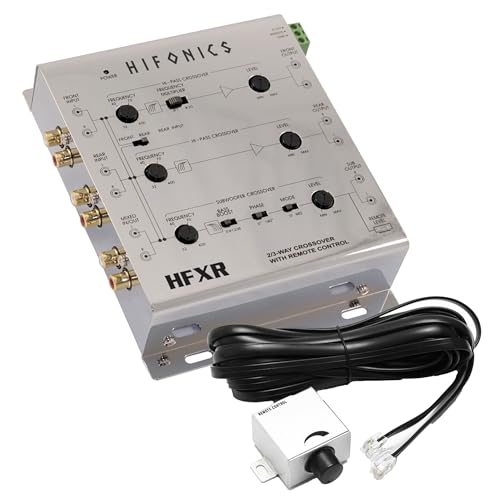
- 2-way/3-way and 2/4-channel selection
- Front, rear, and subwoofer filtering
- Remote bass control with 45Hz boost
Best For: Flexible car systems with convenient bass adjustment
Professional Stereo Splitting

- Stereo 2-way or mono 3-way operation
- Independent subwoofer frequency control
- XLR, TRS, and RCA connectivity
Best For: Multi-amplifier home, studio, or live-sound systems
Flexible PA Control

- Three selectable crossover configurations
- Per-band gain, phase, and 40Hz filtering
- Balanced XLR I/O in a metal rack-mount chassis
Best For: Flexible PA, DJ, studio, and installed audio systems
Custom System Tuning
Timpano TPT-360 3-Way Crossover

- Three-way electronic crossover design
- Can support two-way systems with front/rear fade
- Adjustable points for front, rear, and subwoofer outputs
Best For: Custom systems requiring flexible channel and subwoofer routing
Professional Signal Shaping
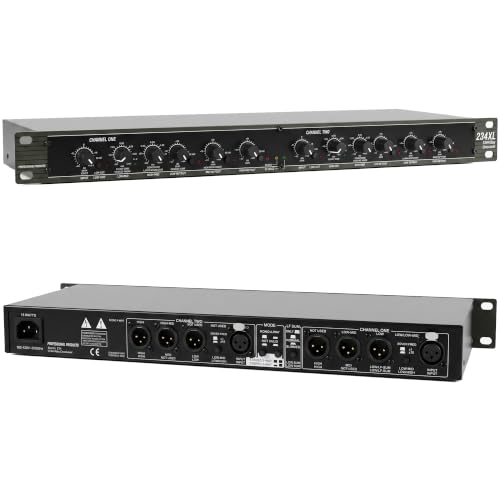
- Stereo 2-way, stereo 3-way, and mono 4-way modes
- Independent gain, phase invert, and 40Hz filters
- Balanced XLR I/O with LED mode and signal indicators
Best For: Professional PA, studio, installed, and mobile DJ systems
Flexible Car Audio Control
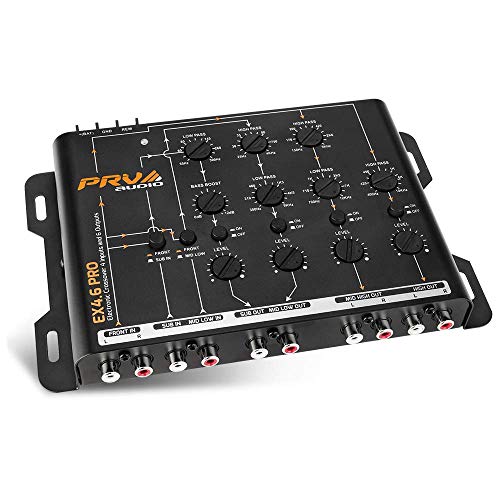
- Supports 2-, 3-, and 4-way RCA configurations
- Up to 9 volts RMS maximum output
- 0–12 dB bass boost at 45 Hz
Best For: Flexible car-audio signal routing and channel control
PA System Routing Power
Professional 2/3-Way Stereo Crossover

- Three selectable operating modes
- Balanced XLR inputs and outputs
- Individual gain and phase controls
Best For: PA, DJ, studio, and venue sound systems
Fine-Tuned Stereo Bass Control
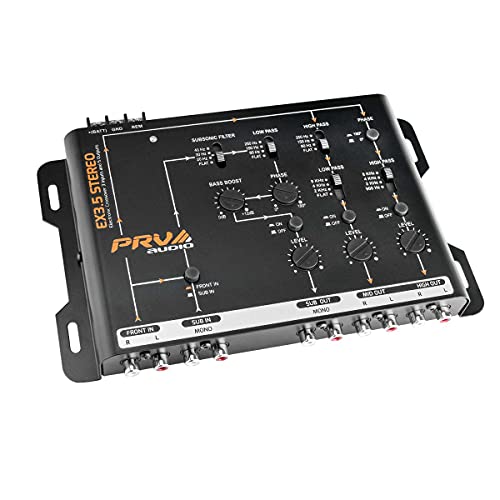
- Two-way or three-way car-audio operation
- Up to six RCA outputs
- Adjustable filters and subwoofer bass boost
Best For: Custom-tuned car stereo and amplifier systems
Versatile 3-Way Control – Clarion MCD360
Clarion Mobile Electronics Mcd360 3 Way 6 Channel Electronic Crossover with Subwoofer Control
Check Price On AmazonThe Clarion MCD360 is a practical choice among active audio crossovers for car systems that need dedicated front, rear, and subwoofer control. Its six-channel design provides adjustable crossover functions, subwoofer boost, and a separate remote level control.
Best For: Car-audio systems needing straightforward 3-way signal management and remote subwoofer adjustment.
Pros:
- 6-channel RCA inputs and 6-channel, 5-volt RCA outputs.
- Supports front, rear, and subwoofer routing with lever controls.
- Includes subwoofer equalizer, boost controls, and a remote level control.
- Gold-plated terminals and a compact 7 x 6 x 0.75-inch chassis.
Cons:
- Uses wired connectivity rather than wireless operation.
- The supplied notes do not specify detailed low-pass filter adjustment ranges.
The MCD360 is a sensible option when you want accessible 3-way control without stepping up to a more complex DSP platform. Its included remote makes subwoofer level changes convenient from the listening position.
DSP Tuning Flexibility – Taramps PRO 2.4S DSP Crossover
The Taramps PRO 2.4S stands out among active audio crossovers for its digital signal-processing features. It combines four-channel output routing with a 15-band graphic equalizer, adjustable filters, time alignment, phase inversion, and output limiting.
Best For: Custom car-audio installations that need detailed DSP tuning and compatibility with factory or aftermarket stereos.
Pros:
- Two inputs and four outputs support flexible system routing.
- Adjustable HPF and LPF filters reach up to 48 dB/octave.
- Offers time alignment, phase inversion, output limiting, and 12 presets.
- Accepts RCA and high-level inputs for factory-stereo integration.
Cons:
- Its extensive DSP controls may be more involved than a basic analog crossover.
- The supplied notes do not list a remote control or included installation accessories.
For listeners who want precise control over multiple channels, the PRO 2.4S is the most feature-focused option in this group. Its clip indicators and anti-pop system also support cleaner, more controlled installation and operation.
Remote Bass Control – Hifonics HFXR Active Crossover
The Hifonics HFXR is a flexible active crossover for car amplifiers and subwoofers, with selectable 2-way or 3-way operation. It provides front, rear, and subwoofer high- and low-pass filtering, plus remote bass adjustment for convenient system control.
Best For: Vehicle audio setups that need flexible channel selection and easy remote control of bass output.
Pros:
- Supports 2-way/3-way operation and 2/4-channel input selection.
- Provides high-pass and low-pass filters for front, rear, and subwoofer channels.
- Includes remote control, a 45Hz boost, and quasi-parametric equalization.
- Compact 6.75 x 5.75 x 1.75-inch design suits space-limited installations.
Cons:
- The supplied specifications contain inconsistent dimensional and connectivity details.
- The notes do not provide a full list of adjustable crossover frequency ranges.
The HFXR makes sense for buyers who value hands-on bass control and adaptable channel configuration. It offers more routing flexibility than a simple subwoofer-only controller while remaining compact for vehicle installations.
Professional Stereo Splitting – Behringer SUPER-X PRO CX2310
The Behringer SUPER-X PRO CX2310 is a professional-style option among active audio crossovers, supporting stereo 2-way or mono 3-way configurations. It adds an independently controlled subwoofer output and individual output mute switches for practical band adjustment.
Best For: Home, studio, or live-sound setups using balanced XLR or TRS connections and configurable multi-band routing.
Pros:
- Supports stereo 2-way and mono 3-way crossover modes.
- Includes a dedicated subwoofer output with independent frequency control.
- Individual output mute switches simplify band-by-band adjustments.
- Provides XLR and TRS outputs with RCA and XLR input options.
Cons:
- Its professional connectors and format may be less convenient for basic car-audio installations.
- The supplied notes do not specify detailed crossover slope or frequency settings.
The CX2310 is a strong fit when connection flexibility and independent band muting matter more than vehicle-specific features. Its stereo and mono operating modes make it adaptable across different multi-amplifier sound systems.
Flexible PA Control – 2/3/4-Way XLR Crossover
For shoppers comparing active audio crossovers for a PA, DJ setup, studio, or installation, this SIKUING model stands out for its selectable routing and balanced XLR connectivity. It supports stereo two-way, stereo three-way, and mono four-way operation, with per-band controls for practical system tuning.
Best For: PA and DJ systems needing flexible crossover modes, balanced connections, and rack-mount construction.
Pros:
- Selectable stereo 2-way, stereo 3-way, and mono 4-way modes.
- Independent gain controls, phase reverse switches, and 40Hz low-cut filtering per band.
- Balanced XLR inputs and outputs with a durable metal chassis.
- Front LED matrix provides quick mode confirmation.
Cons:
- The supplied specifications list a 2,000Hz frequency response, which may not provide the full detail some buyers expect from a crossover specification.
- Designed for 110V input, so compatibility should be checked before use in other electrical regions.
This is a versatile choice when you need one rack unit to accommodate several PA configurations. Its strong control set is especially useful for systems where polarity, rumble filtering, and output-level matching matter.
Custom System Tuning – Timpano TPT-360 3-Way Crossover
The Timpano TPT-360 is a practical option among active audio crossovers for custom car or multi-speaker systems. Its three-way design can also support a two-way setup with front and rear fade, while adjustable crossover points help distribute frequencies across the front, rear, and subwoofer outputs.
Best For: Custom audio systems that need three-way operation, subwoofer control, and front/rear fade capability.
Pros:
- Supports full three-way systems or two-way systems with front and rear fade.
- Offers a range of selectable crossover points for front, rear, and subwoofer outputs.
- Designed to distribute frequencies for clearer, more efficient system operation.
Cons:
- The supplied notes do not specify input/output connector types or the exact crossover frequency range.
- Its 10.6-inch width and 2.28-pound weight may require careful installation planning.
Choose the TPT-360 when flexible output routing is more important than extensive published specifications. It provides the core adjustment needed to balance a custom system around front, rear, and subwoofer channels.
Professional Signal Shaping – 2/3-Way Stereo Crossover
This professional crossover is a strong candidate for active audio crossovers in studio, live-sound, installed, and mobile DJ applications. It provides selectable stereo two-way, stereo three-way, and mono four-way modes, along with balanced XLR I/O and independent controls for shaping each output band.
Best For: Professional PA, studio, house-of-worship, and installed systems needing visual monitoring and detailed band control.
Pros:
- Supports stereo 2-way, stereo 3-way, and mono 4-way configurations.
- Independent output gain, phase invert, and 40Hz low-cut controls per band.
- Balanced XLR inputs and outputs help support clean signal transmission over longer runs.
- LED indicators show the active crossover mode and signal status.
Cons:
- The supplied notes do not provide exact crossover frequency ranges.
- At 5.24 pounds with a 22-inch package length, it may be less convenient for compact setups.
Its combination of selectable routing, band-level controls, and visual indicators makes this a well-rounded option for users who frequently configure or troubleshoot professional audio systems. The durable construction also suits touring and installation demands.
Flexible Car Audio Control – PRV EX4.6 PRO 4-Way Crossover
The PRV EX4.6 PRO is a versatile option for car-audio systems that need active audio crossovers with multiple routing choices. It supports 2-, 3-, or 4-way configurations, offers up to 9 volts RMS maximum output, and includes adjustable bass boost for added low-frequency control.
Best For: Car-audio builders who want flexible RCA signal routing and straightforward channel control.
Pros:
- Supports 2-, 3-, and 4-way RCA input signal options.
- Provides up to 9 volts RMS maximum output.
- Includes 0–12 dB bass boost at 45 Hz.
- Quick on/off buttons simplify channel management.
Cons:
- Uses RCA connections rather than balanced XLR inputs.
- Its listed 12 dB/octave Butterworth slope may offer less filtering flexibility than more advanced processors.
With four channels and six RCA outputs, the EX4.6 PRO is a practical fit for installations that prioritize routing flexibility, bass adjustment, and accessible mechanical controls.
PA System Routing Power – Professional 2/3-Way Stereo Crossover
This rack-mount unit is designed for PA systems that need active audio crossovers with balanced connections and multiple operating modes. It can run as two-way stereo, three-way stereo, or four-way mono, while separate gain controls and phase switches help shape each frequency band.
Best For: PA, DJ, studio, and venue setups using XLR-connected amplifiers, speakers, and subwoofers.
Pros:
- Offers two-way stereo, three-way stereo, and four-way mono operation.
- Uses balanced XLR inputs and outputs.
- Provides individual output gain controls and phase-reverse switches.
- Includes a 40 Hz, 12 dB/octave Butterworth low-cut filter.
Cons:
- Requires 110-volt AC power.
- The 18.9-inch length may require adequate rack or equipment-space planning.
Its broad routing options and band-level controls make this a strong choice when a larger PA system needs dedicated frequency-band management and balanced signal connections.
Fine-Tuned Stereo Bass Control – PRV EX3.5 Car Crossover
The PRV EX3.5 Stereo is a car-focused choice for active audio crossovers, combining two- or three-way operation with adjustable high-pass and low-pass filters. Its RCA layout supports up to six outputs, while individual output controls and subwoofer bass boost allow detailed system tuning.
Best For: Car stereos and amplifiers requiring adjustable stereo, mono, or three-channel RCA signal management.
Pros:
- Supports two-way or three-way car-audio configurations.
- Offers 2/4 RCA inputs and up to 6 RCA outputs.
- Provides adjustable high-pass, low-pass, and output-level controls.
- Includes subwoofer bass boost and channel on/off switches.
Cons:
- Designed for 10–12-volt DC car-audio systems rather than home or PA use.
- Uses RCA connectivity, with no balanced XLR interface listed.
For car installations needing hands-on filter adjustment and flexible output routing, the EX3.5 Stereo offers useful control without moving beyond a dedicated RCA-based processor.
How We Picked These Active Audio Crossovers
We selected models that represent the most useful crossover formats for current car-audio, DJ, and PA applications. The lineup includes two-way, three-way, and four-way configurations, along with RCA and XLR connectivity, balanced signal paths, remote subwoofer controls, phase-reversal options, and multi-channel outputs.
We also considered how easily each unit can fit into a real system. A good crossover should offer the routing and frequency control you need without adding unnecessary complexity. Application fit matters as much as specifications: a compact car-audio processor is not a direct substitute for a rack-style PA crossover.
Quick Comparison
| System Type | Best Features to Prioritize | Typical Crossover Style |
|---|---|---|
| Car audio | RCA inputs and outputs, remote bass control, compact installation | Two-, three-, or four-way electronic crossover |
| PA or DJ system | XLR connectivity, balanced outputs, clear routing controls | Stereo two-way or mono three-/four-way |
| Complex multi-amp setup | Multiple outputs, flexible filters, phase control | Three- or four-way active crossover |
| Budget upgrade | Simple adjustment, reliable signal routing, useful subwoofer output | Basic two- or three-way design |
Key Buying Factors for Active Audio Crossovers
System Configuration
Start by counting the frequency bands and amplifier channels you need to control. A two-way crossover separates low and high frequencies, while a three-way design adds a dedicated midrange band. Four-way models can provide greater control, but they also require more amplifiers, speakers, wiring, and setup time.
Inputs, Outputs, and Signal Type
RCA connections are common in car audio and short cable runs. XLR inputs and outputs are generally better suited to PA and DJ systems because balanced connections help reduce noise over longer distances. Confirm that the crossover’s number of inputs and outputs matches your source components and amplifiers.
Adjustment Range and Controls
Check the available crossover points, filter slopes, gain controls, phase options, and subwoofer level adjustment. Remote bass control can be particularly useful in a vehicle, while independent band controls are more important in a multi-amp PA system. Keep in mind that more controls can mean a longer setup process.
Installation and Headroom
Measure the available mounting space and check power requirements before buying. For car systems, verify voltage compatibility and cable access. For live sound, consider rack placement, balanced connections, output levels, and whether the unit provides enough headroom for the rest of the signal chain.
Who Should Buy Which Active Audio Crossovers?
Choose a car-audio-focused model if you are building or upgrading a vehicle system and want RCA routing, subwoofer control, and straightforward installation. PRV Audio, Clarion, Taramps, Hifonics, and Timpano options are the most relevant starting points for those setups.
For PA, DJ, or studio-style speaker systems, prioritize a model with XLR connectivity, balanced operation, and clearly labeled stereo or mono modes. Behringer and the professional XLR-equipped crossover options are better suited to those environments.
If you are unsure, choose the simplest unit that supports your intended number of frequency bands and amplifier channels. Extra outputs are useful only when the rest of the system can take advantage of them; otherwise, a well-matched two- or three-way crossover is usually easier to configure and maintain.