Transporting a keyboard is easier when the case fits correctly, protects against everyday bumps, and rolls smoothly between the car, rehearsal space, and stage.
We compared 10 rolling keyboard cases across 61-, 73/76-, and 88-key sizes, focusing on padding, portability, storage, durability, and travel-ready features.
Best 10 Rolling Keyboard Cases Picks for 2026
Best All-Around 88-Key Portability
Padded Rolling 88-Key Keyboard Case

- Three carrying modes: roll, hand-carry, or backpack
- Thick padding with two internal security straps
- Water-resistant fabric and organized accessory pockets
Best For: 88-key players needing flexible everyday transport
Best for Maximum Protection
Gator GTSA-KEY61 Molded Flight Case

- Durable polyethylene molded shell
- TSA-approved locking latches for air travel
- Customizable interior and 200-pound-rated wheels
Best For: 61-key touring and air-travel protection
Best 61-Key Soft Case Value
Waterproof Rolling 61-Key Gig Bag

- Two wheels and reinforced handles for easier movement
- Three internal straps with thick foam padding
- Four zippered pockets for accessories
Best For: Everyday 61-key rehearsals, performances, and travel
Best for Adjustable 88-Key Fit

- Removable foam padding for a more tailored fit
- Roll, carry, or use the adjustable shoulder straps
- Three exterior pockets for essential accessories
Best For: 88-key players wanting configurable soft-case padding
Best All-Around Rolling Case
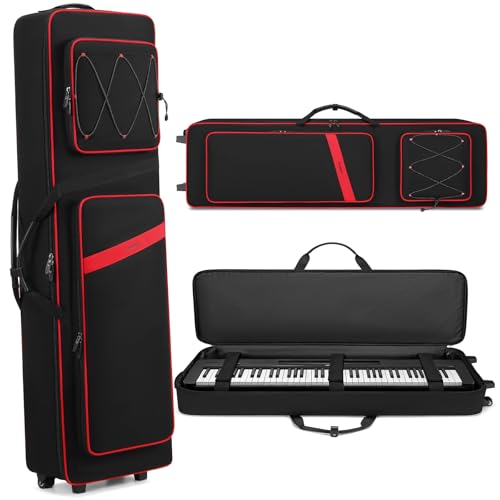
- Wheels, handles, and backpack straps
- Thick padding with water-resistant Oxford fabric
- Large accessory pockets and internal organizers
Best For: Musicians needing flexible transport between home, rehearsals, lessons, and venues
Best Slim-Fit Option
AKOZLIN 88-Key Rolling Keyboard Gig Bag

- Fits keyboards up to 54 x 14.2 x 6.3 inches
- Full 21/64-inch foam padding
- Wheels, handles, and adjustable backpack straps
Best For: Owners of slim 88-key keyboards seeking padded, versatile transport
Best for Extra Room
ORKELS 88-Key Rolling Keyboard Case

- Roomy 56 x 18.1 x 6.3-inch interior
- 10mm padding with three internal straps
- Waterproof fabric and four zippered pockets
Best For: Musicians transporting larger 88-key setups and several accessories
Best Full-Size Option

- Three ways to carry: roll, hand-carry, or backpack
- Padded 600D Oxford cloth construction
- Three accessory pockets for gig essentials
Best For: 88-key keyboards and full-size digital pianos
Best for 73-76 Keys
ORKELS 73/76-Key Rolling Keyboard Case

- Thick foam padding with three internal straps
- Four accessory pockets for organized storage
- Waterproof 900D/600D Oxford cloth
Best For: 73- and 76-key keyboards used for gigs and rehearsals
Best for 61 Keys
ORKELS 61-Key Rolling Keyboard Gig Bag

- Sized for standard 61-key keyboards
- Thick padding and three securing straps
- Four pockets plus wheels and backpack straps
Best For: 61-key keyboards, practices, and local performances
Best All-Around 88-Key Portability – Padded Rolling 88-Key Keyboard Case
For musicians seeking rolling keyboard cases for regular rehearsals, gigs, or practice sessions, this 88-key bag combines padded protection with flexible carrying options. Its 53 x 14.5 x 7-inch interior is designed for many standard 88-key keyboards, but measuring your instrument first is essential.
Best For: 88-key players who want a lightweight case that can roll, be carried, or worn as a backpack.
Pros:
- Two wheels, a reinforced handle, and hidden backpack straps provide three carrying options.
- Thick padding and two internal security straps help protect and stabilize the keyboard.
- Two exterior pockets and interior mesh pockets organize cables, pedals, sheet music, and smaller accessories.
- 900D water-resistant Oxford fabric is designed to help shield the instrument from moisture and dust.
Cons:
- Fits only keyboards within the listed 53 x 14.5 x 7-inch interior dimensions.
- Soft-sided construction may provide less impact protection than a molded flight case.
- The 6.8-pound bag is lightweight, but an 88-key keyboard will still make rolling transport substantial.
This is a practical choice when mobility and storage flexibility matter more than hard-shell protection. Its foldable design also makes it easier to store in compact spaces.
Best for Maximum Protection – Gator GTSA-KEY61 Molded Flight Case
Among rolling keyboard cases, the Gator GTSA-KEY61 stands out for players who prioritize hard-shell protection and travel security. It is designed for most 61-note keyboards and uses a polyethylene molded shell, TSA-approved latches, and recessed wheels.
Best For: 61-key musicians who need rugged protection for air travel, touring, or demanding transport conditions.
Pros:
- Nearly indestructible polyethylene construction is built for impact and wear resistance.
- Two TSA-approved locking latches support compliant air travel.
- Wedge-and-block interior components allow the fit to be customized.
- Recessed in-line wheels are rated for up to 200 pounds.
Cons:
- At 25.8 pounds, it is substantially heavier than soft keyboard gig bags.
- Its 44 x 17.38 x 6-inch exterior dimensions and 61-note format limit compatibility.
- The molded design is less suited to users who need a lightweight, foldable case.
This is the strongest protection-oriented option in the group, especially for air travel and touring. The tradeoff is considerable weight in exchange for a durable shell, locking hardware, and heavy-duty wheels.
Best 61-Key Soft Case Value – Waterproof Rolling 61-Key Gig Bag
This rolling keyboard case is a convenient option for 61-key players who regularly move between rehearsals, worship services, studios, and performances. Its 42.1 x 17.7 x 6.7-inch interior, two wheels, padding, and four accessory pockets support everyday transport.
Best For: Students, teachers, DJs, and performers who want a water-resistant soft case with substantial accessory storage.
Pros:
- Two in-line wheels and reinforced handles reduce the need to carry the keyboard.
- Thick padding and three adjustable straps help stabilize the instrument.
- Four zippered pockets provide space for pedals, cables, adapters, sheet music, and tablets.
- 900D x 600D water-resistant Oxford fabric is suited to regular travel and storage.
Cons:
- Compatibility depends on staying within the 42.1 x 17.7 x 6.7-inch interior dimensions.
- As a soft-shell case, it does not offer the same rigid impact protection as a molded case.
- The listed warranty is six months.
With useful storage and a straightforward rolling design, this bag is well matched to routine local transport. Confirm the keyboard’s dimensions before buying, particularly because 61-key models vary in size.
Best for Adjustable 88-Key Fit – Full-Padded Rolling Piano Bag
For shoppers comparing rolling keyboard cases for larger instruments, this 88-key soft bag offers a roomy 56.5 x 16.2 x 6.8-inch interior and removable padding components. It is designed to make everyday transport easier through rolling, backpack, and hand-carry options.
Best For: 88-key owners who want extra interior length, adjustable padding, and multiple ways to carry the case.
Pros:
- Three thickened Velcro straps, detachable padded foams, and a removable 2 cm top foam layer help secure the keyboard.
- Two wheels, adjustable shoulder straps, and reinforced handles support three carrying modes.
- Three exterior zippered pockets provide room for sheet music, pedals, cables, and adapters.
- Water-resistant, dustproof fabric helps protect against moisture, scratches, and everyday grime.
Cons:
- The 56.5 x 16.2 x 6.8-inch interior may not fit every 88-key model.
- Water-resistant fabric is not the same as a fully waterproof hard case.
- Soft construction offers less rigid protection than a molded flight case.
The adjustable padding is the key advantage for owners whose keyboard needs a more tailored soft-case fit. Measure both the instrument and its controls before relying on the generous listed interior size.
Best All-Around Rolling Case – BOSSTIN 88-Key Keyboard Case
For musicians who need flexible rolling keyboard cases, the BOSSTIN combines wheels, backpack straps, and sturdy handles in one transport-friendly design. Its padded Oxford-fabric construction is sized for most standard 88-key keyboards and includes organized accessory storage.
Best For: Performers, teachers, students, and hobbyists who want multiple carrying options for gigs, rehearsals, lessons, or storage.
Pros:
- Offers three carrying options: wheels, handles, and concealable backpack straps.
- Thick foam padding, water-resistant fabric, and adjustable internal security belts help protect the keyboard.
- Two large front pockets and internal mesh pockets organize music, cables, pedals, cords, and small items.
Cons:
- Its 53.5 x 15 x 7-inch interior should be checked against your keyboard before ordering.
- It has two wheels rather than a four-wheel design.
- The listed manufacturer warranty is three months.
The BOSSTIN is a versatile choice when you want to roll your keyboard most of the time but still have backpack and lift-carry options available. Confirm the dimensions and allow for its approximately 4.01 kg weight.
Best Slim-Fit Option – AKOZLIN 88-Key Rolling Keyboard Gig Bag
The AKOZLIN is one of the more size-specific rolling keyboard cases, designed for slim 88-note keyboards up to 54 x 14.2 x 6.3 inches. It pairs full foam padding with wheels, carrying handles, backpack straps, and three large accessory pockets.
Best For: Owners of slim 88-key keyboards who prioritize padded protection and several ways to carry their instrument.
Pros:
- Uses 21/64-inch full padding to help guard against bumps, scratches, and transport damage.
- Provides wheels, two firm handles, and two adjustable padded backpack straps.
- Three exterior pockets accommodate music books, pedals, power supplies, cables, and other accessories.
- Interior hook-and-loop straps help prevent the keyboard from shifting.
Cons:
- It is intended for slim keyboards, so measuring your instrument is especially important.
- The rigid two-wheel design may require more lifting than a multi-wheel case.
- The notes do not specify a manufacturer warranty duration.
Choose the AKOZLIN when its narrower interior matches your keyboard. Its padded build and multiple carry methods are useful, but the fit should be verified carefully before purchase.
Best for Extra Room – ORKELS 88-Key Rolling Keyboard Case
The ORKELS stands out among rolling keyboard cases with a larger listed interior of 56 x 18.1 x 6.3 inches, 10mm padding, and heavy-duty Oxford fabric. Built-in wheels, multiple handles, backpack straps, and four zippered pockets make it suited to transporting a keyboard and its essential gear.
Best For: Musicians who need a roomier 88-key case with robust padding, weather protection, and accessory storage.
Pros:
- Offers a generous interior designed for most standard 88-key keyboards.
- 10mm foam padding and three adjustable internal straps help protect and stabilize the instrument.
- 900D/600D Oxford fabric is described as waterproof and dustproof, with reinforced stitching.
- Four zippered pockets provide space for stands, books, pedals, cables, and other accessories.
Cons:
- The larger 56 x 18.1 x 6.3-inch size may be more than necessary for compact setups.
- It uses two wheels, so some lifting is still required.
- The listing specifies no manufacturer warranty.
The ORKELS is a strong fit when you want extra interior room and substantial padding. Compare its dimensions with your keyboard and available storage space, especially if portability and a compact footprint are priorities.
Best Full-Size Option – 88-Key Rolling Keyboard Case
For musicians comparing rolling keyboard cases for a full-size digital piano, this 88-key model combines padded storage with three transport options. Its 53-inch interior is designed for many popular Roland, Casio, Yamaha, Korg, and Alesis keyboards, but measuring your instrument first is important.
Best For: 88-key keyboard owners who need flexible transport between home, rehearsals, studios, and gigs.
Pros:
- Dual wheels, carrying handle, and adjustable backpack straps provide three carrying options.
- Padded interior, adjustable security straps, and durable 600D Oxford cloth help protect the keyboard.
- Three zippered pockets hold cables, pedals, power cords, sheet music, and headphones.
Cons:
- The large 53-inch size is intended for 88-key instruments and may be cumbersome for smaller keyboards.
- The soft case offers everyday protection but is not a rigid shell.
This is a practical choice when maximum keyboard length and transport flexibility matter. Confirm your keyboard’s dimensions before ordering to ensure a secure fit.
Best for 73-76 Keys – ORKELS 73/76-Key Rolling Keyboard Case
This ORKELS model is a useful choice among rolling keyboard cases for 73- and 76-key instruments. It has a 48.2-inch interior, thick foam padding, waterproof Oxford cloth, and wheels that let you move the bag like a suitcase.
Best For: Performers and rehearsal musicians carrying 73- or 76-key keyboards with accessories.
Pros:
- Generous 48.2-by-19.1-by-6.5-inch interior fits many standard 73/76-key keyboards.
- 900D Oxford cloth, thick foam padding, and three internal straps help protect and secure the instrument.
- Four zippered pockets provide storage for pedals, cables, books, and music stands.
- Waterproof, dustproof construction and reinforced stitching support outdoor and frequent-use transport.
Cons:
- Its fit is tailored to 73/76-key keyboards, so smaller or unusually shaped instruments should be measured carefully.
- The soft gig-bag design may provide less impact resistance than a hard case.
With substantial padding, weather-resistant fabric, and multiple storage pockets, this case emphasizes protection and organization for mid-size keyboards. Check your instrument’s measurements before purchase.
Best for 61 Keys – ORKELS 61-Key Rolling Keyboard Gig Bag
For a more compact option among rolling keyboard cases, this ORKELS bag is sized for 61-key instruments. Its 42.1-inch interior, built-in wheels, backpack-style straps, and thick padding make it suited to transporting a keyboard and accessories to practices, performances, and rehearsals.
Best For: 61-key keyboard players who want wheeled transport and dedicated accessory storage.
Pros:
- 42.1-by-17.5-by-6.5-inch interior is designed for most standard 61-key keyboards.
- Thick foam padding, three adjustable internal straps, and 900D/600D waterproof nylon help protect the instrument.
- Four zippered pockets organize pedals, cables, books, and other gear.
- Wheels and versatile handles allow vertical or horizontal carrying.
Cons:
- The case is intended for 61-key keyboards and may not accommodate larger models.
- As a soft case, it may not offer the same rigid protection as a hard-shell design.
This bag balances compact sizing with rolling convenience and useful storage. It is a strong fit for routine transport, provided your keyboard matches the listed interior dimensions.
How We Picked the Best Rolling Keyboard Cases
We selected these cases based on the features that matter most when moving a keyboard regularly: interior fit, padding, wheel design, handles, backpack or shoulder straps, storage, weather resistance, and construction quality. The lineup includes soft gig bags for rehearsals and local performances, as well as a molded flight case for musicians who need stronger protection during air travel or frequent transport.
Because keyboards vary substantially in length and depth, we also considered the listed interior dimensions and key-count compatibility. A case that is too large can allow the instrument to shift, while one that is too small may strain zippers or padding.
Quick Comparison
- Best for maximum protection: A molded flight case with TSA-approved latches and recessed wheels.
- Best for everyday portability: A padded rolling gig bag with backpack straps and a reinforced handle.
- Best for 88-key keyboards: A full-length case with substantial padding and interior dimensions that match your instrument.
- Best for accessories: A design with multiple exterior pockets for cables, pedals, sheet music, and power supplies.
- Best for smaller keyboards: A correctly sized 61- or 73/76-key case that avoids excess movement inside.
Key Buying Factors for Rolling Keyboard Cases
Size and Interior Fit
Start with your keyboard’s actual length, depth, and height, including controls or removable accessories. Match those measurements with the case’s interior dimensions rather than relying only on the advertised key count.
Padding and Protection
Thicker padding helps absorb impacts during ordinary loading and unloading. Soft cases are lighter and easier to store, but molded cases provide greater rigidity for airline travel, trailers, and demanding touring schedules.
Wheels, Handles, and Straps
Look for smooth-rolling wheels, a reinforced pull handle, and sturdy grab handles. Backpack or shoulder straps are useful when stairs, curbs, or uneven surfaces make rolling impractical. Check that straps can be secured so they do not drag.
Storage and Weather Resistance
Accessory pockets reduce the need for a second bag, especially when carrying pedals, cables, headphones, or a sustain pedal. Water-resistant fabric or a waterproof exterior helps protect against light rain, but it should not be treated as complete waterproofing unless the manufacturer specifically says so.
Travel Security
For checked baggage or frequent flights, prioritize a rigid shell, secure latches, reinforced corners, and lock compatibility. A soft gig bag is generally better suited to car transport, rehearsals, lessons, and local gigs.
Who Should Buy Which Rolling Keyboard Cases?
Choose an 88-key rolling case if you use a full-size digital piano or stage keyboard, but verify the interior measurements before ordering. Players with 61-key instruments should choose a dedicated 61-key model for a more secure fit and easier handling. A 73/76-key case is the practical middle ground for instruments that do not fit standard 61- or 88-key bags.
For frequent local performers, a padded soft case with wheels, straps, and accessory pockets offers the best balance of convenience and cost. For touring musicians or anyone checking a keyboard on flights, invest in the most rigid, securely latched option available. Before buying, confirm the return policy, measure the instrument twice, and check the case’s weight alongside your keyboard and accessories.