Choosing an 88-key synthesizer workstation comes down to feel, sound engine depth, and how well the board fits your workflow. Some players want a stage-ready all-rounder, while others need a studio hub with deeper sound design tools.
Below, we’ve focused on options that balance performance, weight, action type, and sound quality so you can narrow down the right fit faster.
Best 10 88 Key Synthesizer Workstation Picks for 2026
Portable Synth Power
Yamaha MODX8+ 88-Key Synthesizer Workstation

- AWM2 sample-based and FM-X synthesis
- Motion Control matrix for deep editing
- Portable 88-key workstation design
Best For: players who want a portable 88-key workstation with advanced synthesis
Stage-Ready Performer
Roland JUNO-D8 88-Note Synthesizer

- PHA-4 weighted hammer-action keyboard
- ZEN-Core engine with 3,800+ sounds
- USB-C audio/MIDI and battery power support
Best For: live players who want weighted keys and quick access to stage sounds
Recording-Focused Board
Korg Kross 2-88-MB 88-Key Synthesizer

- Natural weighted hammer-action keybed
- Step MIDI sequencers and audio recorder
- Mic/line inputs for flexible workflow
Best For: players who want an all-in-one workstation for writing and recording
Software Control Pick
M-AUDIO Keystation 88 MK3 MIDI Controller

- 88 full-size semi-weighted velocity-sensitive keys
- USB plug-and-play with no power supply needed
- Transport controls and included software bundle
Best For: producers using virtual instruments and DAW-based setups
Flagship Expression
Yamaha MODX M8 88-Key Synthesizer
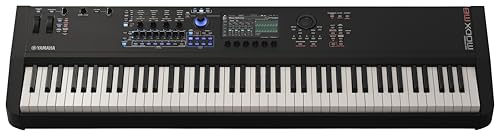
- Graded hammer 88-key action for realistic response
- Three engines cover analog, FM, and acoustic-style sounds
- Faders, Super Knob, and touch screen streamline control
Best For: Pianists and performers who want expressive weighted keys and fast sound editing
Live-Ready Bundle
Roland JUNO-D8 88-Key Synthesizer Bundle

- Over 3800 sounds powered by the ZEN-Core engine
- Knobs, sliders, and lever give hands-on live control
- USB-C mobile battery support adds portability
Best For: Gigging musicians and creators who want a stage-focused 88-key synth bundle
Workstation Depth
Korg Nautilus 88 Workstation Keyboard

- RH3 weighted 88-key action for realistic piano feel
- Nine sound engines and class-leading effects expand options
- Set List mode and 16-track recorder aid performance and production
Best For: Producers and performers who want a deep weighted workstation with live organization tools
Weighted Stage Workhorse
Yamaha MX88 88-Key Weighted Action Synthesizer

- 88-note GHS weighted action with piano-like key balance
- Class-compliant USB audio/MIDI for plug-and-play use
- Motif engine with up to 128-note polyphony
Best For: Pianists and stage players who want weighted keys and easy USB connectivity
Flagship Expression Engine
Yamaha Montage M8X 88-Key Synthesizer

- 400-note total polyphony across 3 engines
- Polyphonic aftertouch for individual note expression
- AN-X engine plus dedicated performance controls
Best For: Advanced performers and producers seeking maximum expressiveness
Modern Workstation Pick
Roland FANTOM-08 88-Key Weighted Synthesizer
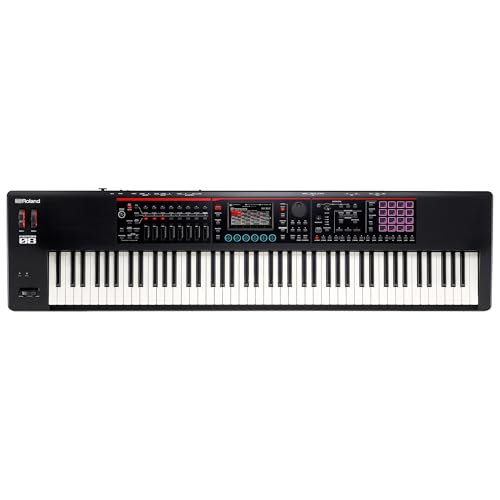
- 88-note weighted keyboard with expressive playability
- ZEN-Core and SuperNATURAL sounds with thousands of tones
- Touchscreen plus TR-REC and clip-based sequencing
Best For: Musicians who want a balanced performance and production workstation
Portable Synth Power – Yamaha MODX8+ 88-Key Synthesizer Workstation
If you want an 88 key synthesizer workstation that leans into deep sound design without giving up portability, the Yamaha MODX8+ is built for that balance. Its AWM2 sample-based engine, FM-X synthesis, and Motion Control matrix give you a lot of room to shape sounds for stage or studio use.
Best For: Players who want a lightweight 88-key workstation with flexible synthesis and modern control features.
Pros:
- AWM2 and FM-X engines provide a wide sound palette.
- Motion Control offers highly customizable synth engine control.
- Includes new Voices, LIVE SETS, and features in MODX OS.
- Portable design makes it easier to move than many full-size workstations.
Cons:
- Semi-weighted synth action may not suit players wanting a hammer-action feel.
- Best value depends on whether you need the advanced synthesis tools.
Overall, the MODX8+ stands out if you want a versatile 88 key synthesizer workstation with serious sound-shaping power in a portable format. It is especially appealing for players who value synthesis depth and gig-friendly flexibility.
Stage-Ready Performer – Roland JUNO-D8 88-Note Synthesizer
The Roland JUNO-D8 is a strong choice if your 88 key synthesizer workstation needs to cover live-band basics quickly and reliably. It combines a weighted hammer-action keyboard with the ZEN-Core engine, giving you access to more than 3,800 onboard sounds and practical tools for performance and editing.
Best For: Live performers and writers who want weighted keys, fast sound access, and battery-powered USB-C flexibility.
Pros:
- PHA-4 weighted hammer-action keyboard with escapement.
- ZEN-Core engine includes over 3,800 ready-to-play sounds.
- USB-C audio/MIDI interface supports mobile and computer workflows.
- Sound Packs, Wave Expansions, and sample import expand creative options.
Cons:
- Focused on stage utility, so it may be more than some casual users need.
- Sound expansion features depend on Roland Cloud content.
In practice, the JUNO-D8 is a straightforward pick for performers who want an 88 key synthesizer workstation with pro sounds and a familiar weighted feel. Its mix of onboard content and modern USB-C connectivity makes it especially adaptable for gigging and writing.
Recording-Focused Board – Korg Kross 2-88-MB 88-Key Synthesizer
If you need an 88 key synthesizer workstation with hands-on recording and sequencing tools, the Korg Kross 2-88-MB is built around that workflow. Its natural weighted hammer-action keybed, EDS-i sound engine, step MIDI sequencers, mic/line inputs, and audio recorder make it useful as an all-in-one writing tool.
Best For: Keyboardists who want a weighted workstation with sequencing, recording, and input flexibility.
Pros:
- Natural weighted hammer-action keybed for a more piano-like response.
- EDS-i sound engine supports workstation-style sound creation.
- Step MIDI sequencers and audio recorder add writing tools.
- Mic/line inputs increase its usefulness for integrated production.
Cons:
- It is a larger 88-key unit at 38.5 pounds.
- Matte black design is functional rather than flashy.
The Kross 2-88-MB makes sense if your priority is a practical 88 key synthesizer workstation with recording and sequencing built in. It is especially attractive for players who want weighted keys and workflow tools in one board.
Software Control Pick – M-AUDIO Keystation 88 MK3 MIDI Controller
The M-AUDIO Keystation 88 MK3 is a simple way to add a full 88 key layout to a software-based synthesizer setup. It is a semi-weighted MIDI keyboard controller, so it does not generate sounds on its own, but it gives you velocity-sensitive keys and hands-on controls for virtual instruments and DAW parameters.
Best For: Producers who want an affordable 88-key controller for software synths and DAW control.
Pros:
- 88 full-size velocity-sensitive semi-weighted keys.
- USB plug-and-play operation with no driver or power supply required.
- Includes pitch/mod wheels, transport buttons, and sustain pedal input.
- Came with production software such as Ableton Live Lite and MPC Beats.
Cons:
- It is a MIDI controller, not a standalone synthesizer workstation.
- No onboard sounds or display-based workstation features.
For software-based music production, the Keystation 88 MK3 is a practical entry point into an 88 key synthesizer workstation-style setup. It is best when your instrument sounds live inside your computer rather than in the keyboard itself.
Flagship Expression – Yamaha MODX M8 88-Key Synthesizer
If you want an 88 key synthesizer workstation that feels close to a real piano but is built for sound design, the Yamaha MODX M8 is aimed squarely at that use case. Its graded hammer action, three sound engines, and hands-on controls make it a practical choice for players who need expressive performance and fast editing in one board.
Best For: Pianists and performers who want weighted 88-key feel, deep sound options, and a streamlined workflow.
Pros:
- 88-key graded hammer action offers a realistic, weighted playing feel.
- Three sound engines cover classic analog, modern FM, and realistic instrument tones.
- 8 faders and Super Knob support real-time expressive control.
- Color touch screen and 6 display knobs help speed up editing and navigation.
Cons:
- Its feature set is geared more toward active sound shaping than simple plug-and-play use.
- The weighted action is ideal for pianists, but may feel less light than synth-style keys.
The MODX M8 stands out if you want a weighted 88 key synthesizer workstation that balances piano-style playability with modern synthesis tools. It is especially appealing for players who want quick control on stage or in the studio without giving up expressive response.
Live-Ready Bundle – Roland JUNO-D8 88-Key Synthesizer Bundle
The Roland JUNO-D8 is a practical 88 key synthesizer workstation-style keyboard for players who want immediate access to stage-ready sounds. With the ZEN-Core engine, more than 3800 sounds, and hands-on controls, it is built for live performance, quick adjustments, and portable use.
Best For: Gigging players, band performers, and creators who want a flexible stage synth with useful included accessories.
Pros:
- Over 3800 ready-to-play sounds give you a wide starting point.
- ZEN-Core engine adds strong sound depth and expansion via Roland Cloud.
- Knobs, sliders, and the pitch bend/mod lever support quick live control.
- USB-C mobile battery support and audio/MIDI connectivity add portability.
Cons:
- The product is a bundle, so some value is tied to the included accessories.
- It is positioned around live performance rather than deep workstation-style sequencing features.
The JUNO-D8 is a straightforward choice if your priority is stage use, fast sound selection, and easy control. The bundled pedal, cable, cover, DVD, and cloth make it even more appealing for players who want an all-in-one setup right away.
Workstation Depth – Korg Nautilus 88 Workstation Keyboard
The Korg Nautilus 88 is a full-size 88 key synthesizer workstation built for players who want broad sound coverage and a weighted piano feel. With nine sound engines, a streamlined interface, and a 16-track recorder, it is suited to performance and production work where fast access and depth both matter.
Best For: Players and producers who want a weighted 88-key workstation with deep sounds and performance organization tools.
Pros:
- 88-key RH3 weighted action provides an ultra-realistic piano playing experience.
- Nine sound engines and class-leading effects support a wide range of sounds.
- Set List mode helps organize sounds and sequences for live performance.
- 16-track audio and MIDI recorder adds practical production capability.
Cons:
- The large feature set may be more than casual players need.
- Its workstation focus may be more complex than a simpler stage keyboard.
The Nautilus 88 is a strong fit if you want one instrument to cover weighted piano playing, sound creation, and organized live use. Its interface and Set List tools make it easier to manage a demanding performance setup without sacrificing sonic range.
Weighted Stage Workhorse – Yamaha MX88 88-Key Weighted Action Synthesizer
If you want an 88 key synthesizer workstation that still feels close to an acoustic piano, the Yamaha MX88 is built around a GHS weighted action with heavier low keys and lighter high keys. It pairs that keyboard feel with Yamaha’s Motif sound engine, 128-note polyphony, and class-compliant USB audio/MIDI, so it’s a practical choice for players who want one board for both performance and straightforward computer connectivity.
Best For: Players who want weighted piano-style action, Motif-based sounds, and simple USB plug-and-play use.
Pros:
- 88-note GHS weighted action is shaped to feel heavier in the lows and lighter in the highs.
- Class-compliant USB audio/MIDI supports true plug-and-play setup without driver installation.
- Motif sound engine supports layer, zone, switch, cycle, randomize, and control of up to 8 elements per voice.
- 128-note polyphony helps keep performance clean in live playing and 16-track sequencing.
Cons:
- At 30.6 pounds, it is not the lightest board to move frequently.
- Its feature set is more focused on practical synthesis and performance than on flagship-level control depth.
Overall, the MX88 is a solid fit for musicians who want a weighted 88 key synthesizer workstation with dependable playability and easy computer integration. It emphasizes usable sounds and familiar piano action over flashier performance features.
Flagship Expression Engine – Yamaha Montage M8X 88-Key Synthesizer
The Yamaha Montage M8X is aimed at players shopping for a premium 88 key synthesizer workstation with deep expressive control. Its GEX action adds polyphonic aftertouch, while 400-note total polyphony across three engines, the AN-X analog-style engine, and Seamless Sound Switching point to a board built for complex performances and sound design. If you want a flagship instrument that can cover layered parts and detailed modulation, this is the most advanced option in this roundup.
Best For: Experienced players and producers who want flagship-level expression, polyphonic aftertouch, and deep synthesis.
Pros:
- 400-note total polyphony across 3 engines supports large, layered performances.
- Polyphonic aftertouch lets you modulate held notes individually with pressure.
- AN-X engine recreates analog synth character with sophisticated modulation.
- Dedicated Keyboard, Part, and Scene controls support fast performance changes.
Cons:
- At 61.94 pounds, it is considerably heavier than the other options here.
- Its flagship feature set will be more than many casual players need.
As a result, the Montage M8X is best viewed as a high-end performance and sound design platform rather than a simple general-purpose keyboard. It offers the most expressive control and deepest engine count in this group.
Modern Workstation Pick – Roland FANTOM-08 88-Key Weighted Synthesizer
The Roland FANTOM-08 is a versatile 88 key synthesizer workstation for players who want a modern workflow without stepping into a full flagship chassis. It combines an 88-note weighted keyboard with ZEN-Core and SuperNATURAL sounds, a color touchscreen, TR-REC sequencing, and clip-based recording, making it a strong fit for both live writing and production-focused setups.
Best For: Players who want an expressive weighted workstation with touchscreen control and built-in sequencing.
Pros:
- 88-note weighted keyboard supports expressive playing across piano and synth parts.
- ZEN-Core and SuperNATURAL engines provide thousands of electronic and acoustic sounds.
- Color touchscreen, knobs, sliders, and pads make control more immediate.
- TR-REC and clip-based sequencing add useful onboard production tools.
Cons:
- At 40 pounds, it is still a substantial keyboard to transport.
- Its feature-rich interface may be more than a basic player needs.
In practice, the FANTOM-08 sits between a stage keyboard and a production workstation, with enough sound and sequencing depth to handle most creative setups. It is the most balanced pick here for users who want modern tools without going to the top-tier Montage level.
How We Picked the Best 88 Key Synthesizer Workstation
For this roundup, we prioritized 88-key models that make sense for real-world players: strong key action, broad sound libraries, performance-friendly controls, and enough flexibility for both live use and production. We also considered whether a board is better suited to piano-first players, synth-focused performers, or workstation users who need deeper editing and sequencing.
Quick Comparison
At a high level, the field splits into three groups. First are flagship-style workstations with the deepest features and sound engines. Second are stage synths that emphasize hands-on performance and fast patch access. Third are controller-style options that trade onboard sounds for DAW control and virtual instrument flexibility.
Key Buying Factors for an 88 Key Synthesizer Workstation
Key Action
Action matters more than many buyers expect. Weighted or graded hammer action feels more piano-like and usually suits players who split time between piano parts and synth sounds. Semi-weighted boards can feel quicker for organ, lead, and electric piano playing. If you’re buying an 88 Key Synthesizer Workstation for expressive performance, test the action if possible.
Sound Engine and Expandability
Look beyond the number of presets. The best boards offer a sound engine that supports layered textures, acoustic instruments, and synth programming without sounding limited. If you produce across genres, favor models with broad onboard palettes and patch management that stays organized under pressure.
Controls and Workflow
Faders, knobs, pads, scene switching, and split/layer shortcuts can save time on stage and in the studio. If you perform live, fast navigation often matters more than deep menu features. If you compose, consider whether the workstation supports intuitive sound shaping and easy multitimbral use.
Connectivity
Check for USB-MIDI, audio outputs, pedal inputs, and any computer integration you rely on. Some players only need a straightforward stage keyboard, while others need a centerpiece for a hybrid hardware-and-software setup.
Who Should Buy Which 88 Key Synthesizer Workstation?
Choose a flagship workstation if you want the deepest creative range and are comfortable paying for premium features. Pick a performance-focused synth if you need quick access, reliable stage use, and a strong core sound set. Go with a controller-style 88 Key Synthesizer Workstation if you mainly work with software instruments and want realistic keys without paying for sounds you won’t use. For pianists crossing into synth territory, a weighted or graded-hammer model is usually the safest starting point.
In short, the best choice depends on whether your priority is piano feel, sound design depth, or live performance speed. Match the keyboard action and feature set to your playing style, and the right board will feel immediately more useful.