If you want one keyboard that can cover writing, performance, and travel, a portable synthesizer workstation is often the smartest buy. The best models balance sound quality, hands-on control, and manageable size.
Below, we focus on options that make sense for real-world use, from compact music-making tools to fuller 61- and 88-key workstations.
Best 10 Portable Synthesizer Workstation Picks for 2026
Portable Studio-Grade Workhorse
Korg Kross 2-61 61-Key Synthesizer Workstation

- 61-key synth-action keybed
- Step and MIDI sequencers
- Mic/line inputs for recording
Best For: players who want a lightweight 61-key workstation for composing and stage use
Ultra-Compact Idea Machine
Akai MPK Mini Play MK3 with Speaker

- Built-in speaker and 100+ sounds
- 25-key dynamic keybed with MPC pads
- USB MIDI plus battery-capable portability
Best For: beat makers, songwriters, and travelers who want a tiny self-contained sketch tool
Full-Size Performance Option
Yamaha MX88 88-Key Weighted Synth

- 88-note GHS weighted action
- Motif sound engine with layering
- USB audio/MIDI plug-and-play
Best For: pianists and live players who want an 88-key weighted board with synth sounds
Arranger-Friendly Portable Workstation
Korg i3 Music Workstation 61-Key

- 790 sounds and 59 drum kits
- 61 velocity-sensitive keys
- Joystick for real-time performance control
Best For: songwriters and arrangers who want a 61-key workstation for building full tracks
Portable Vocoder Workstation
Korg MicroKorg2 Synthesizer/Vocoder

- 37 full-size keys for expressive play
- Loop recorder and vocal processor included
- 2.8-inch color display with guided editing
Best For: performers and producers who want compact synth/vocoder versatility
Portable MIDI Production Controller
Akai MPK Mini Plus 37-Key Controller

- 37 mini keys with 8 MPC pads and knobs
- 64-step sequencer for standalone ideas
- MIDI/CV/Gate I/O for hardware setups
Best For: beatmakers and hardware users who want compact control and sequencing
Battery-Powered FM Synth
Yamaha REFACE DX Portable FM Synth

- 4-operator FM engine for expressive sounds
- Phrase looper and built-in speaker system
- Battery-powered with 37-key mini keyboard
Best For: mobile players and FM sound designers who need true portability
Portable Studio Workstation
Adjustable Keyboard Stand and DJ Desk
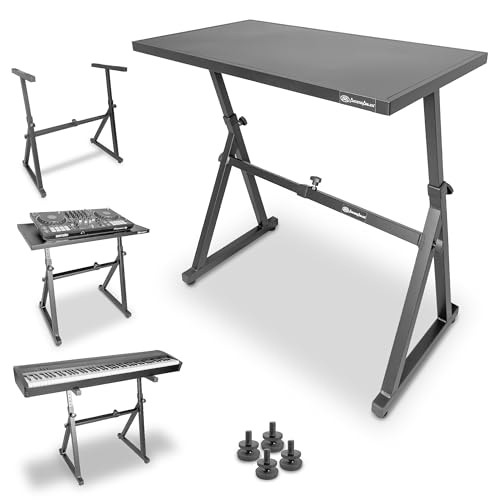
- 2-in-1 design with removable steel tabletop
- Supports up to 200 lbs with reinforced steel frame
- Height and width adjust for seated or standing setups
Best For: portable studios, DJs, and flexible live rigs
Analog Poly Synth
Korg minilogue 37-Key Workhorse

- True analog sound with warm, punchy tones
- Four voices plus 16-step polyphonic motion sequencer
- Compact 37-key design with OLED oscilloscope
Best For: portable analog synthesis and live sequencing
88-Key Workstation

- 88-key weighted hammer action keybed
- Mic/line inputs plus audio recorder
- Step MIDI sequencers and EDS-i sound engine
Best For: players wanting a full-size performance workstation
Portable Studio-Grade Workhorse – Korg Kross 2-61 61-Key Synthesizer Workstation
If you want a portable synthesizer workstation that can handle writing, layering, and live performance, the Korg Kross 2-61 is built for that job. It pairs a 61-key synth-action keybed with sequencers, mic/line inputs, and Korg’s EDS-i sound engine, making it a flexible all-in-one option for players who need more than a basic controller.
Best For: Musicians who want a lightweight 61-key workstation for composing, sequencing, and stage use.
Pros:
- 61-key synth-action keybed suits performance and songwriting.
- Built-in step and MIDI sequencers support sketching complete ideas.
- Mic/line inputs add recording and input flexibility.
- Compact 3.8 kg design improves portability for a workstation.
Cons:
- Synth-action keys are less piano-like than weighted actions.
- 61 keys may feel limiting for players wanting a full 88-key range.
- Workstation features can take time to learn.
The Kross 2-61 stands out if you want a practical portable synthesizer workstation with real composition tools built in. It is aimed at players who value breadth of features, onboard sound design, and easy transport over piano-style key feel.
Ultra-Compact Idea Machine – Akai MPK Mini Play MK3 with Speaker
The Akai MPK Mini Play MK3 is a portable synthesizer workstation in a very compact form, best suited to quick sketches and travel-friendly music making. It combines a 25-key dynamic keybed, built-in sounds, a speaker, pads, and USB MIDI control, so you can play standalone or plug into a computer when you need more.
Best For: Beat makers, songwriters, and travelers who want a tiny all-in-one sketch pad with built-in sounds.
Pros:
- Built-in speaker and over 100 internal sounds allow standalone use.
- 25-key dynamic keybed and 8 velocity-sensitive MPC pads support beatmaking.
- USB MIDI, arpeggiator, and note repeat add useful production tools.
- Very light and battery-capable for easy portability.
Cons:
- 25 keys are restrictive for two-handed playing.
- Built-in speaker is useful for sketching, not full monitoring.
- Less workstation depth than larger keyboards.
This is a smart pick when portability matters more than size or deep workstation editing. If you want a quick, self-contained idea generator that still connects cleanly to a computer, the MPK Mini Play MK3 fits well.
Full-Size Performance Option – Yamaha MX88 88-Key Weighted Synth
The Yamaha MX88 is a portable synthesizer workstation option for players who want an 88-key weighted feel without giving up synth and production features. Its GHS action, Motif sound engine, USB audio/MIDI connectivity, and 128-note polyphony make it a strong fit for both studio work and live performance.
Best For: Pianists and live players who want a full 88-key weighted board with synth and workstation-style sounds.
Pros:
- 88-note GHS weighted action feels closer to an acoustic piano.
- Motif sound engine offers layering and deeper voice control.
- USB audio/MIDI supports simple plug-and-play connection.
- 128-note polyphony helps avoid dropouts in dense performances.
Cons:
- At 30.6 pounds, it is much less portable than smaller boards.
- 88 keys require more space for transport and setup.
- Weighted action may not suit players who prefer synth-style keys.
If your priority is a full keyboard range and realistic key feel, the MX88 is the most piano-like choice here. It is less grab-and-go than compact models, but it offers a serious performance platform for players who need both range and sound power.
Arranger-Friendly Portable Workstation – Korg i3 Music Workstation 61-Key
The Korg i3 is a portable synthesizer workstation built for creating complete tracks, arranging ideas, and performing with a broad sound set. With 790 sounds, 59 drum kits, 61 velocity-sensitive keys, and onboard performance layering, it is designed for users who want a self-contained writing and playing instrument.
Best For: Songwriters and arrangers who want a feature-rich 61-key workstation for building full tracks.
Pros:
- 790 sounds and 59 drum kits provide broad onboard coverage.
- 61 velocity-sensitive keys offer a practical portable size.
- Joystick control adds real-time pitch bend, vibrato, and brilliance.
- Backlit controls and a screen make navigation easier during use.
Cons:
- Not as portable as mini controllers.
- 61 keys may be limiting for players who need a larger range.
- Arranger-style workflow may not suit every synth-focused user.
The i3 is a strong fit if you want a portable workstation with a focus on composition and accompaniment. It emphasizes immediate track building and performance control, making it a useful all-rounder for writers who want lots of sound options in one keyboard.
Portable Vocoder Workstation – Korg MicroKorg2 Synthesizer/Vocoder
If you want a portable synthesizer workstation that can handle sound design, vocal processing, and performance duties in one compact box, the Korg MicroKorg2 is built for that role. Its 37 full-size keys, updated XMT sound engine, loop recorder, and new vocal processor make it practical for players who want a hands-on instrument without giving up editing depth.
Best For: Performers and producers who want a compact synth/vocoder with visual editing tools and vocal effects.
Pros:
- 37 full-size keys support expressive playing
- Loop recorder adds quick idea capture and performance utility
- New vocal processor includes harmonizer and hard-tuning functions
- 2.8-inch full-color IPS display and animated guides help make editing easier
Cons:
- 4-voice polyphony may feel limited for thicker layered parts
- Portable design is helpful, but it is still a dedicated keyboard instrument rather than a tiny controller
The MicroKorg2 is a strong choice if you value portability but still want a true synthesizer experience with performance-friendly features. It leans toward creative sound shaping and vocal treatment, making it a flexible pick for studio sessions or live use.
Portable MIDI Production Controller – Akai MPK Mini Plus 37-Key Controller
The Akai Professional MPK Mini Plus is a practical portable synthesizer workstation companion for producers who want hands-on control without relying entirely on a mouse. With 37 mini keys, 8 MPC pads, a built-in 64-step sequencer, and MIDI/CV/Gate I/O, it can sit at the center of a compact production setup or bridge out to other gear.
Best For: Beatmakers and electronic musicians who want a portable controller with sequencing and hardware connectivity.
Pros:
- 37-key layout gives you three octaves of melodic range
- Built-in 64-step sequencer supports standalone composition
- MIDI/CV/Gate and MIDI I/O connect to modular gear and synths
- 8 RGB MPC pads and 8 rotary knobs add tactile control
Cons:
- Mini keys may not suit players who prefer full-size keys
- It is a controller, so it depends on external sound sources or software
For a portable synthesizer workstation workflow, the MPK Mini Plus is strongest as a control hub rather than a sound engine. It offers useful sequencing and broad connectivity, making it a smart fit for DAW-based studios and small hardware rigs.
Battery-Powered FM Synth – Yamaha REFACE DX Portable FM Synth
The Yamaha REFACE DX is a compact portable synthesizer workstation option for players who want FM sound design, a built-in looper, and true go-anywhere convenience. Its 4-operator FM engine, 37-key mini synth keyboard, battery power, and built-in speaker system make it especially useful when you need to sketch ideas or play without extra gear.
Best For: Mobile players and sound designers who want a portable FM synth with built-in playback and looping.
Pros:
- 4-operator FM sound engine delivers expressive synthesis
- Integrated phrase looper helps capture ideas and jam
- Battery-powered design and built-in speaker support portable use
- 37-key mini keyboard offers fast, natural performance feel
Cons:
- Mini keys may feel small for players used to full-size keyboards
- 32 voice memory locations are useful, but not extensive
The REFACE DX stands out when portability matters as much as sound. It is a straightforward, travel-friendly FM synth for practicing, sketching, and performing in places where a larger workstation would be inconvenient.
Portable Studio Workstation – Adjustable Keyboard Stand and DJ Desk
If you want a portable synthesizer workstation that can also pull double duty as a DJ or utility desk, this AxcessAbles stand is built for flexible setups. The removable steel tabletop, height-adjustable frame, and wide width range make it easy to adapt the same stand for synths, mixers, MIDI gear, and laptops.
Best For: Musicians, DJs, and event setups that need a sturdy, collapsible workstation with room to grow.
Pros:
- 2-in-1 design works as a keyboard stand or a 36″ x 19.4″ tabletop workstation.
- Reinforced steel construction supports up to 200 lbs.
- Height adjusts from 26.25″ to 37.5″ and width expands from 21.5″ to 35″.
- Foot levelers help keep it stable on uneven floors.
Cons:
- Assembly is required.
- At 30.4 pounds, it is portable but not especially lightweight.
This is a practical choice if you need one stand that can handle studio work, live performance, and mobile events. Its strength is flexibility: you get a secure platform and an adjustable layout without committing to a single use.
Analog Poly Synth – Korg minilogue 37-Key Workhorse
The Korg minilogue is a compact portable synthesizer workstation option if you want true analog tone in a small, performance-friendly format. With four voices, a 16-step polyphonic and motion sequencer, and an OLED oscilloscope, it gives you hands-on sound design tools without taking up much space.
Best For: Players who want a compact analog synth for live patches, sequencing, and straightforward sound shaping.
Pros:
- True analog sound with warm, punchy tones.
- Four-voice polyphony supports richer layered parts.
- Built-in 16-step polyphonic and motion sequencer.
- Compact 37-key format with slim, responsive keys.
Cons:
- Only four voices, so it is not built for larger polyphonic arrangements.
- Compact keybed may feel limited for players wanting a full-size setup.
For musicians prioritizing sound quality and portability over deep workstation features, the minilogue is an easy fit. It balances immediate control, usable presets, and performance tools in a format that travels well.
88-Key Workstation – Korg Kross 2 Matte Black
The Korg Kross 2-88 is a full-size portable synthesizer workstation for players who need weighted keys and a broader performance setup. Its 88-key natural weighted hammer action keybed, EDS-i sound engine, step MIDI sequencers, mic/line inputs, and audio recorder make it suited to both keyboardists and one-person live rigs.
Best For: Keyboard players who want a weighted 88-key workstation with sequencing and recording features.
Pros:
- 88-key natural weighted hammer action keybed.
- Includes mic/line inputs for expanded performance or recording use.
- Step MIDI sequencers and audio recorder add workstation functionality.
- EDS-i sound engine supports a wide range of sounds and setups.
Cons:
- At 38.5 pounds, it is less portable than smaller synths.
- Large 88-key format takes more space than compact alternatives.
If you need a more traditional keyboard feel with the features of a modern workstation, this model stands out. It is best suited to players who value full-range keys and built-in production tools over ultra-light portability.
How We Picked the Best Portable Synthesizer Workstation
We prioritized portability, sound variety, workflow, and value. For a Portable Synthesizer Workstation, the key question is whether the instrument helps you create quickly without feeling too bulky to carry, set up, or store. We also considered key size, onboard sounds, sequencing features, connectivity, and whether the layout suits beginners or more experienced players.
Quick Comparison
Smaller options like the Akai MPK Mini Play MK3, Akai MPK Mini Plus, and Yamaha Reface DX favor mobility and simple desk setups. Mid-size instruments such as the Korg Kross 2-61, Korg i3-MB, and Korg microKORG2 offer a stronger balance of sound engine and portability. Full-size choices like the Yamaha MX88 and Korg Kross 2-88-MB are better if weighted keys and a more traditional playing feel matter more than compact size.
Key Buying Factors for a Portable Synthesizer Workstation
Key Action and Size
Think about how you play. Mini keys save space, 37-key models improve melodic range, and 61- or 88-key keyboards are better for two-handed parts and piano-style performance. Weighted action is useful for pianists, while synth-action keys are usually easier for fast programming and travel.
Sound Engine and Workflow
Some players need a broad workstation with multiple instrument types, while others want a focused synth voice, vocoder, or FM palette. If you want to write complete tracks quickly, look for presets, layering, sequencing, and easy sound editing. A Portable Synthesizer Workstation should reduce friction, not add it.
Connectivity and Expandability
MIDI, USB, sustain pedal support, audio outputs, and controller features all matter depending on your setup. If you plan to use software instruments or external gear, choose a board that integrates cleanly with your studio or live rig.
Portability and Setup
Weight, power options, and stand compatibility can make a big difference. A lighter keyboard is easier to move, but a stable stand and sensible dimensions matter just as much once you are at your desk or on stage.
Who Should Buy Which Portable Synthesizer Workstation?
Beginners and mobile creators should lean toward compact models with built-in sounds and simple controls. Gigging players often benefit from 61-key workstations that cover more range without becoming unwieldy. Pianists and studio users who want a serious playing feel should focus on 88-key options. If you mainly need a controller, models with pads, sequencing, and MIDI/CV features may be the better fit. The best Portable Synthesizer Workstation is the one that matches your space, playing style, and how you actually make music.