The best channel strips for vocals combine several essential recording tools—such as microphone gain, compression, equalization, de-essing, and gating—in one streamlined unit. That can simplify a vocal signal path while helping singers, producers, podcasters, and live performers achieve a more controlled sound.
This roundup covers ten options across different budgets and workflows, including rackmount processors, tube-based channel strips, USB-equipped voice interfaces, and compact vocal effects units.
Best 10 Channel Strips for Vocals Picks for 2026
Best All-Around Vocal Strip

- Mic preamp plus compression, de-essing, enhancement, and gate
- Insert/loop-out and line-input flexibility
- Rack-mountable 1U design with status LEDs
Best For: Vocal recording and live microphone processing
Best USB Vocal Interface

- Midas-designed mic and line preamplifier
- Built-in compressor and vocal processor
- 192 kHz USB audio interface
Best For: Computer-based vocal recording and live setups
Best Tube Vocal Channel Strip

- Tube preamp for warmth and definition
- Compressor, expander, de-esser, and gate
- Broad digital I/O plus USB connectivity
Best For: Studio vocal recording with tube character and digital routing
Best Compact Vocal Effects Pedal

- Pitch correction in a portable stompbox
- Warm, Bright, and Normal vocal modes
- Optional 48V phantom power and flexible outputs
Best For: Live singing, streaming, and portable vocal effects
Tube-Tone Vocal Control

- Class A 12AX7 tube preamp
- VCA compressor with flexible controls
- Three-band EQ with parametric mids
Best For: Project studios wanting tube character and complete vocal shaping
Dual-Channel Dynamics
Professional Rackmount Vocal Compressor

- Two-channel VCA compression
- Noise gate and LED metering
- Sidechain insert with XLR/TRS I/O
Best For: Studio, live, streaming, and broadcast vocal dynamics control
Premium Analog Vocal Front End

- Discrete preamp with Lundahl transformers
- Transient Designer and tube saturation
- Integrated compressor in a mono strip
Best For: Premium mono vocal recording and analog tone shaping
Best Tube Channel Strip
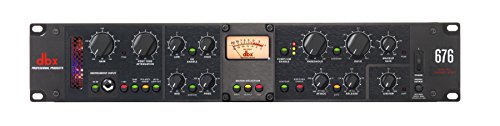
- High-voltage Class-A tube preamp
- Compressor/limiter and parametric EQ
- Rackmount XLR and 1/4-inch connectivity
Best For: Analog vocal tone shaping in studio and live rigs
Best USB Vocal Channel Strip

- One-channel mic/line preamp
- Built-in compressor, gate, and de-esser
- USB interface with up to 192 kHz support
Best For: Computer-based vocal recording and home studios
Best Noise-Reduction Channel Strip

- Analog expander/gate for noise reduction
- Designed for post-preamp line-level use
- Compact, low-latency signal-chain processor
Best For: Cleaning vocal noise after an existing mic preamp
Best All-Around Vocal Strip – dbx 286s
The dbx 286s is a practical choice for anyone comparing channel strips for vocals and wants dedicated dynamics and tone shaping in one rack unit. Its microphone preamp is paired with compression, de-essing, enhancement, and expander/gate sections, with front-panel metering for monitoring signal and processor status.
Best For: Vocal recording, live microphone processing, and users who want a conventional analog-style channel strip with flexible expansion options.
Pros:
- Combines a microphone preamp with compression, de-essing, enhancement, and expander/gate processing.
- Compression can help bring vocals forward by reducing the difference between louder and quieter passages.
- Includes an insert/loop-out connection, balanced XLR input, 1/4-inch line input, and rack-mount hardware.
- Status LEDs provide at-a-glance monitoring of audio levels and processor activity.
Cons:
- It is a single-channel, corded rack unit rather than a compact pedal or USB interface.
- The supplied notes specify a 120VAC/100VAC power configuration, so buyers should confirm compatibility with their setup.
For a straightforward vocal front end, the dbx 286s offers a particularly complete feature set. It is most compelling when you want hands-on processing before the signal reaches your mixer or recorder.
Best USB Vocal Interface – Behringer UV1
Behringer UV1 Audiophile Mic Preamplifier, Voice Processor and 192 kHz USB Audio Interface
Check Price On AmazonThe Behringer UV1 suits shoppers looking at channel strips for vocals who want a direct computer connection alongside microphone processing. It combines a Midas-designed preamplifier, a vocal processor, a compressor, and a 192 kHz USB audio interface in a rack-style unit.
Best For: Home studios, live setups, and recording environments that need microphone or line-level processing with USB connectivity.
Pros:
- Provides a Midas-designed preamplifier for microphone and line-level sources.
- Includes a mic processor and flexible compressor for level control and creative processing.
- The 192 kHz USB audio interface connects directly to a computer.
- Its rack-style dimensions fit studio, live, and professional recording environments.
Cons:
- The supplied information does not list dedicated de-esser, gate, or expander controls.
- Compatibility details specifically identify Windows and computer use, so buyers should verify support for their operating system.
The UV1 is a sensible pick when USB recording is as important as front-end vocal control. Its feature set emphasizes preamp quality, compression, and computer connectivity rather than a long list of separate analog processors.
Best Tube Vocal Channel Strip – ART VoiceChannel
The ART VoiceChannel is a strong option for buyers comparing channel strips for vocals who want tube-based character and extensive digital connectivity. Its tube preamp design is paired with compressor, expander, de-esser, and gate sections, while digital outputs support several studio formats.
Best For: Recording applications where tube warmth, detailed dynamics control, and flexible digital routing are priorities.
Pros:
- Uses an ART Tube preamp design for warmth and definition.
- Provides compressor, expander, de-esser, and gate processing for vocal shaping.
- Offers ADAT, AES/EBU, S/PDIF, TOSLink, and USB connectivity.
- Supports digital output up to 192 kHz and works with Windows, macOS, and Linux systems.
Cons:
- At 5.5 kg, it is substantially heavier than compact vocal processors.
- The wide range of digital connections may be more than needed for a simple analog recording setup.
The VoiceChannel stands out for combining tube preamp coloration with a complete vocal dynamics section and unusually broad digital integration. It is best suited to a more developed studio system rather than a minimalist setup.
Best Compact Vocal Effects Pedal – FLAMMA FV01
The FLAMMA FV01 is a compact alternative for shoppers researching channel strips for vocals who primarily need pitch correction and live vocal effects. This digital pedal offers selectable vocal tone modes, delay and reverb functionality, optional 48V phantom power, and separate or mixed microphone-and-guitar output modes.
Best For: Singers, streamers, and live performers who want portable pitch correction and vocal effects rather than a rack-mounted recording channel strip.
Pros:
- Provides pitch correction in a compact stompbox format.
- Offers Warm, Bright, and Normal vocal modes with different EQ manipulation.
- Optional 48V phantom power supports condenser microphones.
- Can operate as a microphone amplifier or traditional stompbox, with mixed or individual outputs.
Cons:
- It is a pedal-style effects processor, not a full preamp-and-dynamics channel strip.
- The supplied specifications identify a 9V, 500mA power requirement and a compact connector layout that buyers should check against their rig.
- Its listed effects and controls are geared toward live vocal use rather than detailed studio compression and de-essing.
The FV01 makes the most sense when portability, pitch correction, and footswitch control matter more than comprehensive rack processing. It fills a different role from the other products here, but can be useful for live singing, streaming, or compact recording setups.
Tube-Tone Vocal Control – PreSonus StudioChannel
The PreSonus StudioChannel is a versatile choice among channel strips for vocals, pairing a Class A 12AX7 tube preamp with a VCA compressor and three-band EQ. Its mic, line, and instrument inputs make it suitable for shaping vocal recordings as well as other studio sources.
Best For: Home and project studios seeking tube coloration, compression, and EQ in one rack unit.
Pros:
- Class A 12AX7 tube preamplifier offers adjustable tube drive.
- VCA compressor includes automatic attack/release and soft or hard knee options.
- Three-band EQ includes a variable-Q parametric mid band and shelving/peak low and high bands.
- Includes high-pass filter, pad, phantom power, and polarity reverse.
Cons:
- At 10.5 pounds, it is relatively substantial for a single channel strip.
- Its one-channel design may require additional hardware for multi-mic setups.
The StudioChannel stands out when you want preamp character and detailed dynamics and tonal control without assembling separate processors. Its broad input and EQ options also make it useful beyond vocals.
Dual-Channel Dynamics – Professional Rackmount Vocal Compressor
This dual-channel rackmount compressor is a practical option among channel strips for vocals when dynamics control is the priority. It combines VCA compression, adjustable attack and release, a noise gate, LED metering, and XLR/TRS connectivity for studio, live, streaming, and broadcast setups.
Best For: Vocalists, streamers, and live or studio users needing two channels of compression and gating.
Pros:
- Dual-channel design supports two sources or stereo applications.
- Adjustable attack and release allow detailed dynamic shaping.
- Built-in noise gate can help reduce ambient or background noise.
- Sidechain insert supports frequency-based control and ducking.
Cons:
- The supplied notes describe compression and gating but do not specify an onboard preamp or EQ.
- Its 19-inch rackmount format is less convenient for compact desktop setups.
This unit is best viewed as a focused dynamics processor rather than a full preamp-EQ channel strip. Choose it when consistent vocal levels, metering, gating, and flexible routing matter more than tube tone or onboard equalization.
Premium Analog Vocal Front End – SPL Channel One MK3
The SPL Channel One MK3 is a premium mono option among channel strips for vocals, combining a discrete preamp with Lundahl input/output transformers. Its listed features also include a Transient Designer, tube saturation, and compressor for broad analog-style vocal shaping.
Best For: Users seeking a premium mono channel strip with transformer-based I/O and tube saturation.
Pros:
- Discrete preamp provides a dedicated vocal front end.
- Lundahl input and output transformers are included in the signal path.
- Combines Transient Designer, tube saturation, and compression.
Cons:
- It is a mono channel strip, so stereo or multi-source recording requires additional channels.
- At 16.78 pounds, it is heavier than many compact processors.
- The supplied notes do not detail its available EQ controls or connectivity.
The Channel One MK3 is aimed at buyers who value premium construction and a concentrated analog processing path. Its transformer-coupled design and combination of saturation, transient control, and compression make it a strong candidate for a dedicated vocal chain.
Best Tube Channel Strip – dbx 676FX
For vocalists who want hands-on analog control, the dbx 676FX combines a high-voltage Class-A tube preamp with compression, limiting, and a three-band parametric EQ. It is a substantial rackmount option for shaping vocal tone from clean to warm or richly driven.
Best For: Studio vocal recording and users who want detailed analog tone shaping in a rackmount format.
Pros:
- 250-volt Class-A tube design offers a range of vocal tones.
- Built-in compressor/limiter helps create a louder, cleaner output.
- Three-band parametric EQ includes sweepable mids for precise shaping.
- XLR and 1/4-inch connectivity supports varied studio and live setups.
Cons:
- Its 2U rackmount design is relatively large and heavy at 13 pounds.
- May offer more controls and hardware than a simple vocal setup requires.
The 676FX is a strong choice among channel strips for vocals when you want preamp character, dynamics control, and EQ in one dedicated unit. Its rack format and broad connectivity make it better suited to established studio or live rigs than compact desktop setups.
Best USB Vocal Channel Strip – Behringer Ultravoice UV1
The Behringer Ultravoice UV1 is a practical choice for channel strips for vocals if you want a one-channel mic or line preamp paired with a USB audio interface. Its built-in compressor, gate, and dedicated de-esser provide useful vocal-processing tools before or during computer recording.
Best For: Computer-based vocal recording where USB connectivity and basic vocal dynamics control are priorities.
Pros:
- Combines a one-channel mic/line preamp with a USB audio interface.
- Includes compressor, gate, and de-esser functions for vocal processing.
- Supports USB connectivity with Windows 10 and Mac OS X 10.4 or later.
- Offers a maximum sample rate of 192 kHz.
Cons:
- Provides only one channel.
- The supplied notes do not specify analog EQ or tube preamp coloration.
The UV1 makes sense for singers, podcasters, and home-recording users who want a straightforward USB-centered vocal path. It focuses on essential processing and computer connectivity rather than extensive analog tone sculpting.
Best Noise-Reduction Channel Strip – Rodweil RO05 Noise Gate
The Rodweil RO05 is a specialized option among channel strips for vocals, focusing on reducing ambient and preamp-floor noise rather than providing a complete vocal preamp. Its fully analog expander/gate design is intended for line-level use after a mic preamp in a home studio, podcast, stage, or DAW setup.
Best For: Users who already have a mic preamp and need analog noise reduction in a vocal signal chain.
Pros:
- Designed to reduce ambient background noise and preamp-floor noise.
- Fully analog processing is intended to avoid conversion-related latency and signal loss.
- Balanced circuitry is designed for smoother, more natural gating.
- Compact 10.6-ounce format is easy to place in a signal chain.
Cons:
- It is not a standalone microphone preamp; the microphone should not connect directly to it.
- Must be placed after a mic preamp or in a line-level chain.
- The manufacturer notes that higher power consumption and a slight power-off circuit echo are normal.
The RO05 is best viewed as a targeted cleanup tool, not an all-in-one vocal channel strip. It can complement an existing preamp when background noise is the main problem, provided the signal chain is connected correctly.
How We Picked the Best Channel Strips for Vocals
We focused on the features that matter most in real vocal workflows: microphone preamp quality, useful dynamics control, EQ flexibility, noise management, connectivity, monitoring, and ease of setup. We also considered whether each unit is better suited to studio recording, home production, streaming, podcasting, or live performance.
Because channel strips vary widely in design, this list includes both traditional analog processors and modern voice-focused units. A premium mono strip may offer more refined tone shaping, while an affordable USB model may be more practical for a beginner working directly into a computer.
Quick Comparison
| Best For | Look For |
|---|---|
| Home recording | Low-noise preamp, compressor, EQ, and simple connections |
| Streaming and podcasting | USB audio, voice processing, headphone monitoring, and gating |
| Professional studio work | High-quality preamp, flexible EQ, reliable metering, and balanced I/O |
| Live vocals | Feedback-conscious processing, durable controls, and fast adjustment |
| Warm, colored vocals | Tube circuitry or analog saturation controls |
Key Buying Factors for Channel Strips for Vocals
Preamp and Microphone Compatibility
Check the available gain range, phantom power, input type, and noise performance before buying. Condenser microphones require phantom power, while some low-output dynamic or ribbon microphones benefit from substantial clean gain. Balanced XLR inputs and outputs are preferable for longer cable runs and professional setups.
Compression, EQ, and De-Essing
A compressor helps keep vocal levels consistent, but controls such as threshold, ratio, attack, release, and makeup gain determine how precisely you can shape the performance. A de-esser is valuable for reducing harsh “s” sounds, while a parametric or semi-parametric EQ provides more control than fixed tone switches. Expander and gate sections can reduce room noise, but overly aggressive settings may cut off quiet words.
Connectivity and Workflow
Choose analog outputs if you already use an audio interface, or consider USB connectivity when you want a direct computer recording path. Digital outputs, insert points, sidechain connections, and loop-outs can be useful in more advanced rigs. Also verify whether the unit supports the sample rates and monitoring arrangement you need.
Tube Tone Versus Clean Processing
Tube-based designs can add warmth and harmonic color, but they may not be the best choice when maximum transparency is the priority. Clean solid-state processing is often easier to integrate across different microphones and vocal styles.
Who Should Buy Which Channel Strips for Vocals?
Beginners and home recordists should prioritize an affordable unit with a capable preamp, compressor, and straightforward controls. Streamers and podcasters may get the most value from a USB-equipped voice processor with headphone monitoring and a reliable gate. Singers performing live should favor fast, accessible controls and processing that improves clarity without creating noticeable latency.
Producers building a dedicated recording chain should consider a more flexible analog channel strip with detailed EQ, metering, balanced connections, and—when desired—tube coloration. If you already own high-quality outboard preamps and interfaces, a specialized vocal processor may be more useful than another all-in-one strip. Match the feature set to your signal path, microphone, and typical vocal environment rather than choosing solely by price or the number of controls.