The best compact power amplifiers deliver useful power without taking over your desk, media console, or equipment rack. This roundup compares 10 options for passive speakers, desktop systems, home theater, subwoofers, and distributed audio.
We focus on power, connectivity, amplifier design, installation flexibility, and practical value so you can choose a model that fits your speakers and listening space.
Best 10 Compact Power Amplifiers Picks for 2026
Best High-Power Pick

- Up to 300W per channel
- Bass and treble controls
- Supports 2–8-ohm speakers
Best For: Passive speakers, bass shakers, and desktop audio systems
Best Studio-Oriented Option

- Two-channel amplifier
- 130W RMS per channel at 4 ohms
- Thermal-dependent cooling
Best For: Studio systems and select live applications
Best Compact Car Audio Amp

- Four-channel Class D design
- Up to 100W RMS per channel at 2 ohms
- Adjustable high- and low-pass filters
Best For: Space-limited car, truck, and SUV audio installations
Best Feature-Rich Home Receiver

- 100W RMS stereo output
- Bluetooth, FM, USB, and SD playback
- Two microphone inputs and remote control
Best For: Home audio, karaoke, and computer-based listening
Refined HiFi Power

- 70 watts per channel with Hypex NCORE Class D amplification
- RCA and XLR inputs in compact casework
- Bridgeable to 250 watts in mono mode
Best For: Compact two-channel HiFi systems with flexible connectivity
Flexible Desktop Power

- Stereo output up to 180 watts or mono output up to 235 watts
- Balanced XLR/TRS input and 12V trigger-in
- Swappable op-amps enable sound customization
Best For: Scalable desktop and home audio systems using passive speakers
Connected Party Amp
Donner MAMP7 Bluetooth Power Amplifier

- 100 watts RMS per channel or 225 watts bridged
- Bluetooth 5.3 plus USB, RCA, AUX, and XLR inputs
- Treble, midrange, and bass adjustment controls
Best For: Home parties, small live sound, DJs, and flexible multi-source setups
High-Output Choice
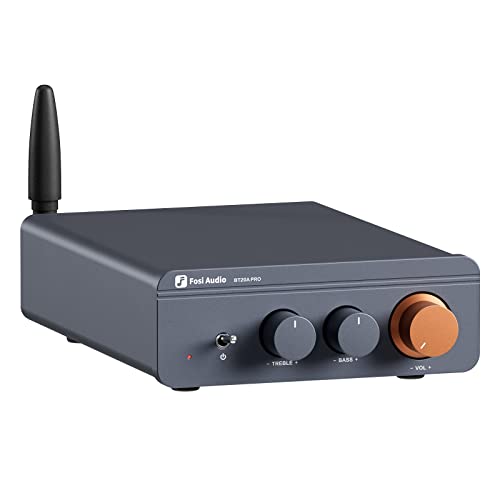
- Up to 300W x2 output
- Bluetooth 5.0 and tone controls
- Replaceable op-amps for customization
Best For: High-output wireless stereo systems with upgrade flexibility
Simple Everyday Pick
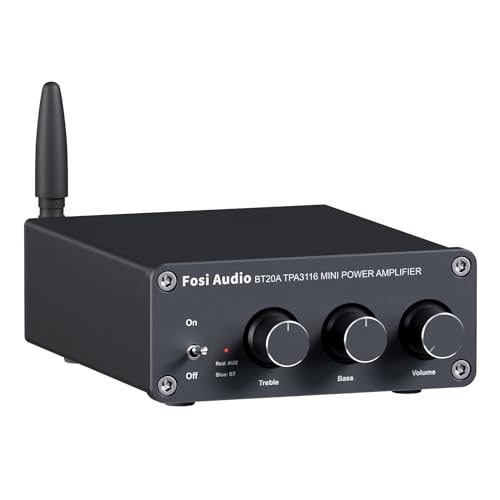
- Up to 100W x2 output
- Bluetooth and RCA inputs
- Bass, treble, and one-touch power controls
Best For: Straightforward passive-speaker setups at home or outdoors
Best High-Power Pick – Fosi Audio TB10D
The Fosi Audio TB10D is a strong choice among compact power amplifiers when you want substantial output in a desktop-friendly enclosure. Its two-channel Class D design delivers up to 300 watts per channel and includes bass and treble controls for straightforward sound adjustments.
Best For: Passive bookshelf speakers, bass shakers, home audio setups, and desktop systems needing flexible RCA connectivity.
Pros:
- Up to 300 watts per channel with the TPA3255 chip
- Supports 2–8-ohm passive speakers
- Bass and treble controls enable simple sound tailoring
- Built-in protection circuits and a 24-month manufacturer warranty
Cons:
- Connectivity is centered on RCA input and passive speaker output
- It is a two-channel amplifier rather than a multichannel model
Choose the TB10D if output headroom and compact size matter more than having a large selection of built-in sources. Its simple layout makes it practical for home audio, gaming, and personal studio use.
Best Studio-Oriented Option – ART SLA1
The ART SLA1 is a practical compact power amplifier for studio systems and select live applications. Its two-channel design provides a wide frequency response, thermal-dependent cooling, and binding-post outputs in a 13.8-pound chassis.
Best For: Studio setups and select live applications that need a straightforward two-channel power amplifier.
Pros:
- Designed for studio or select live use
- Two-channel power amplification
- 130W RMS per channel at 4 ohms
- Thermal-dependent cooling system
Cons:
- Heavier than several mini desktop amplifiers at 13.8 pounds
- The supplied notes do not indicate Bluetooth or other built-in consumer streaming features
The SLA1 favors a conventional amplifier approach over an all-in-one receiver design. It is worth considering when reliable two-channel power and binding-post connectivity fit your system requirements.
Best Compact Car Audio Amp – Orion CEA400.4D
The Orion CEA400.4D is one of the more versatile compact power amplifiers for vehicle installations. Its Class D, four-channel layout produces up to 100 watts RMS per channel at 2 ohms, while adjustable high- and low-pass filters help distribute frequencies across a custom car audio system.
Best For: Cars, trucks, and SUVs needing space-efficient four-channel power for door, component, coaxial, or midrange speakers.
Pros:
- Four-channel output with up to 400 watts RMS total
- 2-ohm and 4-ohm operating flexibility
- Adjustable 40Hz–500Hz high- and low-pass filters
- Protection circuitry helps address thermal, short-circuit, and voltage issues
Cons:
- Requires a 12-volt vehicle power system
- Designed for car audio rather than home or desktop use
The CEA400.4D is a focused choice for installations where multiple channels and a slim chassis are more important than home-audio convenience features. Its onboard crossover controls add useful setup flexibility.
Best Feature-Rich Home Receiver – Pyle PDA29BU.5
The Pyle PDA29BU.5 combines compact amplification with a broad set of built-in sources. This two-channel receiver provides 100 watts of continuous power, Bluetooth streaming, FM radio, USB and SD playback, microphone inputs, and a digital LED display.
Best For: Home audio, karaoke, computer audio, and users who want Bluetooth and multiple playback inputs in one small receiver.
Pros:
- 100 watts RMS continuous power with 200 watts peak output
- Bluetooth, FM radio, USB, SD, AUX, and RCA connectivity
- Two 1/4-inch microphone inputs for karaoke or announcements
- Includes LED display, remote control, and bass, treble, and microphone controls
Cons:
- Two-channel output limits expansion compared with four-channel amplifiers
- Its feature-rich receiver format may be more than needed for simple passive-speaker amplification
The PDA29BU.5 is a sensible pick when convenience and source variety are priorities. It offers more integrated playback and control features than a basic power amp while retaining a compact 7-by-6.2-by-2.4-inch format.
Refined HiFi Power – Cambridge Audio MXW 70
The Cambridge Audio MXW 70 is one of the more polished compact power amplifiers for a two-channel HiFi system. Its Hypex NCORE Class D design provides 70 watts per channel, while both RCA and XLR inputs make it suitable for varied source and preamp setups.
Best For: Stereo HiFi systems where compact casework, balanced connectivity, and clean system integration matter.
Pros:
- Delivers 70 watts per channel from a compact chassis.
- Includes both RCA and XLR inputs.
- Offers a 12V trigger input and pass-through for convenient system control.
- Can be bridged into a 250-watt mono amplifier.
Cons:
- Provides fewer built-in features than an amplifier with Bluetooth or EQ controls.
- Its 70-watt stereo output may be less suitable for especially demanding speakers.
The MXW 70 is a strong choice when you want compact power amplification with useful installation features and a clear upgrade path to mono operation. It is particularly well matched to a dedicated, component-based HiFi setup.
Flexible Desktop Power – Fosi Audio ZA3 Mini Amplifier
The Fosi Audio ZA3 is a versatile compact power amplifier that can operate in stereo or mono mode. With its included 48V power supply, it is designed for passive speakers, subwoofer applications, and desktop or home theater systems that need scalable output in a small chassis.
Best For: Desktop, bookshelf-speaker, and modular home audio systems that benefit from stereo/mono flexibility and balanced input.
Pros:
- Outputs up to 180 watts in stereo mode or 235 watts in mono mode.
- Provides a balanced combo input for XLR or 1/4-inch TRS connections.
- Includes a 12V trigger input for synchronized system operation.
- Supports swappable DIP8 dual op-amps for sound customization.
Cons:
- The listed maximum output depends on the operating mode and 48V power supply.
- Op-amp rolling requires compatible replacement components and additional setup.
- It has only two amplifier channels.
The ZA3 stands out among compact power amplifiers for its unusually adaptable design. Choose stereo mode for a conventional two-channel setup, or use mono operation—and potentially pair two units—when a higher-power configuration is more important.
Connected Party Amp – Donner MAMP7 Bluetooth Power Amplifier
The Donner MAMP7 combines compact power amplification with everyday playback convenience. It delivers 100 watts per channel in stereo or 225 watts in bridged mode, while Bluetooth 5.3, USB, RCA, AUX, and XLR inputs support home parties, small performances, and flexible garage or venue setups.
Best For: Users who want a multi-input amplifier with wireless playback, EQ adjustment, and bridgeable output for casual events or small live sound systems.
Pros:
- Offers 100 watts RMS per channel or 225 watts in bridge mode.
- Supports Bluetooth 5.3 with a stated range of up to 59 feet.
- Accepts Bluetooth, USB, RCA, AUX, and XLR sources.
- Includes treble, midrange, and bass controls.
Cons:
- The 2U-style design may take more space than ultra-compact desktop amplifiers.
- Its cooling fan may be less appealing in very quiet listening environments.
- The warranty is listed as one year.
For buyers prioritizing inputs and ease of use over minimalist HiFi styling, the MAMP7 is a practical all-purpose option. Its Bluetooth support and front-panel EQ controls make it especially convenient for mixed-source playback and casual sound reinforcement.
High-Output Choice – Fosi Audio BT20A Pro
The Fosi Audio BT20A Pro is a strong option among compact power amplifiers when you want substantial output in a small stereo chassis. Its TPA3255 Class D design delivers up to 300W x2, while Bluetooth 5.0, bass and treble controls, and replaceable op-amps add flexibility for home or outdoor passive-speaker setups.
Best For: Listeners who want high output, wireless streaming, and room to experiment with amplifier op-amps.
Pros:
- Up to 300W x2 output with low idle loss under 2.5W.
- Bluetooth 5.0 with pairing memory and a removable pairing function.
- Replaceable NE5532 op-amps support several compatible upgrade options.
- Bass and treble controls allow straightforward sound adjustment.
Cons:
- Its high output may be more than needed for smaller desktop systems.
- Op-amp swapping adds complexity for buyers seeking a set-and-forget amplifier.
Choose the BT20A Pro if power and customization matter more than the simplest possible feature set. The included 32V/5A adapter and Bluetooth antenna help make it ready for a capable passive-speaker system.
Ultra-Compact Value – Nobsound Mini Bluetooth Amplifier
The Nobsound Mini Bluetooth Amplifier is one of the more space-conscious compact power amplifiers for desktop, office, or small home audio. Despite its one-hand size, it provides 50W x2 output and accepts AUX, USB, and Bluetooth 5.0 sources, with included cables and a 19V power supply for a quick setup.
Best For: Desktop listeners and small-room users who need multiple inputs in a compact aluminum enclosure.
Pros:
- Compact 2.76 x 3.07 x 1.5-inch design.
- 50W x2 output from the upgraded amplifier chip.
- Supports AUX, USB, and Bluetooth 5.0 inputs.
- Includes power supply, AUX, USB, and RCA cables.
Cons:
- Its 100W total output is lower than the larger Fosi option in this roundup.
- The supplied specifications list a 12V direct-current voltage while the product notes also describe a 19V power supply, so buyers should verify the included adapter information.
This is a practical pick when minimizing equipment footprint is the priority. USB playback without a driver and the included accessories make it particularly convenient for computer-based listening.
Simple Everyday Pick – Fosi Audio BT20A
The Fosi Audio BT20A keeps the compact power amplifier format straightforward. It offers up to 100W x2 for passive speakers, Bluetooth and RCA inputs, and simple bass and treble controls in an all-black Class D enclosure suited to bedrooms, offices, garages, living rooms, or patios.
Best For: Buyers who want an uncomplicated Bluetooth amplifier for everyday passive-speaker listening.
Pros:
- Up to 100W x2 maximum output for a compact two-channel amp.
- Bluetooth and RCA inputs support wireless and wired sources.
- Simple controls include a one-touch power switch plus bass and treble adjustment.
- Compact all-black design fits varied indoor or outdoor spaces.
Cons:
- It lacks the replaceable op-amps and higher output of the BT20A Pro.
- The supplied feature set is focused on basic amplification rather than multiple digital inputs.
The BT20A is a sensible choice for listeners who value easy installation over extensive customization. Its included 24V/4.5A power supply and no-frills controls make it a convenient match for passive bookshelf, ceiling, or garage speakers.
How We Picked These Compact Power Amplifiers
We selected models across several common use cases rather than treating wattage as the only measure of quality. The lineup includes small stereo amplifiers for desktop and bookshelf speakers, higher-output Class D designs, a professional-style rack amplifier, a four-channel car amplifier, and units with Bluetooth or media-player features.
Our comparisons emphasize rated output, channel configuration, input and output options, impedance compatibility, physical size, controls, and intended installation. Because amplifier specifications can vary by impedance, distortion level, and bridged operation, treat headline wattage as a starting point—not a guarantee of real-world performance.
Quick Comparison
- Best for simple desktop or bookshelf systems: Look for a compact two-channel amplifier with RCA, Bluetooth, or both.
- Best for higher-output home audio: Class D models using modern amplifier platforms can provide strong power in a small enclosure.
- Best for flexible installations: Choose multiple channels, bridgeable operation, or balanced inputs when your system may expand.
- Best for convenience: Bluetooth, USB, SD, FM, microphone inputs, and tone controls reduce the need for additional equipment.
- Best for professional setups: Rack-friendly construction, XLR inputs, dependable cooling, and predictable connections matter more than extra consumer features.
Key Buying Factors for Compact Power Amplifiers
Power and Speaker Matching
Match the amplifier to your speakers’ nominal impedance and recommended power range. A model rated for 4-ohm loads may offer more output than one specified only for 8-ohm speakers, but it must also have adequate cooling and a suitable power supply. Avoid choosing solely by inflated peak or bridged figures; RMS output is generally more useful for comparison.
Channels and System Layout
Two channels suit a normal stereo pair. Four channels can drive multiple speakers or separate front and rear zones, while bridgeable designs may provide more power to a single speaker or subwoofer when supported by the manufacturer. Confirm that bridging is compatible with your speaker impedance before using it.
Inputs, Outputs, and Controls
Bluetooth is convenient for phones and tablets, while RCA remains useful for streamers, DACs, televisions, and CD players. Balanced XLR inputs can help in longer cable runs or professional systems. Check whether the amplifier includes a subwoofer output, preamp function, tone controls, USB playback, or microphone support if those features are important to your setup.
Size, Cooling, and Installation
Measure the available space, including room for ventilation and cable bends. Small Class D amplifiers are easy to place, but compact does not mean maintenance-free: keep vents clear and avoid stacking heat-producing components directly on top of one another.
Who Should Buy Which Compact Power Amplifiers?
Choose a basic two-channel mini amplifier for a desk, bedroom, kitchen, or simple bookshelf-speaker system. Pick a higher-powered Class D stereo model if you need more headroom for larger passive speakers or want to add a subwoofer. A multi-channel amplifier is the better choice for several speaker zones or a custom installation. For live, studio, or rack-based equipment, prioritize balanced connectivity, robust construction, and dependable thermal performance over wireless extras. If convenience is your priority, select a model with Bluetooth and the playback inputs you already use.